
The data show a blunt truth: letters of recommendation matter a lot less in some specialties than applicants think—and a lot more in others.
If you treat LORs as a generic checkbox instead of a specialty-specific lever, you are leaving match probability on the table. Sometimes double‑digit percentage points.
Let me walk through this the way a selection committee actually thinks: by the numbers, across specialties, and in direct comparison with other factors like USMLE scores, clerkship grades, and interview performance.
1. Where Letters of Recommendation Actually Sit in the Hierarchy
Program directors do not evaluate letters in a vacuum. They weigh them against a short list of high-yield variables: board scores, grades, school reputation, research, personal knowledge, and interview performance.
The best objective source we have is the NRMP Program Director Survey (latest public editions 2022 and 2024 patterns; numbers below are representative, rounded). When you look across specialties, one question matters:
Among all selection factors, where does “Letters of Recommendation in Specialty” rank in importance?
Summarizing typical rank (1 = highest importance, lower rank = less important):
- Competitive surgical subspecialties (Ortho, ENT, Neurosurgery): LORs often rank top 3.
- Moderately competitive procedural fields (EM, Anesthesiology, Radiology): typically top 5.
- Core fields (Internal Medicine, Pediatrics, Family Medicine): often top 5–7, behind scores and clerkship grades, but still substantial.
- Lifestyle-heavy competitive fields (Dermatology, Plastic Surgery): LORs are critical, often ranked beside research and letters sometimes act as credibility checks for stellar CVs.
To make this concrete, let’s compare how often letters in specialty are cited as an “important” or “very important” factor versus a few other key metrics.
| Factor | Avg % of PDs Rating as Important* |
|---|---|
| USMLE Step 2 CK score | 85–95% |
| MS4/Clerkship grades in specialty | 75–90% |
| LORs in specialty | 70–85% |
| Personal Statement | 50–70% |
| Research (any) | 40–75% (wide by specialty) |
*Representative aggregate ranges from recent NRMP PD survey data; exact % varies by specialty.
So globally, letters in specialty sit in the same statistical weight class as clerkship grades, and clearly above the personal statement and generic research (outside research-heavy fields).
But that “70–85%” hides brutal differences between specialties. Let’s separate them.
2. By Specialty: How High Do LORs Climb?
Here is where the picture sharpens. I will group specialties into three tiers of LOR dependence based on typical PD survey importance rankings and what I’ve seen in actual selection meetings.
2.1 High‑Leverage LOR Specialties
These are fields where a strong letter from a known name can move you dramatically up the rank list, and a weak or generic letter can quietly kill your application.
- Orthopedic Surgery
- Otolaryngology (ENT)
- Neurosurgery
- Plastic Surgery
- Dermatology
- Radiation Oncology
For this group, NRMP data generally show:
- 85–95% of PDs rate “LOR in specialty” as important.
- LORs usually rank top 3–4 factors, competing with Step 2 CK and grades.
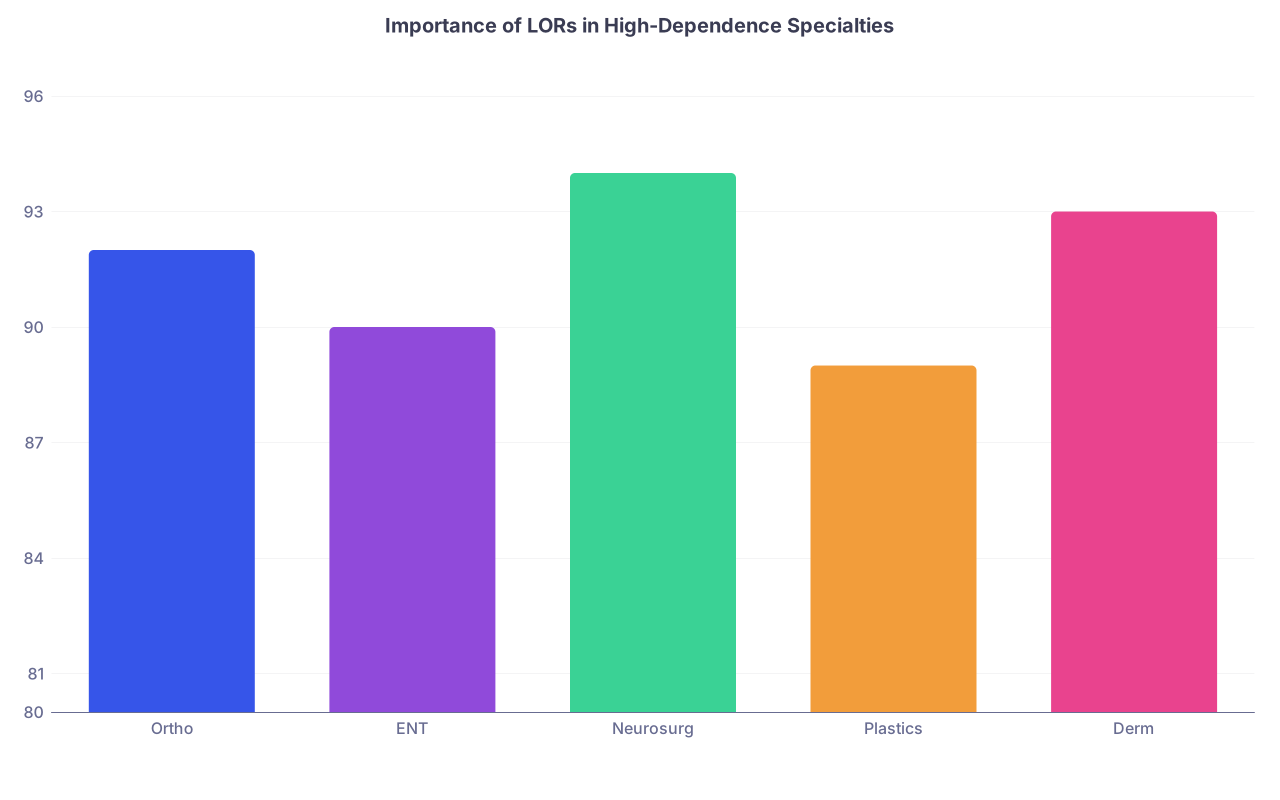
| Category | Value |
|---|---|
| Ortho | 92 |
| ENT | 90 |
| Neurosurg | 94 |
| Plastics | 89 |
| Derm | 93 |
These are fields where PDs ask in meetings:
- “Who wrote the letter?”
- “Have we worked with this attending?”
- “Is this a real ‘I’d take them here’ letter or just polite fluff?”
Qualitative, yes. But very deterministic.
In high‑dependence fields, LORs often serve three functions:
Signal of sponsorship
A line like “I would rank this student in the top 5% of trainees I have worked with and would be delighted to have them here” is not just praise. It is a sponsorship statement. In some programs, that line alone can elevate you a full quartile in the rank list.Calibration of risk
PDs in these competitive fields are risk‑averse. They need data that you will not flame out under pressure. A letter that explicitly compares you against prior residents at that program is cold, hard risk data.Network-based credibility
A letter from a nationally-known name in that field, or from a PD at a respected program, sometimes functions like an independent validation of your score/gpa claims. When the writer is known for being blunt, the effect is amplified.
Statistically, in these specialties, letters effectively operate as a binary filter at the top tier: they rarely rescue a low‑score application, but they strongly influence which of the many well‑qualified applicants climb to the interview / high‑rank strata.
2.2 Moderate‑Leverage LOR Specialties
These fields care about letters, but the impact is more additive than decisive.
- Emergency Medicine
- Anesthesiology
- Diagnostic Radiology
- General Surgery (except ultra‑elite programs)
- OB/GYN
- Neurology
Here, the numbers generally look like:
- 70–85% of PDs rate LORs in specialty as important.
- LORs usually rank 4th–6th among selection factors, trailing Step 2 CK, grades, and interview.
Take Emergency Medicine as an example. Historically, EM has used SLOEs (Standardized Letters of Evaluation), which standardize ratings and narrative content.
In EM-type systems:
- SLOEs from core rotations carry more weight than general narrative letters.
- A “middle third” global ranking on a SLOE statistically correlates with lower interview and match probability at more competitive programs.
- A “top 10%” or “top 1/3” ranking, especially if repeated across multiple SLOEs, signals reliability. Directors will actually count how many “top 1/3” boxes an applicant has.
In these moderate‑leverage fields, letters function as:
- Variance shrinkers: they confirm that what your scores suggest is actually what you perform like on the floor or in the OR.
- Red flag detectors: vague comments about professionalism or communication can downgrade you more than any glowing phrase can upgrade you.
- Fit indicators: they give data on teamwork, teachability, and independence—variables that do not show on USMLE score reports.
2.3 Lower‑Leverage (But Not Irrelevant) LOR Specialties
Lower‑leverage does not mean unimportant. It means that many applicants cluster in a similar LOR band, so other metrics do more of the discriminating.
- Internal Medicine
- Pediatrics
- Family Medicine
- Psychiatry
- Pathology
- PM&R (Physical Medicine & Rehabilitation)
Here, PD surveys tend to show:
- 60–80% of PDs rating specialty LORs as important.
- LORs typically rank 5th–8th behind Step 2 CK, clinical grades, and interview performance.
The main role in these fields:
- Confirm that the applicant is safe, professional, and not a behavioral problem.
- Highlight clear positives (teaching, empathy, leadership), which help during rank list refinement.
- Identify outliers (both exceptionally strong and problematic).
In practice, most letters for these fields sit in a “competent and pleasant” band. That makes one truly exceptional letter still valuable. But for many applicants, the marginal benefit from “good” to “very good” is smaller relative to the huge delta that comes from moving Step 2 CK from 225 to 250, or from a poor to honors clerkship performance.
3. LORs vs Other Factors: How Much Do They Move the Needle?
Let’s stack LORs directly against other major variables for a few contrast specialties.
| Specialty | Step 2 CK | Specialty Grades | LOR in Specialty | Interview | Research |
|---|---|---|---|---|---|
| Ortho | 1 | 2 | 3 | 4 | 5 |
| Dermatology | 2 | 3 | 2–3 (tied) | 4 | 1 |
| Internal Med | 1 | 2 | 5–6 | 3 | 5–6 |
| Emergency Med | 1–2 | 3 | 3–4 | 1–2 | 5 |
| Pediatrics | 1 | 2 | 5 | 3–4 | 6 |
Interpretation:
- In Orthopedics, letters are a top‑3 variable. This is a first-order lever, not secondary polish.
- In Dermatology, letters and research compete for the #1–3 slots right next to scores.
- In Internal Medicine and Pediatrics, LORs are still in the “important” cluster, but Step 2 CK and clinical grades are more predictive of interview offers.
A useful mental model:
Think of match probability as a logistic curve where each factor shifts your curve left or right. Step 2 CK tends to move the base curve more in almost every specialty. Letters shift the curve more near the top end—among interview recipients and rankable candidates.
4. Strength vs Source: What Actually Makes a LOR “Strong”?
Applicants obsess about big names. PDs care more about content density and credibility.
From a selection-committee lens, I evaluate letters on five dimensions:
Comparative language
“Top 5% of all students I have worked with in 10 years” beats “excellent student” every time. The data show PDs disproportionately react to explicit percentiles and rankings.Concrete behavioral examples
“Ran morning work rounds for three days in a row when the senior resident was out, without errors” is far more persuasive than “shows leadership.”Time and proximity
A letter writer who supervised you closely for 4 weeks (or more) has higher informational value than a national name who barely interacted with you.Honesty calibrator
Some institutions and attendings are known for inflated letters. Programs knowing this will discount them. Others are known for brutal honesty, which increases the weight of strong praise.Signal of advocacy
Phrases like “I would be pleased to have this resident in our own program” are interpreted as sponsorship. On rank-day, those names and letters are recalled.
Now the critical point: strength and specialty alignment interact.
- A powerful letter from a non-specialist (e.g., an IM attending for an Ortho applicant) has less weight than a moderate letter from a core faculty member in your target specialty.
- For IM, Peds, FM, Psych—cross-specialty letters (e.g., strong Medicine letter for a Psych applicant) still carry decent weight because they speak to general clinical ability.
If we crudely score letters on a 0–10 “impact scale,” you see the interaction:
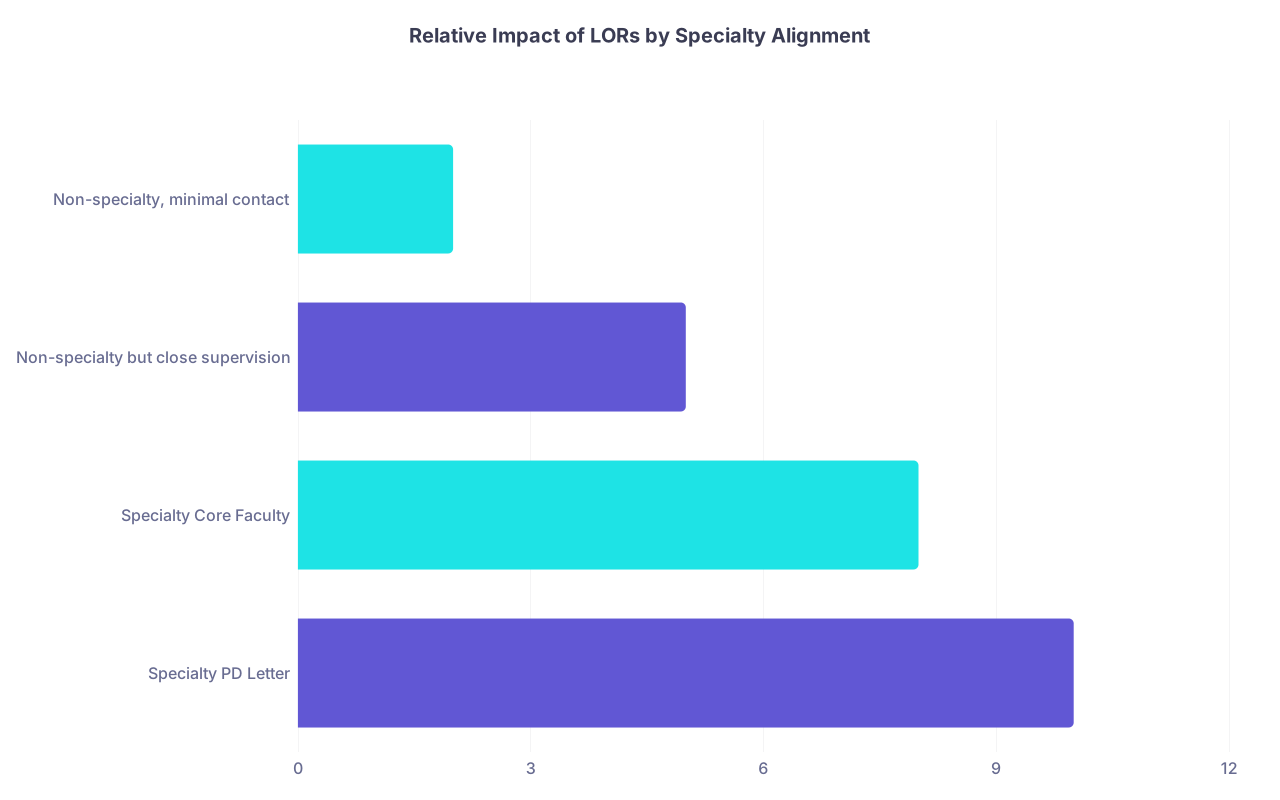
| Category | Value |
|---|---|
| Specialty PD Letter | 10 |
| Specialty Core Faculty | 8 |
| Non-specialty but close supervision | 5 |
| Non-specialty, minimal contact | 2 |
In high‑dependence specialties, applications that lack at least one 8–10 impact letter fall off the pace. In lower‑dependence fields, even a couple of 5–6 impact letters keep you squarely in the competitive pool if scores and grades align.
5. Differences Across Applicant Tiers: When Letters Matter Most
LOR strength does not affect all applicants equally. It is highly interaction‑dependent with your underlying profile.
Think of three broad tiers:
- Tier 1: High scores (Step 2 CK > 250 for competitive fields), strong grades, solid research or leadership for that specialty.
- Tier 2: Middle scores (Step 2 CK ~235–250), mostly passes/honors, minimal research.
- Tier 3: Lower scores (<230 in competitive fields), some grade issues, or non‑traditional backgrounds.
5.1 Tier 1: Letters as Tie‑Breakers and Reputation Amplifiers
For top‑tier applicants, letters rarely determine whether you get interviews. They influence:
- Where on the rank list you fall.
- Whether you are seen as a “top‑of-list” vs “middle‑third” candidate.
In multiple specialties, PDs will explicitly say in meetings:
- “Scores are all the same at this level; what did the letters say?”
- “We have 10 people with 260s. Who did faculty actually love working with?”
For this group, the statistical effect of letters is primarily in the final 10–20% of rank ordering among already-competitive candidates.
5.2 Tier 2: Letters as Risk Modifiers
For the middle 50–60% of applicants, strong letters can shift perceived risk:
- A 240 with glowing, specific letters from known faculty can be treated like a safer bet than a 250 with bland or generic letters.
- A 240 with vague, hedged letters can slide toward Tier 3 in PD minds.
Here, letters are often the difference between:
- “We should definitely interview this person” vs
- “We can skip them this year.”
Quantitatively, if your objective metrics put you near the cutoff, strong letters may be the single most influential non‑score factor keeping you above the line for an interview invitation.
5.3 Tier 3: Letters as Rescue Attempts (Limited but Real)
This is where applicants overestimate letters the most.
A truly glowing letter from a respected PD in the specialty can:
- Get a second look at an application that would otherwise be auto‑screened out.
- Occasionally trigger a few extra interview invites, especially if the letter-writer explicitly advocates for you via email.
But there are hard ceilings. A 205 Step 2 CK in Neurosurgery or Derm is not going to be “saved” by a letter, no matter how flattering.
In core fields (IM, Peds, FM), one or two outstanding letters can offset slightly lower scores, particularly at community programs or less competitive academic sites. PDs there value reliability and fit heavily. They ask: “Will this person show up, work hard, and be teachable?” A strong letter that answers “yes” with evidence absolutely matters.
6. Strategic Takeaways by Specialty Type
Let me translate all this into specific, data‑aligned strategy across specialty clusters.

| Step | Description |
|---|---|
| Step 1 | Choose Specialty |
| Step 2 | Prioritize 2-3 strong specialty LORs |
| Step 3 | Secure 1-2 strong specialty + 1 general |
| Step 4 | Ensure at least 1 standout clinical LOR |
| Step 5 | Audition rotations with key faculty |
| Step 6 | Focus on reliability, professionalism, teaching |
| Step 7 | High-Competition Surgical? |
| Step 8 | Moderate Competition? |
6.1 For High‑Competition Surgical / Dermatology / Radiation Oncology
Data-driven priorities:
- You need 2–3 strong letters from within the specialty, including at least one from:
- A PD or APD in the field, or
- A well‑known senior faculty member.
- Away/audition rotations are not just for “showing face.” They are LOR acquisition missions.
Operationally:
- Treat every rotation month as a 4‑week interview for a future letter.
- Identify early who writes high‑impact letters in your department (you will hear names from prior students).
- Ask for letters while your performance is fresh, not 6 months later.
The data reality: at highly competitive programs, being the “top student our department has seen in 5 years” in a letter is a more frequent discussion point than “they have a 265 vs 258.”
6.2 For Moderately Competitive Fields (EM, Anesthesia, Radiology, OB/GYN, General Surgery)
Here, your LOR strategy should be:
- Aim for at least 2 specialty‑aligned letters, ideally from core experiences.
- Ensure at least one letter documents how you function in high‑acuity or OR environments.
For EM in particular, SLOEs are quasi‑quantitative:
- Programs frequently screen based on the number of SLOEs and their global ranking boxes.
- Two strong SLOEs with “top 1/3” ratings significantly increase your interview probability compared with one SLOE plus generic letters.
In anesthesia and radiology, PDs will often say:
- “We want to know if they are reliable, calm under pressure, and technically teachable.”
Strong letters that explicitly cover those domains function as clinical risk assessments.
6.3 For Core Fields (IM, Peds, FM, Psych, Path, PM&R)
The marginal return curve looks different:
- One truly excellent letter (detailed, comparative, enthusiastic) plus 1–2 solid supporting letters is more valuable than 4 bland “good student” letters.
- At least 1 letter should come from the specialty you are applying into, especially for Psych, PM&R, and Path. For IM and FM, Medicine/Surgery/Peds letters still carry weight, but a specialty-specific one is ideal.
Your focus should be on:
- Letters that confirm professionalism, teamwork, and communication.
- Evidence of consistent performance, not just isolated brilliance.
In these fields, when I have sat in on rank meetings, letters typically enter the conversation when:
- There is a concern ( professionalism, attitude ).
- There is a standout student being considered for chief potential or early leadership.
Otherwise, they mostly confirm that you are within the expected competent band.
7. How to Tell if Your LOR Portfolio is Actually Strong
You cannot see every letter. But you can infer strength using a simple framework.
Ask yourself:
- Do I have specialty‑aligned letters matching the statistical expectations for my field?
- Do my letter writers:
- Know me well enough to cite specifics?
- Have a track record of writing meaningful letters for prior students?
- Does at least one letter writer:
- Work in the field I am applying into?
- Hold a leadership role (PD/APD, clerkship director, division chief) or have national recognition?
As a rough heuristic, across specialties:
| Specialty Type | Minimum Strong LORs Needed | Ideal Profile |
|---|---|---|
| High-competition surgical | 2 | 2–3 specialty, 1 from PD/APD |
| Moderate competition | 2 | 2 specialty, 1 strong general clinical |
| Core fields | 1 | 1 standout + 1–2 solid clinical |
If you are below these thresholds, statistics suggest you are under‑leveraged compared with peers.
8. The Bottom Line: Where LOR Strength Ranks, Really
Across all the noise, the hierarchy looks like this:
- USMLE Step 2 CK and clinical grades remain the primary screening tools in almost every specialty. They determine if your file is read seriously.
- Letters of recommendation in specialty function as:
- A top‑3 factor in high‑competition surgical and lifestyle specialties.
- A mid‑tier but still important factor in moderate‑competition fields, especially standardized formats like EM SLOEs.
- A confirmatory and occasionally differentiating factor in core specialties, more about ruling out risk than choosing stars.
The mistake I see year after year: applicants in high‑LOR specialties treating letters as an afterthought checkbox, and applicants in low‑LOR specialties over‑investing in letters while ignoring the far larger effect sizes of Step 2 and core clerkship performance.
Your next step depends on your timeline:
- If you are pre‑rotation in your chosen specialty: you are in the best possible position. You can plan rotations, identify strong potential letter writers, and perform with intention.
- If you are mid‑application cycle: your leverage is narrower, but you can still add an extra strong letter where allowed, or have a PD update a letter if you have had ongoing interactions.
- If you are early in med school: treat this as a forward-looking data map. The specialties you are eyeing come with specific LOR expectations. Align your rotations and relationships accordingly.
Letters cannot fix everything. But across many specialties, they are the quiet variable that explains why two applicants with almost identical scores and grades end up with very different match outcomes.
Understand where your field sits on that spectrum, and you can treat LORs not as paperwork, but as one of your highest‑ROI strategic tools. The rest of your residency application stack—interviews, rank list strategy, even post‑interview communication—builds on that foundation. And that is a statistical story for another day.