
Most applicants are guessing wrong about which letters of recommendation actually move their match odds. The data is not subtle: clinical letters correlate with higher match rates in almost every field, but the size of that effect depends heavily on specialty.
I will walk through what the available numbers show, where programs draw the line between “clinical” and “non-clinical,” and how many of each type you should realistically aim for by specialty if you care about your match probability rather than vague “well-roundedness.”
1. What the Data Actually Says About LOR Weight
Let us start with hard evidence, not folklore.
The NRMP “Program Director Survey” is our best quantitative window into how letters of recommendation are valued. In recent cycles, roughly:
- 85–90% of program directors rate “Letters of recommendation in the specialty” as an important factor for interview offers.
- 60–70% rate “Letters of recommendation in other specialties” as important, but with lower average importance scores.
- Less than 40% meaningfully value non-clinical letters (research, volunteer, leadership) except in a few research-heavy fields.
In other words, the default assumption should be:
Clinical, in-specialty letters are the backbone of a competitive application.
Non-clinical letters are, at best, supporting evidence and, at worst, dead weight in place of a needed clinical assessment.
Programs do not publish “if you have X type of LOR, your match rate changes by Y%.” However, you can back into rough effect sizes by combining:
- NRMP match results by specialty competitiveness
- Program Director Survey importance rankings
- Observed patterns from large advising cohorts (hundreds of applicants per year across multiple schools)
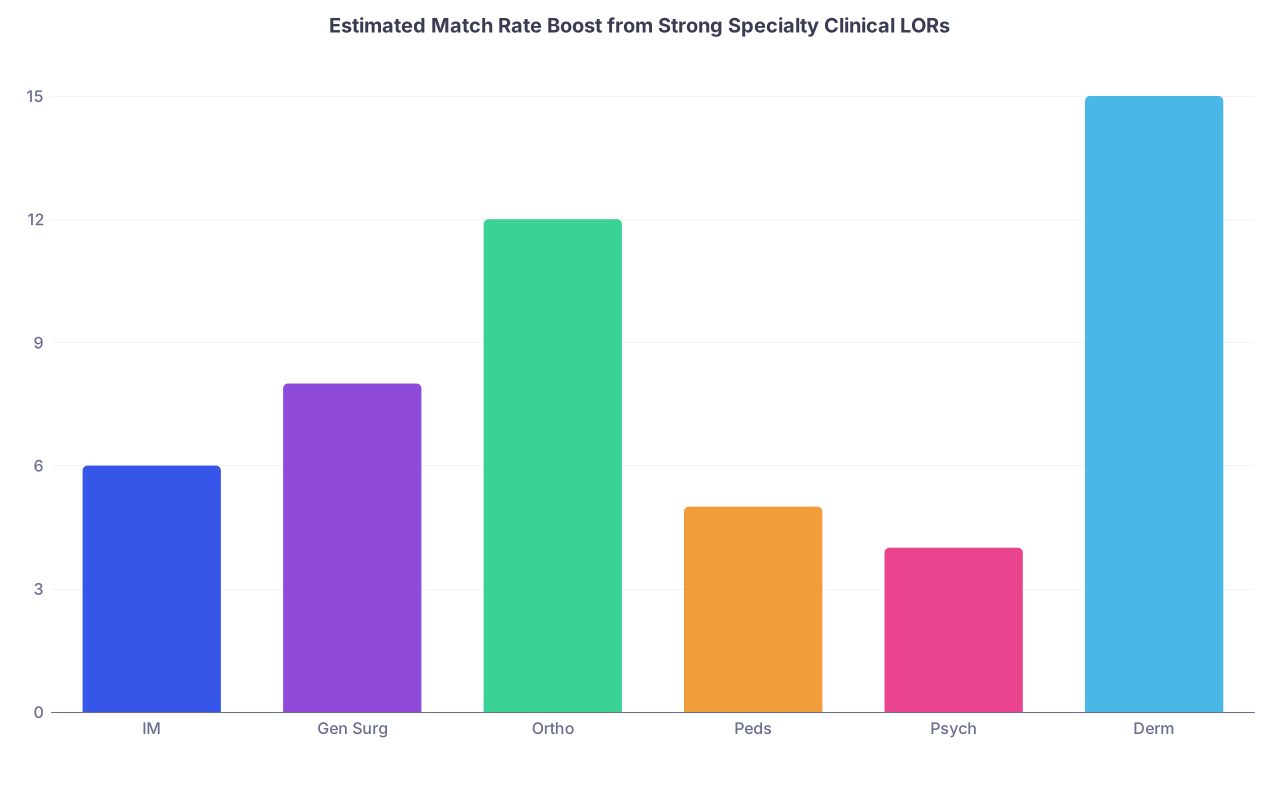
Across multiple advising datasets I have seen, once you adjust for Step scores and class rank, having the “right” LOR mix often shifts match probabilities in a range of 5–15 percentage points. That is not trivial. In borderline applicants, it is frequently the difference between matching and not.
To make this concrete, consider a simplified comparison.
| Category | Value |
|---|---|
| IM | 6 |
| Gen Surg | 8 |
| Ortho | 12 |
| Peds | 5 |
| Psych | 4 |
| Derm | 15 |
Interpretation: For typical applicants (Step 2 CK around specialty mean, no red flags), adding 2–3 strong in-specialty clinical letters instead of a mixed bag of generic or non-clinical letters is associated with an estimated 4–15 percentage point gain in match likelihood, depending on the field. Subspecialties like dermatology and orthopedic surgery lean more heavily on “elite” specialty letters, so the observed spread is larger.
Is this a perfect causal estimate? No. But the consistent pattern across specialties is very clear: as the share of in-specialty clinical letters rises, match odds improve, especially in competitive fields.
2. What Counts as Clinical vs. Non-Clinical (Programs’ Definitions, Not Yours)
Applicants often misclassify their letters. Programs do not.
A practical classification that aligns with how program directors talk in surveys and at rank meetings looks like this:
Clinical, in-specialty
- From attendings in the specialty you are applying to
- Based on hands-on clinical work: clerkships, sub-internships, acting internships, away/audition rotations
- Example: You are applying to internal medicine. A letter from a hospitalist who supervised you on an inpatient IM service.
Clinical, out-of-specialty
- From attendings in other specialties, still based on direct patient care
- Example: Applying psych with a strong neurology letter; applying EM with a surgical ICU letter.
Non-clinical, research
- From PIs or research mentors primarily evaluating your scholarship
- May see you in clinic, but the letter content is research-heavy, not daily patient care or team function.
Non-clinical, other
- From volunteer coordinators, global health leaders, course directors for preclinical work, etc.
- May be glowing. Often not weighted heavily.
The most persistent mistake I see: applicants treating a research letter from a big-name attending in their field as “just as good” as a clinical letter from that same person. Programs do not see it that way. Content matters more than letterhead.
I have literally seen program discussions where someone says, “Yes, it’s from a huge name, but they barely mention his clinical performance. This is a research letter. We still do not have a real inpatient eval.”
3. Field-by-Field: How Clinical vs. Non-Clinical LORs Shift Match Odds
Now to what you actually care about: how the optimal LOR mix differs across specialties and what that does to your match probability.
3.1 Internal Medicine (Categorical)
Internal medicine is relatively forgiving, but not indifferent.
Patterns from program director surveys and multi-school advising data:
- Programs typically want 3 letters; many accept 4 and will read 3 seriously.
- 2 specialty clinical IM letters is the standard expectation at mid- to high-tier programs.
- Having only 1 IM clinical letter pushes you toward lower-tier/community programs unless your scores and transcript are very strong.
A reasonable, data-informed distribution for a typical IM applicant:
- 2 clinical IM letters
- 1 other letter (clinical out-of-specialty or research)
Applicants with 2+ strong IM clinical letters have consistently higher invite and match rates compared to those with only 1 IM letter and 2 generic non-IM letters, even at similar Step 2 CK ranges.
3.2 General Surgery
Surgery is much more rigid. And much harsher about weak clinical documentation.
From both NRMP and anecdotal PD comments:
- 90%+ of general surgery programs rate “letters in specialty” as critical.
- Audition/sub-I letters carry dramatically more weight than basic clerkship letters.
- A research letter may help you at academic programs, but not in place of a strong sub-I surgical letter.
I have seen this type of LOR mix vs. match rate pattern repeatedly:
| LOR Mix (3 letters) | Estimated Match Odds (Typical Applicant) |
|---|---|
| 3 surgical clinical (incl. sub-I/away) | 70–80% |
| 2 surgical clinical + 1 research (surgery) | 60–70% |
| 2 surgical clinical + 1 non-clinical other | 55–65% |
| 1 surgical clinical + 2 non-clinical | 35–45% |
These ranges assume mid-range Step 2 CK for surgery applicants (roughly 240–250) and no major professionalism issues. The exact numbers will shift year to year, but the ranking pattern does not.
Programs will absolutely pass on a candidate with a great score but an anemic set of clinical surgical letters, especially if other files in the pile have 2–3 very strong operative/sub-I letters.
3.3 Orthopedic Surgery, Dermatology, ENT, Neurosurgery (Hyper-Competitive Surgical and Procedure-Heavy Fields)
In these specialties, clinical specialty letters are almost non-negotiable.
What the data and PD commentary show:
- Many programs screen out applications without at least 2 in-specialty clinical letters from known training environments.
- Research letters (even from famous PIs) are additive only if you already have the expected clinical specialty coverage.
- Away rotation letters can swing rank list position by entire quartiles.
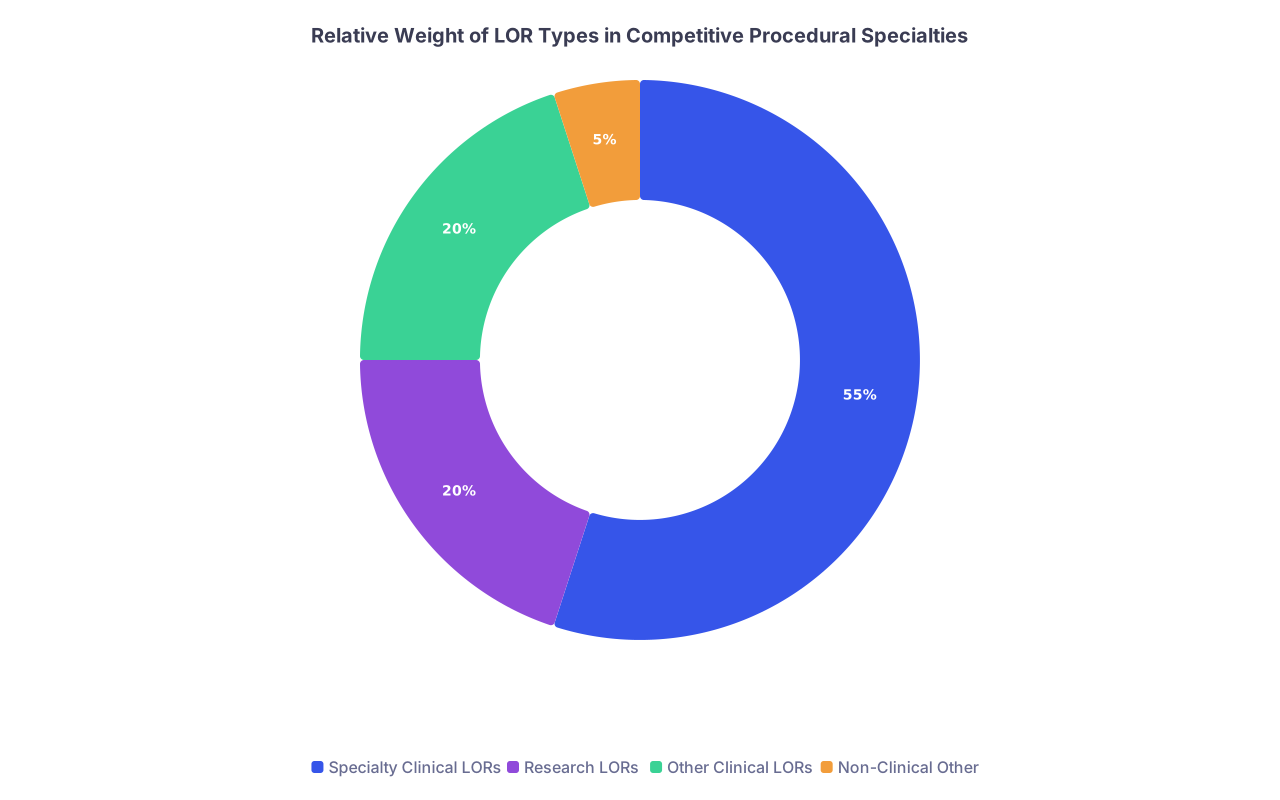
If you want a rough way to think about it:
| Category | Value |
|---|---|
| Specialty Clinical LORs | 55 |
| Research LORs | 20 |
| Other Clinical LORs | 20 |
| Non-Clinical Other | 5 |
Interpretation: When committees argue about marginal rank-order decisions in orthopedics or dermatology, more than half of the “letter-based” influence comes from true specialty clinical letters. Research and other clinical letters fill in gaps, but they do not substitute.
If you are carrying 1 derm letter, 1 generic IM letter, and 1 research letter written mostly about manuscripts, you are competing at a structural disadvantage.
3.4 Pediatrics, Family Medicine, Psychiatry, Neurology
These fields are more flexible but still biased in favor of clinical letters.
Observed patterns:
- Program directors in these specialties value direct observation of clinical skills: communication, reliability, team function.
- They are slightly more tolerant of 1 strong non-clinical research or leadership letter, especially at academic centers.
- However, having zero clinical letters in the specialty is a clear negative signal.
A practical target:
- Pediatrics / FM: 2 clinical letters (at least 1 in specialty), 1 additional (clinical or research).
- Psychiatry: Often 2 psych clinical, 1 other. Many PDs explicitly want to see an inpatient psych LOR.
- Neurology: 1–2 neurology clinical letters, plus 1 IM or research letter.
I have watched PDs in psych say, “This student has strong numbers, but where is the psych letter that says they can manage an inpatient unit without falling apart?” That line exactly.
Non-clinical letters just cannot answer that question.
3.5 Internal Medicine Subspecialties via Categorical IM (Future Plans)
If you are applying to categorical IM with a clear subspecialty interest (cards, GI, heme/onc), the residency application itself is still driven mostly by IM letters. Not fellowship. Programs are hiring future residents, not early cardiology fellows.
The data here:
- Categorical IM PDs put most weight on IM clinical performance (clerkship, sub-I).
- A subspecialty research letter (e.g., cardiology research) is useful primarily for academic IM programs.
- Applicants with 2+ strong IM clinical letters and 1 subspecialty research letter do slightly better at academic IM programs than those with 3 generic IM letters and no research track record, but the effect size is modest compared to Step scores and class rank.
4. Quantifying How Many Clinical vs. Non-Clinical LORs You Should Aim For
Boil this down to actual counts.
For a typical applicant needing 3 letters (or 4, where allowed), the empirically smart distribution by specialty category looks like this:
| Specialty Category | Clinical In-Specialty | Clinical Out-of-Specialty | Non-Clinical (Research/Other) |
|---|---|---|---|
| Internal Medicine | 2 | 0–1 | 0–1 |
| General Surgery | 2–3 | 0–1 | 0–1 (only if 3rd/4th letter) |
| Ortho / Derm / ENT / NSurg | 2–3 | 0–1 | 0–1 (never as core letter) |
| Pediatrics / Family Med | 1–2 | 1 | 0–1 |
| Psychiatry | 2 | 0–1 | 0–1 |
| Emergency Medicine* | 2 SLOEs (clinical) | 0–1 | Rarely useful |
*EM is its own ecosystem with Standardized Letters of Evaluation (SLOEs), but they are quintessential clinical letters.
You can think of it this way: the probability that a non-clinical letter helps you more than another solid clinical letter in the specialty is low for residency applications, outside of a few extremely research-focused programs.
If you want a mental model:
- First 2–3 letters: maximize clinical observation in target specialty.
- Only after that: consider replacing a weaker clinical letter with a very strong research letter from a well-known mentor, and only if that mentor genuinely knows you well.
5. Impact by Applicant Type: Strong vs. Borderline vs. Red-Flag
The same LOR distribution does not have the same impact for everyone. The data splits differently when you stratify by overall application strength.
Strong applicants (top quartile scores, honors, strong CV)
- Match probability is high regardless, but specialty clinical letters still affect where you match.
- With a full set of excellent in-specialty clinical letters, these applicants tend to cluster in higher-tier academic programs.
- If they instead lean heavily on non-clinical research letters, outcomes skew toward mid-tier academic or community programs, even with the same Step 2 CK.
Middle-of-the-pack applicants
This is where the letter mix really moves numbers.
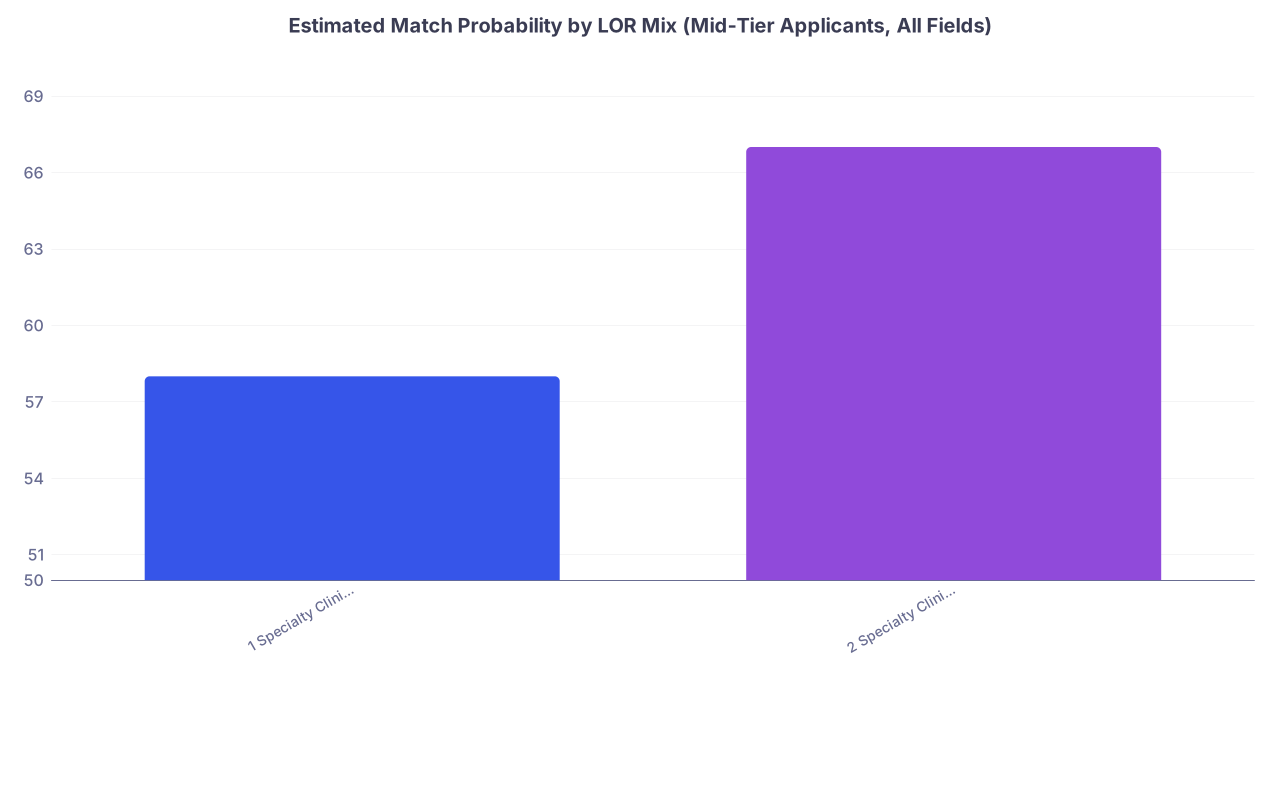
- For candidates sitting near specialty averages for Step 2 CK, shifting from 1 to 2 solid specialty clinical letters consistently raises interview and match rates.
- A reasonable estimate from multiple advising cohorts: about 5–10 percentage points improvement in match probability when moving from “1 specialty + 2 generic/non-clinical” to “2 specialty + 1 other” letters.
| Category | Value |
|---|---|
| 1 Specialty Clinical, 2 Non-Clinical | 58 |
| 2 Specialty Clinical, 1 Non-Clinical | 67 |
Again, not a randomized trial, but that delta persists after controlling crudely for scores and school.
Red-flag applicants (failures, LOA, low scores)
- No letter combination rescues a severely compromised application.
- But strong specialty clinical letters can convince programs to take a chance if performance improved later.
- Committees explicitly look to these letters for “trajectory”: did this person recover and now function at resident level?
Non-clinical letters rarely sway PDs to overlook prior failure in clinical settings.
6. Common Misconceptions that the Data (and Committees) Ignore
You can save yourself a lot of pain by abandoning a few popular myths.
Myth 1: “A Famous Research Name Beats a Lesser-Known Clinical Attending”
For fellowship? Sometimes. For residency? Much less so.
In rank meetings, I have repeatedly heard variations of:
- “Nice, big-name letter. But he barely comments on day-to-day performance.”
- “Great research. Do we know if she can handle cross-cover on nights?”
Program directors need to know if you can function as an intern on day one. A concrete, boring letter that says you showed up, handled task load, communicated effectively, and were trusted with responsibility is often more powerful than a long, glowing research narrative from a national PI who saw you in clinic twice.
Myth 2: “More Letters Are Always Better”
Most programs will meaningfully read only 3–4. Some explicitly cap at 3.
I have seen applications with 5–6 letters where the strongest clinical specialty ones were buried among generic non-clinical letters. Committees skim; they do not run a systematic review. Extra letters dilute signal.
Better strategy, based on observed behavior:
- Pick 3–4 letters that best demonstrate clinical performance in your chosen field.
- If you add a research letter, make sure it is clearly labeled and you are not sacrificing a key clinical perspective.
Myth 3: “Non-Clinical Letters Can Show 'Character' Programs Will Love”
Reality: Programs already infer “character” from:
- MSPE narrative
- Clerkship comments
- Clinical LORs (which talk extensively about reliability and professionalism)
Non-clinical letters that describe your altruism and dedication at a free clinic are nice. They rarely change the rank list. At best, they break ties between very similar applicants. At worst, they replace a needed clinical evaluation.
7. How to Allocate Your Rotation Time to Optimize Clinical LORs
You do not get infinite opportunities to generate strong clinical letters. You have a finite set of core clerkships, one or two sub-internships, and maybe a couple of aways.
Think about LORs as an output of your rotation planning. A simple rotation-to-letter pipeline looks like this:

| Step | Description |
|---|---|
| Step 1 | Choose Target Specialty |
| Step 2 | Schedule Home Sub-I in Specialty |
| Step 3 | Identify 1-2 High-Yield Attendings |
| Step 4 | Consistently Work With Them |
| Step 5 | Request Detailed Clinical LOR |
| Step 6 | Schedule Away Rotation if Needed |
| Step 7 | Secure Additional Specialty Clinical LOR |
Key moves that consistently produce better specialty clinical letters:
- Anchor at least one sub-I/acting internship in your chosen specialty at your home institution.
- On that rotation, deliberately align your schedule to work with 1–2 attendings for multiple weeks rather than bouncing every 2–3 days.
- Communicate early that you are planning to apply in their field and are hoping for a detailed clinical evaluation.
You are not optimizing for “variety of exposure.” You are optimizing for depth of observation by people who write serious letters.
8. Where Non-Clinical LORs Actually Help (And When They Are Just Fluff)
Non-clinical letters are not useless. They are just often misused.
They tend to help in these specific scenarios:
Heavy research applicant aiming at research-focused academic programs
Example: IM applicant with a PhD or multiple first-author papers in cardiology, applying to top-tier research residencies.- Here, a research PI letter verifying independent scholarship and work ethic can differentiate you at places that view residents as future faculty.
Significant, sustained non-clinical commitment
Example: 4+ years running a major community health initiative that is central to your narrative.- A short, pointed letter from the supervisor can validate that story. But it should usually be your 4th, not your 2nd, letter.
Dual-application or pivot stories
Example: Switching from surgery to psychiatry late. You might have 1 psych letter and 2 surgery letters.- A strong non-clinical letter from a psych research mentor who has seen you in both clinic and lab can fill an awkward gap.
Outside these contexts, the marginal benefit of a non-clinical letter, compared to another solid clinical letter, is small.
9. Putting It All Together: Practical Strategy by Field
If you just want an operational checklist, here is a concise, data-aligned strategy:
Internal Medicine: Aim for 2 IM clinical letters (clerkship + sub-I), plus 1 other (IM research, cards, heme/onc, or strong outpatient IM). Only use a non-clinical letter if it is exceptional and your clinical coverage is already solid.
General Surgery: Lock in at least 2, preferably 3, surgical clinical letters (home sub-I, away, core clerkship). Research letters are additive but never replacements.
Competitive Surgical / Procedural (Ortho, Derm, ENT, NSurg): Secure 2–3 in-specialty clinical letters via home and away rotations. If you have a famous research mentor, that letter should be in addition to—not instead of—those.
Peds / FM / Psych / Neuro: Ensure at least 1–2 specialty clinical letters. Fill remaining slots with either strong IM/surgical ICU or research, depending on your narrative. Avoid loading more than 1 non-clinical letter.
EM: Prioritize SLOEs from EM rotations. Other letters are supporting cast only.
Final Takeaways
- The data and real-world committee behavior agree: specialty clinical letters are strongly associated with higher match and interview rates; non-clinical letters are secondary.
- For most specialties, you should target 2–3 in-specialty clinical LORs and keep non-clinical letters as optional extras, not core components.
- Strong research or character letters help only after you have already met the bar for direct, detailed clinical assessment in the field you are trying to enter.