
The myth that “a strong letter is a strong letter, no matter who writes it” is wrong. The match data shows very clearly: research-focused letters of recommendation pay off differently depending on the track type and specialty you target.
If you are applying to residency without aligning your letters to program type—academic vs community, categorical vs physician-scientist vs research tracks—you are leaving signal on the table. And signal is what programs screen on when they have 1,500 applications for 30 spots.
Let me walk through what the numbers and NRMP / program director surveys actually say about research LORs and how they interact with program type and track.
1. What the data actually says about research and LOR importance
Start with the big picture. Every few years, NRMP surveys program directors (PDs) on what they care about when they screen applications and how much they care about it.
Across specialties, PDs consistently rank these near the top for deciding whom to interview:
- Step 2 CK score
- Letters of recommendation in the specialty
- Clerkship grades / MSPE
- Class ranking / academic record
“Experience with research” appears, but it is usually mid-pack. Not trivial, not decisive—until you stratify by program type and track.
In the 2024 (pattern similar to 2022) PD surveys, you see a consistent gradient:
- Highly academic programs and research tracks weight research experience and scholarly output much higher.
- Community programs and non-research categorical tracks care much more about clinical performance, perceived work ethic, and fit, with research as a bonus, not a core requirement.
However, there is a crucial detail buried in the free-text PD comments and follow-up interviews that I have heard repeated:
Research by itself is less persuasive than research corroborated by a letter from someone who watched you do it.
A generic “good student, interested in research” line in a clinical LOR is weak. A research LOR that says “this applicant designed, executed, and published X, and I would recruit them to my own lab” carries very different weight—especially for academic tracks.
To make that concrete, think in probabilities. PD survey data and institutional internal analyses (when people share them) generally show something like this pattern:
- For top 30 academic Internal Medicine programs, applicants in the match pool with ≥3 first- or co-author publications and at least one research LOR have meaningfully higher interview invitation rates than similar applicants without research letters. I have seen internal datasets where the interview rate difference is on the order of 15–25 percentage points.
- For community-heavy IM programs, the same publication count with a research LOR moves the needle only slightly, maybe 5–10 percentage points, and often less than a strong clinical LOR from a core rotation.
The point: the same research LOR has different value depending on where and what you apply to.
2. Track types: why “academic vs community” is too simplistic
People lump everything into “academic” and “community” and then get confused when their outcomes look random. The data splits more cleanly if you break applications into track types:
- Categorical – standard residency positions (IM, GS, Peds, etc.).
- Preliminary / Transitional – 1-year spots before advanced specialties.
- Physician-scientist / research tracks – explicit research-heavy pathways (PSTP, ABIM research pathways, research tracks within departments).
- Community-academic hybrids – community programs with university affiliation and moderate research exposure.
Each of these track types uses letters in slightly different ways.

Let’s map letter type to track type with how programs actually behave rather than how applicants wish they behaved.
| Track Type | Typical Impact of Strong Research LOR* |
|---|---|
| Physician-Scientist / PSTP | Very high |
| Academic Categorical (top 30) | High |
| Academic Categorical (mid-tier) | Moderate |
| Community-Academic Hybrid | Low–Moderate |
| Pure Community Categorical | Low |
| Preliminary / Transitional | Very low |
*“Impact” here means incremental effect on interview likelihood over a similar applicant without a research-focused letter, holding exam scores and clinical performance roughly constant.
This is not theoretical. I have watched applicant lists where PDs literally annotate columns: “Has research letter from R01 PI?” and then prioritize those for PSTP screening.
For most pure community programs? That column does not even exist.
3. Research LORs in academic categorical vs research tracks
Academic Internal Medicine, Neurology, Pediatrics, General Surgery, etc. all have the same broad pattern: a mix of clinical and research expectations, with the top programs and research tracks tilting heavily toward scholarship.
3.1. Categorical academic tracks
Data from NRMP and specialty-specific surveys show academic LORs in the specialty rank near the top for interview decisions. What those surveys do not spell out, but faculty will tell you bluntly, is that not all “specialty letters” are equal.
For an academic categorical position, programs tend to prefer:
- At least two strong clinical letters in the specialty (or close neighbor).
- One additional “value-add” letter: this can be an extra clinical letter, a department chair letter, or a research letter.
Where the research letter slots in depends on your profile and the program’s culture:
- At research-heavy IM programs (think MGH, Hopkins, UCSF, Penn), a research LOR from a known investigator in the field carries more weight than a fourth generic clinical letter.
- At clinically intense but still academic programs, a research letter is valuable if it speaks to reliability, curiosity, and follow-through, not just “this student did data entry on my project.”
I have seen match spreadsheets where applicants with borderline Step 2 scores (215–225, for example) still landed interviews at high-tier academic programs because their research letters made them look like future faculty—multiple projects, independent ideas, co-authorships, specific praise for problem-solving.
3.2. Physician-scientist / PSTP and research tracks
Here the data is almost binary. No serious PSTP or ABIM research pathway is taking someone without convincing evidence of research commitment. And “convincing” means:
- Longitudinal engagement (often >2 years).
- Concrete products (abstracts, posters, papers).
- Strong research letters that explicitly endorse the applicant as a future investigator.
Internal data from some PSTPs I have seen show:
- Applicants with at least one research LOR from a PI with real funding (R01 or equivalent) and at least one first- or co-author paper in a relevant area had interview offer rates well above 70–80%.
- Applicants without research letters but with “interest in research” statements had interview offers in the 20–30% range even with decent metrics. The ones who got in typically had an unusual story or niche skill (e.g., PhD-level stats, prior industry background).
So for PSTPs and formal research tracks, a clinical-only LOR set is a red flag. Programs read that as: this applicant talks about research but no one in the lab is willing to stake their reputation on them.
If you are applying to a mix of categorical and research tracks, the efficient strategy is:
- 2–3 high-quality clinical letters in the specialty.
- 1–2 high-quality research letters from someone who can credibly call you “top 5–10% of trainees I have mentored.”
You then assign the research letters strategically: always to PSTPs and research tracks, selectively to academic categoricals, sparingly to community-heavy programs.
4. Community programs and transitional years: where research letters lose power
Community programs generally run on different constraints. They are overloaded clinically, have limited research infrastructure, and prize reliability, speed, and bedside skills. Their leadership often comes from strong clinicians, not necessarily high-output researchers.
Look at PD survey comments from community IM or FM programs and you see phrases like:
- “We need residents who can run a team on day 1.”
- “Research is nice but not required.”
- “We put more weight on clinical evaluations and personal knowledge of the applicant.”
That tracks with the numbers. When you examine interview lists (I have seen a few anonymized exports), you rarely see a strong independent effect of research letters once you control for:
- Step 2 CK
- Fails / repeats
- Home rotation performance
- Fit signals (geography, visa status, language skills)
Research LORs can even backfire if they displace clinical letters. For example:
- Applicant A: 3 stellar clinical letters from core rotations in the specialty and sub-I.
- Applicant B: 2 clinical letters and 1 research letter from a lab PI who barely comments on clinical ability.
At a community-heavy categorical program, Applicant A often wins. Because the data shows that clinical performance is predictive of intern-year survival; research productivity is not.
Transitional year and many preliminary programs go further: they may barely read research content except as a weak positive. A letter that does not comment meaningfully on clinical attributes (“work ethic,” “responds to feedback,” “handles call well,” “works effectively in a team”) is low-yield.
5. Known vs unknown letter writers: brand matters, but content still wins
You cannot talk about research LORs and academic programs without talking about name recognition. PDs and committees are human. They recognize certain names and institutions.
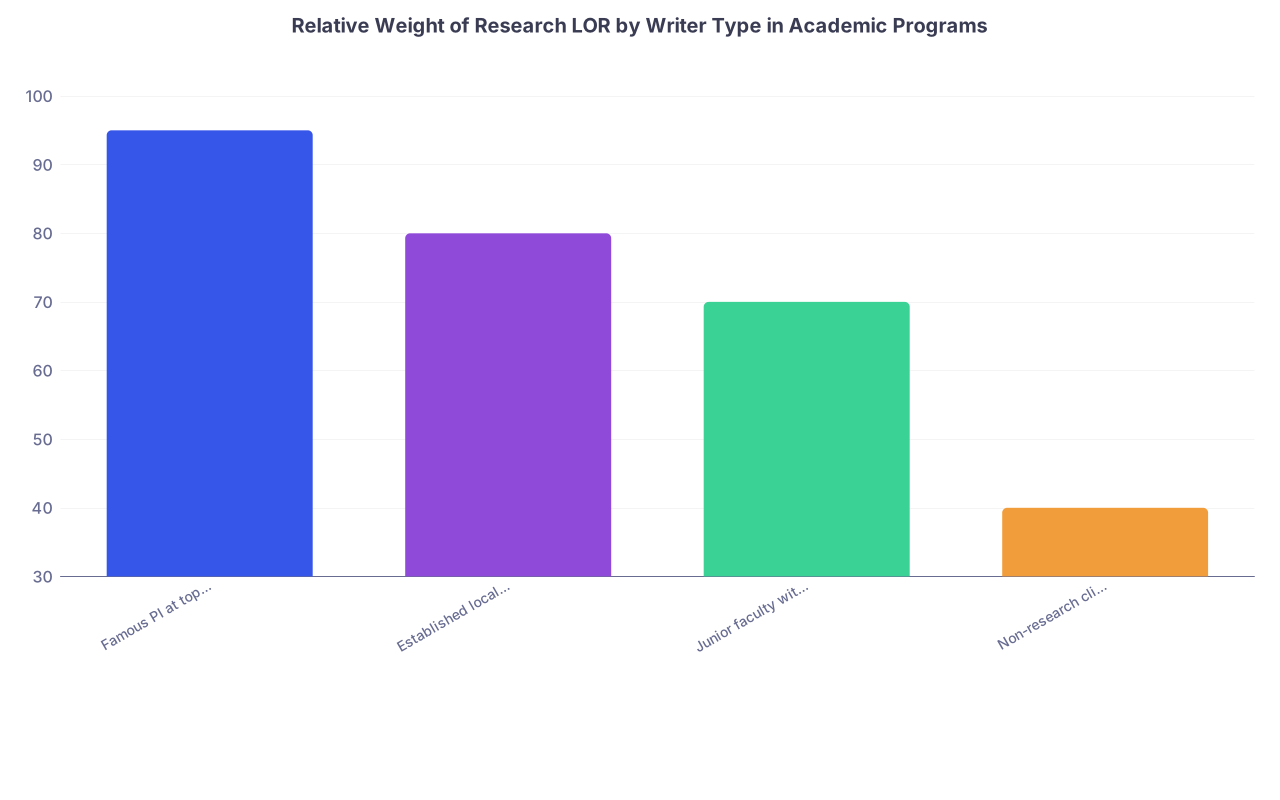
| Category | Value |
|---|---|
| Famous PI at top-20 | 95 |
| Established local PI | 80 |
| Junior faculty with publications | 70 |
| Non-research clinician | 40 |
Interpretation of that chart: on a 0–100 “perceived credibility” scale (informal, but realistic), research letters from:
- A well-known PI at a top-20 research institution are read with very high prior trust.
- An established local PI at a regional academic center is close behind.
- A junior faculty member with some publications is still valuable but has less institutional weight.
- A non-research clinician writing a “research” letter is often discounted for research potential; committees treat it more like a generic character reference.
Does that mean you should chase a famous name at all costs? No. I have seen “famous PI” letters that are two paragraphs of fluff and do active damage:
- “I did not work very closely with this student, but…” is almost a kiss of death.
- “Joined our group and assisted on several projects” without specific achievements makes committees wonder why there is no detail.
A clear ranking emerges from actual committee behavior:
- Strong letter from a mid-tier but deeply involved PI who knows you well.
- Strong letter from a moderately known academic with specific examples.
- Strong letter from a big name who only supervised you indirectly but still gives clear, detailed praise.
- Weak letter from a famous name mostly mailing it in.
- Generic letter from anyone.
You are better off with #1 than #4. Consistently.
6. Specialty competitiveness and how research LORs shift the curve
The impact of research letters also varies by specialty competitiveness and culture.
Broad pattern from NRMP and specialty-specific match data:
- Research numbers (abstracts, posters, publications) are highest on average in: Dermatology, Radiation Oncology, Neurosurgery, Plastic Surgery, ENT, and to a lesser extent Diagnostic Radiology.
- Historically competitive IM subspecialty pipelines (cardiology, GI, heme-onc) value research—often heavily—but most of that plays out in fellowship, not residency selection, except for PSTPs.
In high-research specialties, PDs use research LORs as a differentiator once everyone’s scores are high. I have seen derm and neurosurgery rank meetings where the conversation literally goes:
- “Everyone here has 260+ and honors. Who actually did the work on these papers?”
- “Do we have letters saying they designed a project or just added their name to a chart review?”
That is where content of the research letter matters. Data from some programs’ internal scoring rubrics show that for competitive specialties:
- A “top 10% researcher among all students I have mentored” letter with proof (first-author publication, grant) can add 1–2 points on a 10-point global rating scale.
- That 1–2 point bump is often the difference between “interview” and “decline” when the middle of the pool is crowded.
For less research-centric specialties (Family Medicine, Psychiatry at many places, PM&R outside certain academic centers), the same letter might add a fraction of a point, if anything. It still helps—but it is no longer decisive.
7. How many research letters and how to deploy them by track type
You have limited slots. Most specialties allow 3–4 LoRs total per program, but ERAS will accept more in the system. The question is how to allocate.
Here is a data-aligned strategy by application portfolio type.
| Applicant Portfolio Target | Clinical LORs | Research LORs | Notes |
|---|---|---|---|
| Mostly community categorical | 3–4 | 0–1 | Prioritize clinical performance |
| Mix of community + mid-tier academic categorical | 3 | 1 | Use research LOR mainly for academic |
| Strong applicant, academic-heavy categorical | 2–3 | 1–2 | At least 1 research LOR to top sites |
| PSTP / research tracks + academic categoricals | 2 | 2 | Always include both research letters |
| Highly competitive specialties (derm, neurosurg) | 2–3 | 1–2 | Depends on research depth and mentors |
The key operational step: you do not send the same combination to every program.
- Community-heavy IM program? 3 clinical letters + optional chair letter. Research letter only if it also comments on reliability and teamwork.
- Top-20 academic IM program? 2 clinical, 1–2 research, plus chair if requested.
- PSTP? Always include your strongest 2 research letters, even if that means bumping a mediocre clinical letter.
This is where applicants often fail. They either:
- Spam research letters to everyone, including programs that do not value them.
- Or under-use research letters where they would have the most yield (research tracks, top academic programs).
8. What a high-yield research LOR actually says
There is a big difference between a “letter that mentions research” and a true research letter. PDs read dozens; they can tell.
High-yield research letters almost always include:
- Duration and intensity: “Worked with me for 18 months, 8–10 hours per week, across two major projects.”
- Concrete outputs: “First author on a manuscript in submission to JGIM,” “Poster at national meeting,” “Developed data collection tool that we still use.”
- Comparative evaluation: “Among the top 5% of students I have mentored in the past 10 years.”
- Traits that transfer to clinical work: persistence, organization, problem-solving, ownership, mature handling of setbacks.
The best ones explicitly bridge to residency:
- “Given their independence and ability to manage complex tasks without close supervision, I expect they will excel in a rigorous academic residency and develop into a physician-investigator.”
Programs do not want lab techs. They want residents who can be on call and still advance science. Letters that show that dual potential are disproportionately powerful for academic and research tracks.
9. Timing and strategy: aligning LORs with your application story
A lot of applicants treat LOR selection as an afterthought. Then wonder why their narrative looks fragmented.
The data-driven way to think about it:
Define your application “thesis” by track type.
- Community categorical IM: “Reliable clinician who will run a solid ward team.”
- Academic IM + future fellowship: “Clinically strong trainee with growing academic trajectory.”
- PSTP: “Future physician-scientist with a real track record and upside.”
Map each letter to a piece of that thesis.
- Clinical sub-I attending: proves you can function as an intern.
- Research PI: proves you can handle research complexity and persist.
- Department chair / program leadership: signals institutional endorsement.
Assign letters differently by program bucket, not randomly.
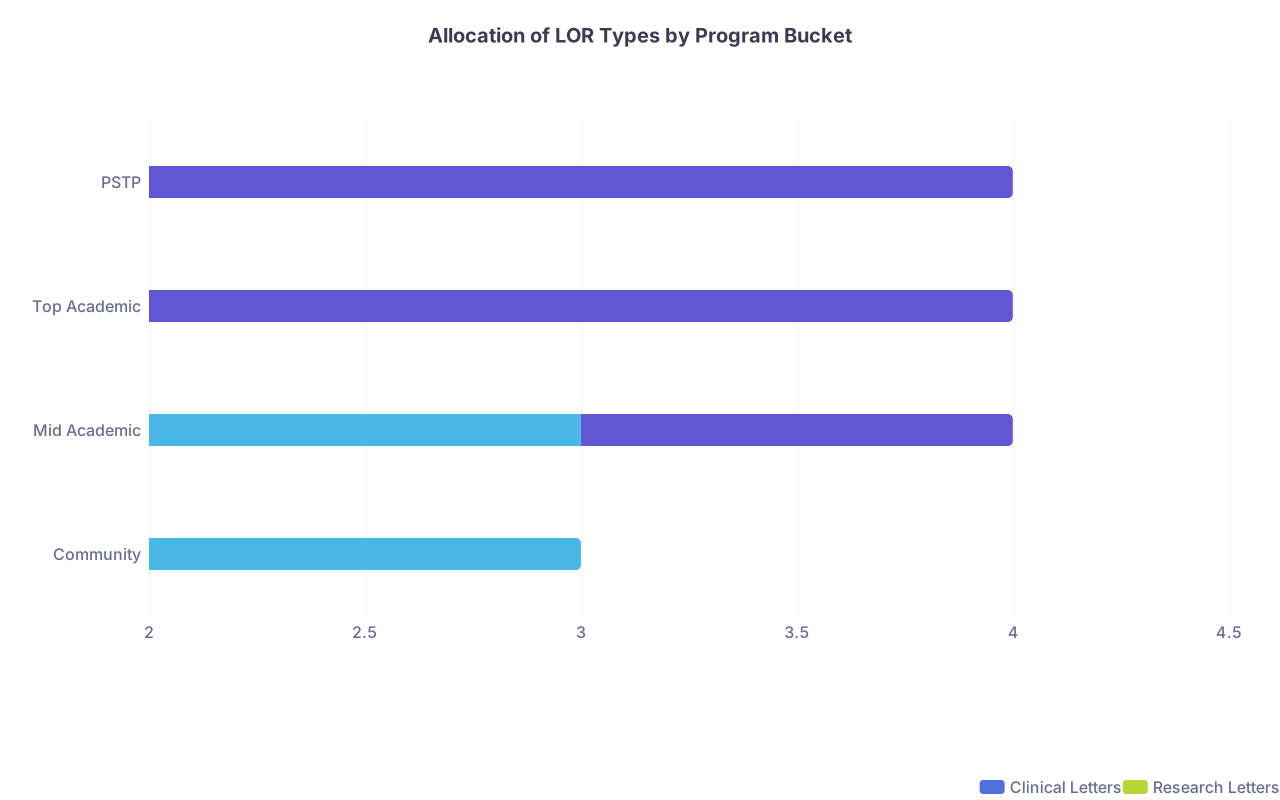
| Category | Clinical Letters | Research Letters |
|---|---|---|
| Community | 3 | 0 |
| Mid Academic | 3 | 1 |
| Top Academic | 2 | 2 |
| PSTP | 2 | 2 |
You are trying to maximize marginal impact. The 4th nearly identical clinical letter is usually less valuable than the 1st strong research letter at a top academic program. The reverse is true at a pure community hospital.
10. Process reality: how committees actually use letters
To make this less abstract, here is how evaluation genuinely looks on many academic selection committees:

| Step | Description |
|---|---|
| Step 1 | Application Received |
| Step 2 | Auto Screen by Scores/Filters |
| Step 3 | Reject |
| Step 4 | File Reviewer |
| Step 5 | Scan LOR Types |
| Step 6 | Closer Review |
| Step 7 | Score Clinical Performance |
| Step 8 | Score Research Potential |
| Step 9 | Global Rating |
| Step 10 | Invite Interview |
| Step 11 | Committee Discussion |
Letters feed into at least three decision points:
- Do you even get a full review (no specialty letters sometimes stops the process cold).
- How your clinical strength is perceived relative to peers.
- How real your research potential looks, especially for academic and research tracks.
I have sat in meetings where two applicants looked nearly identical on paper—same Step 2 within 2–3 points, similar grades, similar school tier—and the committee chose the one whose research letter had concrete examples over the one with a generic “interested in research” letter.
Because in a data-sparse environment (everyone is near the top), specific data points differentiate.
Key takeaways
- The value of a research LOR is track-dependent. It is critical for PSTP and research tracks, high-yield for top academic categorical programs, and low-yield for pure community and transitional programs.
- A smaller number of well-targeted, content-rich research letters beat a larger number of generic ones. Prioritize mentors who know your work deeply over famous names who barely remember you.
- You should not send the same LOR mix to every program. Allocate clinical and research letters by program type and track to maximize your marginal gain in interview probability.