

Research letters get dismissed all the time outside of big-name university hospitals.
“You’re not applying to a physician-scientist track, who cares?”
That mindset is wrong—and it quietly costs applicants interviews every year.
If you think research letters only matter for MD/PhD types and hardcore academic IM programs, you’re playing the game with outdated rules. Non-academic and “community” programs absolutely use research letters as signals—just not in the simplistic way pre-meds imagine.
Let’s break the myth properly.
What Programs Actually Care About (Spoiler: It’s Not Just ‘Community vs Academic’)
People talk like there are two worlds: “academic” programs that care about research, and “community” programs that don’t. That binary is fake.
Here’s what program leadership actually cares about, regardless of label:
- Will you be safe and reliable on day one?
- Will you pass your boards on time?
- Will you make their lives easier, not harder?
- Will you represent the program well to patients, other services, and—yes—future applicants?
Letters are one of the few places where they get evidence beyond numbers and generic adjectives.
A strong research letter can answer those questions better than yet another lukewarm clerkship letter that reads like a templated MSPE paragraph.
The important distinction isn’t “research vs non-research program”. It’s:
- Garbage, generic letter
vs. - Specific, behavior-focused, credible letter from someone who’s actually seen you work.
Research letters, done right, excel at that. And non-academic programs know it.
What the Data and PDs Actually Say About Research Letters
Let’s go to the receipts.
The NRMP Program Director Survey (the closest thing you have to reading PDs’ minds) repeatedly shows two things:
- Letters of recommendation in the specialty are among the top factors for interview offers.
- Specific comments about work ethic, professionalism, and teamwork are heavily valued.
The survey doesn’t have a checkbox that says “research letter: yes/no,” but here’s the key: many of the highest-yield letters—especially for applicants without superstar clerkship performance—come from research mentors who can actually describe your behavior over months, not a couple of shifts.
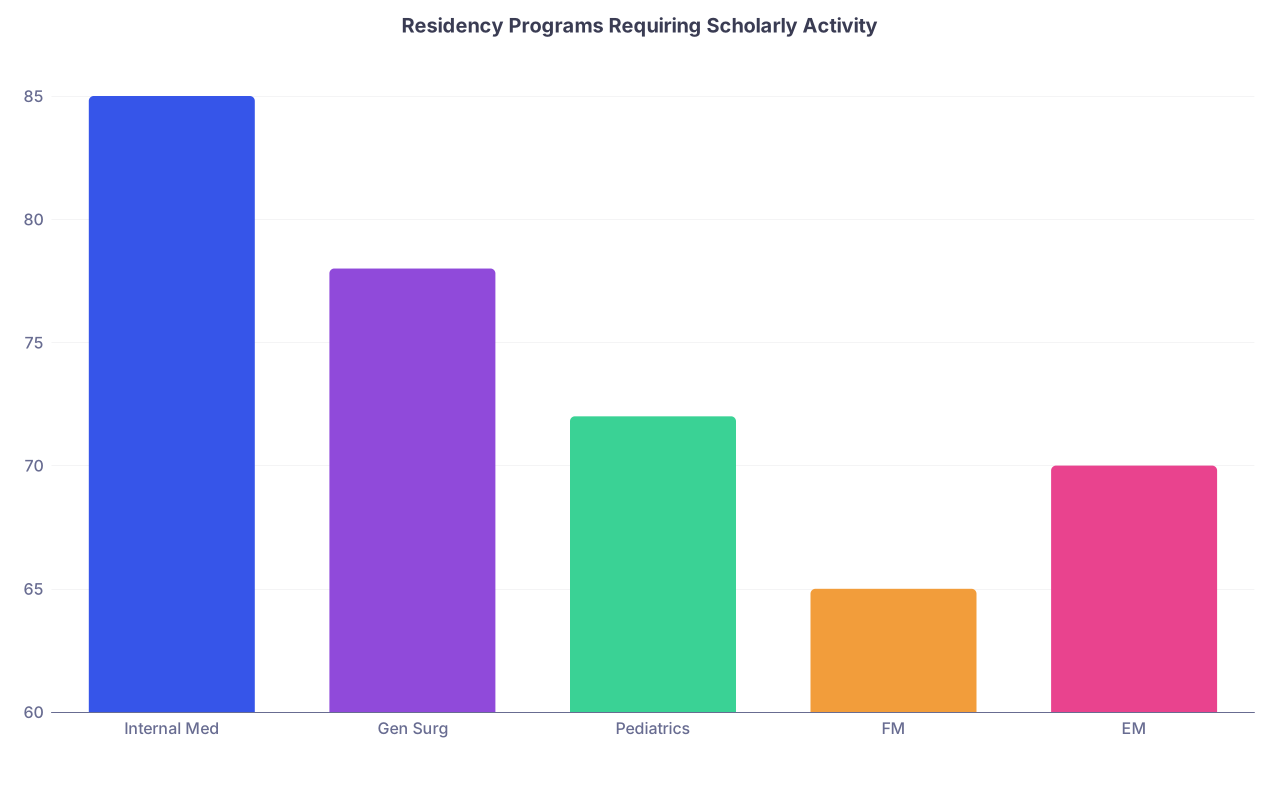
For programs that do any QI, research, or scholarly activity requirement—and that’s most ACGME-accredited programs now—someone who’s demonstrated they can grind through a research project is worth paying attention to.
| Category | Value |
|---|---|
| Internal Med | 85 |
| Gen Surg | 78 |
| Pediatrics | 72 |
| FM | 65 |
| EM | 70 |
Those numbers bounce around a bit across survey cycles and specialty, but the pattern is stable: the majority of “non-academic” programs still have real expectations for scholarly work—case reports, QI projects, M&M presentations, etc. They want residents who don’t melt down the moment something looks like a project.
Where does a PD see evidence of that in your file? Mostly in:
- Your CV
- Your personal statement
- Your letters
Research letters connect all three.
When I’ve heard community PDs talk in selection meetings, a typical line goes like this:
“They did a couple of QI and a poster, and the research PI says they were the one actually pushing the project forward. That’s someone who will finish our QI requirement without hand-holding.”
That comment is about behavior, not p-values. But it came from a research letter.
The Real Problem: Bad Research Letters, Not Research Letters
Here’s why the myth persists: a lot of research letters are terrible.
Common patterns I’ve seen:
- The mentor barely knows you.
“They came to lab meetings and assisted with data collection.” That’s it. Useless. - The letter is all about the project, not about you.
Three paragraphs about the study design, one line: “Student X was helpful.” Translation: no idea what to say. - The tone is lukewarm.
“I expect they will be a fine resident.” You might as well stamp “rank at bottom” on your ERAS.
So yes, those research letters don’t help you at any program—academic or not.
But that’s not a research problem. That’s a weak writer / weak relationship problem.
When the mentor knows you well, research letters can do things routine clerkship letters often fail at:
- Describe long-term work ethic (6–18 months, not 2 weeks on wards)
- Show follow-through: did you stick with a project past the initial “this is exciting” phase?
- Give examples of ownership and initiative (“They redesigned our REDCap form on their own after catching errors in our initial version.”)
- Highlight maturity and professionalism in settings where residents and attendings actually saw you off the clock and under pressure (abstract deadlines, revisions, IRB headaches)
That’s exactly the content non-academic programs want. They are staffing a workforce, not a journal club.
How Non-Academic Programs Quietly Use Research Letters
Let’s talk about how non-university programs actually read these.
Imagine a mid-sized community internal medicine program:
- Not a research powerhouse
- Main mission: train solid clinicians, board pass rate stable, plenty of hospitalist grads
- PD and APDs still need a few residents each year to run QI, journal club, and the occasional poster at ACP/state chapters
Here’s how they react to a research letter that actually says something.
Scenario A: You have a Step score slightly below their usual range, but:
- CV: two posters, one QI project
- Personal statement: thread about improving systems / patient safety
- Research letter: “They almost single-handedly kept our mortality-review project alive when multiple team members graduated. They learned basic stats enough to run their own analyses under my supervision. They presented at our departmental conference and handled aggressive questions without getting defensive.”
That application is now safer. You just gave them evidence you’re disciplined, you finish what you start, and you can communicate under stress. That matters in every program.
Scenario B: You are average across the board, but:
- CV: one poster
- Research letter 1: generic, doesn’t really describe you
- Clerkship letters: “pleasant,” “punctual,” “team player,” nothing concrete
Guess which applicant the PD is more comfortable inviting? Hint: not the one with a mythical “non-research” profile.
Non-academic doesn’t mean “doesn’t care about documented competence.”
When a Research Letter Helps You More Than Another Clinical Letter
This is where people get uncomfortable, but it’s the truth: sometimes your best letter won’t be from a clinical rotation.
You know the situation:
- You did fine on most clerkships. Not bad. Not glowing.
- Your “best” clerkship letter is from an attending who worked with you for 5 days, liked you, but writes the same letter for 25 students a year.
- Your research mentor has watched you for a year and can tell specific stories about your work, reliability, and growth.
If you force yourself to only use “clinical” letters because “community programs don’t care about research,” you’re sabotaging yourself.
For many applicants:
- 2 strong clinical letters + 1 strong research/QI letter
beats - 3 mediocre, template-ish clinical letters.
Programs are not stupid. They know:
MS3/MS4 clinical evaluations are compressed and noisy.
Attendings often barely remember you by the time they write your letter.
Research mentors, especially if they are MDs who also see patients, can assess many of the same attributes:
- Work ethic
- Self-directed learning
- Response to feedback
- Professionalism
- Communication with a team
If your research PI is also a clinician at the same hospital system? Even better. They’re not “just a basic scientist”—they’re faculty attesting to how you function in a semi-real-world environment.
The Catch: When Research Letters Actually Don’t Help Much
Let me be very clear: not all research letters are worth using. Some you should bury.
A research letter is usually low-value if:
- The writer is non-clinical, has no idea what residency is like, and focuses only on technical skill (“They wrote excellent Python scripts”) with zero commentary on professionalism, communication, or reliability.
- The tone is clearly weaker than your clinical letters.
- It’s from a short, superficial experience (4-week summer project, one remote data-cleaning gig).
Also, some specialties and programs really do prioritize in-specialty clinical letters above all else (e.g., general surgery, EM). For those, you generally still want:
- 2–3 letters in the specialty
- Then a research letter as an optional 4th upload if allowed and genuinely strong
But that is about relative priority, not “research letters don’t matter.”
Use the rule of thumb I give students:
- If the research mentor can describe your behavior, reliability, and growth with concrete examples, it’s probably a good letter.
- If they mostly talk about the project and your technical task list, it’s probably a weak letter.
How to Turn a Research Experience into a High-Impact Letter
If you’re going to use research letters for non-academic programs, you have to set them up right. This isn’t passive.
Do not just email: “Can you write me a strong letter?” and hope for the best.
You want to shape the content they’ll be able to write. That starts months before you ever ask.
During your research time, deliberately show the behaviors PDs care about:
- Ownership: volunteer to own a sub-project or specific piece of the workflow.
- Consistency: show up when you say you will, hit deadlines, send updates without being chased.
- Communication: present your work at lab meetings, QI committees, student research day—anything that lets your mentor see you in front of a group.
- Maturity: handle criticism without sulking; propose concrete fixes when things go wrong.
Then, when you ask for the letter, give them ammo:
- A one-page brag sheet with:
- Specific projects you worked on
- Times you took initiative or solved a problem
- Any presentations/posters/publications
- Feedback they gave you and how you acted on it
- A CV and draft of your personal statement
- A brief note like:
“It would help me a lot if you could comment specifically on my reliability, independence, and communication with the team, since programs care a lot about those aspects.”
That nudge alone can turn a vague research letter into one that hits PDs where they live.
Comparing Letter Types: Where Research Letters Punch Above Their Weight
Here’s the part people underestimate: on several critical dimensions, research letters often outperform standard clerkship letters.
| Dimension | Typical Clerkship Letter | Strong Research Letter |
|---|---|---|
| Duration of observation | 2–4 weeks | 6–18 months |
| Specificity of examples | Often low | Often high |
| Evidence of follow-through | Limited | Strong |
| Project/Systems thinking | Variable | Usually present |
| Board-relevant skills (work ethic, reliability) | Moderate | High when well-written |
Again, this assumes the research letter is actually good. But when it is, it gives non-academic programs exactly what they want: proof you’re a grinder who finishes things.
So, Do Research Letters Matter for Non-Academic Programs?
Yes. They do. Just not for the cartoon reason people think (“they love research”).
They matter because:
- They can be the best documented evidence of your reliability, work ethic, and ability to finish unsexy tasks.
- They help programs predict whether you’ll complete required QI/scholarly work without drama.
- They sometimes rescue otherwise borderline applications by providing real, specific, credible praise.
Use them strategically:
- Prioritize at least 2 strong clinical letters in your target specialty where required.
- Add a strong research/QI letter when:
- The writer knows you well and is enthusiastic.
- The content reinforces the story your CV and personal statement tell.
- It’s clearly as strong or stronger than your weaker clinical letters.
Stop repeating the lazy line that “research letters don’t matter for community programs.” Programs are not allergic to research. They’re allergic to vague, useless letters.
If your research mentor actually knows you—and can prove you’re the kind of person who does the work even when nobody’s watching—that letter absolutely matters.
Key points:
- The real divide isn’t academic vs community; it’s specific, behavior-rich letters vs generic fluff. Strong research letters belong in the first group.
- Non-academic programs still need residents who can complete QI and scholarly requirements. Research letters are powerful signals of follow-through and reliability.
- Use research letters when the mentor knows you well and can speak concretely about your work ethic, professionalism, and growth—often more convincingly than a 2-week clerkship attending ever could.


