

Myth: ‘Any LOR Is Better Than None’—When a Letter Hurts You
The idea that “any letter of recommendation is better than none” is flat-out wrong. A mediocre—or subtly negative—letter can sink an otherwise strong residency application faster than a slightly lower Step score.
I’ve watched this play out in rank meetings. People in the room arguing over one vague, lukewarm letter while a 260+ Step score and solid transcript sit ignored on the next slide. You think committees are “holistic”? They are—right up until they see a letter that quietly screams, “Don’t trust this applicant.”
Let’s dismantle the myth, then walk through what actually happens when a bad or weak LOR lands in front of a residency selection committee.
What The Data and Programs Actually Say About LORs
Letters of recommendation are not decoration. They’re one of the most weighted parts of your residency file.
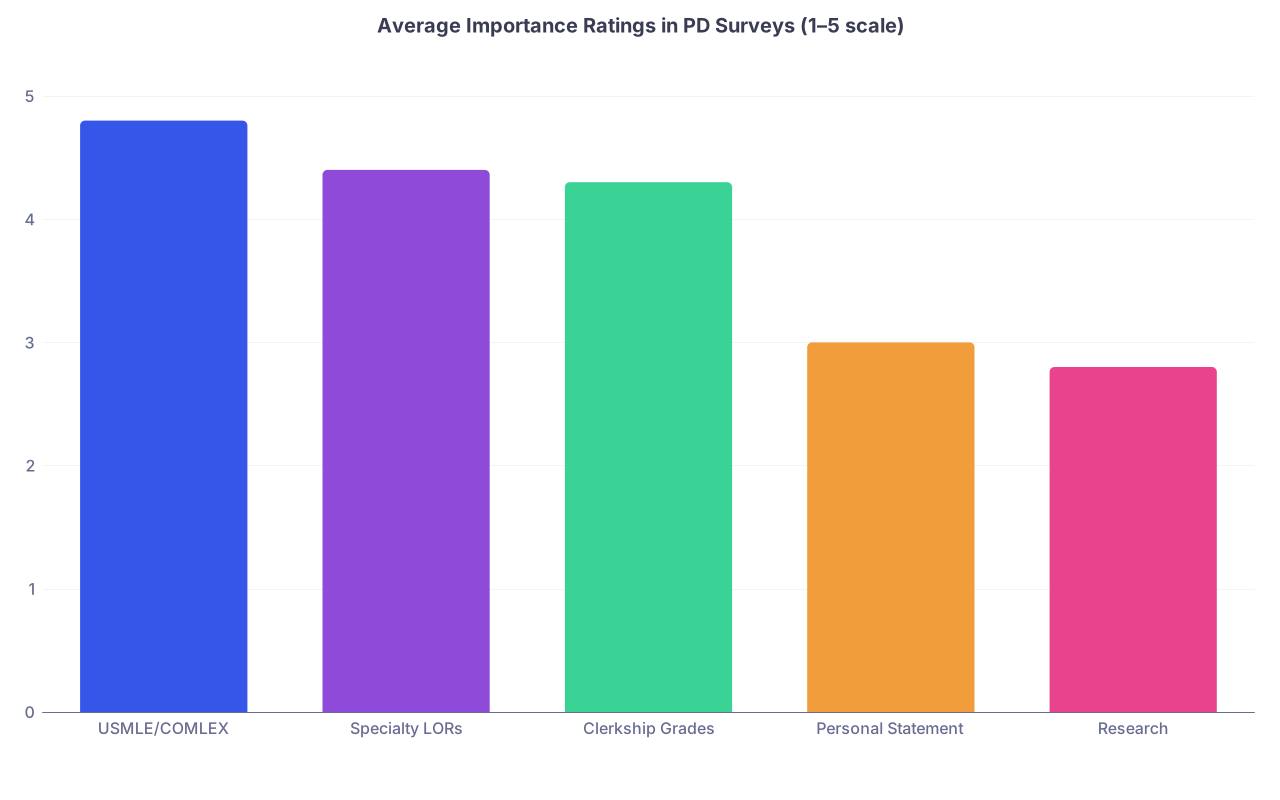
Look at NRMP’s Program Director Survey (and yes, PDs actually fill it out). Year after year, “Letters of recommendation in the specialty” ranks near the very top—usually just behind Step scores and clerkship grades.
| Category | Value |
|---|---|
| USMLE/COMLEX | 4.8 |
| Specialty LORs | 4.4 |
| Clerkship Grades | 4.3 |
| Personal Statement | 3 |
| Research | 2.8 |
Those are importance ratings. But the more uncomfortable truth: letters are used as negative filters even more aggressively than as positive ones.
Here’s how it plays out behind closed doors:
- A glowing, detailed letter can push a borderline applicant into the interview pile.
- A bland, generic, or coded-negative letter can push a strong applicant out of contention entirely.
Program directors routinely say some version of: “Scores get you considered. Letters tell me if I should trust you with my patients at 2 a.m.” That’s not fluff. That’s how they think.
So no, “any letter” is not better than none. A bad one is a liability. A neutral one is often a missed opportunity. And a genuinely strong letter is a competitive weapon.
The Silent Killer: Lukewarm and “Damning with Faint Praise” LORs
When applicants worry about “bad letters,” they imagine a nuclear disaster: “This student is unsafe,” “I cannot recommend them,” “I had major concerns.”
Those letters are rare because most attendings are conflict-avoidant. They’ll just refuse to write the letter rather than torch you openly.
The real danger is the lukewarm letter. The “meh” letter. The one that sounds positive to you, but raises red flags for people who read hundreds of them each year.
Here’s what that actually looks like.
The coded signals programs read that you probably miss
Selection committees speak fluent LOR. You usually do not. That’s the imbalance.
Phrases that sound fine to you but mean “problem” or “not impressive” to seasoned readers:
- “X completed the rotation without any major issues.”
- “X is reliable and shows up on time.”
- “X was respectful to staff and patients.”
- “Given more time, I believe X will continue to grow.”
- “At their level of training, X is appropriate.”
- “I did not observe any major professionalism concerns.”
- “X will make a fine resident in the right program.”
I’ve seen PDs slide a file aside based only on this kind of language. No drama, no argument. Just, “Next—letters aren’t strong.”
Contrast that with letters that help you:
- “I recommend her without reservation for residency in internal medicine.”
- “He ranks in the top 5% of students I have worked with in the last decade.”
- “I would love to have her in our program and will be disappointed if she goes elsewhere.”
The difference is not subtle to someone who reads LORs for a living.
When No Letter Is Actually Better Than a Bad One
Here’s the part nobody tells you: in some scenarios, no letter from a certain person or rotation is safer than a lukewarm or negative one.
Consider these situations.
Case 1: The disaster rotation
You had one rotation where you clashed with an attending, missed some soft expectations, or just did poorly. You’re tempted to “cover” it by asking that attending for a letter so it doesn’t look suspicious.
Do not. A generic evaluation in your MSPE is survivable. A soft-poison letter from that same attending is not.
In that situation, skipping that attending altogether is smarter than rolling the dice on a letter you suspect will be weak. Programs see gaps all the time. They do not automatically assume “no letter from Dr. X = disaster.” They do react to obviously unenthusiastic letters.
Case 2: The “big name” who barely knows you
This one kills a lot of applicants. You chase the celebrity letter: the department chair who met you twice, the national name who saw you for half a day in clinic.
You get a one-paragraph letter:
“X rotated with our service and showed interest in the field. X was punctual and interacted appropriately with patients and staff. I support their application to residency.”
You’re thrilled because: big name. The PD is unimpressed because: content-free.
Meanwhile, your quieter, mid-career associate professor who actually watched you manage a full patient load could have written two pages of detailed advocacy. But you did not ask them, because they were not “famous.”
Between a famous name with a content-sparse letter and a lesser-known faculty with a rich, specific, “I’d hire them” letter, programs overwhelmingly prefer the second. Every time.
Case 3: The field mismatch
Another myth: “Any positive LOR helps, even if it’s not in the specialty.” Not really.
A strong psych letter does not “cancel out” a bad EM letter when you’re applying EM. In fact, it highlights the problem: “Why is their psych attending over the moon while the actual specialty letters are meh?”
If your specialty letter options are weak and your non-specialty letter is excellent, that’s a sign to be strategic, not to blast all of them into ERAS and hope for the best.
How Committees Actually Use Letters in Screening and Ranking
Let me walk you through the real workflow, because once you see that, it’s obvious why “any LOR” is a myth.

| Step | Description |
|---|---|
| Step 1 | Application Received |
| Step 2 | Initial Screen: Scores & Filters |
| Step 3 | Reject |
| Step 4 | Review LORs & MSPE |
| Step 5 | Invite to Interview |
| Step 6 | Borderline or Lower Priority |
| Step 7 | Pass Minimum Cutoffs? |
| Step 8 | LORs Strong/Supportive? |
In the first pass, scores, geography, visa status, and sometimes class rank filter the pile. But pretty quickly—especially once you get near the interview capacity—letters become the tiebreaker.
Then, post-interview, letters resurface again when building the rank list. I’ve sat in those meetings. It’s not uncommon to hear:
- “I loved her in the interview, but did you read that surgery letter?”
- “His PD letter is weirdly vague. No comparative language at all.”
- “Two letters mention needing a lot of supervision. I’m nervous.”
You want your letters to be weapons in that room. Not liabilities. Not shrug-inducing filler.
How a Single Problematic Sentence Can Torpedo You
The scariest part: letters don’t have to be obviously terrible to hurt you. A single off-hand sentence can do real damage.
I’ve seen lines like:
- “He occasionally needed reminders about timely documentation.”
- “She sometimes struggled to prioritize tasks on busy days.”
- “He improved after feedback about his tone with nursing staff.”
- “She continues to work on her confidence and independent decision-making.”
Are any of these career-ending? Alone, no. But in a competitive pile, they become a reason to move you down or out, especially in high-acuity fields.
Now contrast that with: no letter from that attending at all. Programs never see the critique. They just see the rest of your file. Scores, other letters, narrative comments.
That’s why “any letter is better than none” is a bad strategy. You are better off not giving programs ammunition against you.
Choosing Writers: Strength Over Status, Specificity Over Politeness
So, who should you actually ask? Ignore the myths and use a simple hierarchy:
| Writer Type | Impact Level |
|---|---|
| Knows you well + in specialty | Very High |
| Knows you well + related specialty | High |
| Knows you well + other field | Moderate |
| Famous name, barely knows you | Low |
| Known conflict / weak eval | Toxic |
You want the first two rows as much as possible. The last two can hurt you.
A few concrete rules I’ve seen work well:
- If an attending hesitates when you ask (“I suppose I can write something”), abort. That is code for “It will not be strong.”
- If they say, “I’d be happy to write you a strong letter,” that word—strong—is what you’re listening for.
- If you know you were borderline on a rotation, do not ask out of guilt or obligation. You’re not “covering” anything. You’re arming the other side.
And yes, you are allowed to ask directly: “Do you feel you can write me a strong, supportive letter for [specialty]?” If they can’t, you’d rather know in July than in February when you are staring at a short interview list.
When You Suspect a Weak Letter: Damage Control, Not Denial
Sometimes the damage is done. You already asked. You’re worried it won’t be great. Now what?
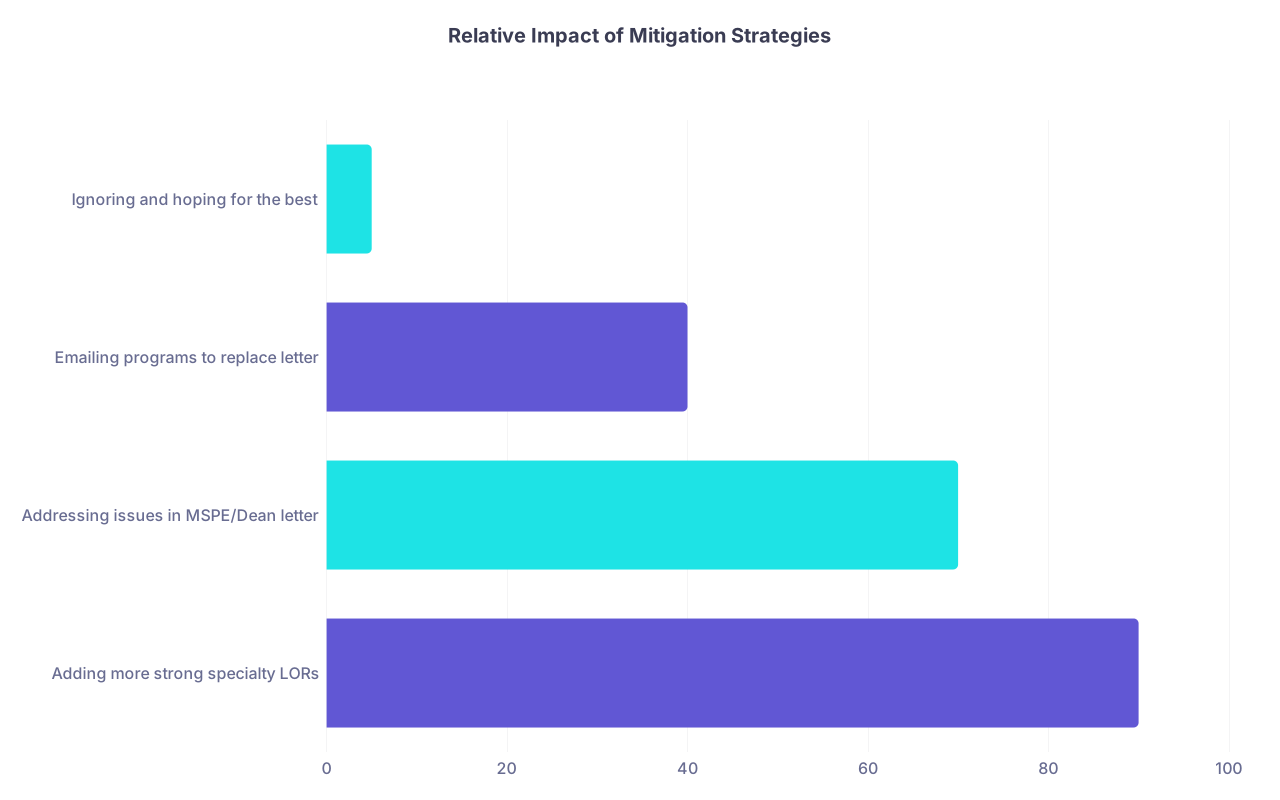
You do not have perfect control, but you still have options.
| Category | Value |
|---|---|
| Adding more strong specialty LORs | 90 |
| Addressing issues in MSPE/Dean letter | 70 |
| Emailing programs to replace letter | 40 |
| Ignoring and hoping for the best | 5 |
A few moves that actually help:
Stack stronger letters around it. If your school allows four letters, do not waste that on mediocrity. If you already have a suspect letter uploaded, prioritize securing at least two clearly strong, detailed letters from other attendings.
Talk to your dean’s office / advisor honestly. If you think a letter might be negative (not just “not amazing”), tell your dean or MSPE author. Sometimes, they can contextualize things or quietly advise you whether that writer has a reputation.
Replace when possible. If a writer drags their feet and uploads in November, and you’ve since secured a rock-star letter, you can choose which ones to assign to programs (and in some systems, stop sending the weaker one to new programs).
What you should not do is pretend it doesn’t matter. Or cling to the myth that “programs don’t read all the letters.” They do. Maybe not every single line for every single file. But if your letter count is small—and one looks off—that one will absolutely be read.
The One Time “Any LOR” Is Almost True
There is one narrow situation where “any” letter is closer to better than none: extremely small or community programs that receive relatively few applications and are desperately trying to fill interview slots.
Even there, though, the reality is more nuanced:
- A generic but positive letter might be neutral or mildly helpful.
- A clearly negative or hesitant letter is still toxic, even at less competitive programs.
So at best, the myth becomes: “A bland but positive letter may be slightly better than none at a very non-competitive program.” That is not the rule you should use to design your entire application strategy.
What You Should Actually Believe About LORs
Let me strip this down to what the data and real-world behavior actually support:
- Letters of recommendation are high-impact. They are used as both positive anchors and negative filters.
- A weak, vague, or faint-praise letter can quietly sabotage you, even if no one ever tells you that’s what happened.
- You should prioritize strength and specificity of content over title, fame, or “I need something from this rotation.”
- In several common scenarios, no letter is safer than a bad one—especially from a problematic rotation or a barely acquainted “big name.”
If you remember nothing else, remember this:
A letter is not a checkbox. It’s testimony. You are putting people on the stand to talk about you when you are not in the room. Choose your witnesses very, very carefully.
Core Takeaways
- “Any LOR is better than none” is false. A weak or subtly negative letter can absolutely hurt you more than its absence.
- Status of the writer is overrated; genuine enthusiasm and specific, comparative praise are what move the needle.
- If you wouldn’t bet your rank list on what a person will say about you, don’t bet your application on their letter either.


