

The panic about “wrong-specialty” letters of recommendation is massively overblown.
You’ve probably heard some version of this: “If you’re applying to Internal Medicine, and one of your letters is from a surgeon, programs will toss your app.” Or, “For derm you MUST have three derm letters or you’re done.”
That’s not how programs actually read files. At all.
Let me walk through what really happens, what data we actually have, and when a different-specialty LOR helps, hurts, or simply does not matter.
How Programs Actually Use Letters (Not How Reddit Thinks)
Program directors don’t read letters like premed committees. They don’t sit there with a checklist: “Three home-specialty letters or auto-reject.” They are usually skimming in between patient care, meetings, and their actual job.
Most PDs I’ve talked with read letters for three things:
- Does anyone I know and trust vouch for this person?
- Are there any red flags or lukewarm phrases?
- Do I get any clear, concrete evidence of how this person works on a team and with patients?
Specialty of the letter writer is a secondary or even tertiary concern. It matters only insofar as it affects those three questions.
If a cardiologist says, “This is the best student I have worked with in ten years,” that carries far more weight than a bland, copy-pasted letter from a random attending in the ‘correct’ specialty who barely remembers you.
Here’s why this myth persists: students confuse program preferences with absolute rules.
Yes, many specialties prefer some home-specialty letters. But that’s not the same as: “Different-specialty letters hurt you.” That logical leap is pure anxiety, not evidence.
What the Data and Surveys Actually Show
We do not have a randomized controlled trial of “different-specialty LOR vs same-specialty LOR.” But we do have something better than rumor: program director surveys.
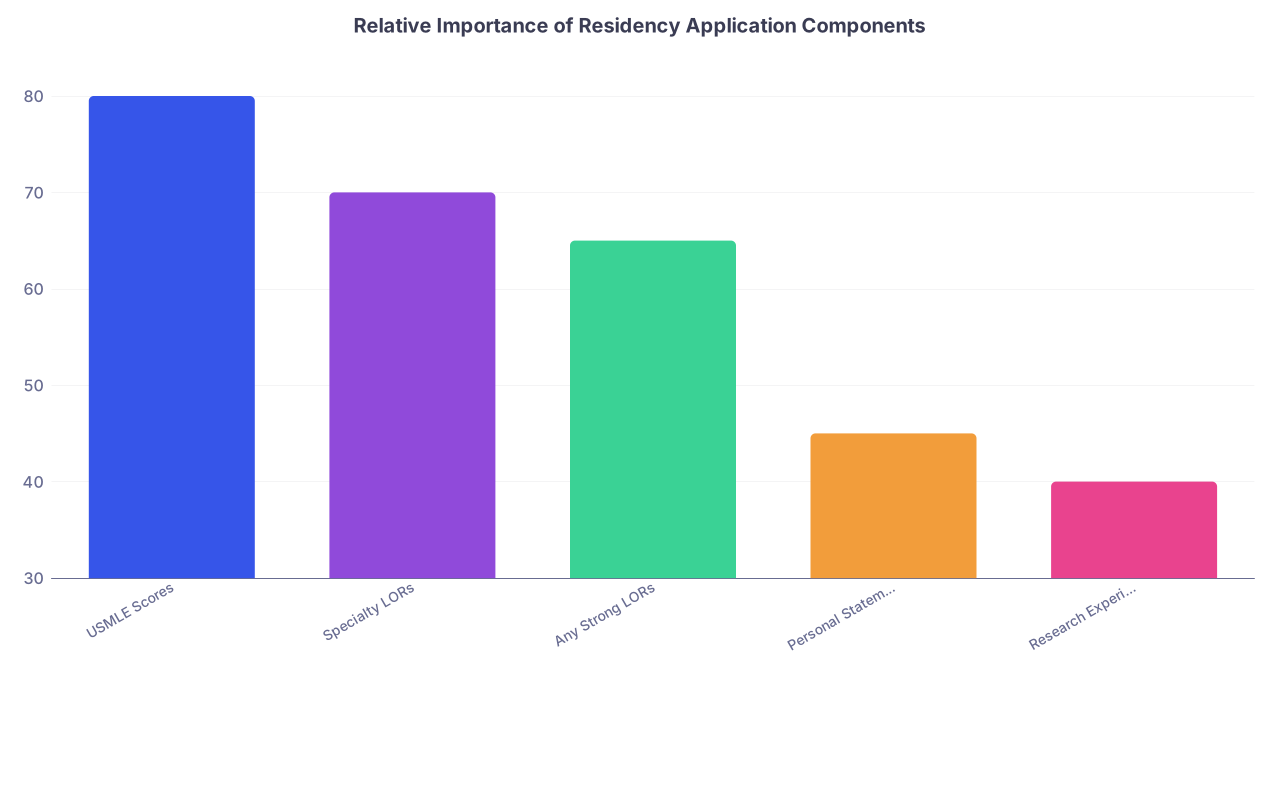
The NRMP publishes the “Program Director Survey” regularly. For most specialties, “Letters of recommendation in the specialty” rank high in importance for deciding whom to interview. That is true.
But read that phrase carefully. It doesn’t say “ONLY letters in the specialty,” and it certainly doesn’t say “letters from other specialties are harmful.”
For example (numbers vary a bit by year, but pattern is stable):
| Category | Value |
|---|---|
| USMLE Scores | 80 |
| Specialty LORs | 70 |
| Any Strong LORs | 65 |
| Personal Statement | 45 |
| Research Experiences | 40 |
Those percentages are “percent of programs rating as an important factor.” Notice:
- Specialty LORs are important.
- Strong LORs (regardless of specialty) are also heavily valued.
- Nowhere is there a metric called “punished for non-specialty LOR.”
When I’ve asked PDs directly (IM, EM, peds, surgery), the answers are consistent:
- They like at least one or two specialty letters, especially from people they know or from recognizable institutions.
- They absolutely do not penalize you for including a strong letter from a different specialty—particularly if the writer clearly knows you well.
- What they hate: generic, short, or faint-praise letters that say nothing specific.
So if you’re worrying that a glowing letter from a different specialty is a liability, you’re fighting the wrong battle.
When a Different-Specialty LOR Helps You
Let’s flip the script. A lot of cross-specialty letters are actually assets.
1. When the writer knows you extremely well
This is the big one.
I watched a PD in Internal Medicine scan a file and pause hard on a letter from a Trauma Surgeon. Why? Because the letter said:
“I routinely staff 4–6 students per month in a high-acuity trauma service. In five years, this student is one of the three I would unhesitatingly hire. She anticipates needs, handles pressure, and is trusted by the entire team.”
The PD’s exact words: “I don’t care that he’s a surgeon. This is a real letter.”
If your strongest evaluator is from a different specialty—an ICU attending, a trauma surgeon, a psychiatrist who saw you manage challenging patients—use that. Programs can tell when someone is speaking from actual experience versus filling out a template.
2. When the specialty is adjacent or logical
Some pairings make inherent sense:
- IM applicant with a strong cardiology or ICU letter
- EM applicant with a trauma surgery or ICU letter
- Anesthesia applicant with a surgical or ICU letter
- Neurology applicant with a medicine or neurosurgery letter
These don’t raise eyebrows. If anything, they reinforce clinical skills in settings that overlap with your target specialty.
3. When the writer is known or highly respected
Programs are networks. A strong letter from a big-name attending in a different field can easily outweigh a mediocre same-specialty letter from an unknown attending.
I’ve seen applications where a PD literally said, “Oh, I know this surgeon. If he says this student is excellent, that’s enough for me.”
Prestige alone doesn’t save a bad letter. But a recognized, credible name vouching for you is currency, regardless of department label.
When a Different-Specialty LOR Is Neutral (Most of the Time)
So does a different-specialty LOR ever “hurt”? In most cases, no. It just doesn’t help as much as a strong specialty letter would—if that strong specialty letter actually exists.
To make this concrete, imagine three Internal Medicine applicants:
| Applicant | LOR Mix | Net Effect |
|---|---|---|
| A | 2 strong IM, 1 strong surgery | Positive/neutral |
| B | 1 strong IM, 2 strong ICU/cardiology | Neutral to positive |
| C | 0 strong IM, 3 mixed other specialties | Weak overall, but not because of “wrong specialty” |
Applicant C is not struggling because of “different specialties.” They’re struggling because there’s no one in the target field really standing behind them. That’s a signal issue, not a technicality.
Programs read your letters as a gestalt:
- Do clinicians in this field vouch for you at least somewhat?
- Do clinicians in demanding environments (any field) see you as reliable, teachable, safe?
If those boxes are checked, the precise specialty label of every single writer is far less important than message boards would have you believe.
When Different-Specialty Letters Actually Do Hurt
Here’s where the myth has a tiny grain of truth. Different-specialty letters can hurt you—but not because of the specialty. Because of what they imply.
There are three genuinely problematic scenarios.
1. Lack of any meaningful specialty support
If you’re applying to Orthopedics with:
- LOR 1: Family Medicine
- LOR 2: Psychiatry
- LOR 3: Pediatrics
Programs will wonder:
“Why doesn’t any orthopedic surgeon want to write for this person?”
They’re not upset at FM or psych per se. They’re reading the absence of ortho letters as evidence you didn’t impress anyone in ortho, or barely rotated there. That’s the real problem.
2. The letter explicitly questions your fit for the specialty
This is rarer but devastating. I’ve seen it.
A psych attending writing about a student applying to EM:
“He has a calm, methodical style and might be better suited for a more longitudinal specialty than the high-intensity pace of emergency medicine.”
You don’t recover from that easily. The damage isn’t “it’s psych.” It’s “they’re openly doubting your chosen field.”
If your non-specialty writer doesn’t fully buy into your specialty choice, do not use that letter.
3. The set of letters feels confused and unfocused
If your personal statement says you’ve always wanted OB/GYN, your CV is saturated with OB stuff, but your three letters are:
- One pediatrics
- One IM
- One surgery
Programs pick up on that dissonance. It makes you look “random” or last-minute. Not fatal, but not ideal, especially in competitive fields.
Again, it’s not the existence of non-OB/GYN letters; it’s the complete absence of any specialty-aligned support, plus a story that doesn’t quite hang together.
Competitive vs Less Competitive Fields: Does It Change?
Yes, slightly. But not the way people think.
For hyper-competitive specialties (derm, plastics, ortho, ENT, some ophthalmology), programs lean heavily on evidence that:
- You know what the field is like
- Real people in that field would work with you
In those cases, having at least one or two strong same-specialty letters is close to mandatory if you want serious consideration. But even in those fields, a powerhouse cross-specialty letter is still an asset, not a liability.
A derm applicant with:
- 2 strong derm letters
- 1 strong medicine or rheumatology letter
Is usually better off than someone with:
- 3 derm letters, but one is obviously generic fluff.
For less competitive or broader-match specialties (Internal Medicine, Pediatrics, FM, Psych, even many EM programs), the bar is a bit more flexible. They still like specialty letters, but they’re much more open to “this student shined on our ICU/surgery/OB service” as strong evidence of clinical ability.
How PDs Mentally Weigh a Mixed LOR Set
Here’s roughly how the mental calculus looks when a PD scans your letters. Not an algorithm, but close to the thought process:

| Step | Description |
|---|---|
| Step 1 | See LOR List |
| Step 2 | Skim for strength & specifics |
| Step 3 | Look for strong non-specialty support |
| Step 4 | Positive signal |
| Step 5 | Weak signal |
| Step 6 | Any in specialty? |
| Step 7 | Strong or generic? |
| Step 8 | Any standout letter? |
Notice the branching: once they see you have at least some specialty support, the key variable becomes strength and specificity. Non-specialty strong letters still feed into the “positive signal” bucket.
PDs are not sitting there with an Excel script rejecting anyone whose third letter isn’t labeled with the right department.
How To Use Different-Specialty Letters Strategically
Here’s the part that applicants actually need: how to play this in real life.
1. Prioritize strength and specificity over perfect specialty alignment
If you have:
- A bland same-specialty letter (“completed the rotation, was punctual, read about patients”)
versus - A detailed, enthusiastic different-specialty letter describing your work ethic, team role, and clinical reasoning
You are almost always better off sending the second one.
Reddit will disagree. Program directors won’t.
2. Still aim for at least one solid letter in your chosen field
This is not me walking back everything I said. It’s just the reality of signaling.
At least one decent letter from your target specialty says, “I showed up, did the work, and somebody in this field thinks I’m fine to good.” That keeps you out of the “why does nobody in this field like you?” bucket.
But if that “decent” letter is lukewarm and your cross-specialty letter is glowing, mix them. Don’t sacrifice obvious strength just to hit a rigid, made-up quota.
3. Be honest about what your letters actually say
A lot of students overestimate the quality of their weakest letter, especially from big-name or “right specialty” attendings.
Any of these are warning signs:
- The attending barely knew you and wrote it “as a favor.”
- The letter came back in <24 hours after signing the form.
- They explicitly told you, “I can write you a standard letter.”
That “standard” letter is doing you no favors. If your best-written, most personal letter is from a different specialty, lean into it.
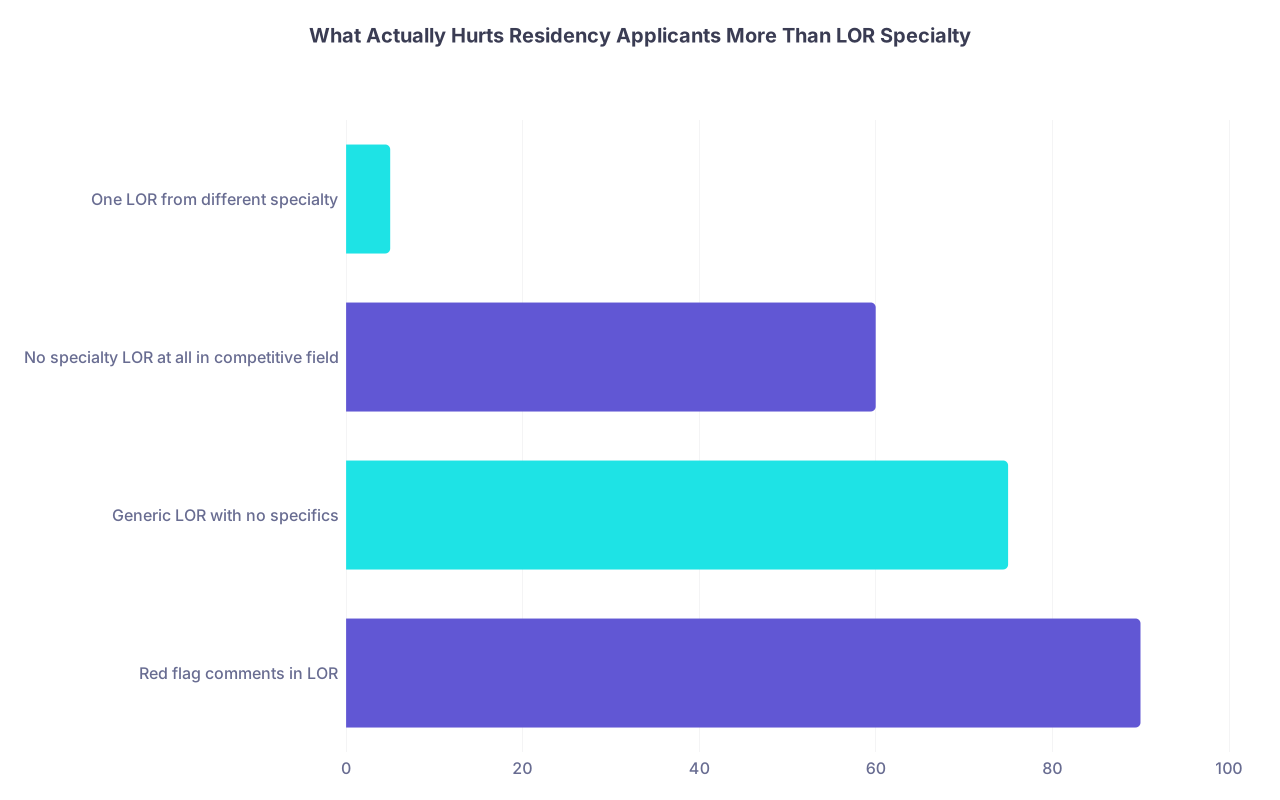
One More Thing You’re Overlooking: Red Flags vs Specialty
| Category | Value |
|---|---|
| Red flag comments in LOR | 90 |
| Generic LOR with no specifics | 75 |
| No specialty LOR at all in competitive field | 60 |
| One LOR from different specialty | 5 |
A single cross-specialty letter is far, far less damaging (if at all) than:
- A hint of unprofessionalism
- A suggestion that you struggle with feedback
- A vague “performed at the expected level” from someone who should be excited about you
If PDs are going to kill your app over a letter, it won’t be due to the department name at the top of the stationery. It will be due to what’s between the lines.
The Bottom Line: Does a Different-Specialty LOR Really Hurt?
No—a strong letter from a different specialty does not hurt your chances. The idea that it does is one of the more persistent, anxiety-fueled myths in residency applications.
If you want the distilled version:
- Programs care more about strength, specificity, and credibility of letters than whether every single one is from the “correct” specialty.
- Different-specialty LORs help when they’re strong, from demanding settings, or from respected faculty. They hurt only indirectly when they highlight the absence of any decent specialty support or when they question your fit.
- For most applicants, the right move is a mixed set: at least one reasonably good specialty letter, plus your strongest letters overall—even if those are from other fields.


