

The obsession with “big name” letters of recommendation is overrated—and often counterproductive.
Program directors are not idiots. They can tell the difference between a prestige signature and an actually useful letter in about ten seconds. And they’re surprisingly blunt about which one they value more.
Let’s cut through the folklore and look at what really moves the needle.
What Program Directors Actually Read (And How)
Most applicants imagine the same fantasy: some famous department chair signs your letter, the program director sees the name, and suddenly your application levitates into the “must interview” pile.
Reality is less magical and more… administrative.
Here’s what really happens in most programs:
- A coordinator or faculty reviewer opens your application in ERAS.
- They skim your scores, transcript, MSPE, personal statement—fast.
- They click into your LORs.
- They glance at:
- Writer’s name and title
- Institution
- A few key sentences and the overall tone
If you think they’re reading every letter line-by-line for all 800+ applications, you haven’t watched how this works in real life. I have. Most PDs are doing triage, not literary criticism.
And what stands out in that triage is not “Professor of Medicine, Harvard Medical School” at the bottom. It’s whether the letter can convincingly answer three questions:
- Do you perform at or above the level of their current residents?
- Can you be trusted with real responsibility without drama or babysitting?
- Would this writer personally want you on their own team?
Famous name helps only if it makes those three answers more believable. In practice, it usually does not.
What the Data Actually Shows (Not Reddit Lore)
Let’s bring in something other than anecdotes and “my senior told me.”
Surveys of program directors (NRMP Program Director Survey, multiple years) consistently show a pattern:
- “Letters of recommendation in specialty” are rated important to very important for offering interviews.
- But when PDs are asked what within letters matters, the themes are consistent:
- Depth of knowledge of the applicant
- Specific clinical performance
- Comparative statements (“top X%”)
- Clear, unambiguous enthusiasm
What you do not see is:
“Signed by national name I recognize” as an explicit or high-ranking factor.
That does not mean names never matter—human beings are biased, and some PDs will notice a celebrity signature. But across large numbers of programs, what moves the needle is signal content, not letterhead aesthetics.
To make this concrete:
| Factor | Typical Impact on PDs |
|---|---|
| Specific, detailed performance | High |
| Clear ranking vs. peers | High |
| Writer clearly knows you well | High |
| Specialty-specific writer | Moderate to High |
| Institutional prestige | Low to Moderate |
| Famous individual name | Low (unless also knows you well) |
The “knows you well” piece is not feel-good fluff. It’s literally what lets a letter contain the specific, comparative language that PDs actually use to separate “fine” from “we want this person.”
Why “Big Name” Letters Often Backfire
Let me be blunt: a vague letter from a big name can hurt you more than a sharp, specific letter from a mid-career nobody.
I’ve watched selection meetings where someone says, “This is from [well-known name] but… it’s basically a template. Not helpful.” And that applicant gets zero extra credit.
Typical problems with prestige-chasing letters:
1. They’re generic and obviously boilerplate
If you barely worked with the person, they often default to safe, content-free language:
“I had the opportunity to briefly interact with Ms. X during her sub-internship. She was punctual, courteous, and eager to learn.”
Translation for PDs: No idea who this is. Probably fine. Nothing special. Move on.
Compare that with a non-famous associate program director who clearly knows you:
“On our busy pulmonary consult service, Mr. Y consistently functioned at or above the level of an intern. He independently managed complex patients with septic shock and ARDS, presented concise and accurate assessments, and his notes were used as the attending’s note on multiple occasions. Among the ~80 students I’ve worked with in the last 5 years, he’s in the top 5% for clinical reasoning and professionalism.”
One of these letters actually tells the PD something. It’s not the one with the campus-named professorship.
2. They often avoid strong comparative language
Big names sometimes play it safe. Reputation risk. They don’t want to be on record calling you “the best” if they barely know you.
So you end up with:
“She will be an excellent addition to any residency program.”
Sounds nice. Also completely useless because they say that about everyone.
Strong letters have comparators and risk:
“I would rank her in the top 10% of all students I have supervised in the last decade. I would be thrilled to have her as a resident in our own program.”
That’s commitment. PDs notice when someone actually sticks their neck out.
3. The content reveals the writer barely knows you
PDs have seen enough letters to smell this from a mile away. Telltale signs:
- Entire letter is generic “hard working, team player, communicates well” with zero stories.
- No reference to specific patients, rotations, or situations.
- They clearly mix you up with “the student” as an abstract entity: “the student was able to…”
If a big name writes like this, the net effect is: “This person didn’t know the applicant, the applicant chased prestige, and we still have no idea if they can function as a resident.”
What “Knows You Well” Really Buys You
People romanticize “letter from someone who knows you well” as if it’s touchy-feely. It’s the opposite. It’s about data quality.
A writer who actually supervised you closely can supply the four ingredients that PDs crave.
1. Concrete, credible stories
Not “she’s compassionate.” Every letter says that.
From someone who actually watched you work:
“On one overnight call, he stayed late to help a Spanish-speaking family understand a new cancer diagnosis, using the interpreter and drawing diagrams. The family specifically asked if he could continue following their case because they felt he was the first person who explained things clearly.”
That kind of specific vignette does two things:
It’s memorable, and it’s hard to fake.
2. Clear level-of-training benchmarking
Residency is all about: “Can this person function at the next level?”
A writer who’s observed you across multiple days or weeks can say:
- “Performed at the level of a strong intern by the end of the rotation.”
- “Required minimal supervision for pre-rounding and initial assessment.”
- “Handled cross-cover level pages under supervision.”
That is the currency of residency letters. Not, “They will be a wonderful physician someday.”
3. Real comparative data
The best letters explicitly rank you. PDs read this language in shorthand.
Common phrases and how they actually land:
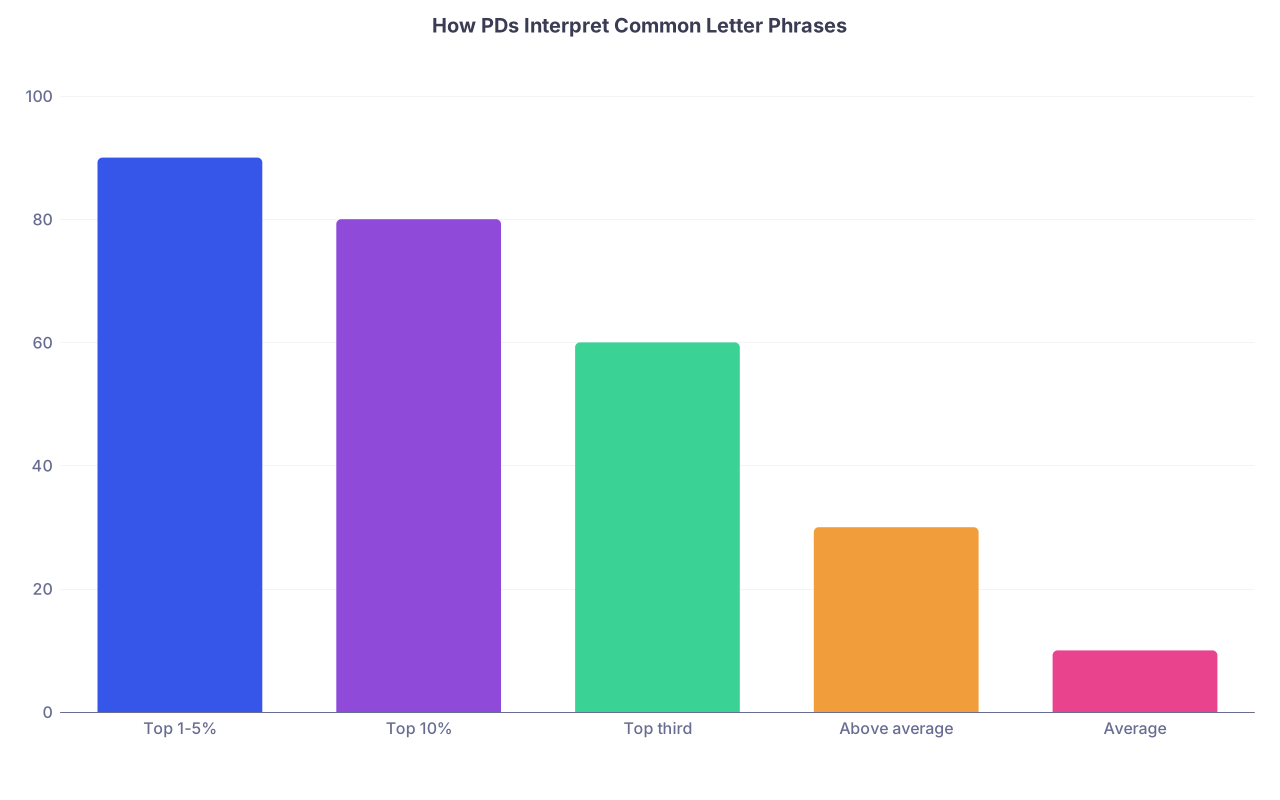
| Category | Value |
|---|---|
| Top 1-5% | 90 |
| Top 10% | 80 |
| Top third | 60 |
| Above average | 30 |
| Average | 10 |
Roughly speaking, this is how “helpful” those phrases are perceived (scale 0–100). “Average” is basically neutral to negative in competitive specialties. “Above average” is lukewarm. “Top 10%” and better starts to matter—if the writer seems credible.
And credibility comes from actually knowing you.
4. Unambiguous enthusiasm
You cannot fake tone. PDs are sensitive to hedged language.
Compare:
“I am pleased to recommend…”
vs.
“I strongly and enthusiastically support…”
And:
“I am confident she will succeed…”
vs.
“I give her my highest recommendation without reservation and would be delighted to have her as a resident in our own program.”
Writers who have actually worked with you are more willing to write that last kind of sentence. Big-name strangers rarely are.
When Name and Knowing You Well Align (The Sweet Spot)
Now, let’s be fair: prestige itself is not useless. A strong, detailed letter from a big name at a respected institution is absolutely better than the same letter from someone nobody has heard of.
The problem isn’t “big name.” The problem is “big name who barely knows you.”
There are a few situations where name recognition meaningfully helps:
- You did a sub-I at a highly regarded academic center in your specialty, worked daily with the PD or APD, and they clearly knew you well.
- You did substantive research with a national leader, met regularly, and they can speak to your work ethic, independence, and problem-solving.
- Your home program PD—well known in the field—writes a personalized, specific letter explicitly endorsing you.
Here, name boosts the credibility of already strong content. It doesn’t replace it.
Think of the name as a multiplier, not a substitute.
0 × famous = 0.
Strong letter × famous = even better.
What PDs Actually Complain About in Letters
You learn a lot listening to PDs vent at conferences and rank meetings. Patterns pop up.
Common complaints:
- “Another letter from [big name] that could have been written about 200 people.”
- “No comparative language. I have no idea if this person is in their top 10% or just not terrible.”
- “This says nothing about how they handle stress or responsibility.”
- “All personality, no performance.”
What they praise:
- “This letter is detailed; this writer clearly worked with them.”
- “If [APD at X program] says they’d take them in their own program, that means something.”
- “This PD is conservative with praise; ‘top 10% in my career’ from them is a huge statement.”
Notice what is missing in both lists:
No one ever says, “We interviewed them because that guy has a famous textbook.”
How You Should Actually Choose LOR Writers
Strip away the myths. Here’s the real hierarchy of value when you’re picking writers.
Roughly in this order:
Knows you well + specialty-aligned + respected position at that program
Example: Your home program PD, APD, or key faculty in the specialty who supervised you closely on an inpatient service or sub-I.Knows you well + specialty-aligned + solid but not famous
Example: Associate professor who ran your ICU month and saw you work every day.Knows you well + different specialty but clinical, can speak to work ethic, reliability, professionalism
Example: Hospitalist who watched you handle cross-cover and acute situations.Somewhat knows you + big institutional name but vague exposure
Example: Rotation director who gave you a couple of mini-CEXs but barely rounded with you.Barely knows you + famous individual name
Example: Department chair or national figure who met you twice, signs a letter written by someone else that is 90% template.
Most students invert 2 and 5. That’s a mistake.
To make the point visually:
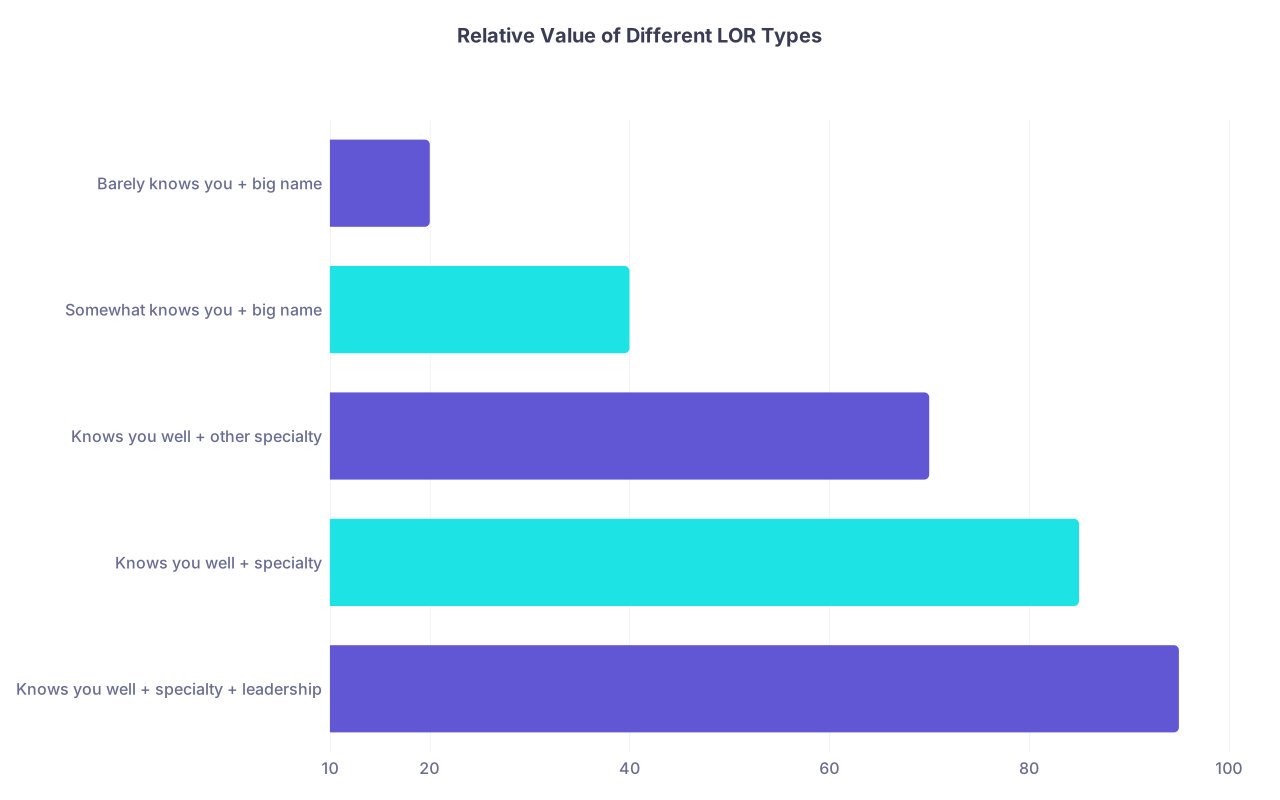
| Category | Value |
|---|---|
| Knows you well + specialty + leadership | 95 |
| Knows you well + specialty | 85 |
| Knows you well + other specialty | 70 |
| Somewhat knows you + big name | 40 |
| Barely knows you + big name | 20 |
Those numbers aren’t from a single study; they’re a realistic approximation of how PDs talk and behave.
The Only Time a Weak Letter is Better Than No Letter
One nuance: for some specialties and programs, they “expect” a certain type of letter—like a Chair’s letter or PD letter—because it’s traditional or explicitly requested.
In those cases:
- If your chair genuinely doesn’t know you, but your school has a standard process to generate a Chair’s letter from a committee or dossier, you usually still get it. PDs know how these are produced and mentally weight them appropriately.
- That letter doesn’t carry you. It just checks a box. Your other letters still do the heavy lifting.
So yes, sometimes you’ll need a semi-generic “required” letter from a big name. Fine. But treat it as compliance, not as your main weapon.
Your real strategy question is: who writes the other 2–3 letters that actually influence decisions?
The Bottom Line: Myths vs. Reality
Let’s end with the core truths, without the fluff.
- A specific, enthusiastic letter from someone who truly knows your work beats a vague, generic letter from a famous name. Every time.
- Big names only help when they also know you well and can provide detailed, comparative, high-risk praise. Name alone is weak currency.
- Program directors are reading for evidence, not prestige signals. Stories, benchmarks, and clear rankings move you. Titles and letterhead only amplify what’s already there.
If you’re choosing between “famous but distant” and “knows me inside out,” stop making it a hard decision. The data, and the people doing the actual selecting, are not nearly as confused as applicants are.


