

What actually happens when a program director opens your “template” letter of recommendation and recognizes the same phrases they’ve seen in five other applications this week?
Let me ruin a popular myth right away: the template LOR itself is not what kills you. It’s what it usually stands for—generic, lazy content that says nothing specific about you. Programs do not reject an otherwise strong applicant purely because an attending used a template. They do, however, ignore useless letters. And that’s the quiet way your application dies.
You’re being told two conflicting things:
- “You must get strong, personalized LORs.”
- “Most attendings are busy and want you to write your own letter or give them a template.”
Both are true. And yes, it’s absurd.
So let’s separate the panic from reality.
What Programs Actually Do With Your LORs
Before we talk templates, you need to understand how LORs are really used.
Program directors are not reading every word of every letter for 1,000+ applicants. That fantasy is pushed by people trying to sell you anxiety. In practice, letters are triage tools and tie-breakers.
Most PDs and selection committees use letters to answer a few specific questions:
- Is this person safe to work with? (Clinical judgment, professionalism, reliability.)
- Are they above-average, or just fine?
- Does someone I trust stake their reputation on this applicant?
- Is there anything concerning hiding between the lines?
They look for:
- Who wrote it (title, specialty, and sometimes institutional “weight”)
- How clearly the writer actually knows you
- Concrete examples of performance (not adjectives, examples)
- Strength of endorsement (the “I would rank this applicant in my top 5%” level language)
They do not have a checkbox that says: “Used template? Reject.”
What burns you is the combination of:
- generic writer + generic phrasing + no examples + obviously copy-pasted structure.
Not “template” as a concept.
What the Data and Surveys Actually Show
We don’t have randomized controlled trials of “template letter vs non-template letter,” so if you’re expecting that level of evidence, you’re in the wrong game. What we do have is:
- NRMP Program Director Surveys
- Specialty-specific LOR guidelines and studies
- Direct reports from PDs, APDs, and faculty who sit on selection committees
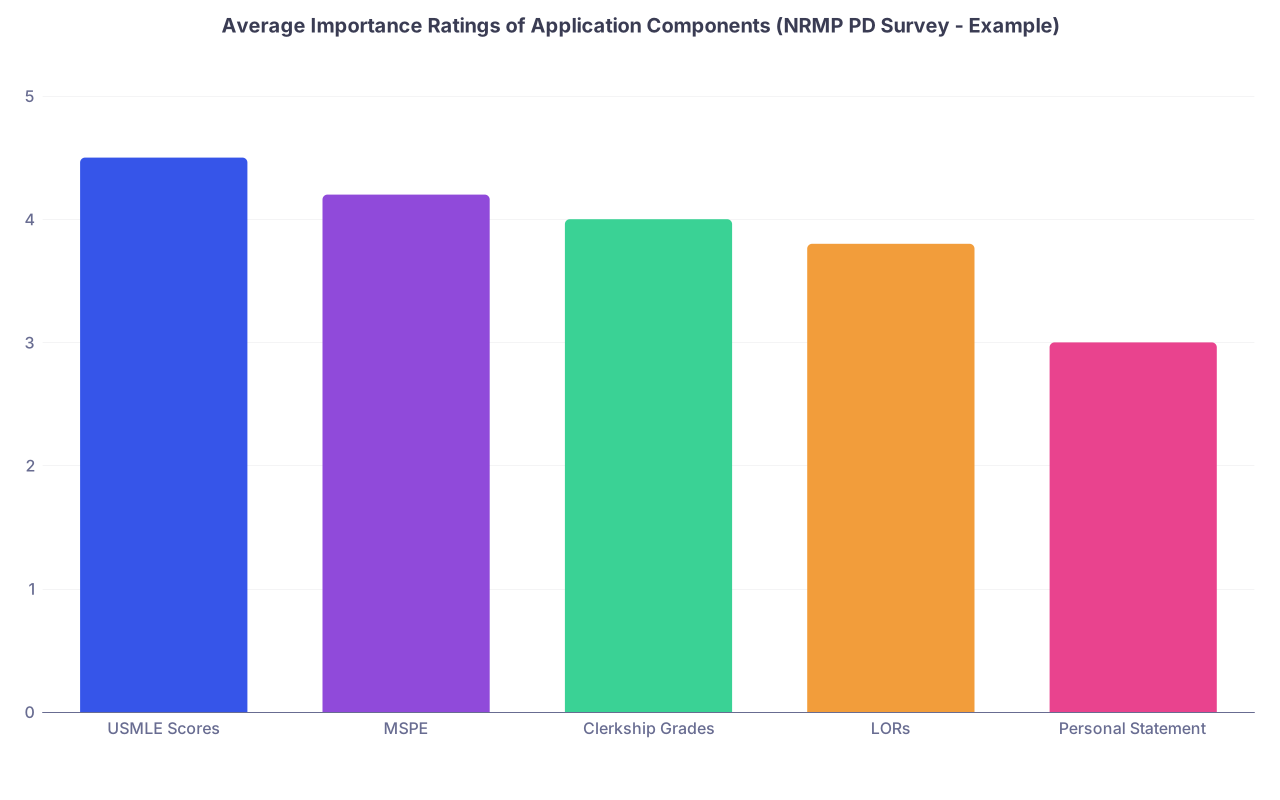
Across multiple NRMP PD Surveys, LORs consistently rank as important, but not #1. Things like USMLE scores (where still used), clerkship grades, and class rank often edge out individual letters.
| Category | Value |
|---|---|
| USMLE Scores | 4.5 |
| MSPE | 4.2 |
| Clerkship Grades | 4 |
| LORs | 3.8 |
| Personal Statement | 3 |
That 3.8-ish average rating for LORs masks a key nuance:
- A truly strong letter can pull you up when you’re borderline.
- A truly bad or clearly negative letter can sink you.
- A generic letter usually does nothing. It’s background noise.
Some specialties have tried to standardize this (EM is the poster child: SLOEs – Standardized Letters of Evaluation). Why? Because free-form letters are all over the place and packed with fluff and bias.
Literally none of these initiatives are aimed at eliminating “templates.” They’re aimed at increasing signal and reducing noise.
So the real issue is signal vs noise, not template vs original prose.
The Real Problem With Template LORs (And It’s Not What You Think)
The obsession with “template = red flag” misses the point. Programs don’t care if your letter uses a standard structure. In fact, a lot of excellent letters do:
- Short intro: who I am, how I know the applicant
- Clinical performance: specific examples
- Comparative statement: top X% or “one of the best / above average”
- Endorsement: “I strongly recommend…”
That’s a template. Everyone uses it. Nobody cares.
Where template LORs go to die is when:
- The attending barely knows you and relies entirely on your draft/template.
- The language is obviously generic: “hard-working, team-player, pleasant to work with” with zero proof.
- The same exact sentences appear across multiple students’ letters from the same service/rotation.
I’ve seen PDs shrug off templated structure. I’ve also seen them roll their eyes at cookie-cutter content that makes it obvious the writer didn’t bother.
The pattern that actually hurts you:
- Writer: “Great job, just send me something and I’ll sign it.”
- Student: panics, Googles “sample LOR,” Frankensteins a fake-sounding masterpiece full of clichés.
- Letter: sounds like 12 others that year, contains no real stories, and often exposes the student’s own writing through awkward phrasing.
Programs aren’t tracking templates. They’re reacting to vagueness and low-information content.
When a Template is Completely Harmless (Even Useful)
Let’s be blunt: many attendings are bad writers, overworked, or both. A subtle, well-crafted narrative letter is not appearing out of thin air for every MS4 on a busy inpatient team.
There are cases where a template is essentially neutral or even helpful.
Harmless / helpful scenarios:
Structured prompts from a department
Some departments or schools give faculty a structured guide:- How do you know this student?
- What are their clinical strengths?
- Compare them to peers.
- Would you rank them highly?
That’s a “template.” It boosts signal. PDs like this.
Faculty who use their personal standard letter skeleton
Many attendings have a “house style”:- Paragraph 1: relationship and context
- Paragraph 2–3: strengths with examples
- Paragraph 4: comparative statement and endorsement
They reuse this for everyone and swap in details. This is not a red flag. This is called efficiency. Programs know this happens.
Student-provided bullet points and CV instead of a full draft
You give them:- CV
- Personal statement
- 5–7 bullet points of things you did with them, cases, qualities, and moments they might remember
They plug that into their own template. Final product: structured, specific, and useful. Zero downside.
The risk skyrockets when you author the actual letter text and the attending rubber-stamps it without meaningful revision.
That is where committees start thinking: “Does this attending even know this student?” or worse: “Who is really vouching for this person?”
Where Template LORs Become A Real Problem
Let me draw a clearer line.
Not a problem:
- “My internal medicine attending has a standard format but wrote specific examples about me.”
- “My surgery PD uses the same paragraph structure for everyone but clearly compares me to peers.”
- “My EM SLOE uses a standard form with checkboxes and a narrative following the usual pattern.”
Potentially serious problem:
- “The attending barely interacted with me but agreed to sign whatever I write.”
- “I copy-pasted a letter from Reddit or a ‘premium LOR pack’ PDF and just swapped names.”
- “Three of my letters all sound like variations of the same generic buzzwords with no concrete stories.”
One more trap:
If a letter sounds like your personal statement—same phrasing, same metaphors, same story about your grandma’s illness—PDs notice. They don’t need forensic software. Human pattern recognition is enough.
At best, they mentally downgrade the letter: “Okay, student clearly wrote this.”
At worst, they question your integrity and the faculty’s judgment.
Is it an automatic rejection? No. But it erodes trust. And trust is the entire point of a recommendation.
What PDs and Faculty Actually Complain About
You want real-world feedback? Here’s what you hear if you sit in enough committee rooms or PD dinners:
- “Another letter that could be about any student.”
- “This one says they’re ‘one of the best’ but never says why. Useless.”
- “Three different letters from this school all use the exact same phrases.”
- “If you say ‘hard-working and punctual’ and that’s it, I assume they’re average at best.”
Notice what they don’t say:
“I’m outraged this letter used a template format.”
They’re not purity testing prose. They’re trying to get any real signal out of a stack of PDFs.
What spooks them:
- Obvious grade inflation language with no proof.
- Letters that dodge comparative statements (“I recommend without reservation” is weak compared to “top 10% of students I’ve taught”).
- Overly formal, strangely written letters that feel student-generated.
How To Use Templates Without Torching Your Credibility
You’re not going to magically transform attendings into Pulitzer-caliber writers. So you work with reality.
Here’s how to navigate this without getting burned.
1. Stop sending full letter drafts. Send ammo instead.
When an attending says, “Send me something to help,” that does not mean “ghostwrite my letter.”
Send:
- Your CV
- Your personal statement
- A 1-page “LOR support doc” with:
- How long you worked with them and in what setting
- 3–5 specific patients/cases you were involved in that show your skills
- 3 qualities you hope they can comment on (with examples)
- Any comparative feedback they already gave you (e.g., “you’re functioning at intern level”)
They can drop this into their template and produce something real. That’s the sweet spot.
2. If you must draft, write like a faculty member, not a desperate applicant
I don’t recommend fully drafting your own letter. But if an attending insists and you’re stuck, avoid the usual rookie mistakes:
- Drop the over-the-top language (“one of the most exceptional humans I have ever encountered”).
- Use specific, boringly factual clinical examples. Committees trust those more.
- Include a clear, simple comparative line: “In my 8 years working with students, I would place [Name] in the top third.” Only if the attending actually agrees and will edit if needed.
- Use the attending’s perspective, not yours. That means no personal statement storytelling, no “why they chose medicine.”
Then tell the attending: “Please edit this heavily and adjust or remove anything that doesn’t reflect your view.” Many will.
Is this ideal? No. But it reduces the “this sounds like the student wrote it last night” problem.
3. Prioritize letter writers, not letter templates
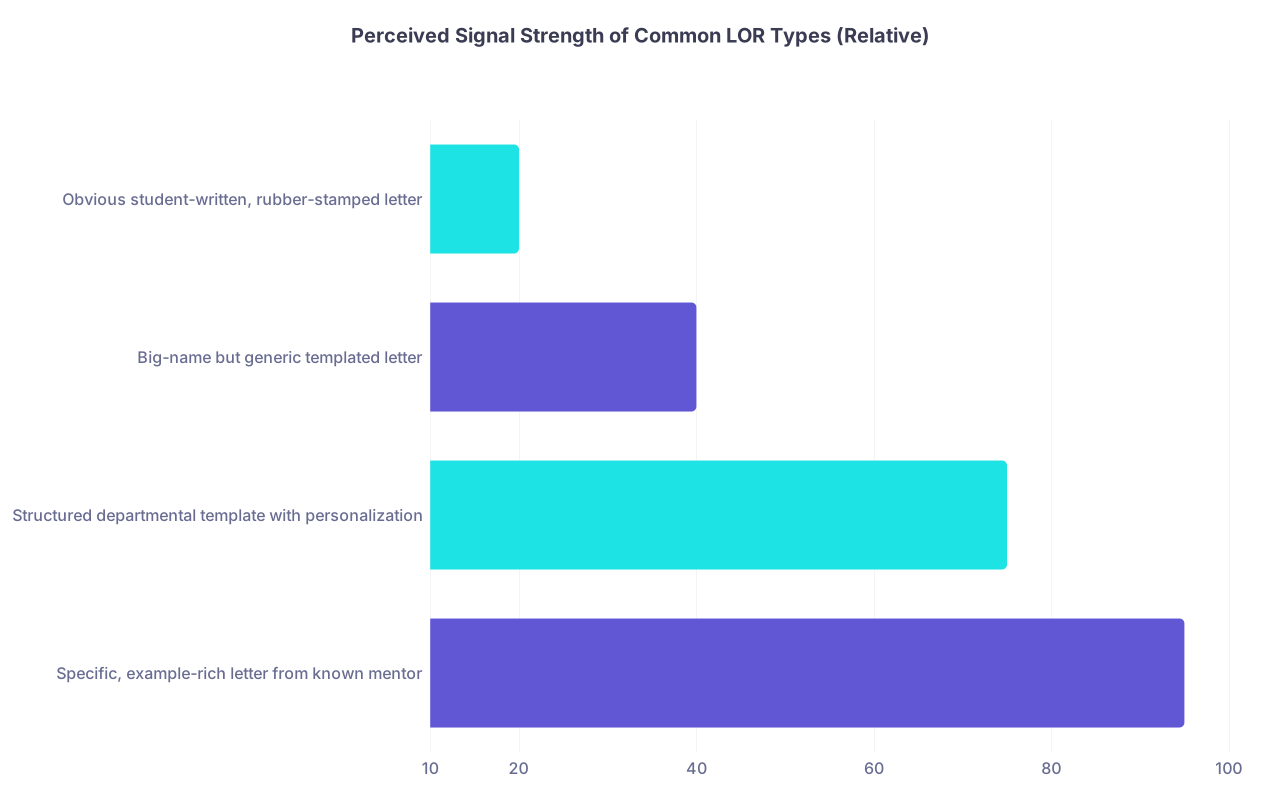
A mediocre letter from someone who actually supervised you closely is often more valuable than a glorified template from a big-name attending who barely remembers you.
Strong letters usually come from:
- Sub-I / acting internship attendings
- Longitudinal clinic preceptors
- Research mentors you’ve worked with for months or years
- Program leadership who actually saw you work (not just met twice)
The writer’s ability to be specific matters more than their ability to be literary.
When You Should Actually Worry
There are a few scenarios where your antennae should go up:
- A letter is clearly generic, and you know the attending barely knows you, yet you’re counting it as a “key” letter for your chosen specialty.
- Two or more letters come from the same service and you suspect the department uses the same lazy template with minimal personalization.
- You wrote full drafts for multiple letters and none of the attendings pushed back or edited much.
In that situation, no, you’re probably not getting “red-flagged.” But you are forfeiting one of the few parts of the application that can make you stand out beyond your numbers.
If your stats are borderline for your target specialty or programs, that’s a serious missed opportunity.
Quick Reality Check vs Myth
| Claim | Reality |
|---|---|
| Template letters are automatic red flags | No. Generic, low-signal content is the real problem |
| PDs hate any form of standardized letter | Many prefer structure if it increases signal |
| You must write your own LOR to make it good | Dangerous myth; better to provide bullets and context |
| Big-name writer + template = great letter | Weak if they barely know you and stay generic |
| Category | Value |
|---|---|
| Specific, example-rich letter from known mentor | 95 |
| Structured departmental template with personalization | 75 |
| Big-name but generic templated letter | 40 |
| Obvious student-written, rubber-stamped letter | 20 |
The Bottom Line
Template LORs are not the villain you’ve been sold. Committees don’t care about structure; they care about signal.
Three points to walk away with:
- Templates are fine when they’re frameworks for real, specific content from someone who actually knows you.
- What hurts you isn’t the template—it’s generic, vague, obviously copy-pasted letters that say nothing new.
- Your job is not to write your own glowing fiction; it’s to choose the right writers and arm them with enough detail to write something real.


