

Program directors are not reading every word of every letter. They are skimming for signals. If you build your application around the fantasy that they’re savoring each sentence, you’re already behind.
Let me be blunt: the worship of letters of recommendation in residency applications is half reality, half religion. Letters matter. But not in the way most applicants think. You are sweating over paragraphs PDs will never read, chasing “perfect” letters that get scanned for 20 seconds, then buried under 2,000 other PDFs.
Let’s dismantle the myth and walk through what actually happens on the other side of ERAS.
What PDs Actually Do With Your Letters
Residency applications are a volume problem, not a literature seminar.
Most competitive programs are getting hundreds to thousands of applications for a few dozen spots. Those applications have transcripts, MSPEs, Step scores, personal statements, supplemental questions, and—yes—letters. Now imagine going through all of that, for all of them, while also running a clinical service and dealing with interns who cannot remember how to order a CT with contrast.
Here’s what real surveys and anecdotal data show:
NRMP Program Director Surveys repeatedly rank letters as “important,” but that’s deceptive. “Important” doesn’t mean “carefully read line-by-line for every applicant.” It means: when they do look, letters can sway decisions at critical points—borderline cases, rank list debates, committee disagreements.
In practice, for the majority of applicants, PDs and selection committees are:
- Screening first on objective filters (Step scores, class rank, medical school, failures, red flags).
- Glancing at letters for quick signals, not detailed prose.
What do they actually look for in a letter?
Consistently, it’s a short list:
- Who wrote it (title, specialty, reputation, how well they know you).
- How strongly they recommend you (strength and clarity of endorsement).
- Specific red or yellow flags.
- A few concrete, memorable positives that confirm what they already think.
Everything else? Background noise.
I’ve watched PDs scroll a three-page letter and literally pause only for phrases like:
- “Top 5% of students I have worked with in 20 years”
- “I cannot recommend this applicant”
- “Below the level of their peers in reliability”
- “Would absolutely recruit to our residency”
They’re skimming for signal words, not evaluating writing quality.
The Time Math That Kills the Myth
Let’s run numbers because numbers kill delusions.
Say a program gets 1,000 applications for 10 spots. Each application has 3–4 letters.
That’s 3,000–4,000 letters.
If a PD or committee member spent just 3 minutes per letter, that’s 9,000–12,000 minutes.
150–200 hours. Only for letters. On top of everything else.
That’s fantasy.
What happens instead is triage.
Early in the season:
- Applications get screened quickly.
- Many letters get zero attention beyond:
- “Okay, 3 letters, all in specialty, official-looking, nothing obviously weird.”
Middle phase (interview invites):
- For stronger or borderline candidates, they may:
- Look at who wrote the letters.
- Scan for strength statements.
- Check for consistency with other parts of the app.
Late phase (ranking):
- For final decisions, letters for top candidates and “question mark” candidates get more careful reading—but that’s still more like one thoughtful skim, not a forensic analysis of every clause.
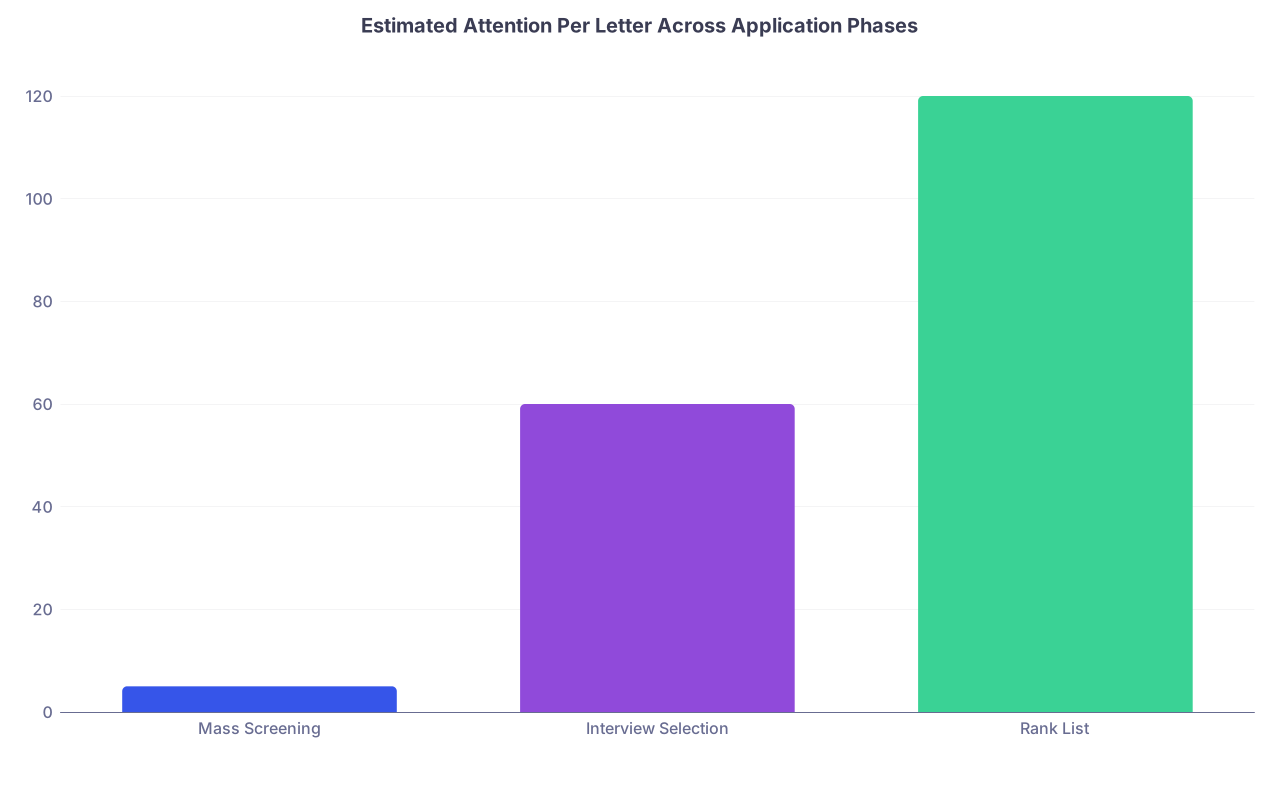
| Category | Value |
|---|---|
| Mass Screening | 5 |
| Interview Selection | 60 |
| Rank List | 120 |
That chart isn’t from a randomized trial. It’s reality-based approximation from talking to PDs and faculty who actually sit in those rooms. And they all say some version of the same thing: “We don’t have time to read every word. We look for what matters.”
What PDs Actually Care About in Letters
If PDs aren’t carefully reading every sentence, what are they doing?
They’re pattern-matching.
They already have your scores, MSPE, transcript, school name, and often your personal statement. The letter is there to either:
- Confirm the narrative: “Yes, this person really is what they look like on paper.”
- Change the narrative: “Their Step score is mediocre, but wow, this letter is incredible.”
- Kill the narrative: “On paper they look great, but these letters are lukewarm or concerning.”
The core letter signals PDs scan for:
Author identity and credibility
Title. Specialty. Relationship.A short, specific line like “I supervised her directly for 8 weeks on the inpatient cardiology service” carries more weight than a half-page of generic compliments from someone who barely knows you.
Strength of recommendation
PDs are reading strength language like a code. And yes, there’s a code. Roughly:- “I give my highest recommendation…” → Strong
- “I recommend without reservation…” → Strong
- “I recommend [Name] for your program.” → Neutral to lukewarm
- “I believe [Name] will be a competent resident.” → Weak
- Any hedging, “with appropriate supervision,” “might do well in the right environment” → Red flag
They notice this in seconds.
Comparative statements
PDs love rank-order language because it’s fast signal:
“Top 10% of students I’ve worked with”
“Truly among the top 3 students this year”
Even better when it’s anchored: “In my 15 years on faculty…”Without comparison, “hardworking and smart” lands as white noise.
Specific, memorable behaviors
Short, concrete examples get attention:- Stayed late to help cross-cover when another intern was overwhelmed.
- Took initiative to call a family before rounds to update them.
- Interpreted complex imaging independently and changed management appropriately.
It’s not about storytelling elegance. It’s about credibility through detail.
Red or yellow flags
PDs are hypersensitive to negative wording. One strained phrase can outweigh 10 bland compliments:- “Can become flustered under pressure.”
- “Required more supervision than typical.”
- “Some concerns regarding professionalism that improved over time.”
Anything that hints at reliability, professionalism, integrity, or behavior issues jumps off the page.

Why the “Every Word Matters” Myth Persists
You’d think by now people would accept that PDs are drowning in volume. Yet many med students still treat letters like sacred texts. Why?
A few reasons.
First, faculty and advisors are often stuck repeating outdated wisdom they heard from their own mentors: “Make sure your letters are perfect, they read EVERYTHING.” It’s easier to repeat that than to admit: “Honestly, half the time they don’t.”
Second, letters are one of the few parts of the application you cannot see or control directly. That uncertainty breeds superstition. If you can’t verify what’s inside, you’ll assume it’s either your ticket to glory or your silent killer.
Third, ERAS gives letters the illusion of equal weight. Every letter is uploaded, labeled, organized. It looks official and important. The interface doesn’t show you the reality: 90% of these will be skimmed for less than a minute.
And finally, there’s a convenient myth for faculty as well. Pretending they are crafting deeply-read, high-impact documents makes their late-night, templated letter-writing feel more meaningful. I’ve literally heard: “I spent so much time on that letter; I know the PD will read it carefully.” No, they’ll scroll for 30 seconds and extract two phrases.
The Parts of Letters That Are Wildly Overrated
Here’s where students waste energy.
Flowery prose and length
No one is awarding style points. A three-page epic full of generic superlatives is less useful than a tight, one-page letter with clear ranking language, concrete examples, and a strong conclusion.
Verbose letters can actually work against you. PDs’ eyes glaze over. They scroll faster. Important words are buried in fluff.
Over-polished “personality essays”
You do not need your letter writer to wax poetic about your childhood dreams, your “ever-present smile,” or how you “light up a room.” Those paragraphs tend to be skipped, especially when they sound identical across multiple letters and multiple applicants.
What matters is whether the writer believes you will show up, carry the pager, think clearly at 3 a.m., not implode under stress, and not make the program regret ranking you.
Template-driven platitudes
Most students don’t realize how much faculty reuse structures, and sometimes full sentences, across letters. PDs absolutely notice. They’ve seen:
- “He is a joy to work with.”
- “She will be an asset to your residency program.”
- “I have no doubt he will be a fine resident.”
Tired, generic lines do not hurt you directly. But they also do not help when you’re competing against letters that actually say something sharp and memorable.
Where Letters Actually Change Outcomes
So if most letters are skimmed, when do they really matter?
Three main points.
Borderline or “maybe” applicants for interviews
The committee is staring at someone with middling scores but a strong clinical narrative from the MSPE, maybe non-trad experience. They look at letters to see:- Is there a surprisingly strong endorsement?
- Do multiple writers independently paint the same positive picture?
A single powerful letter here can flip “no invite” to “okay, let’s meet them.”
Internal vs external applicants
For home students or rotators, PDs often know the letter writers personally. That changes the game. A short “I’d recruit them here in a second” from a trusted colleague is huge. Conversely, a cautious, bland letter from someone known to be enthusiastic is a quiet but real warning.Rank list disputes
In many programs, final ranking is a committee sport. Person A loves you. Person B is lukewarm. Someone pulls up your letters.Now, a line like “I would be delighted to have her as a resident in our own program” becomes ammunition. So does “I recommend him without hesitation but do note he sometimes requires direct prompting to complete tasks.”
I’ve seen candidates move up or down several rank slots because of one line in a letter that no one fully registered during interview season.

| Step | Description |
|---|---|
| Step 1 | Application Received |
| Step 2 | Reject |
| Step 3 | Quick Letter Scan |
| Step 4 | Interview Consideration |
| Step 5 | Interviewed |
| Step 6 | Letters Re-reviewed for Top & Borderline Candidates |
| Step 7 | Final Rank List |
| Step 8 | Score & Filter Pass? |
| Step 9 | Clear Red Flags? |
| Step 10 | Rank Meeting |
How You Should Actually Think About Letters
So what do you do with this knowledge? You stop trying to engineer a perfect 2,000-word literary masterpiece and optimize for signal density.
A few practical implications.
1. The writer matters more than the adjective count
A shorter, blunt, high-credibility letter from someone who truly knows your work is far more valuable than a long, gushy, generic letter from a big name who barely remembers you.
You want:
- Someone who supervised you closely.
- In your chosen specialty (for at least 2–3 letters).
- Who has a reputation, locally or nationally, for being straightforward and not a pushover.
2. Ask for the type of letter you need
You’re allowed to be explicit. You should be.
When you ask for a letter, frame it:
- “Would you be comfortable writing a strong letter of recommendation for my application to [specialty]?”
- If they hesitate, back out gracefully. A lukewarm letter is dead weight.
Then give them targeted material:
- A short bullet list of 3–5 specific things you did that demonstrate resident-like behavior.
- Your CV and personal statement, sure—but highlight what you hope they’ll comment on: work ethic, independence, team behavior, etc.
You are not dictating content, but you are nudging toward high-yield signal.
3. Accept that they will skim—and plan for skimmability
Since we know PDs scan, your letter is more powerful if it’s structured for that:
- Clear opening: relationship, setting, duration.
- Early strength statement: “I give my strongest recommendation…”
- One or two short concrete examples.
- Clear closing: “I would rank her at the very top of any list” or similar.
Many good letter writers already do this. They learned it the hard way, from being on the reading side.

The Ugly Truth About Bad or Mediocre Letters
You should also drop the comforting belief that “as long as it’s not obviously terrible, I’m fine.” Not true.
Because PDs skim, a weak letter stands out in a specific way: not by being overtly negative, but by being conspicuously bland compared to others in the stack.
Think about what happens when they review several applicants back-to-back:
- Applicant A: “Top 5%… would recruit in a heartbeat… never hesitated to take responsibility…”
- Applicant B: “Pleasant to work with… completed tasks assigned… will be a competent resident…”
- Applicant C: “Truly outstanding… among the best I have worked with this year…”
Applicant B just lost ground, and quickly. No one read every word. They didn’t need to.
And yes, truly negative letters still appear. Less often than legends suggest, but they exist. Sometimes in subtle language. Sometimes in an explicit “I cannot recommend.” Both are devastating. You may never even know why interviews dried up.
Letters Are Signals, Not Novels
Stop designing your application around the fantasy that PDs read your letters like a book club selection. They do not. They scan for who wrote it, how strongly they’re backing you, whether your story is consistent, and whether anyone is quietly warning them away.
Your job is not to micromanage every adjective in a document you’ll never see. Your job is to:
- Choose writers who truly know how you function in clinical settings.
- Ask clearly for strong letters and back that up with real performance.
- Make it easy for them to write concrete, specific, high-signal endorsements.
The rest—the syntax, the poetic closing, the third paragraph about how much you love the specialty—is largely for your own anxiety, not for program directors.
The Bottom Line
Three things to walk away with:
- Program directors are not reading every word of every letter. They are scanning for author, strength, consistency, and red flags under severe time pressure.
- The who and the signal phrases in your letters matter far more than length, prose, or emotional flourishes. Strong, concrete, comparative statements move the needle.
- Your best move is not obsessing over invisible paragraphs, but choosing the right letter writers, performing like a resident, and making it easy for them to write sharp, high-yield endorsements that survive the 30-second skim.


