

Myth: You Need 4 Clinical LORs for Every Specialty Application
You do not need four clinical letters of recommendation for every specialty application. That “rule” is residency folklore, not an evidence-based requirement.
The idea that you must stockpile a separate set of 3–4 specialty-specific clinical letters for every single field you apply to is one of the more damaging myths in the Match ecosystem. It pushes students to chase signatures instead of substance, schedule low-yield “LOR rotations,” and burn out attendings who then crank out generic letters that do nothing for you.
Let’s dismantle this properly.
What Programs Actually Ask For (Not What Students Repeat To Each Other)
First step: separate ERAS constraints, program requirements, and applicant anxiety. They are not the same thing.
On ERAS, you can assign:
- Up to 4 letters per program.
- From a shared pool of letters for all specialties you’re applying to.
Most categorical residencies in competitive but not insane fields (IM, FM, Peds, Psych, OB/Gyn, etc.) usually require or prefer 3 letters, sometimes plus a dean’s/MSPE letter (which doesn’t count toward the 4 on ERAS).
Here’s what programs actually post on their websites and FREIDA listings, across common specialties:
| Specialty | Usual # Required | Specialty-Specific Requirement? |
|---|---|---|
| Internal Med | 3 | 1–2 IM letters preferred |
| General Surgery | 3 | 2+ surgery letters preferred |
| Pediatrics | 3 | 1–2 peds letters preferred |
| Psychiatry | 3 | Often 1 psych letter preferred |
| Family Med | 3 | Primary care letter preferred |
| EM (via SLOEs) | 2–3 SLOEs | Strongly preferred / de facto |
Notice what’s missing: “You must have 4 clinical LORs in every specialty you apply into, or you’ll be auto-rejected.” Because that is not real.
Most programs:
- Require 3 letters.
- Explicitly say “we accept up to 4.”
- Prefer at least one letter from the specialty you’re applying into.
- Do not say “we will rank you lower if you only have 2 specialty-specific letters instead of 3–4.”
The “4 clinical letters per specialty” thing mostly comes from:
- Class Facebook groups.
- One super-anxious upperclassman who matched derm and now speaks like a prophet.
- Advisors repeating worst‑case advice so they’re never blamed if you don’t match.
You should care what actual programs say, not what the loudest M4 in your group chat insists.
Why This Myth Persists: Fear, Not Data
I’ve heard the same lines dozens of times:
“My mentor said I should get 4 IM letters just in case.”
“Our dean told us to have 4 per specialty to be safe.”
“Someone unmatched with only 2 specialty letters; that’s why I’m doing 5.”
This is how myths reproduce: one bad anecdote, repeated without context.
Here’s what the data actually suggests.
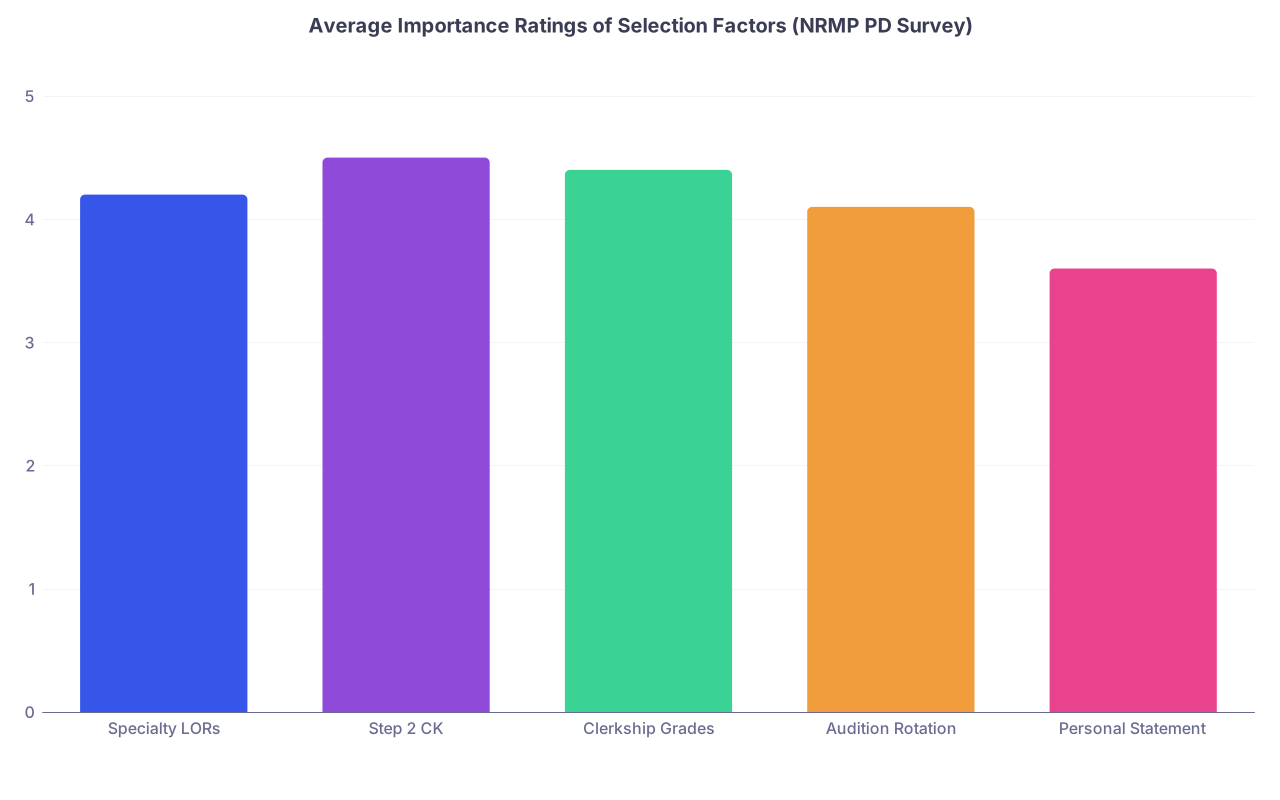
The NRMP Program Director Survey (you should read it; it’s not that long) consistently shows:
- “Letters of recommendation in the specialty” rank high in importance.
- But there’s no signal that 4 letters are substantially better than 3 if quality is similar.
- “Demonstrated commitment to specialty,” “USMLE Step 2 CK,” “Clerkship grades,” and “Audition rotations” often weigh as much or more than pushing from 3 to 4 generic letters.
| Category | Value |
|---|---|
| Specialty LORs | 4.2 |
| Step 2 CK | 4.5 |
| Clerkship Grades | 4.4 |
| Audition Rotation | 4.1 |
| Personal Statement | 3.6 |
Program directors care that:
- You have credible support from people who supervised you clinically.
- At least one or two of those people are in the field you’re applying to.
- The letters are strong, specific, and believable.
They do not care that you played LOR Pokémon and “caught all 4” for every specialty.
The Quality vs Quantity Problem (This Is Where People Mess Up)
I’ve read hundreds of letters sitting with academic chiefs and PDs. Here’s the reality:
The 4th letter is very often the weakest one.
The letter hierarchy usually looks like this:
- The attending who really knows you, with specific, vivid comments.
- The research PI or clerkship director who has watched you over months.
- A decent, competent letter from a subspecialist who liked you.
- The “filler” letter you chased at the last minute from a 2‑week elective.
Guess which one gets ignored or skimmed?
Program directors read fast. By the time they’re on page three of your file, they’re not digging for nuance in the fourth letter from “Gen Med Ward Team D, July Block.” Many PDs I’ve worked with will frankly admit they heavily weight the best two letters and scan the others for red flags.
The common ways the “4 clinical letters per specialty” mindset backfires:
- You choose a short elective with limited patient responsibility just to grab a letter.
- You ask someone who barely knows your name at the end of a crowded sub‑I.
- You get a generic, cookie‑cutter letter: “Pleasure to work with… punctual and professional… would do well in any residency program.” Death by faint praise.
Meanwhile, you might have:
- A killer letter from your research mentor in the same field.
- A superb letter from a medicine clerkship director or your sub‑I.
- A strong multi‑block inpatient attending from a different but related field.
But you downplay those or delay uploads because someone told you, “No, you need one more GI letter so you have four ‘IM’ letters.”
This is backwards.
A strong letter from someone who knows your work well beats a lukewarm letter from a random attending in the “right” specialty every time.
How Many Letters You Actually Need: By Scenario
Let’s get concrete. What do you actually need to be competitive, based on how many specialties you’re applying to?
Scenario 1: You’re Applying to One Specialty
Say you’re applying categorical Internal Medicine.
A robust, realistic letter setup:
- 2 strong IM clinical letters (ideally one from a sub‑I / acting internship or inpatient attending, one from a key IM experience).
- 1 letter from someone who knows you well: research mentor, another medicine faculty, maybe a subspecialist who worked with you seriously.
- Optional 4th: only if it’s clearly strong and adds new information.
What you do not need:
4 separate IM attendings all writing near-identical “solid student” letters.
Most IM programs will be very happy with 2 excellent IM letters + 1 very strong “other but related” letter. If you have a 4th strong one, fine. But if you are stretching for it? Stop.
Scenario 2: You’re Applying to Two Related Specialties (Common Case)
Example: IM and Neurology. Or FM and Psych. Or Peds and Med-Peds.
This is where the “4 per specialty” myth really punishes people. Because you only get one ERAS letter pool.
You do not build two totally separate ecosystems of letters. That’s not how ERAS works, and it’s a massive waste of time.
A rational configuration might be:
- 2 letters that work for both specialties (e.g., strong IM inpatient attending letters that show your general medicine skills, teamwork, clinical reasoning).
- 1 letter specifically from specialty A (e.g., neurology attending).
- 1 letter specifically from specialty B (e.g., FM or psych attending, depending on pairing).
Then you mix and match:
- IM programs: 1–2 IM letters + whichever of the others best supports your narrative.
- Neuro programs: at least 1 neuro letter + 1–2 good IM letters.
- FM/Psych: 1 primary care or psych letter + strong generalist letters.
You end up with 4–5 total letters that you strategically assign in different combinations. Not 8–10 unique letters siloed by specialty.
Here’s how that looks schematically:

| Step | Description |
|---|---|
| Step 1 | Core IM Letter #1 |
| Step 2 | IM Programs |
| Step 3 | Neurology Programs |
| Step 4 | Core IM Letter #2 |
| Step 5 | Neurology Letter |
| Step 6 | FM/Psych Letter |
That’s how most program directors assume you’re doing it if you dual apply. They know letters will overlap. They don’t expect you to conjure four neuro letters and four IM letters unless you’ve done half your clinical time in those fields.
Scenario 3: You’re Dual Applying to Very Different Fields
Example: EM and IM. Or Surgery and Radiology. Or Anesthesiology and IM.
Now you need to be more deliberate. But the same principle holds: reusability + quality.
Let’s pick EM and IM:
- You absolutely should have SLOEs (standardized EM letters) if you’re serious about EM. Those are non-negotiable for most EM programs.
- You should also have 1–2 strong IM-style clinical letters showing you’re solid on the wards.
You do not need 4 EM SLOEs + 4 IM letters. Programs know you’re dual applying. They see it every year.
A sane approach:
- 2 EM SLOEs (maybe 3 if you have them without sacrificing quality).
- 2 solid IM letters (one could be sub‑I, one from a key core rotation).
- Maybe 1 non‑clinical (research) letter only if it is truly standout.
Then:
- EM-only programs: 2–3 SLOEs, plus 0–1 excellent IM/general letters.
- IM-only programs: 2 IM letters, plus 1 SLOE if it actually shows strong inpatient performance (some SLOEs do).
Again, you are in the total pool of ~5 letters world, not the “I need 8 clinical letters because Reddit said so” world.
When a 4th Letter Helps vs When It’s Just Noise
There are cases where a 4th letter is useful. But they’re narrow and specific.
A 4th letter can help if:
- It covers a different domain (e.g., research productivity in the same specialty, leadership, or unique longitudinal clinic work).
- It’s from a nationally recognized name in the field who genuinely knows you and wrote a detailed letter.
- It fills a true gap (you had a rocky clerkship but then crushed a sub‑I and someone is explicitly addressing your growth).
A 4th letter is useless—or actively harmful—if:
- It’s vague, formulaic, or clearly a template.
- It contradicts the strength of your other letters by being lukewarm.
- It just repeats the same “hardworking, punctual, worked well with the team” language with no new content.
- You obtained it at the cost of doing fewer meaningful rotations or spreading yourself too thin.
Program directors are not counting: “3, hm. 4, good. 5, better.” They are comparing you to the dozens of other applicants on their desk that morning and asking:
“Who do I actually want on my team at 2 a.m. when the wheels come off?”
If your third and fourth letters don’t answer that better than your first and second, they’re not helping you.
How Programs Interpret Different LOR Patterns
Students over-interpret numbers and under-interpret content. Program leadership does the opposite.
Does a file with 2 specialty letters vs 3 automatically signal lower interest? Usually no. They start looking at:
- How strong are the letters? Any phrases like “top 5%,” “one of the best students I’ve worked with,” “I would rank this applicant at the very top of our list”?
- Are there red flags, coded language, or conspicuous omissions?
- Do the letters match your personal statement and experiences, or does it feel like a mismatched application?
Here’s a rough sense of how different setups actually read to PDs:
| LOR Setup | Typical Interpretation |
|---|---|
| 2 strong specialty, 1 strong other | Committed, high-quality support |
| 3 specialty, 1 weak filler | Mixed; they mentally ignore the weak one |
| 1 specialty, 2 strong general | Curious; still viable, esp. if story coherent |
| 4 generic “fine” letters | No clear champion; forgettable |
| 2 specialty, 2 outstanding others | Very strong overall, especially for academics |
Nowhere in that table is “automatic rejection for only having 3 letters” unless a specific program explicitly required a 4th and you ignored instructions. That’s a different issue: reading and following directions.
How to Actually Play This Smart
If you want an evidence-based approach instead of superstition, use this framework:
Check program and specialty requirements, not rumors.
Look at FREIDA, actual program websites, and specialty organization guidance (EMRA for EM, APDIM for IM, etc.). Count how many letters they require and how many must be specialty-specific.Aim for 3 very strong letters as your core.
If you don’t have three people who can write you convincingly strong letters, your problem isn’t “not enough letters.” It’s “not enough strong clinical mentorship/engagement.” Fix that first.Use the 4th letter slot strategically, not reflexively.
Only add a 4th if it provides new, meaningful, clearly positive information. If it’s “meh,” leave it out.Design your letter pool for reusability across related specialties.
Two strong generalist letters + one in each of your target specialties is often enough. You do not need to Balkanize your letters.Stop chasing headcount; start curating signal.
Ask yourself: “If I were reading my own file at midnight during ranking crunch, which letters would I actually care about?”
The Bottom Line
You do not need—and in many cases should not chase—four clinical LORs for every specialty application.
Three key points to walk away with:
- Most programs care about the strength and relevance of 2–3 letters far more than whether you hit a magic number like “4 clinical per specialty.”
- A smaller pool of high-quality, reusable letters across specialties beats a bloated list of generic, “polite but forgettable” notes from attendings who barely remember you.
- Use your 4th letter slot only when it adds real value; otherwise, focus your time on performance, relationships, and a coherent application story—not on LOR hoarding.


