
Away rotation letters do not work the way students think they do.
You imagine a committee solemnly reading every line, being blown away by “hard‑working and pleasant to work with,” and bumping you 20 spots up the list. That’s fantasy. The real conversation in a final rank meeting about your away rotation LOR is faster, harsher, and based on a few key signals that most students never realize they’re sending.
I’ve sat in those rooms. I’ve watched applicants go from top 5 to off the list in under 30 seconds because of something buried in a “strong” away LOR. I’ve also seen an average Step score get completely forgiven because a rotation letter was essentially a glowing character witness from someone the PD trusted.
Let me walk you through what really happens.
What Actually Happens in Final Rank Meetings
Let’s start at the scene everyone romanticizes.
It’s late January or early February. PD, APDs, maybe a chief or two, program coordinator with a laptop, a couple of core faculty. Half the room is post‑call or looks like it. There’s a master spreadsheet or rank list tool projected on the wall.
You are not a full narrative; you’re a row.
Scores. Interview score. School. Class ranking if available. Maybe a color code for “rotated here.” And then a column for “LOR summary” or just short notes like:
- “Home + away PD, very strong”
- “Away LOR lukewarm”
- “No letter from here despite rotation”
- “Rockstar away per Dr. X”
What you need to understand: the full text of your away LOR is rarely read in that moment. It’s been read already by the PD or an APD. What the group sees are the interpretations and flags from people they trust.
The committee will go through something like:
“Applicant 37, Jane Smith. Rotated here in September.”
Someone scrolls. PD says:
“Yeah, that’s the student Dr. Patel wrote about. Very strong clinically, great team member. I’d be comfortable working with her as an intern.”
That one sentence just did more than the entire two‑page letter in ERAS.
If the PD doesn’t bring up the letter at all? That tells you almost as much. A “meh” away letter does not help you. At many places, it quietly hurts you.
How Away LORs Are Really Categorized Behind Closed Doors
No one in those meetings is saying “This letter is a 9.1/10.” They use buckets. Informally, but consistently. Here’s how it usually works in their heads.
| LOR Bucket | Real Impact on Rank |
|---|---|
| Stellar / Top Tier | Can bump you up tiers |
| Strong, no red flags | Keeps you where your interview put you |
| Lukewarm / Vague | Pulls you down quietly |
| Negative / Concern raised | You drop, sometimes off the list |
| Missing from away site | Often interpreted as a bad sign |
Faculty will never call them “buckets,” but you’ll hear phrases like:
- “Dr. S actually went out of her way in this one – that means something.”
- “This is pretty generic for someone who spent four weeks here.”
- “If he was that good, Dr. Y would’ve said so more clearly.”
The “Stellar” Away LOR
These are rare. Maybe 5–10% of away rotators at best.
They sound like this (faculty version, not student version):
- Clear, explicit comparative language: “top 5% of students I’ve worked with in the last five years.”
- Concrete behaviors: “routinely stayed late to help with board sign‑outs without being asked,” “presented like a sub‑I at the start of the month.”
- Trust signal: “I would be thrilled to have her as a resident in our program.”
What happens in the room?
The PD brings your name up with energy.
“This is the rotator Dr. B wouldn’t stop talking about. We’d be lucky to match him.”
That kind of letter can overcome a weaker Step score or a mid‑tier school. I’ve seen a 230‑range Step 1/2 candidate with a killer away LOR get ranked above multiple 250s because the PD believed, based on that LOR, “We know what we’re getting.”
The Silent Killer: Lukewarm Away LORs
This is where most rotators land—and it’s more damaging than you think.
Students see: “hard‑working, pleasant to work with, will make an excellent resident.”
They think: “Great, strong letter.”
Faculty see: “If this person had been impressive, the writer would’ve said more.”
At rank meetings, the translated summary is:
- “Away letter just okay”
- “Nothing bad, but nothing that stands out”
- Or worse: silence when your name comes up
Here’s the insider truth: programs expect away rotators to be among the strongest in that month. You’re a guest trying to impress. If a PD or big‑name attending cannot muster more than generic praise, people infer you were average or below their home students.
That doesn’t always drop you from the list, but it usually:
- Prevents any “bump up” based on your rotation
- Lowers your position relative to similar candidates who only have home letters but no potential “disappointment” at the away
In competitive fields—ortho, derm, ENT, neurosurg—a lukewarm away LOR can quietly kill your chances there.
What Carries the Most Weight: Writer, Content, and Context
Not all away LORs are equal. Three variables matter: who wrote it, what they said, and what’s around it.
1. Who wrote it
Let me be blunt: the signature line changes everything.
Hierarchy looks roughly like this in most programs:
- Program director at that institution: Gold standard. PDs understand each other’s language. If the away site PD wrote you a strong letter, that will absolutely be mentioned in your rank meeting.
- Highly respected faculty / division chief: Very useful, especially if someone in the room knows them personally. You’ll hear, “Oh, that’s from Dr. R at Mayo? If he says she’s solid, she’s solid.”
- Associate program director / core teaching faculty: Still good, especially if they’re known teachers. The weight depends on what the PD thinks of them.
- Junior faculty, hospitalist, fellow: Can still help, but loses potency if there’s no senior co‑signer and they’re essentially unknown to the PD reviewing the app.
I’ve watched PDs literally say: “I don’t really know this person” and mentally downgrade an otherwise good‑sounding letter.
If you did an away at a big name program and your letter came from a random assistant professor while your peers got PD or chair letters, that will be noticed. The unspoken question becomes: “Why didn’t the PD pick this person?”
2. What they actually say (between the lines)
Faculty speak LOR‑ese. They know how to say “absolutely not” without ever writing those words.
Phrases that get flagged positively:
- “One of the best students I’ve had in several years”
- “Functioned at or above the level of a strong intern by the end of the rotation”
- “I give my strongest possible recommendation without reservation”
- “I actively recruit her to our program”
Phrases that set off alarms:
- “With appropriate supervision, he will be a safe and effective resident.”
- “She responded appropriately to feedback” (with no context of what the issue was)
- “He was punctual and professional” as the main compliment
- “I expect she will do well in residency training” with no superlative, no comparison, no specific detail
The committee doesn’t read every word in rank meeting, but the PD has already decoded this and will color‑code you in their mind accordingly.
3. Context with your application
Away letters are read in context, not in isolation.
If you:
- Rotated there
- Got a letter there
- Interviewed there
…the question in the room becomes: “Does the impression from the letter match what we saw on interview day and what the residents said?”
If there’s mismatch—glowing away LOR but half‑hearted interview feedback—that comes up fast:
“Dr. T loved him on the rotation, but the interview evals were ‘fine, quiet, not super engaged.’ I’d still rank him, but lower third.”
When an Away Rotation LOR Will Move Your Rank
Programs won’t re‑order an entire list based on one letter, but in the fuzzy middle where everyone looks similar on paper, a strong away LOR is one of the few real differentiators.
You see it in conversations like:
- “We’ve got three similar candidates around here. This one actually rotated with us and Dr. K said she was ‘outstanding’—I’d put her at the top of that little group.”
- “He’s a marginal Step but the away PD went out of his way in that letter. I’d be comfortable pushing him up.”
Here’s where it actually shifts rank:
- Tier Decisions
Many programs mentally group applicants:
- Must‑have / top tier
- Strong
- Solid middle
- Backup / unlikely to match here but we need length
A killer away letter can lift you from “solid middle” to “strong” or occasionally “must‑have,” especially if the writer is respected and specific.
- Ties and near‑ties after interviews
Two similar interview scores, similar schools, similar boards. One has a letter from the away site PD saying, “We’d absolutely take him if he ranked us highly.” The other has three decent generic letters.
The committee will almost always favor the one with the strong away LOR. That’s as close to a “tiebreaker” as letters get.
- Redemption for stepwise or academic blemishes
I’ve seen this more than once: mid‑range or even low USMLE, some concern about pre‑clinical performance, then a respected PD letter essentially saying:
“He rose to the level of a strong intern on our service. I would not hesitate to take him in our program.”
That won’t make you top 5 at a hyper‑competitive place, but it can keep you solidly on the list instead of getting cut when they prune.
When an Away Rotation LOR Will Sink You
You will almost never see an openly negative away letter. Program directors avoid putting explicit poison into ERAS. But there are subtle versions that function the same way.
Things that crush you:
- No letter from the place you rotated, while your peers all got them. In rank meetings, someone will eventually ask:
“He rotated at Big State in August; did we ever get a letter from there?”
If the answer is no, people assume there was a reason. And it wasn’t good. - Short, vague letters from someone who “should” have known you for four weeks.
“Two paragraphs, no details? She clearly didn’t win anyone over.” - Damning faint praise: basically a student professionalism checklist turned into prose.
And then there’s the quiet nuclear bomb: informal backchannel.
I’ve heard variations of this more than once:
“We got a letter from Dr. M at their away, but I also got an email from a friend there saying they had some concerns about his reliability. I’d drop him lower.”
You will never know that conversation happened. But your name goes from “mid‑list” to “bottom third or off.”
What PDs Really Think of Away Rotations Themselves
This part no one tells students honestly.
Away rotations, from a PD’s point of view, are:
- A ton of work for the service
- A mixed bag in terms of student quality
- A very useful audition tool when done right
Most PDs care less that you did three aways, and more whether one of them produced a trustworthy, detailed letter.
They also know:
- Some institutions hand out strong letters like candy. They adjust for that.
- Some big names are chronically stingy with praise. A “strong” from them can mean more than “outstanding” from somewhere else.
- Some away rotators just don’t click with the team. A neutral or absent letter fits that narrative.
So in rank meetings, away LORs are used to answer a simple internal question:
“If we had to work with this person here, based on what people who’ve actually done that say—are we excited, comfortable, or nervous?”
That’s it. All the florid prose boils down to one of those three categories.
How to Position Yourself for a High‑Impact Away LOR
You’re not just trying to “get a letter.” You’re trying to generate the kind of narrative that PDs will talk about in that meeting.
So you work backwards from that.
Before the rotation
Make sure your potential letter writer:
- Is someone the PD at your target program will actually recognize or respect.
- Has a real chance to see you work closely: service attending, PD, APD, or high‑volume teacher.
Quiet truth: a glowing letter from a beloved chief resident that the PD has never met will not move your rank much. If at all.
During the rotation
Everyone says “be hardworking.” That’s baseline. The things that actually get written down later are:
- You took ownership of patients beyond what they expected of a student.
- You asked for and visibly incorporated feedback within the same week.
- Residents trusted you enough to let you pre‑round independently and present like an intern.
- You made someone’s life easier. Consistently.
I’ve watched faculty literally type LOR phrases during the rotation after an interaction:
- “Presented like a sub‑I from day 3.”
- “Stayed late for two nights in a row to help with consult notes during a surge.”
You want them collecting those sentences while you’re there, not trying to remember you among 18 other students four months later.
Asking for the letter
One more insider truth: how you ask sometimes gets mentioned later.
If you say, very directly, “I’m really interested in your program and would be honored if you’d be willing to write a letter in support of my application to X. If you can’t write a strong one, I totally understand,” you give them an out.
If they hesitate, or say, “Maybe you should get one from Y instead,” pay attention. That’s often them trying not to write you a lukewarm or negative letter.
How Different Specialties Use Away LORs
They don’t all treat aways the same way. I’ll generalize a bit, but this is what I’ve seen across programs.
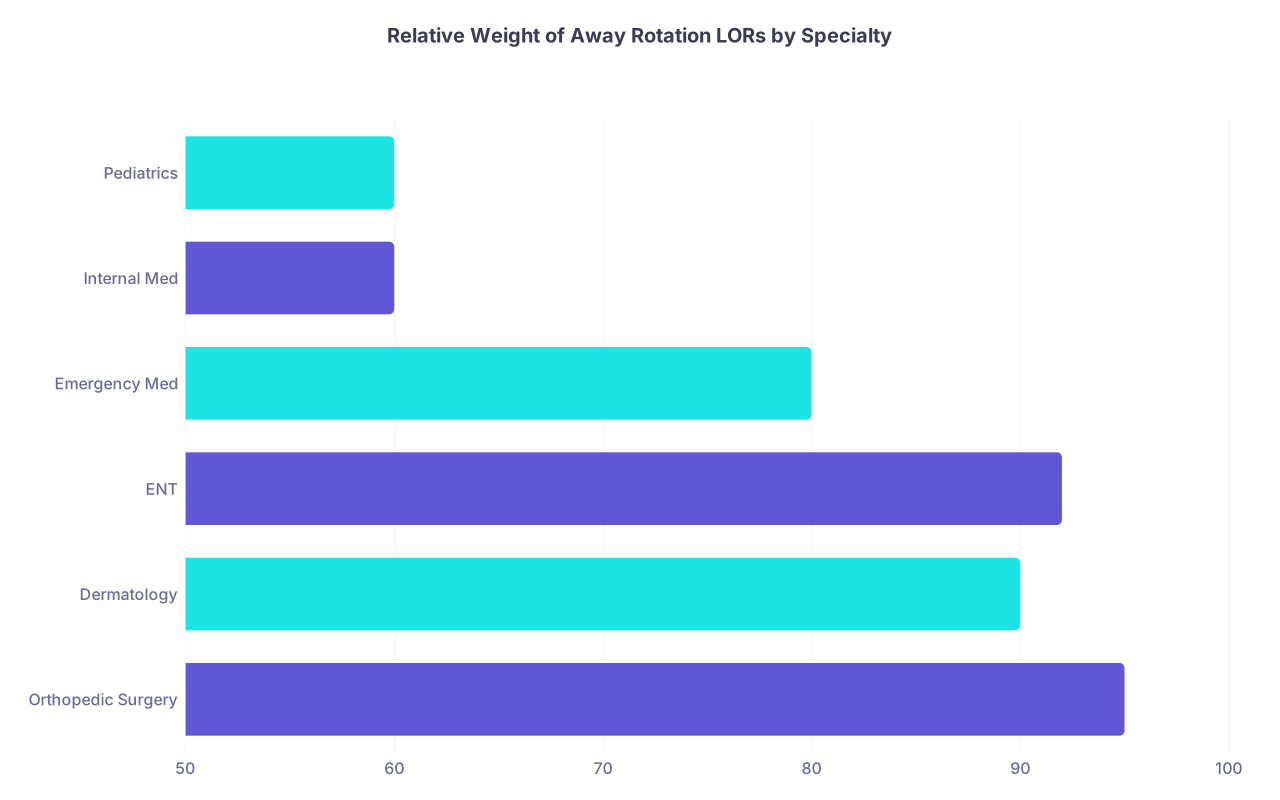
| Category | Value |
|---|---|
| Orthopedic Surgery | 95 |
| Dermatology | 90 |
| ENT | 92 |
| Emergency Med | 80 |
| Internal Med | 60 |
| Pediatrics | 60 |
- Orthopedic surgery / ENT / Neurosurgery: Away rotation LORs are almost currency. Final rank meetings absolutely discuss them. Lukewarm or absent letters from aways can drop you brutally.
- Dermatology / Plastics: Insanely competitive; away LORs from big‑name places matter a lot, especially if the writer is a known name.
- Emergency Medicine: Historically had SLOEs; those are essentially standardized away LORs and are heavily weighted.
- Internal Medicine / Pediatrics: Still matter, but the overall picture (interview, fit, academics, home evaluations) can blunt a mediocre away letter more easily.
- Surgical subspecialties: Very culture‑ and relationship‑driven. An away LOR from “one of us” is taken seriously.
What Never Gets Said Out Loud (But Matters)
Three quiet truths to end with:
An away rotation LOR is sometimes more about how well you fit into that program’s culture than raw intelligence.
If the letter sounds like, “The residents loved working with her, she blended seamlessly into the team,” that’s a huge green flag in final meetings. PDs are terrified of bringing in someone who disrupts the resident culture.Residents’ informal feedback can override a letter.
If everyone on the team says you were difficult, but the attending writes a neutral or even mildly positive letter, the PD will trust their residents more. The committee will hear:
“The team wasn’t wild about him on his away. I’d keep him low.”Once a red flag from an away is on the table, it’s almost impossible to erase.
Concern about reliability. One unprofessional moment that gets backchannel‑reported. A hint in the letter that “with close supervision” you might be okay. In rank meetings, that sticks harder than any compliment.