Two weeks before rank lists were due, I sat in a cramped conference room with four other faculty and a pot of coffee that had definitely gone cold. We were “officially” discussing the application files. Unofficially? We were trading comments about letter writers: “If Patel wrote for her, I don’t need to read the rest,” “Oh, he got a ‘strong’ from [redacted]… that’s a polite no.”
You think programs only read what’s on ERAS. They don’t. There’s a whole unofficial channel built around your letters of recommendation, and if you do not understand it, you are playing this game blind.
Let me walk you through how it really works.
The Hidden Currency Behind Your LORs
Every applicant obsesses over the content of their letters. The paragraphs. The adjectives. The closing line.
Faculty do not.
They glance at content, sure, but what they really read is who wrote it, how they wrote it relative to their usual style, and what other people in the room already think of that writer. Your letter isn’t just a narrative. It’s a data point in a long-standing whisper network.
Here’s the part no one tells you: faculty have their own “Step scores” for letter writers.
- Some attendings are “inflationary.” Everyone is “outstanding,” “top 5%,” “superb.”
- Some are brutal graders and almost never write letters.
- Some are known bullshitters.
- Some are gold-standard signalers. When they say “top 10%,” people believe it.
In our committee meetings, the conversation often starts with something like:
“Who wrote this one?”
“Oh, it’s from Hernandez in GI.”
“Okay, that’s legit. What did she say?”
That reaction comes before anyone cares about your clerkship comments or your heartfelt conclusion about loving the specialty.
If you get this wrong, you walk into the process with what looks like “strong letters” to you… that in the backchannel are quietly downgraded as meaningless.
The Quiet Taxonomy of Letter Writers
There’s a mental classification system faculty use, and it’s shockingly consistent across institutions.

1. The “Currency” Writers
These are the heavyweights. Their letters move you on the rank list. They tend to be:
- Division chiefs
- Program directors or APDs
- Nationally known subspecialists
- People who routinely sit on selection committees
When a currency writer uses a strong phrase, everyone in that room knows what it means because they’ve seen dozens of their letters before. They have a personal “scale” that’s been calibrated over years.
For example, one cardiology PD I know has these code phrases:
- “Top 5% of students I’ve worked with” → I will call you if this student ranks us high.
- “Top 10%” → Solid, safe, will do well.
- “Top 25%” → Fine, but not a star. Not a red flag either.
- “Excellent” with no percent → I’m not sticking my neck out for them.
Everybody reading her letters knows that’s her language. So when she writes, “Truly one of the strongest students I’ve had the pleasure to work with,” but doesn’t attach a percentage or ranking, the backchannel translation is: “Nice kid, not a killer.”
2. The Inflators
These are the letter writers whose every student is “outstanding.” Committees know it. I’ve literally heard:
“This is from X. He calls everyone ‘exceptional.’ Discount it by 50%.”
If three of your four letters are from known inflators, you look… undifferentiated. Not bad. Just bland. And bland is toxic in a sea of 800 applications.
3. The Minimalists
They write three paragraphs. Short, polite, generic. No ranking, no specific stories, no concrete examples. On the surface, it’s not negative. But on a committee?
People lean back and say, “That’s a non-endorsement.” Or worse: “They clearly didn’t know this student well.”
Sometimes it’s because the writer truly didn’t know you. Sometimes they’re just a bad writer. Backchannel doesn’t care about the nuance. It sees “lukewarm.”
4. The Known Signalers
Some attendings almost never write letters. They only write for students they’re willing to put their professional reputation behind. That scarcity creates weight.
In one program I worked with, the PD said during committee:
“If Dr. [Name] wrote this, it means something. She says no to 90% of letter requests.”
So a short but enthusiastic letter from that person did more for a candidate than a glowing page-and-a-half from a chronic over-writer.
5. The Red-Flaggers
There are a few attendings whose letters make people sit up in the wrong way. They’re overly blunt, or they slip in loaded phrases, or they’re known to use “damning with faint praise” as a hobby.
When we see their name, we scan for:
- “With guidance, will…”
- “Will do well in a supportive environment.”
- “Improved greatly over the course of the rotation.”
- “I have no concerns about patient safety.”
Out loud, no one says “this is bad.” But the looks around the room tell you everything.
The Backchannel Conversations You Never Hear
Let’s talk about how these letters get discussed in real time. Because the official story—“we holistically review each application using standardized criteria”—is… incomplete.
The Hallway Consult
This happens constantly. A faculty member on the committee gets a letter from a name they don’t know. They do not ignore that.
They walk down the hall (or fire off an email, or send a text):
“Hey, do you know Dr. Smith from University of X? Is this a strong letter or just standard language from them?”
Or on Zoom:
“Anyone here familiar with this writer?”
“Yeah, she’s very conservative with praise. That’s a real endorsement.”
You will never see this exchange. But it colors how your letter is interpreted.
The Inter-Institution Backchannel
Here’s the other layer: PDs and APDs talk to each other across institutions. A lot.
I’ve been on calls where someone says:
“We’ve got a letter from [Name] at your place. When they say ‘top 25%,’ should I be impressed or is that boilerplate?”
Response:
“From them, that’s good. They reserve ‘top 5–10%’ for people they’d try to keep for fellowship.”
That one sentence just shifted an applicant a few spots up or down a rank list.

| Step | Description |
|---|---|
| Step 1 | Letter Uploaded to ERAS |
| Step 2 | Faculty Reads Name of Writer |
| Step 3 | Apply Known Reputation Filter |
| Step 4 | Ask Colleagues / Email Other PDs |
| Step 5 | Interpret Language Using Writers Known Style |
| Step 6 | Discuss in Committee Meeting |
| Step 7 | Recognized Writer? |
The “I Know This Person” Moment
This is the wild card you cannot plan but happens all the time.
Committee member sees your letter and says:
“Oh, I trained with her. If she’s this positive, that’s a serious vote of confidence.”
Or:
“I know this guy. He writes novels. Skip to the last two sentences for his real opinion.”
Suddenly, your letter just got a tailored interpretation because two people did residency together fifteen years ago.
Code Phrases and What They Really Mean
You read a letter once. Faculty read versions of the same letter a hundred times a year, from the same small set of writers. Patterns become obvious.
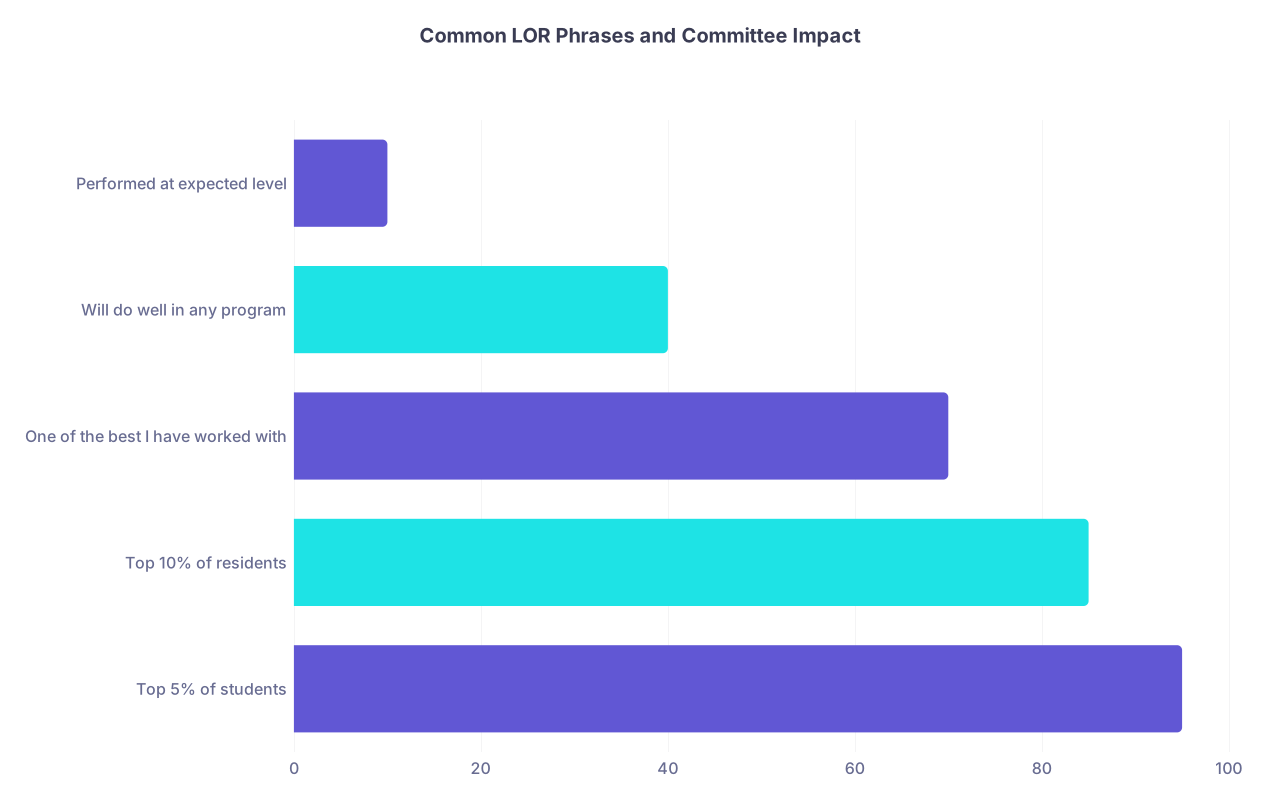
| Category | Value |
|---|---|
| Top 5% of students | 95 |
| Top 10% of residents | 85 |
| One of the best I have worked with | 70 |
| Will do well in any program | 40 |
| Performed at expected level | 10 |
Let me decode a few categories for you.
The Strong, Clear Endorsements
Things that usually help you move up:
- “Top 5% of students I have worked with in the last X years.”
- “I would be delighted to have them in our own residency program.”
- “I would rank this applicant at the very top of any list.”
- “One of the strongest students I have encountered in my career.”
Those are risky phrases for a writer. They’re sticking their neck out. Committees know that and treat them accordingly.
The Soft Positives (Looks Good to You, Neutral to Us)
Stuff that sounds nice but is utterly average in PD-land:
- “Will do well in any residency program.”
- “I recommend them without hesitation.”
- “I have no reservations in recommending this applicant.”
- “Pleasure to work with, dependable, hardworking.”
This is default language. It doesn’t hurt you. It also doesn’t rescue you from a mediocre application.
The Padded Neutral
This is disguised concern:
- “Improved significantly during the rotation.”
- “With more experience, will develop into a strong resident.”
- “Will flourish in a supportive, structured environment.”
- “Accepts feedback well” as the only strength mentioned.
I watched one PD circle “improved significantly” and say:
“Okay, so they started off rough.”
No one else argued.
The Nuclear Codes
These are rare but unforgettable. Phrases like:
- “At times struggled with professionalism expectations.”
- “Required close supervision for clinical decision-making.”
- “Colleagues occasionally found communication challenging.”
No one writes “unprofessional” or “unsafe” unless something truly went wrong. That’s the kiss of death in anything competitive. Even in less competitive specialties, that applicant drops several tiers.
Why Your Choice of Letter Writers Matters More Than You Think
Students obsess about “big names” vs. “people who know me well.” The truth is more specific: you need writers whose backchannel reputation plus actual knowledge of you align.
| Writer Type | Knows You Well? | Backchannel Reputation | Real Committee Impact |
|---|---|---|---|
| Famous but distant | No | Strong name | Mild bump at best |
| PD/APD who supervised you | Yes | High trust | Big positive |
| Chronic inflator | Yes/No | Known exaggerator | Diluted impact |
| Low-profile but respected | Yes | Neutral/locally known | Solid if detailed |
| Minimalist/grudging | Yes | Mixed | Risky |
I’ve seen this play out painfully. One applicant to a competitive IM program: 260+ Step 2, AOA, good research. But his letters were:
- One from a big-name chair who barely knew him, generic but “positive.”
- One from a visiting rotation where he didn’t stand out.
- One from an associate professor who writes the same glowing letter for everyone.
On paper? Three “great letters.” In our room? The reactions were:
“Chair doesn’t know him.”
“Visiting letter is fine, not a standout.”
“Isn’t this the same writer who called five applicants ‘best I’ve worked with’ last year?”
He was massaged into the middle of the list. Not because he was weak, but because none of his writers were credible signalers for him.
Meanwhile, another applicant with slightly lower scores had:
- A very detailed letter from an APD who supervised them directly.
- A subspecialist letter telling two specific patient stories about their initiative.
- A PD letter saying, “We will be recruiting them heavily to come back for fellowship.”
Guess who the committee pushed higher.
The Subspecialty and “We Want Them Back” Effect
There’s another layer, especially in medicine, surgery, and fellowships: letters that signal “we would take this person ourselves.”

Phrases like:
- “We would be thrilled if they matched at our program.”
- “We are actively recruiting them for our own residency.”
- “I have encouraged them to strongly consider training here.”
Those have two translated messages:
- This person is good enough that we’d keep them.
- They’re not a problem. Because nobody publicly recruits a problem.
When faculty see that, there’s an instinctive trust: “If they’re good enough for X’s own house, we’re probably safe.”
This is also why home institution PD letters matter more than students realize. Even when they’re “standardized,” there are micro-variations. We pick up on them.
I’ve sat in meetings where someone said:
“Our PD is always politically correct. If he gave them this level of praise, they must be really strong.”
You can’t fake that. It comes from a real relationship and a history of how that PD usually writes.
How the Backchannel Treats Red Flags and Oddities
Letters that don’t match the rest of the picture trigger a different kind of behind-the-scenes discussion.
The Outlier Letter
Say you have three stellar letters and one lukewarm one. Committees do not just average them.
Backchannel conversation sounds like:
“Three are strong, one is meh. Anyone know the meh writer?”
“Yeah, she’s just terse. Her ‘meh’ is neutral.”
“Okay, ignore it.”
Or:
“This one is from their supposed mentor but is generic. Why didn’t that mentor go stronger?”
“Do we have any narrative comments that match up with concerns?”
If the outlier is the home PD letter and it’s tepid compared to others, that’s much more concerning. People assume the PD knows more than anyone else and may be quietly warning others.
The Letter That Isn’t Included
Here’s a quieter signal: the conspicuous absence of a letter.
You did a big research project with someone and only have a short, generic note from them. Or you rotated on a service for two months but don’t have a letter from that attending—just from the junior faculty.
Some PDs notice this and ask:
“Why didn’t they get a letter from X? Did something happen on that rotation?”
Often we never know the answer. But that little question mark can nudge your file into the “slightly more cautious” pile.
What You Can Actually Control
You can’t control the old-boy networks, or which PD trained with whom. But you’re not powerless either. There are ways to play this game with your eyes open instead of walking in blind.

| Step | Description |
|---|---|
| Step 1 | Identify Potential Writers |
| Step 2 | Ask Residents About Their Reputation |
| Step 3 | Lower Priority |
| Step 4 | Request Letter Early, Provide Materials |
| Step 5 | Consider Alternative Writer |
| Step 6 | Follow Up Politely Before Deadline |
| Step 7 | Did they directly supervise you? |
| Step 8 | Known to write strong, specific letters? |
Vet the Writer’s Reputation — Quietly
Ask residents and senior students one specific question:
“When Dr. X writes a strong letter, do PDs trust it?”
Not “is Dr. X famous.” Not “is Dr. X nice.” You want to know if their letters carry weight or if they’re noise.
Residents are brutally honest about this stuff. They’ve seen how past applicants fared. They’ve heard what PDs mutter when your name isn’t in the room.
Make It Easy for Them to Be Specific
Faculty fall back on generic language when they don’t remember you well or don’t have material. Your job is to give them material.
Short summary email. Bullet points of specific cases. Concrete reminders of what you did that was above the usual student behavior. That’s how you get those “she took ownership of X complicated patient” anecdotes that committees remember.
No, you’re not “writing your own letter.” You’re giving them ammo. Big difference.
Match Writer to Specialty
Chasing a big name in the wrong field is a common rookie mistake. A soft but specific letter from someone in your target specialty who actually saw you work is worth far more than a generic “excellent student” from a famous basic science chair you met twice.
Committees absolutely factor in specialty alignment. For residency, letters from your chosen field are the ones that get dissected hardest.
Final Truths About the Backchannel
Let me strip this down.
First: Your letters are not read in a vacuum. They’re filtered through years of accumulated impressions about who wrote them, how they usually write, and what they’ve said in the past.
Second: The most powerful part of your letter is often invisible to you—the name at the top and the reputation that name carries when doors close and faculty start talking honestly.
Third: You cannot control every backchannel conversation, but you can choose writers strategically, provide them with real material, and avoid relying on famous but empty endorsements.
Play the letter game with that in mind, and you stop being just another applicant with “strong LORs.” You become the applicant whose letters faculty actually lean forward to read.