
It’s late November. You’re scrolling through ERAS for the hundredth time, half-dissociated, and you click into your documents just to reassure yourself everything actually uploaded. You open one of your letters of recommendation.
Four sentences.
Your stomach drops. You tell yourself, “Maybe that’s just how this attending writes.” You close ERAS, try not to think about it, and convince yourself programs won’t care.
Let me be blunt: they care.
You’re underestimating how much a short, thin, content‑light LOR freaks out selection committees. Not because they need flowery prose. Because of what a short letter silently signals to people who read hundreds of these every year.
I’ve sat in those rooms. I’ve watched PDs scroll through letters for 10 seconds, say “Nope,” and move on. I’ve watched a single skimpy letter sink an otherwise competitive application.
So let’s talk about why short LORs are such a red flag, what’s actually happening in those closed‑door meetings, and what you can still do if you already know one of your letters is bad.
How Committees Actually Use Letters (Not How You Think)
You’ve probably been told letters are “one part of a holistic review.” That’s the brochure version.
In reality, letters are the interpretation guide for your whole application. Step scores and grades tell us what you did. Letters tell us how you did it and what it was like to work with you.
Program directors and faculty aren’t reading every word of every letter. They don’t have that kind of time. But they’re incredibly sensitive to patterns.
Here’s what actually happens at that table.
A resident or faculty reviewer summarizes:
“US MD, Step 1 pass, Step 2 243, solid clerkship comments, no red flags. Three letters: two from core faculty, one from the sub‑I.”
PD: “Anything interesting in the letters?”
Reviewer: “One is strong, one is decent, one’s… very short.”
That last phrase—“very short”—immediately puts the brakes on. Now they’re not thinking, “Is this student excellent?” They’re thinking, “What’s wrong that this writer couldn’t say more?”
Because in 2026, with how heavily everyone coaches letter writers and how much pressure faculty get from med schools, a very short letter usually means one of three things in the committee’s mind:
- The writer doesn’t know you well.
- The writer doesn’t think you’re strong and refused to lie.
- You misjudged who to ask, which raises questions about your judgment.
That’s why short letters scare them more than you expect.
What “Short” Actually Means To A Program Director
Let’s get concrete. When faculty say “short letter,” they’re not counting characters. They’re reacting to how much signal the letter carries.
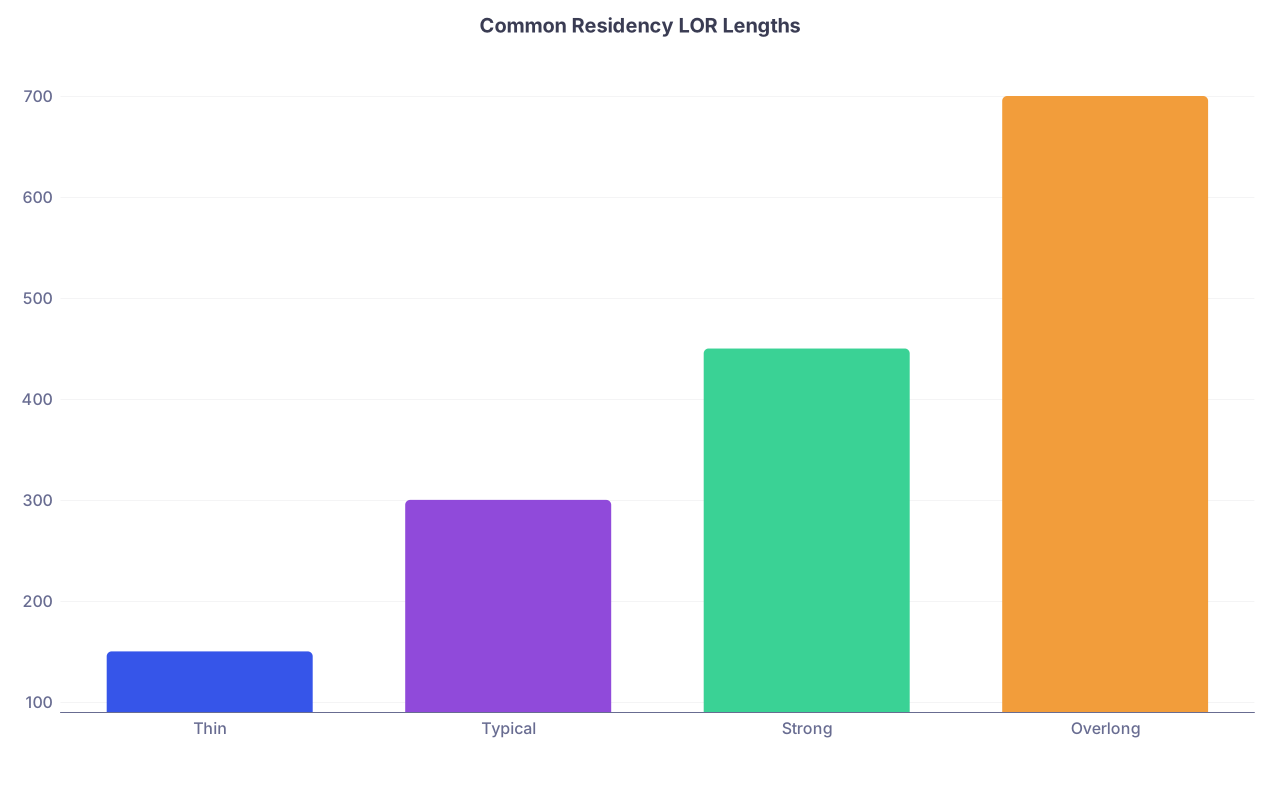
| Category | Value |
|---|---|
| Thin | 150 |
| Typical | 300 |
| Strong | 450 |
| Overlong | 700 |
Here’s the rough internal calibration people on committees use:
- Thin letter: 1 short paragraph, maybe 150 words or less. Often looks like it was written in 3 minutes. No specifics, just generic statements.
- Typical letter: 2–3 paragraphs, ~250–350 words, at least one specific clinical example, clear overall recommendation.
- Strong letter: 3–4 paragraphs, ~400–600 words, stories, comparison to peers, clear enthusiasm.
- Overlong: 800+ words, pages of rambling with minimal added value. Not ideal, but much less dangerous than a short one.
A truly short letter doesn’t give us:
- Any convincing examples of your performance
- Any clear sense of your strengths relative to peers
- Any sense the writer actually worked with you enough to have an opinion
And here’s the uncomfortable truth: committees have been burned enough times that they treat a short letter as presumptively negative until proven otherwise.
They won’t say that out loud in public forums. But watch what they do in the room.
What A Short LOR Actually Signals Behind Closed Doors
Picture a faculty meeting. We’re going through internal med applicants. Someone flags a candidate from a good school, decent scores, nice MSPE. Then we open a letter that looks like this:
“I had the pleasure of supervising Jane Doe on our inpatient medicine service. She was a hardworking, punctual student who took good care of her patients. She will do well in residency. I recommend her for your program.”
That’s it. Seven lines. No examples. No comparisons. No “top X percent.”
Let me tell you how that gets interpreted by different people in the room:
- The PD thinks: “Attending didn’t want to stick their neck out. Why?”
- The chief resident on the committee thinks: “We’ve all written ‘hardworking and punctual’ when we had nothing better to say.”
- The crusty senior faculty member thinks: “If that student were impressive, this letter would not be this short.”
No one says “this is a bad letter” because faculty rarely want to accuse other faculty of phoning it in. But the overall vibe is: this applicant no longer feels like a safe bet.
And safety is what committees care about. They don’t need you to be a star. They need you not to blow up in their face.
A short letter feels unsafe, because:
- There’s less to anchor your narrative (no specific case, no “I saw them manage X situation”)
- There’s no language that signals “this person is one of our better students”
- There’s no positive data to counteract minor weaknesses elsewhere in your file
So the file quietly moves down the pile.
Why Committees Fear Silence More Than Criticism
An openly negative letter actually happens less often than you think. Rare, but it’s obvious when it does:
“While John was punctual and completed his assigned tasks, he requires closer supervision than most students at his level.”
That’s a torpedo. Everyone sees it.
But here’s the twist: committees sometimes prefer an honest, mixed letter over a suspiciously bland, microscopic one. At least with the mixed letter, they know:
- The writer actually knew you.
- They respected programs enough to be honest.
- The concern is specific and bounded (“needs closer supervision with procedures,” etc.).
A short, empty letter is more unnerving because it’s ambiguous. And in selection, ambiguity is the enemy. PDs aren’t just choosing residents—they’re trying to avoid disasters.
Silence suggests:
- The attending didn’t care enough to spend 10 minutes writing more.
- The attending had concerns but didn’t want to put them in writing.
- You either misread the relationship or were desperate and asked anyone who’d say yes.
Programs know med schools heavily coach students on “ask people who know you well and can comment in detail.” So when they see the opposite—someone clearly did not know you well—they wonder: Did no one know this student well? Why?
That’s why short letters quietly kill borderline applications.
How Much Do Short LORs Actually Hurt You?
Let me quantify this the way PDs think, not the way advisors sugarcoat it.
Take two borderline applicants for a competitive IM program. Same Step 2 (let’s say 235), average school, decent but not glowing MSPE.
- Applicant A: Three “typical” letters, each with at least one concrete anecdote and a clear “highly recommend.”
- Applicant B: One strong letter, one typical, one noticeably short, generic letter.
If we’re sitting in a room and we have to pick whom to interview, Applicant A wins almost every time. Applicant B might still get some interviews, but the short letter is a drag on the file.
| LOR Profile | Relative Interview Odds* |
|---|---|
| 3 strong, detailed letters | Very high |
| 1 strong, 2 solid typical letters | High |
| 2 typical, 1 obviously short letter | Moderate/Borderline |
| 1 strong, 1 short, 1 unknown writer | Lower |
| Multiple short/generic letters | Very low |
*Not real percentages—this is the mental ranking people actually use.
One short letter won’t automatically sink you at every program. But here’s the nuance you’re not told:
- Short letter = tiebreaker against you when they’re sifting through a huge pile.
- Multiple short letters = strong signal that you’re not trusted or known by faculty.
Most applicants will never hear this feedback. You’ll just see fewer interviews than your peers with similar stats.
The Subtle Details Committees Look For In Length
It’s not just word count. It’s what’s missing.
PDs and faculty subconsciously expect a few things in a decent letter:
- A line or two about the context (which rotation, how long, what setting).
- Some sense of frequency of interaction (“I worked closely with them daily for 4 weeks”).
- At least one 具体 story: a hard patient, a crisis, a complicated social case.
- A comparative frame (“among the top third of students I’ve worked with this year”).
- A clear bottom‑line statement (“I recommend without reservation,” or “I recommend with enthusiasm”).
When a letter is very short, usually multiple of those are missing. The letter becomes “floating praise” without anchors. Committees know how these things are written; they recognize placeholders.
They’ve all written them themselves when they did not want to commit.
Here’s the part no one says out loud: a short letter often reads like a forced favor. As in, the student asked, the attending didn’t want to say no, so they did the absolute minimum.
If someone on the committee says, “Maybe they were just busy,” you’ll usually hear a quiet, “If the student were that great, they would’ve made time.”
Harsh. But that’s how it plays.
Red Flags That Your LOR Is Too Short (If You Catch A Glimpse)
A lot of schools block you from seeing letters. Good. That’s how it should be. But many of you will accidentally see something—faculty forwarding it to you, uploading to a wrong portal, or just being lazy.
If you do see your letter and you notice:
- It fits entirely on half a page with large margins
- No specific patient cases or moments are mentioned
- No comparison language (“top” / “above average” / “among the best”)
- No description of how long or how closely you worked together
- Generic phrases like “pleasant,” “hardworking,” “punctual,” “professional” and almost nothing else
You’ve probably got a “short” or “thin” letter in the committee’s eyes, even if it doesn’t look terrifying to you as a student.
This is when you need to stop hoping and start triaging.
If You Already Suspect A Short LOR: What You Can Still Do
If ERAS is already submitted and you’re mid‑cycle, your options are limited—but not zero.
Here’s how people who understand the system actually handle this.
1. Get Another Letter If You Possibly Can
Even mid‑cycle, you can sometimes add an extra letter and assign it to future programs or even to some already‑applied programs that allow late assignment.
You don’t broadcast, “This is replacing a bad letter.” You just add another one from:
- Your sub‑I where you know you crushed it
- A program director or clerkship director who saw you extensively
- A research mentor who can actually speak to your behavior and work ethic, not just your abstract count
More data dilutes the effect of a short letter. If two letters are strong and one is short, committees are more likely to decide, “Ok, that one writer just didn’t know them well.”
2. Use Your Personal Statement And Experiences To Counter The Vibe
A short letter often implies “forgettable, doesn’t stand out clinically.” So your job is to manufacture specificity everywhere else.
Your personal statement and experiences should lean into:
- Concrete patient stories where you showed ownership and judgment
- Times you were trusted with more responsibility than typical for your level
- Longitudinal relationships with mentors, teams, or projects
You’re not consciously “fixing” the letter. But you’re giving the committee the narrative the letter failed to provide.
3. Destroy The Interview
Let me be honest: if your stats are fine and you’ve still landed interviews, programs are already giving you the benefit of the doubt. Once you’re in the room (or on Zoom), letters matter less.
What scares committees most is: “Will this person be weak on the wards and hard to work with?”
So if you come across as grounded, thoughtful, clinically engaged, and able to talk about specific patient care experiences, you’re rewriting the story in real time.
I’ve seen applicants with a lukewarm letter get moved up the rank list after a strong interview block. It happens.
How To Avoid Short, Useless Letters In The First Place
The real move is prevention. Most short letters are predictable. Students just ignore the warning signs.
A few behind‑the‑scenes truths:
- Faculty who write chronically short letters are known on the wards. Residents know. Coordinators know. If three people tell you, “She doesn’t really know the students,” believe them.
- People who barely worked with you will often still say yes if you ask for a letter. That “yes” is meaningless. They’re being polite, not endorsing you.
- The strongest letters almost always come from people who have seen you in messy, real situations: cross‑cover, night float, complicated social admissions, tense family meetings.

| Step | Description |
|---|---|
| Step 1 | Need LOR |
| Step 2 | Dont ask |
| Step 3 | Maybe, but not first choice |
| Step 4 | Strong candidate for LOR |
| Step 5 | Did they see you clinically for >= 3 weeks? |
| Step 6 | Do they know you by name without prompting? |
| Step 7 | Did they see you handle challenging cases? |
When you ask for a letter, do not say, “Can you write me a strong letter?” if you’re not willing to hear “no.” A lot of attendings hate that phrasing and will say yes anyway, then write something thin.
Better version:
“Dr. X, I’m applying to internal medicine and I really valued working with you on [rotation]. Do you feel you know my work well enough to write me a detailed and supportive letter for residency?”
“Detailed and supportive” gives them an escape hatch. If they hesitate, or say something like “I can write a standard letter,” that’s code for: it will be generic and probably short.
Take the hint. Do not push.
What PDs Wish You Knew About Letters (But Won’t Say Publicly)
I’ve watched PDs at national meetings vent about this stuff when students aren’t in the room. Here’s the unfiltered version:
- They don’t expect poetic letters. They expect evidence.
- They assume every student tried to pick their best writers. So when a letter is short or generic, it’s interpreted as “this is literally the best they could get.”
- They know some departments and countries have cultural norms toward short letters. But they also know those same places can produce detailed letters when the student is outstanding.
- They care a lot about consistency. One average letter in a sea of strong ones is fine. A pattern of short/non‑specific letters is not.
And here’s the part most people miss: PDs actually remember specific phrases they’ve seen in short letters that later correlated with underperforming residents. Things like:
- “Completed all assigned tasks” (code: did the bare minimum)
- “Was punctual and reliable” (fine, but where’s the rest?)
- “Pleasant to work with” (we say this about people we have no clinical respect for but no social issues with)
So when they see those phrases in a five‑line letter, they get nervous.
Quick Reality Check: When A Short Letter Doesn't Hurt You Much
Not every short letter is fatal. Context matters.
A short LOR is less damaging when:
- It’s your research letter, and your clinical letters are all strong and detailed.
- It’s from a “big name” who doesn’t write long letters for anyone—but even then, most big names will at least throw in a “top X%” line for someone they truly like.
- It’s one of four letters, the other three are all solid and clearly from people who know you well.
But the situation that does terrify committees is:
- Two or more short/generic letters
- Or your home specialty letter (e.g., your home IM or surgery letter) is short and vague
Home specialty letters carry disproportionate weight. If your own department can’t write more than a few lines about you, programs assume there’s a reason.
FAQs
1. Is a short LOR from a “famous” attending still bad?
Usually yes. Committees love big names, but they’re not naive. A famous person writing five bland lines is still saying, “I don’t really know this student.” If it’s a fourth letter alongside three strong ones, fine. If it’s your main specialty letter, it’s a problem.
2. What if my school culture is to write shorter letters in general?
Committees do recognize some institutional patterns, but they also see when multiple students from your school have detailed, specific letters. If everyone else from your school has 2–3 paragraph letters and you have half a page of generic adjectives, that’s not “culture.” That’s you.
3. Can I ask a letter writer to revise or expand a very short letter?
If you saw the letter accidentally and it’s truly thin, you can try—but very, very carefully. Something like: “If it’s not too much trouble, would it be possible to add a specific clinical example?” But understand this: if they wanted to champion you, they would have. Forced expansions rarely turn into strong letters; they just get slightly longer.
4. Is it better to have three great letters or add a fourth mediocre one?
Three great letters are better than three great plus one truly weak letter. But if the fourth is just “meh,” not actively negative, it usually doesn’t hurt that much. The danger is a clearly short or subtly negative letter, not just a slightly boring one.
5. How do I know in advance who writes strong, detailed letters?
Ask residents. Quietly. Ask, “Who have you seen write really detailed, supportive letters for students who’ve done well?” Residents know exactly which attendings advocate hard and which ones crank out two‑sentence templates. Believe them.
If you remember nothing else:
- A short, generic LOR doesn’t look neutral to committees. It looks like a silent warning.
- Prevention is everything—only ask people who truly know your clinical work and are willing to go on record about it.
- If you’re already stuck with a thin letter, drown it out with stronger ones and concrete stories everywhere else in your application.