
The worst-kept secret of ERAS: too many letters of recommendation can quietly kill a strong application.
Everyone obsesses over getting “more letters.” Very few people ask the better question: “Do these letters actually tell one coherent, compelling story about me?” That’s the difference between a tight, memorable file and a forgettable blur the committee barely discusses.
You’re not rewarded for volume. You’re rewarded for clarity. And overloading ERAS with LORs is one of the fastest ways to lose it.
The Core Mistake: Confusing “More” With “Stronger”
Let me be blunt: most programs are not reading 6–8 letters of recommendation for you. They barely have time to fully read 3–4.
- Skim the first one or two carefully
- Glance at the rest (if at all)
- Look for red flags, contradictions, or generic fluff
When you upload every letter you can get your hands on “just in case,” you send three dangerous signals:
- You don’t understand how program directors think.
- You don’t know what your own narrative is.
- You might be hiding a weak core by burying it in noise.
I’ve heard this exact sentence from faculty on selection committees:
“He has seven letters… no one with seven letters has seven good letters.”
They’re not impressed. They’re suspicious.
The Capacity Problem You’re Ignoring
Programs read thousands of applications in a few weeks. Residents and faculty are skimming them between consults, after call, with 10 tabs open.
They are not doing a deep literary analysis of every paragraph in every letter. They’re pattern-matching:
- Is this person strong, average, or concerning?
- Do multiple independent people say the same thing?
- Does this fit what we need in our program?
You help them when you give them:
- The right number of letters
- From the right people
- Saying the right, consistent things
You hurt yourself when you overload them with 1–3 extra letters that add nothing new or subtly conflict with the others.
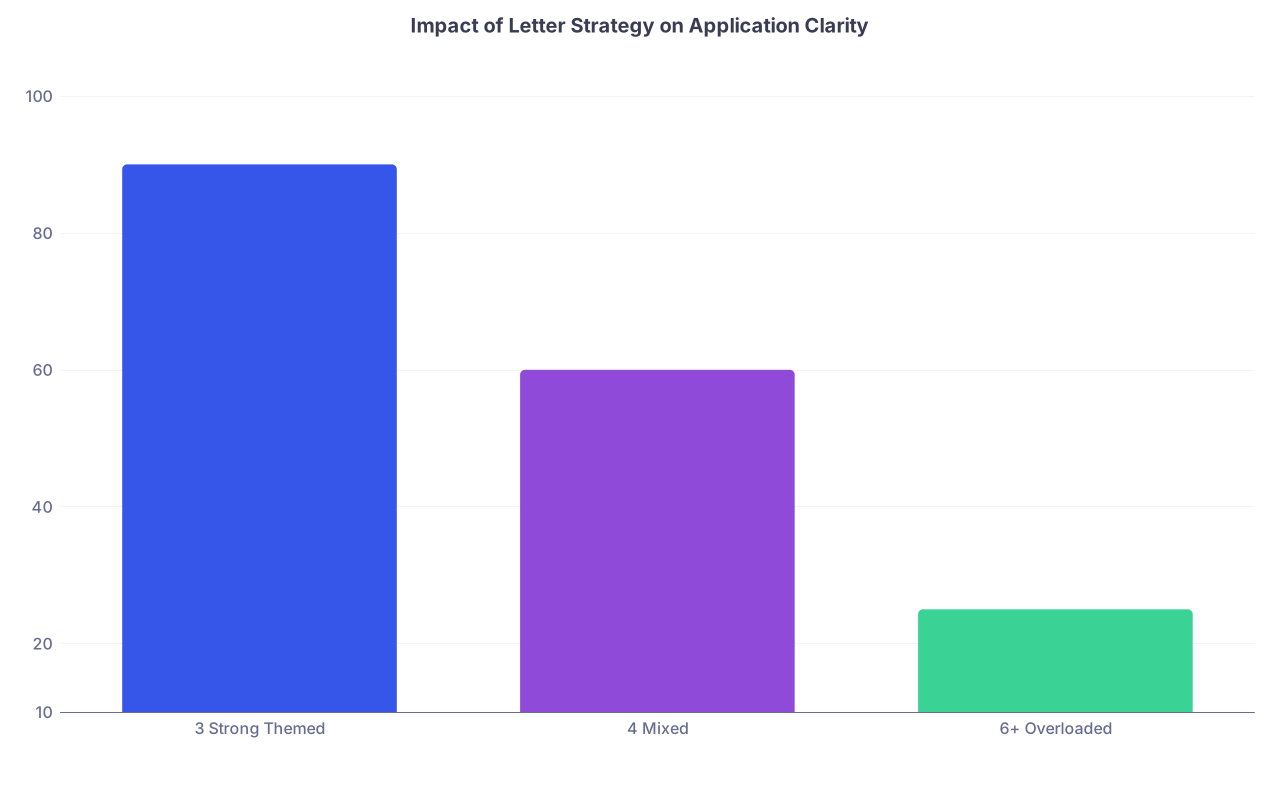
How Too Many Letters Dilute Your Story
| Category | Value |
|---|---|
| 3 Strong Themed | 90 |
| 4 Mixed | 60 |
| 6+ Overloaded | 25 |
The danger isn’t just “they won’t read them.” The danger is that the extra letters actively weaken the impression of you.
1. Mixed Messages = Muddled Identity
You want your letters to converge on a few core themes:
- Reliable, hardworking, teachable
- Good team player and communicator
- Clinically sound with appropriate level of independence
- Specialty-specific interest and fit
When you add too many letters from random rotations, you get this mess:
- One letter: “Excellent team player, very strong on medicine wards.”
- Another: “Outstanding surgical intern potential, loved the OR.”
- Another: “Great with kids, interested in pediatrics.”
- Another: lukewarm from a short elective.
Now what is your story? Internal medicine? Surgery? Peds? General “I’ll do anything, please just take me”?
Programs don’t like that. They want to see intention, not desperation.
2. The “Why Did They Include This?” Problem
Every mediocre or generic letter raises anxiety on the reader’s side:
- “Was this the best they could get?”
- “If this is what they chose to upload, what did they not upload?”
- “Why is this so short / vague / impersonal?”
You think you’re playing it safe by submitting everything. You’re actually forcing the reader to wonder what you were thinking.
I’ve watched a committee discussion freeze on a single weak letter. Strong personal statement, solid scores, good clinical comments… then a short, generic letter:
“Maybe they had professionalism issues that the writer is tiptoeing around.”
And that’s it. Candidate quietly drops on the rank list.
3. Letter Fatigue: When Your Best Advocates Get Lost
Your best letter is usually:
- From someone who truly knows you
- Who watched you over time
- Who has written strong letters before
- Who cares that you match well
When you put that great letter next to five others, here’s what happens:
- The impact gets spread out.
- The strong themes get diluted by inconsistent comments.
- The reader can’t remember which letter said what.
If they can’t remember one clear takeaway about you after reading your letters, you’ve failed. That’s what overloading does: it buries the gold.
How Many Letters Is Actually Enough?
| Specialty | Common Minimum | Strong Range | More Than This = Questionable |
|---|---|---|---|
| Internal Med | 3 | 3–4 | 5+ |
| General Surgery | 3 | 3–4 | 5+ |
| Pediatrics | 3 | 3–4 | 5+ |
| EM (with SLOEs) | 2 SLOEs | 2–3 total | 4+ |
| Psych/Family | 3 | 3–4 | 5+ |
Always start with what programs require and prefer:
- Minimum letters required (often 3)
- Maximum letters they’ll actually accept in ERAS (sometimes 4)
- Specialty norms (e.g. EM SLOEs; surgery chairs)
If a program’s ERAS listing says “Maximum: 4,” treat that as a hard ceiling. Cramming 5–6 into other programs that allow more doesn’t magically help.
Baseline guidance that covers most people:
- Aim for 3 very strong, aligned letters.
- Add a 4th only if it clearly adds something distinct and positive.
- Stop. Even if you have more.
The Wrong Letters People Keep Including (And Regret)

You don’t just want “enough” letters. You want the right letters. Here’s where people go wrong.
1. Short Rotation, Weak Relationship
You worked with the attending for 3–4 half days in clinic. They barely remember your name.
They write:
“Student rotated with me for a brief period. They were punctual, professional, and interacted appropriately with patients. I anticipate they’ll be a good resident.”
Zero specifics. Zero anecdotes. Zero differentiation from any other average, polite student.
Why this is harmful:
- Screams “they just needed a warm body to submit a letter.”
- Signals you couldn’t find enough people who knew you well.
- Makes your actual strong letters look like outliers instead of the norm.
2. The Prestige Trap Letter
The classic move: “But this is from the department chair at Big Name University. I have to include it.”
No, you don’t—unless:
- They saw you regularly
- They can compare you to many students
- They wrote a detailed, enthusiastic letter
A generic letter from a famous name reads worse than a glowing letter from a respected but not-famous faculty member.
Committees would much rather see:
“Dr. Patel, Associate Program Director, who clearly watched this student closely and actually cares about training residents here”
than:
“Professor World-Renowned, who clearly dictated the same 4 sentences they use for everyone.”
3. The Off-Specialty Filler Letter
You’re applying to internal medicine. You throw in a random pediatrics or surgery letter “just to show range.”
Here’s the problem:
- The metrics they care about (management, team leadership, patient ownership) are best demonstrated in the target specialty or closely related fields.
- Off-specialty letters often focus on things that don’t directly matter for that residency.
- It looks like you didn’t have enough strong medicine letters.
One strong off-specialty letter that fits your story? Fine. A pile of random specialties? Sloppy.
4. The Old Letter That No Longer Fits
That stellar M3 letter from your early surgery rotation. Sounds great. Except:
- You’re now applying to psychiatry.
- Your recent psych letters focus on growth, empathy, and fit—very different emphasis.
- The old surgery letter reads like a completely different person.
Programs wonder: did you pivot late? Were you weaker in your actual target field? Why are your older letters stronger than your newer ones?
If a letter doesn’t align with who you’re telling them you are now, leave it out.
Building a Coherent Letter Strategy (Instead of Hoarding)

| Step | Description |
|---|---|
| Step 1 | List All Potential Letter Writers |
| Step 2 | Identify Target Specialty |
| Step 3 | Prioritize Core Specialty Letters |
| Step 4 | Request Strong Letter |
| Step 5 | Skip or Backup Only |
| Step 6 | Review Which Programs Accept How Many |
| Step 7 | Select 3 Essential Letters |
| Step 8 | Include 4th Letter |
| Step 9 | Stop at 3 |
| Step 10 | Know You Well? |
| Step 11 | 4th Adds New Value? |
You should be curating, not collecting. Here’s how to avoid the overloading trap.
Step 1: Start With Your Story, Not Your Options
Before you think about who can write, decide who you’re trying to show them you are:
- Future academic surgeon?
- Community family doctor who loves continuity?
- Medicine resident with strong ICU interest?
- EM doctor who thrives in chaos?
Once you know your story, pick the letter types that reinforce it:
- Core specialty attendings
- Subspecialty or research in that field
- A powerful “character witness” who saw you work over time
If a potential letter writer doesn’t clearly support that story, they’re already lower priority.
Step 2: Ruthlessly Prioritize Depth Over Spread
Ask yourself for each potential writer:
- How well do they know my day-to-day performance?
- Did they see me handle challenges, not just routine?
- Will they remember specific cases and details without me spoon-feeding?
- Have I heard them described as a “strong letter writer” for others?
Three of those people > six “they seemed nice and said yes.”
Step 3: Decide in Advance How Many You’ll Actually Use
Look at your specialty norms and program limits. Then commit:
- “I’m using 3 letters for 90% of programs.”
- “I’ll consider a 4th only if it’s a true standout and adds something clearly new.”
If you collect backup letters for safety, fine. But treat them as backups. Not as “well, might as well upload everything.”
Step 4: Prevent Letters That Will Hurt You
This is uncomfortable, but essential. Avoid two silent killers:
Vague offers — “Sure, I can write you a letter if you need another one.”
Translation: “It’ll be generic.”Uncertain tone — “I’d be happy to write you a letter, but I didn’t get to work with you that much.”
Translation: “Low detail, low enthusiasm.”
Your script should be:
“Would you feel comfortable writing me a strong letter of recommendation for [specialty] residency, where you can comment on my clinical performance and how I compare to my peers?”
If they hesitate, back out gracefully. Do not pressure them into writing a lukewarm letter that you’ll later feel obligated to use because you “went through all that trouble.”
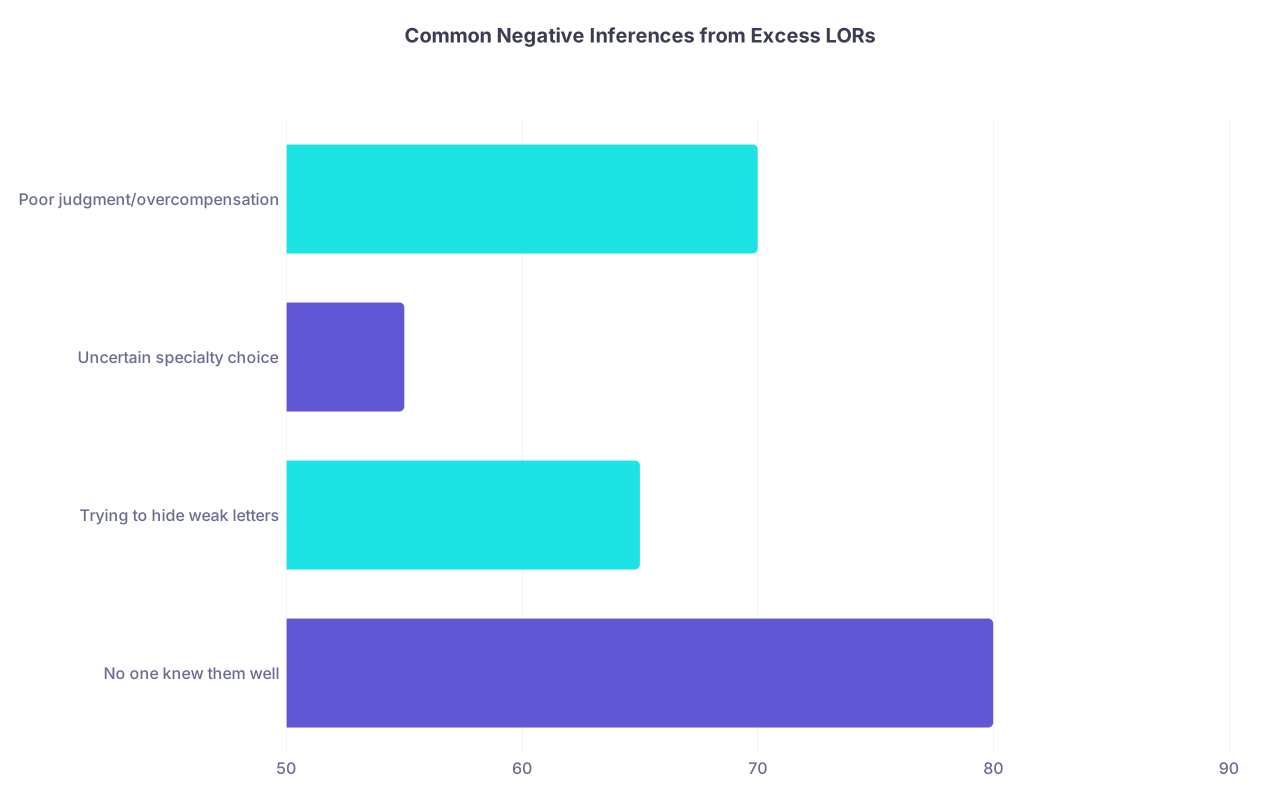
Red Flags Committees Notice When You Overload Letters
| Category | Value |
|---|---|
| No one knew them well | 80 |
| Trying to hide weak letters | 65 |
| Uncertain specialty choice | 55 |
| Poor judgment/overcompensation | 70 |
You think “more letters” = “more proof I’m good.” Here’s what they see instead.
1. Compensating for a Weak Core
If your core specialty letters were obviously excellent, why would you need so many extras?
They assume:
- One or two of those letters are mediocre
- You’re hoping quantity will overshadow quality
- You don’t trust your own performance
Good candidates look selective. Not desperate.
2. Poor Judgment and Lack of Focus
ERAS is a test of judgment as much as achievement.
When you:
- Don’t follow program guidelines
- Upload everything without strategy
- Mix unrelated specialties and levels of enthusiasm
…you show that you might make similar unfocused decisions as a resident. Over-ordering tests. Over-documenting nonsense. Not prioritizing.
3. Inconsistent Professional Identity
Nothing gets you downgraded faster than looking like you don’t know what you want.
If your letters tell three different stories about who you are and what you’re aiming for, committees won’t assume “multi-talented.” They assume:
- You pivoted late
- You’re applying broadly without real interest in their field
- You might be harder to retain long-term
You can be open-minded about your future. You just can’t sound confused about why you’re applying to their specialty now.
Practical Examples: What To Include vs. What To Cut

Let’s get concrete.
Scenario 1: Internal Medicine Applicant
You have:
- IM ward attending who worked with you for 4 weeks, loved you
- IM subspecialty elective (Cards) attending, strong feedback
- Research mentor in cardiology, 1.5 years, knows you well
- Surgery attending from M3 who wrote “top 10%”
- Family medicine preceptor who thought you were “pleasant and teachable”
Strong set:
1, 2, and 3.
Possible 4th:
Maybe surgery if it’s truly detailed and aligns with your work ethic and clinical skills.
Cut without regret:
Family medicine, unless you’re also applying FM.
Scenario 2: Pediatrics Applicant
You have:
- Core pediatrics inpatient attending (glowing)
- NICU elective attending (very strong)
- PICU attending (good but shorter relationship)
- OB/GYN attending (generic)
- Volunteer clinic physician from 2 years ago (vague but kind)
Use: 1, 2, and probably 3.
Skip: 4 and 5. Including those will not move your application up a single rank slot. But they could make readers question your choices.
Scenario 3: Emergency Medicine with SLOEs
You have:
- SLOE from home EM program
- SLOE from away EM rotation
- IM attending letter
- Surgery trauma attending
- Research mentor in EM (non-clinical)
Core: 1 and 2. That’s non-negotiable.
Common mistake: shoving in all three non-EM letters “because I worked hard for them.”
Smarter play:
- Pick 1 of 3–5 that best reinforces your EM strengths (usually IM or research if the mentor is strong and knows you well).
- Stop at 3 letters total for most programs that accept that.
More than that? You’re just adding noise.
Common Myths About Letters You Should Ignore

Myth 1: “If a program lets me upload 6 letters, they want 6.”
Reality: They’re giving flexibility, not a target. Committees are not happier to see giant LOR sections.
Myth 2: “More letters prove I’m consistent.”
Reality: They prove you can ask people for letters. Consistency comes from aligned, detailed, and specific content, not sheer count.
Myth 3: “Any letter from a big-name institution is automatically helpful.”
Reality: Generic big-name letters often do less for you than detailed local ones. People on committees have learned this the hard way.
Myth 4: “I worked hard for this letter; it’d be a waste not to use it.”
Reality: Your application is not a scrapbook. It’s a filtered argument for why they should rank you highly. You owe your past self respect—but you owe your future self strategy.
FAQs
1. If a program allows up to 4 letters, should I always submit 4?
No. Submit 4 only if you have 4 genuinely strong letters that each add distinct, positive information. Three excellent, aligned letters are far better than three excellent plus one generic or lukewarm letter that drags down the overall impression. “Because I have it” is not a good enough reason to include a letter.
2. Is it bad if not all of my letters are from my chosen specialty?
Not necessarily. One off-specialty letter can help if that attending knows you extremely well and can speak in detail about your clinical performance and character. The problem is when off-specialty letters outnumber or overshadow your core specialty letters, or when they’re clearly filler from people who barely worked with you.
3. Can I ask to see my letters before deciding which to use?
At many institutions, you can’t see them if you’ve waived your rights (which you generally should, to maintain credibility). That’s why you must screen before they’re written: ask only people who know you well, who’ve worked with you enough to comment specifically, and who explicitly agree to write a strong letter. Your selection is mostly in who you ask, not what you edit afterward.
4. What if I already requested too many letters—am I obligated to use them all?
No. You’re not required to upload every letter you’ve collected. It’s fine—and smart—to choose the best 3–4 that most strongly support your narrative and leave the others unused. The worst mistake is feeling guilty about “wasting” a letter and then loading your ERAS with content that weakens your file. Your primary duty is to protect your application, not to honor every letter equally.
Remember:
- You’re not graded on how many letters you can stuff into ERAS; you’re judged on the clarity and strength of your story.
- Three to four excellent, consistent, specialty-aligned letters will always beat a bloated pile of mixed, mediocre ones.