
The most glowing letter from the wrong person can quietly kill your residency application.
That is the uncomfortable truth most applicants learn too late.
Everyone tells you to “pick someone who knows you well and is enthusiastic.” That advice is dangerously incomplete. An enthusiastic but unknown writer is one of the most common and most costly recommendation mistakes I see in residency applications.
You know the scenario:
- The junior faculty who “loves you” and says, “I’ll write you a fantastic letter.”
- The fellow who worked closely with you and promises, “I can really speak to your clinical skills.”
- The community preceptor who keeps telling you, “Program directors will love hearing about how you handled my patients.”
They very well might love you. But residency program directors are not asking, “Who likes this applicant?” They are asking, “Whose judgment do I trust enough to stake a residency spot on this person?”
And that is where choosing an enthusiastic but unknown writer backfires.
The Core Problem: Credibility > Compliments
Letters are not graded on adjectives. They are graded on credibility.
Program directors scan for two things first:
- Who is this writer?
- How well do they know what they are talking about?
Only after that do they pay attention to what the letter actually says. If your writer fails at those first two filters, the strongest praise becomes background noise.
You invite disaster when you prioritize “enthusiastic” over “known and credible.”
Here is how that looks in real life:
- A PGY-4 chief resident writes you a passionate, detailed letter. Knows your work intimately. The PD reading it thinks: “Why is a trainee writing this instead of an attending?”
- A junior community preceptor writes, “Best student I have seen in years.” The PD: “I have no idea who this person is. No academic track record. No context. Move on.”
- A research fellow writes three pages describing your project. The PD: “This person has no faculty rank, no history with our program. They might be right. Or not. I cannot tell.”
The mistake is assuming that detail + enthusiasm compensates for low status + low name recognition. It does not. At best, it dilutes your file. At worst, it raises red flags.
How Program Directors Actually Read Letters
If you think letters are read line by line with equal attention, you are overestimating how much time residency leadership has in October.
Here is the usual mental process, boiled down:
Scan name and title of writer.
- “Associate Program Director in IM at a major academic center” → attention goes up.
- “Clinical Instructor, Community Hospital” → attention stays flat, maybe down.
- No rank listed, just “MD” → skeptical by default.
Look at institutional affiliation.
- Known academic center in that specialty → their norms and grading style are known.
- Your home institution program director / chair → highly weighted.
- Unfamiliar clinic, small private group → minimal institutional weight.
Check if the letter matches expected types.
- For IM: Do you have a medicine subspecialty or general inpatient attending?
- For Surgery: Is there an actual surgeon with an academic appointment?
- For competitive specialties: Are there letters from recognized people in that field?
Only then, actually read the content.
- Specific, comparative, concrete → trusted.
- Generic, overly effusive, vague → discounted.
Notice what comes first. Identity, rank, and context. Your “enthusiastic but unknown” writer fails at the first gate.
The Common Traps That Lure You Into This Mistake
You usually do not pick a weak writer on purpose. You drift into it. I keep seeing the same traps.
Trap 1: Confusing Familiarity With Power
You worked every day with:
- The fellow who staffed every patient with you.
- The chief resident who basically ran your rotation.
- The NP/PA who watched you manage the service.
They know you extremely well. They feel accessible. They offer, “I can absolutely write you a letter. You were amazing.”
But here is the blunt truth:
Trainees and non-physician providers do not carry the same evaluative weight as faculty attendings with academic roles. They can contribute input. They should not be your primary official writers.
If a fellow or chief wants to support you, the correct structure is:
- They draft input or a summary of your work.
- The attending of record incorporates that into their letter.
- The attending signs, ideally on institutional letterhead, with rank clearly shown.
You avoid the mistake by making sure the person whose name appears on the letter is someone PDs are trained to take seriously.
Trap 2: Being Seduced by Effusive Promises
The worst letters often start with the most dramatic verbal promises:
- “I’ll write you the best letter you have ever seen.”
- “I can say you are the top student I have worked with.”
- “I know exactly what programs want to hear.”
People who say this are almost always:
- Less experienced with residency selection.
- Unaware of how their own credibility is perceived outside their bubble.
- Overestimating the power of adjectives.
The people who write the best letters rarely talk like this. They say things like:
- “I would be happy to support your application.”
- “Given the time we worked together, I can write you a strong and specific letter.”
- “I can speak in detail about your clinical performance on our service.”
If someone leads with fireworks and superlatives, stop and ask yourself: Who are they to a program director?
Trap 3: Panic Near ERAS Deadline
September hits. You realize:
- One of your chosen faculty has not uploaded their letter.
- A rotation did not go as well as you hoped.
- You need one more specialty-specific letter, and the obvious attendings are too busy or lukewarm.
So you take the path of least resistance: the enthusiastic but unknown attending who says yes immediately and promises speed.
Fast letters from low-influence writers are a terrible trade. PDs do not reward you for punctual mediocrity.
You are better off:
- Nudging higher-yield faculty early and repeatedly.
- Using a strong general IM or surgery letter rather than a weak specialty-specific one.
- Accepting one fewer letter from your target specialty instead of padding with fluff.
Unknown vs Low-Profile vs Bad: Know the Difference
Not every non-famous writer is a bad choice. The danger is not “non-famous,” it is “non-credible to the reader.”
You want to avoid misunderstanding these categories:
| Writer Type | Risk Level | Commentary |
|---|---|---|
| Home PD / Chair in your specialty | Very Low | High credibility, high impact |
| Academic attending in specialty | Low | Solid, common, usually respected |
| Non-academic but seasoned attending | Medium | Variable; depends on letter content |
| Fellow / Chief Resident (solo) | High | Limited authority, letter discounted |
| Community MD with no context | High | Unknown standards, impact uncertain |
The “unknown” problem shows up when:
- The reader does not know the institution, division, or clinical setting.
- The writer has no academic title, leadership role, or identifiable expertise.
- The letter itself does not establish why this writer’s judgment should matter.
A low-profile but legitimate academic attending who clearly describes:
- Their role,
- Their experience supervising residents and students,
- Their comparison pool,
can still help you. They are not the issue.
The problem writer is the one whose name triggers immediate questions:
- “Who is this?”
- “Do they even supervise residents?”
- “Why is this the best person this applicant could get?”
You never want the PD’s first thought to be, “Could they really not find anyone better?”
Specific Red Flags Inside Enthusiastic-But-Unknown Letters
Let me walk you through what I have seen in these letters that quietly undermines applicants.
1. Over-the-Top Praise With Zero Comparisons
Example phrases:
- “The best medical student I have ever seen.”
- “Absolutely outstanding in every way.”
- “Flawless performance.”
Without:
- “Among X number of students over Y years.”
- “Top 5% of students I have supervised.”
- “Comparable to our incoming interns in…”
PDs see this as emotional, not evaluative. Especially from unknown writers. It reads as flattery, not data.
2. Vague Role Description
Letter starts:
“I have known Ms. Smith for several months…”
And never actually clarifies:
- Are they a clerkship director?
- A ward attending?
- A preceptor in a tiny outpatient elective?
Unknown writer + unclear role = near-zero impact.
Strong letters from less-known people spell it out:
- “I am a hospitalist and Associate Program Director for the Internal Medicine Residency.”
- “I have supervised over 150 medical students from multiple schools over the last 10 years.”
If your enthusiastic writer cannot or does not do this, you have a problem.
3. Over-Focus on Personality, Under-Focus on Performance
These letters are full of:
- “Pleasant to work with.”
- “Always smiling.”
- “Patients loved him.”
- “She was always on time and eager to help.”
All fine qualities. None justify a residency position on their own.
Program directors want:
- Clinical reasoning
- Reliability under pressure
- Team functioning with residents and nurses
- Response to feedback
- Level of autonomy near the end of the rotation
Unknown writers who lean heavily on “great personality, great attitude” sound like they are stretching. Or like they did not supervise you in high-stakes situations.
4. Over-Length as Compensation
Four single-spaced pages. Endless description of each patient encounter. Exaggerated narrative detail.
This is usually a sign the writer:
- Lacks experience writing residency letters.
- Is trying to prove how well they know you instead of why you should be trusted with residents and patients.
PDs do not have time for that. And long letters from unknown faculty are more annoying than impressive.
The Specialty-Specific Disaster: Trying To “Force” Fit
This mistake gets worse in competitive specialties: dermatology, plastic surgery, ortho, ENT, ophthalmology, etc.
Applicants think:
“I must have three letters in the specialty. I will take anyone who offers.”
So they accept:
- A very junior faculty member at a small outside hospital whom no one has heard of.
- A community preceptor with no residents and no academic appointment.
- A fellow who just matched last year and is “happy to help.”
Then, to hit the magic number, they substitute these letters for stronger, more credible letters in related fields (IM, surgery, etc.) from known faculty.
Here is the part no one tells you:
Program directors in competitive specialties would rather see 1–2 high-credibility, adjacent-field letters than 3 mediocre, obscure, “in-specialty” letters.
A letter from:
- Your home institution PD in Internal Medicine,
- The chair of Surgery who actually knows you,
will often beat:
- A random assistant clinical instructor in dermatology from a community affiliate.
Because again, the question is not, “Is this niche-correct?” It is, “Do I trust this judgment?”
How To Vet a Potential Writer Before Saying Yes
You can stop most of these problems by doing some basic due diligence before you accept.
Ask yourself, privately:
What is their role?
- Do they have a faculty title?
- Are they involved with residents, students, or the residency program?
How visible are they outside their institution?
- PD or APD? High yield.
- Division chief, clerkship director? Strong.
- Long-standing academic attending? Usually good.
- Sole private practitioner in a small clinic? Very limited impact.
How well can they compare me?
- Have they supervised many students over years?
- Can they reasonably say “top X% of students” based on a real cohort?
Do they actually know my performance in settings that mirror residency?
- Inpatient wards
- Busy consult service
- OR with residents
- High-volume clinic where you had responsibility
If several of those answers are “no” or “not really,” but the person is wildly enthusiastic, you are looking at the mistake described in the title.
When an Enthusiastic But Unknown Writer Is Actually Acceptable
There are narrow situations where you can safely use them – but only with clear rules.
Use them:
- As a supplemental letter beyond the standard 3–4 required, not replacing a core high-credibility letter.
- For targeted programs that specifically value that setting (for example, a strong community FM letter for community FM programs, but still alongside an academic letter).
- When they can establish their own credibility in the letter, like a long-time community physician heavily involved in teaching with a defined title (e.g., “Community Affiliate Faculty, Clerkship Site Director for X School of Medicine”).
Do not use them:
- As your only letter in a given specialty.
- Instead of your home PD/chair letter when one is expected.
- As the majority of your letters for competitive fields.
How To Politely Decline a Well-Meaning But Low-Yield Writer
You will need this. Because enthusiastic but unknown writers are often the ones who offer without being asked.
Here is language that works and protects the relationship:
- “I really appreciate your offer to write on my behalf. For residency applications, my school strongly encourages at least two letters from academic faculty in my target specialty, so I am obligated to prioritize those. If I am able to include an additional letter from my community experience, I would be honored to reach out to you.”
Or:
- “Thank you so much. Right now I am required to secure letters from my core clerkship attendings and program director. If I find that I can add more letters later in the season, I would love to follow up with you.”
You are not obligated to accept every offer. You are obligated to protect your own application.
A Simple Priority Order You Should Not Violate
If you want a mental cheat-sheet, here is a hierarchy that avoids most disasters:
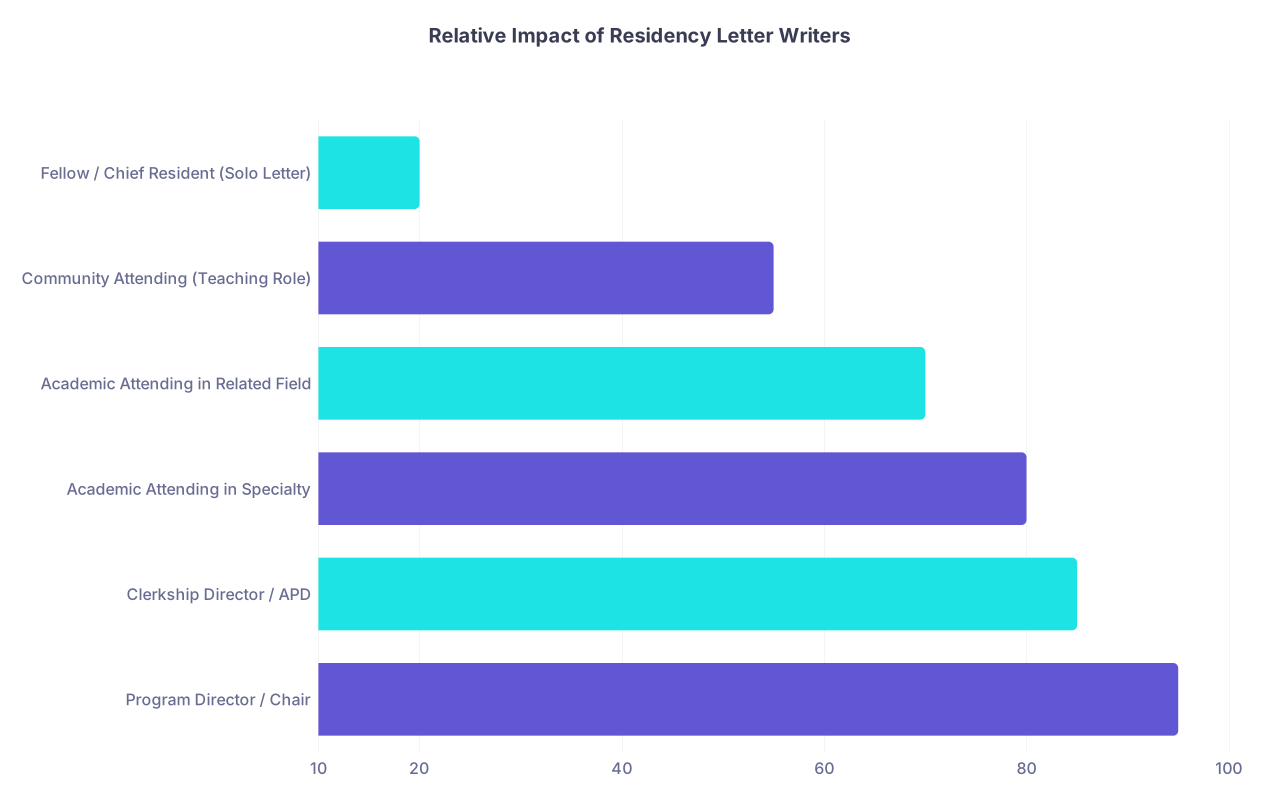
| Category | Value |
|---|---|
| Program Director / Chair | 95 |
| Clerkship Director / APD | 85 |
| Academic Attending in Specialty | 80 |
| Academic Attending in Related Field | 70 |
| Community Attending (Teaching Role) | 55 |
| Fellow / Chief Resident (Solo Letter) | 20 |
Follow this general priority order:
- Program director / chair in your target specialty (when customary).
- Clerkship director or APD in the specialty who actually supervised you.
- Academic attending in the specialty with clear teaching and evaluation role.
- Academic attending in a closely related field who saw you in high-responsibility settings.
- Community attending with recognized teaching role, ideally with an affiliate faculty title.
- Fellow / chief / unknown community preceptor only as extra, not core.
If you are choosing #6 over #2–4 because #6 is more “enthusiastic,” you are making the exact mistake this article is warning you about.
Final Check: A Quick Flow Before You Confirm Any Writer
Use this simple flow. If you cannot honestly answer “yes” to the first two, you are heading toward trouble.

| Step | Description |
|---|---|
| Step 1 | Potential Letter Writer |
| Step 2 | Use only as supplemental letter |
| Step 3 | Lower priority, consider alternative |
| Step 4 | Moderate value, use if needed |
| Step 5 | High value, prioritize this writer |
| Step 6 | Has faculty title or leadership role? |
| Step 7 | Supervised you in residency-like setting? |
| Step 8 | Can compare you to many students? |
Bottom Line: Do Not Confuse Warmth With Weight
Three points to keep in your head as you choose:
Program directors trust judgment, not adjectives. A “pretty good” letter from a known, credible writer is almost always better than a “spectacular” letter from someone they do not recognize or respect as an evaluator.
Enthusiastic but unknown writers are best used as supplements, not anchors. Let them be extra support, not the pillars holding up your entire application.
You must sometimes say no to protect your application. Declining a low-yield writer politely today is far better than discovering in March that your “amazing” letter never actually counted where it mattered.