
The fastest way to kill a strong letter of recommendation is not your medical knowledge. It’s your behavior on rotation.
You think letters are about brilliance. Attendings think letters are about trust. And trust dies from a thousand small behavioral cuts long before anyone bothers to say, “You’re not getting a letter.”
Let me walk you through the behaviors that quietly destroy your future LORs. I’ve seen students with 260+ board scores get mediocre letters because they made these mistakes. Do not repeat them.
1. Acting Like the Rotation Is a Performance, Not a Job
The worst mindset: “I’m here to impress.”
Attendings don’t want performers. They want future colleagues. When you treat the rotation like an audition instead of real patient care, it shows.
Red flag behaviors
- Only working hard when “important” people are around
- Being wildly different with residents vs attendings
- Grandstanding on rounds, then disappearing when notes and scut show up
- Caring more about “face time” than follow‑through
You know the student: they light up when the chair walks in, quote guidelines, ask flashy questions… then residents are hunting them down two hours later because “their” discharges aren’t done.
That student does not get a strong letter. They get: “Worked well with supervision and demonstrated appropriate medical knowledge.” Which is code for: neutral. Death in residency applications.
What attendings actually notice
- Do you show up when nobody’s watching?
- Do you own tasks without constant reminders?
- Do you ask, “What else can I take off your plate?” and mean it?
- Do nurses trust you enough to tell you things first?
If you’re switching into “on” and “off” modes depending on who’s watching, stop. The rotation is your real job for that month. Treat it that way, or expect a bland letter.
2. Being Unreliable in Small, “Trivial” Ways
Your letter writer is not judging you mainly on your “knowledge base.” They’re judging: Will this person be safe as a resident at 2 a.m.?
The quickest way to trigger a “Nope”? Unreliability.
Common reliability mistakes
- Repeatedly showing up 5–10 minutes late and pretending it’s fine
- Saying “I’ll take care of that” and not documenting, not calling, not closing the loop
- Leaving before confirming your responsibilities are done or handed off
- Not checking your email/EMR messages and missing updates
Here’s what actually sticks in an attending’s mind when they sit down to write:
- The day you said you’d follow up a critical lab and didn’t
- The consult you “put in” but never actually submitted
- The patient whose family waited because you forgot to update them
One bad miss like this can override three weeks of “good job.” Because it’s about safety.
How this shows up in your letter
It turns into poison phrases like:
- “With appropriate supervision…”
- “Would do well in a structured program…”
- “Improved over the course of the rotation…”
Those are red flags to PDs. Sometimes that’s all it takes to push you to the bottom of the pile.
If you want letters, your default setting must be: If I say I will do it, it gets done. Every time.
3. Toxic “Gun-Gunner” Behavior
Yes, you should be proactive. No, you should not be that person.
There’s a difference between motivated and obnoxious. Cross that line and you don’t just lose a strong letter—you may lose a letter at all.
Behaviors that scream “do not recommend”
- Answering questions directed to other students
- Correcting peers on rounds to look smart (especially in front of patients)
- Hoarding “interesting” patients, procedures, or presentations
- Volunteering for every high-yield thing but bailing on the boring work
- Name-dropping your exam scores/ publications/ Step 2 every other day
Residents talk. A lot. If they start using your name as a verb (“Don’t gunner this like [Name]”), your letter just took a major hit.
I’ve watched attendings change mid-rotation from “Maybe a great letter” to “I’ll just say they met expectations” after a student repeatedly undercut their peers.
The rule
You can be ambitious without being predatory.
If your “initiative” makes other students’ lives worse, it will cost you.
Ask yourself before you jump on a case:
- Have I already had similar opportunities this week?
- Is someone else clearly more interested in this area?
- Am I regularly stepping up for the dull stuff too?
If the answer is no, you’re not being motivated. You’re being selfish. And that’s what lands in the subtext of your letter.
4. Poor Response to Feedback (Huge Red Flag)
Nothing tanks a letter faster than someone who handles feedback badly.
Program directors read for this. If an attending can’t convincingly say “this student takes feedback and improves,” your letter is devalued immediately.
What bad feedback response looks like
- Getting visibly defensive when corrected (“Well on my last rotation they told me to…”)
- Blaming others: “The intern didn’t tell me…” “Nurse never paged me back…”
- Nodding in the moment, then changing absolutely nothing
- Arguing about minor points in front of the team
- Repeatedly making the same mistake after clear feedback
I’ve seen attendings decide not to write a letter at all over a single ugly feedback interaction. It sticks with them. They remember.
The behavior that actually earns strong letters
Not perfection. Not never messing up.
This:
- You get clear corrective feedback.
- You do not explain it away right then. You say “Got it, thank you.”
- Within 24–48 hours, the attending sees concrete change.
- You reference it later. “After our conversation I’ve been doing X instead of Y.”
Then, when they’re writing, they can honestly say:
- “Responded exceptionally well to feedback.”
- “Showed rapid growth over a short rotation.”
- “Demonstrated maturity and insight into their own limitations.”
Those phrases matter. A lot.
If you’re tempted to justify yourself when someone points out a mistake—don’t. Write the explanation in a notes app if you need to vent. Say less out loud. Then fix the behavior.
5. Disappearing from Patient Ownership
Rotation mistake that quietly kills letters: acting like a tourist instead of a doctor-in-training.
You’re not there for a hospital tour. You’re there to own patients at your level.
Ownership-killing behaviors
- Presenting a patient once, then barely checking on them after
- Never knowing the latest labs/imaging without being prompted
- Skipping family updates because they’re “awkward”
- Letting nurses chase you for simple questions because you’re “working on your note” in a corner
- Saying “I’m just the med student” to dodge responsibility instead of escalating appropriately
Attendings don’t need you to manage septic shock alone. They do need to see you care enough to stay on top of your patients.
What they want to be able to say:
- “Took primary ownership of patients within the scope of a medical student.”
- “Was the first to know and communicate changes in the patient’s status.”
- “Patients consistently recognized and appreciated them.”
You don’t get that by showing up on rounds and then vanishing. You get it by:
- Seeing your patients early
- Checking overnight events and new labs
- Asking, “What’s the one thing I should know about this patient this afternoon?”
- Circling back to check on plans actually happening
If your name isn’t naturally associated with specific patients in your team’s mind, your letter will be generic. Generic = weak.
6. Poor Professionalism With Staff and Peers
Here’s where many otherwise strong students sabotage themselves: they think their main audience is the attending.
Wrong. Your entire ecosystem is watching.
Nurses. MAs. Unit clerks. Techs. Other students. They don’t officially “grade” you. But their impressions leak.
Classic professionalism mistakes
- Being noticeably nicer to attendings than to nurses
- Ignoring pages or taking forever to respond
- Rolling your eyes or complaining in the workroom where staff can hear
- Using sarcastic or dismissive language about difficult patients
- Flirting or boundary-crossing with staff
- Oversharing personal drama or bad-mouthing other services
Here’s what happens behind the scenes:
- A nurse casually tells the attending, “That student’s kinda rude.”
- A resident vents, “They’re always on their phone when we need them.”
- Another student reports, “They keep disappearing when there’s work to do.”
Later, the attending sits down to write your letter. They may still like you. But they’re not going to stake their reputation on you. So they play it safe.
You get:
- “Was pleasant on rounds.”
- “Completed assigned tasks.”
Not: “I would be thrilled to have them as a resident.”
Those are very different letters.
Assume every interaction in the hospital can indirectly affect your LOR. Because it can.
7. Misreading the Line Between Eager and Annoying
You’ve been told “show interest,” “ask questions,” “be engaged.” True. But there’s a way to overdo this and quietly annoy everyone.
That annoyance shows up in your letter, even if it doesn’t show up on your face-to-face eval.
Eagerness mistakes that backfire
- Firing off complex questions during sign-out or when the team is clearly slammed
- Asking questions you could have Googled in 30 seconds
- Turning every patient into an essay question factory
- Interrupting flow on rounds to ask tangential “academic” questions
- Constantly asking, “Can you pimp me on this?” or “What else should I read?” in a way that feels performative
You’re not being graded on “number of questions asked.” You’re being graded on judgment.
Smart approach:
- Jot questions in your pocket notebook
- Ask 1–2 targeted questions when the team has bandwidth
- Read on your own, then circle back with, “I read about X, but I’m still unclear on Y.”
That last move signals self-directed learning and efficiency. That’s what translates into strong LOR lines like:
- “Consistently prepared with insightful, focused questions.”
- “Engaged in independent study that clearly informed their care.”
If your attending thinks “They ask a lot of questions, but the timing is terrible,” that enthusiasm becomes a liability instead of an asset.
8. Being Invisible: The “Fine but Forgettable” Trap
One of the biggest rotation mistakes is also the quietest: you’re not doing anything wrong, but you’re not doing anything memorable either.
You show up. You’re polite. You present. You leave.
Zero disaster. Zero standout.
This sounds safe. It’s not. Because letters are comparative. “Fine” is a soft rejection.
How students become forgettable
- Never volunteering to take on more than the minimum
- Avoiding presentations, procedures, or anything that feels risky
- Rarely speaking up, even when they know the answer
- Not building any real rapport with attendings or residents
- Always fading to the back of the group, physically and socially
If an attending has to open the EMR to remember who you were when they write your letter, you’re in trouble.
You don’t need to be the star of the show. You just need one or two clear stories that make you stand out as a person, not a name on a list.
Think:
- The time you stayed late to help a scared patient call their family
- The teaching session you led for other students
- The mini-QI idea you suggested and actually executed (even in a tiny way)
Those are the things that become paragraphs in your letter. Without them, you get generic fluff.
9. Mishandling the “Ask” for a Letter
Another way students sabotage themselves: the way they ask for letters after the rotation ends.
You can perform great for four weeks and still mess this up.
Common asking mistakes
- Waiting months to ask, so the attending barely remembers you
- Asking over a rushed hallway interaction
- Sending a two-line email with no context: “Can you write me a strong letter?”
- Not specifying what you’re applying to or why you’re asking them
- Not providing a CV/personal statement/ERAS sheet when requested
- Asking someone who clearly didn’t see your best work
Here’s how attendings interpret that:
- “This student is disorganized.”
- “They’re not that serious about this specialty.”
- “They don’t understand how important this is.”
Some will still write for you. But not with conviction.
Stronger approach (without annoying people)
Ask during the last week of the rotation, in person if possible:
“Dr. X, I’ve really enjoyed working with you this month and I’m applying to [specialty]. Would you feel comfortable writing a strong letter of recommendation for me?”If they hesitate at all, do not push. That’s a no. You just saved yourself a weak letter.
Follow up with a concise email that includes:
- Updated CV
- Brief paragraph about your specialty interest
- Any specific patients/projects you worked on with them (jogs their memory)
- Timeline and upload instructions
Weak ask = weak letter. Or no letter. Don’t sabotage yourself at the finish line.
10. Letting Burnout Show in All the Wrong Ways
Final killer: you’re tired, stressed, over it—and it leaks everywhere.
Everyone gets fatigued. But when your frustration starts coloring your behavior, your letter takes a hit.
Burnout behaviors that spook attendings
- Chronic negativity or cynicism in the workroom
- Complaining about hours, call, or “how useless this is for my specialty”
- Checking out mentally: on your phone constantly, missing details, zoning out on rounds
- Passive-aggressive comments about other specialties or services
- Making it very clear you “don’t care” about this rotation because it’s not your planned field
Here’s what ends up in the letter when this happens:
- “Did well overall but may struggle with workload at times.”
- “Maintained professionalism in most circumstances.”
- Or worse: the attending just never agrees to write one.
You can be tired and still be professional. That balance is what program directors want to see.
If you’re at your limit, talk to someone you trust outside the evaluation chain. Vent to your friends, your therapist, your non-medical partner. Don’t bleed it all over residents and attendings who are deciding whether to attach their name to yours.
| Category | Value |
|---|---|
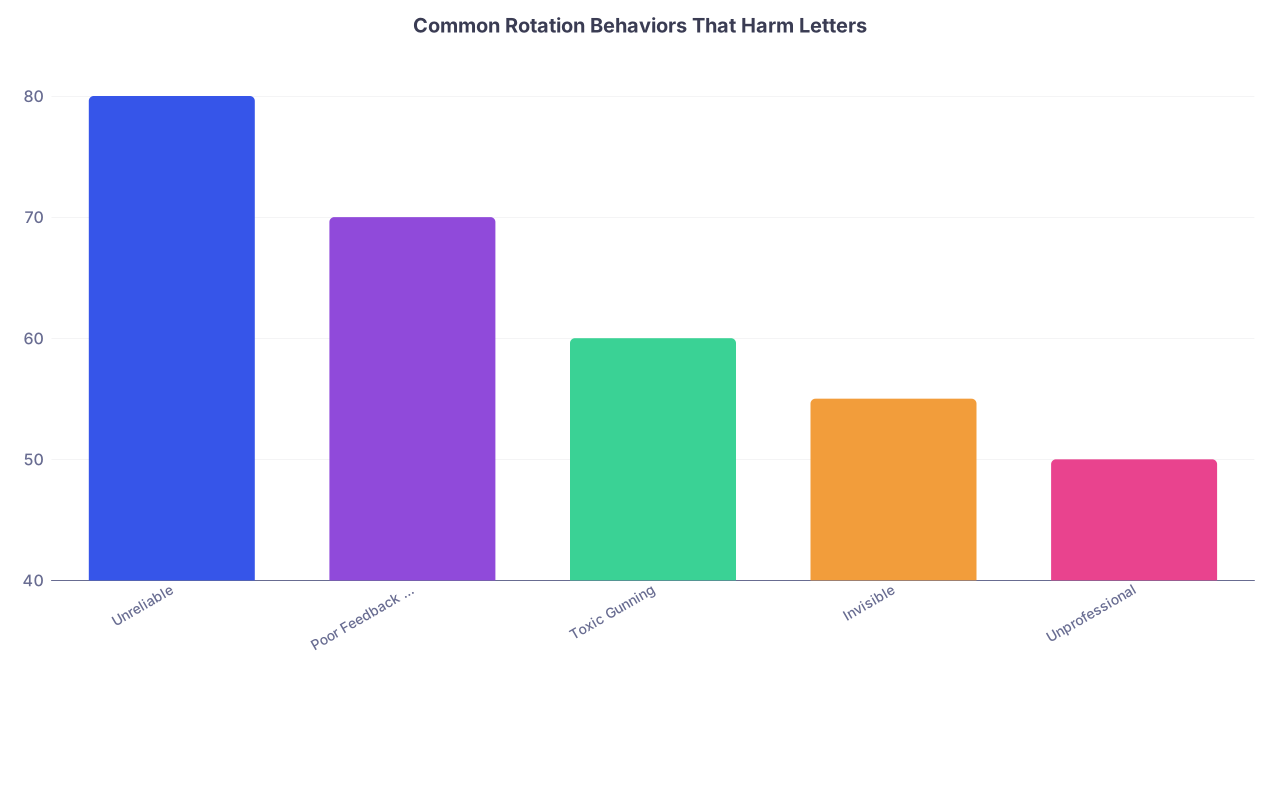
| Unreliable | 80 |
| Poor Feedback Response | 70 |
| Toxic Gunning | 60 |
| Invisible | 55 |
| Unprofessional | 50 |
| Behavior Pattern | Likely Letter Language |
|---|---|
| Reliable & proactive | “I would rank this student at the top tier” |
| Just “fine”/forgettable | “Met expectations for level of training” |
| Defensive to feedback | “Improved with supervision and guidance” |
| Toxic gunner | “Strong knowledge base, worked independently” |
| Unprofessional | Vague, short, heavily hedged letter |

| Step | Description |
|---|---|
| Step 1 | Rotation Behavior |
| Step 2 | Weak or Neutral Letter |
| Step 3 | Strong, Specific Letter |
| Step 4 | Reliable & Professional? |
| Step 5 | Teachable & Reflective? |


| Category | Value |
|---|---|
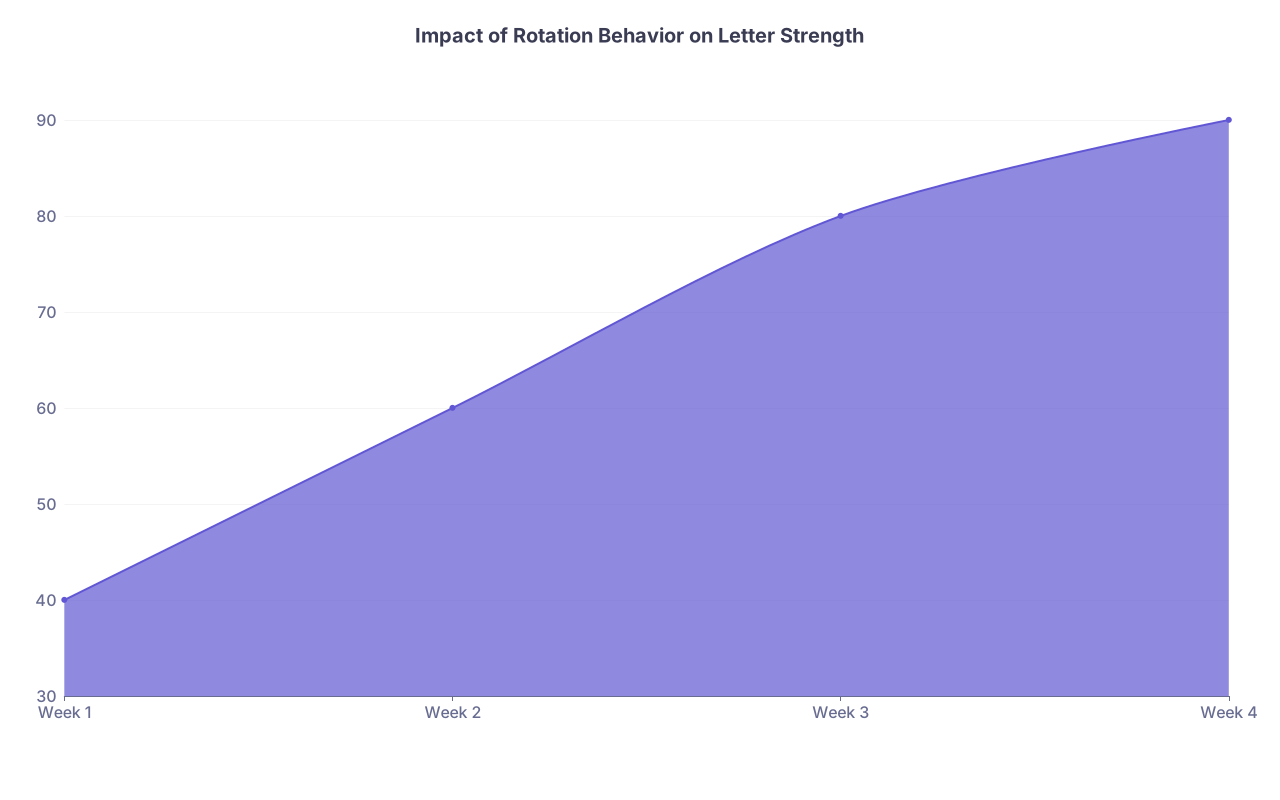
| Week 1 | 40 |
| Week 2 | 60 |
| Week 3 | 80 |
| Week 4 | 90 |
Here’s your next move, not “sometime later,” but today:
Take one current or recent rotation and write down three moments where your behavior could have looked unreliable, defensive, selfish, or checked-out from someone else’s perspective. Then pick one of those patterns and decide exactly what you’ll do differently on your very next clinical day—down to the specific words or actions. If you don’t rewrite those habits now, they’ll get rewritten for you in your letters.