

You are post-call, half-running down the stairwell between floors, because that is the only place you can corner your attending alone. You finally ask the question that has been sitting in your notes app for three weeks:
“Dr. Smith, would you be willing to write me a strong letter of recommendation for residency?”
He glances at his pager, then at you.
“I’ll try.”
And then he is gone.
Now you are stuck in limbo. Do you count this as a “yes”? Was that a soft “no”? Do you ask someone else? Push him again? Add his name into ERAS and hope for the best?
Here is the hard truth: “I’ll try” is not a commitment. It is a warning label.
The good news: you can often convert that “maybe” into a real, strong letter or at least into a clear answer you can plan around. You just need a protocol instead of wishful thinking.
Let me walk you through it.
Step 1: Decode What “I’ll Try” Actually Means
First, stop taking words at face value. Attendings are not trained in direct communication about letters. Many are conflict-avoidant. “I’ll try” can mean five very different things.

The 5 Most Common Translations of “I’ll Try”
| Version | Real Meaning |
|---|---|
| Time excuse | I like you but I am overloaded |
| Soft no | I cannot say no directly |
| Neutral letter | I can write something, not glowing |
| Uncertain fit | I do not know you well enough |
| Genuine intention | I will probably do it, not top 5% |
Let me spell them out.
Time excuse
“I’ll try, my schedule is crazy with service right now.”
Translation: They are willing, but admin tasks are at the bottom of their list. This can turn into a late or rushed letter.Soft no
“I’ll try, but I am really behind on letters already.”
Tone is hesitant. No enthusiasm. No “of course” or “you’ve been great.”
Translation: They do not want to commit and will either forget, delay, or produce something lukewarm.Neutral letter
“I’ll try. I am happy to say you completed the rotation and did well.”
Watch for bland language. No mention of “strong” or “enthusiastic.”
Translation: Expect a cookie-cutter letter with generic praise. Not harmful, not helpful in competitive fields.Uncertain fit
“I’ll try. We did not work together that much, but I can speak to the time I saw you.”
Translation: They know they lack specific examples. This will be a thin letter, even if positive.Genuine intention but low priority
“I’ll try, send me your stuff, I just need reminders.” Said with a smile, maybe a specific timeline, “Shoot me an email this weekend.”
Translation: They probably will write you a reasonably strong letter if managed correctly, but you will have to drive the process.
You are not trying to psychoanalyze every syllable. You are looking for two things:
- Did they explicitly agree to write a strong letter?
- Did they sound genuinely positive about you?
If the answer to both is “no,” treat “I’ll try” as conditional. It is your job now to clarify and either convert it into a real “yes” or safely walk away.
Step 2: Clarify Strength and Commitment (Without Being Awkward)
You fix this right where most students freeze: the follow-up sentence.
Instead of accepting “I’ll try” and walking away, you need one more line.
Use this exact structure:
- Reiterate the request for a strong letter.
- Give them a safe out.
- Anchor with a clear timeline.
Something like:
“Thank you. I really appreciate it. Because I am applying to [internal medicine] this cycle, strong letters matter a lot. If you do not feel you can write a strong letter for me, I completely understand and would rather know so I can ask someone else.”
You are not being pushy. You are giving them an elegant exit so they do not torpedo your application with a lukewarm letter.
If You Already Accepted “I’ll Try” and Walked Away
Fine. It happens. Here is how you repair it over email.
Subject: Letter of recommendation for [Your Name] – clarification
Body template:
Dear Dr. [Name],
Thank you again for being willing to consider a letter of recommendation for my [internal medicine / EM / etc.] residency applications.
Because letters play such a significant role, I wanted to check in briefly. If you feel you can write a strong, positive letter reflecting my performance on your service, I would be very grateful. If, for any reason, you feel you cannot write a strong letter, please let me know – I completely understand and have a few other potential letter writers I can approach.
If you are comfortable moving forward, I will send along my CV, personal statement draft, and ERAS information. My target ERAS deadline for finalized letters is [date about 2–3 weeks before you truly need it].
Thank you again for your time and teaching,
[Name]
[AAMC ID]
Will this feel a little uncomfortable? Yes.
Is it better than a vague “I’ll try” that turns into a generic or late letter? Absolutely.
Step 3: Decide Whether to Keep or Drop the “I’ll Try” Attending
Once you clarify, you still have a decision to make. Not every “yes” is worth keeping.
Here is the triage.
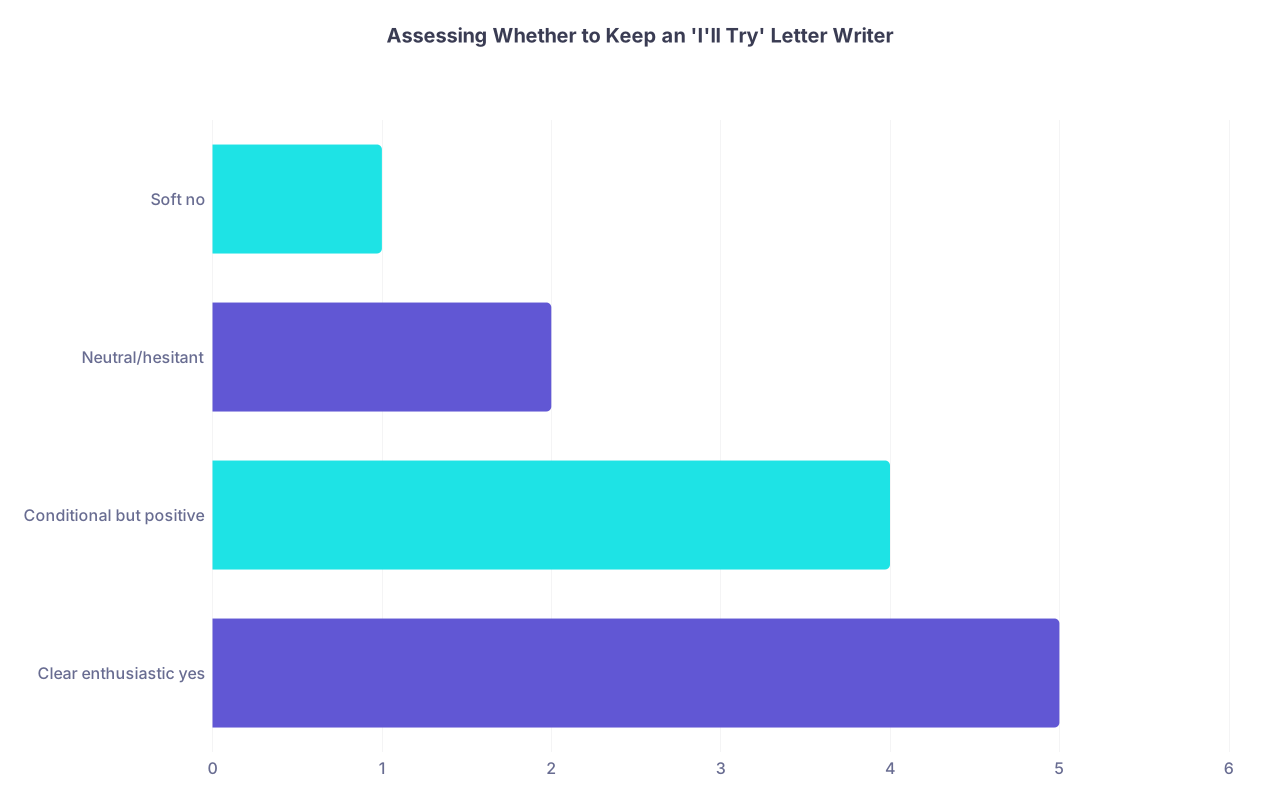
| Category | Value |
|---|---|
| Clear enthusiastic yes | 5 |
| Conditional but positive | 4 |
| Neutral/hesitant | 2 |
| Soft no | 1 |
Strong Green Light – Keep Them
Signs:
- They say “Yes, I can write you a strong letter” in speech or email.
- They respond quickly and positively.
- They remember specific details about your performance.
- They mention things like, “You were one of the stronger students we had this year,” or “I would be happy to support your application.”
Outcome: Proceed. Now your job is to make writing the letter as easy as possible (we will cover that).
Yellow Light – Use Only If Necessary
Signs:
- They agree, but their language is cautious:
- “I can write you a solid letter.”
- “I can say you did a good job.”
- They seem to struggle to recall specifics about you.
- You were middle-of-the-pack on that rotation.
These letters are usually neutral. Use them if:
- You need a required department letter.
- You are applying to a less competitive specialty and your other letters are strong.
- You have no one better from that rotation.
Red Light – Walk Away (Politely)
Signs:
- They delay answering even after your clarification email.
- Their written reply ducks the word “strong”:
- “I can write something.”
- “I can confirm you rotated with us.”
- You know your performance was below average or there was conflict.
Your move:
“Thank you very much for considering it. Given how competitive [specialty] is, I think I will work on getting letters from attendings who know me more closely. I really appreciate your time and teaching during the rotation.”
Yes, you can say that. You are not obliged to use someone just because they said “I’ll try.” ERAS does not notify them if you never assign their letter.
Step 4: Turn a Weak “Yes” into a Stronger Letter
Let us say the attending agrees to write a strong letter, but you know they are busy and their default letter style is “generic praise paragraph.” You are not helpless.
You can upgrade the letter indirectly by doing the heavy lifting for them.
Send a Real LOR Packet (Not Just a CV)
Most students send this:
- CV
- ERAS letter request with password
- Maybe a personal statement
You are going to add three high-yield pieces:
One-page “highlights” sheet
Very underused. This is where you shape their narrative.Include:
- Your name, photo (headshot), and contact info.
- Specialty and why you are choosing it (2–3 sentences).
- Bullet points: “Specific things you observed that might be helpful to mention:”
- Concrete patient encounters where you stepped up.
- Any feedback they gave you (e.g., “You presented like a sub-I”).
- Examples of work ethic, initiative, teaching, or teamwork they saw.
Example bullets:
- Led family meeting for Mr. X (CHF) with you present, summarized complex plan in patient-friendly language.
- Volunteered to come in early on post-call day to help with new admissions.
- Created sign-out template we used for new interns.
You are not telling them what to write. You are jogging their memory.
Rotation summary paragraph you pre-write
4–6 sentences you include in the email:“I worked with you on the MICU service from May 1–28, 2026, on your A team. During this time, I carried an average of 4–6 patients, wrote daily notes, presented on rounds, and assisted with several procedures (paracentesis, central line placement). You gave me feedback on improving my assessment and plan formatting and in my final evaluation commented that I ‘functioned at the level of a strong sub-intern.’”
Many attendings will literally mirror your language when they forget details.
Program list and context
Tell them:- Your target programs (a few examples).
- Your Step 2 score range or class percentile if strong.
- Any red flags they might help contextualize (if they know about them).
Short and factual. No essays.
Step 5: Manage Deadlines So “I’ll Try” Does Not Become “Never Sent”
“I’ll try” people are often late letter writers. You are responsible for managing them.
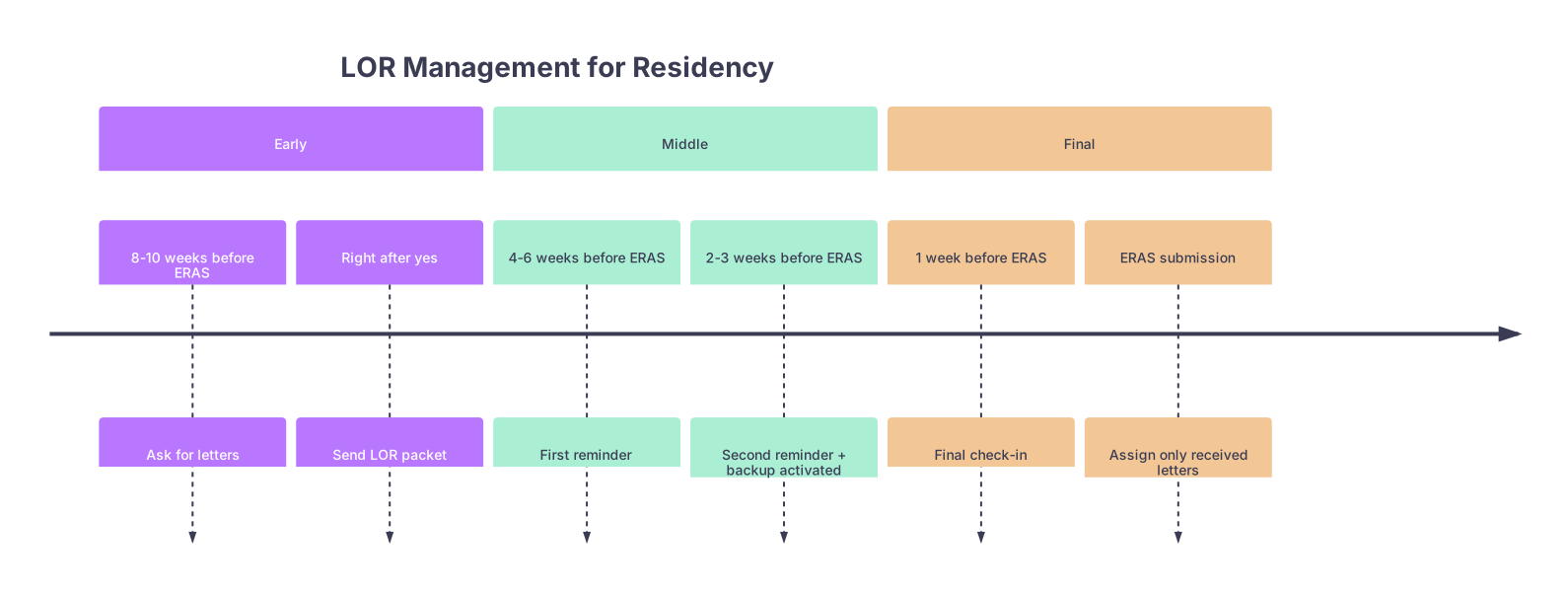
| Period | Event |
|---|---|
| Early - 8-10 weeks before ERAS | Ask for letters |
| Early - Right after yes | Send LOR packet |
| Middle - 4-6 weeks before ERAS | First reminder |
| Middle - 2-3 weeks before ERAS | Second reminder + backup activated |
| Final - 1 week before ERAS | Final check-in |
| Final - ERAS submission | Assign only received letters |
Your Working Timeline
Work backwards from when you want your application complete, not just submitted.
- Aim: All letters uploaded 1–2 weeks before programs start downloading heavily (usually early October for ERAS).
- That means asking:
- 8–10 weeks before that target date for new letters.
- First reminder:
- 4–6 weeks before.
- Second reminder:
- 2–3 weeks before.
- Final check:
- 1 week before: decide whether to replace them with a backup writer if the letter is still missing.
Reminder Scripts That Do Not Sound Desperate
Reminder #1 (friendly, assume good intent):
Dear Dr. [Name],
I hope you are doing well. I wanted to send a quick reminder about the residency letter of recommendation you kindly agreed to write. My goal is to have all letters uploaded by [date], so if you are still able to write it, submitting it in the next couple of weeks would be very helpful.
I have re-attached my CV and highlights sheet here for convenience.
Thank you again for your support,
[Name]
Reminder #2 (polite but firm, with an out):
Dear Dr. [Name],
I wanted to touch base again about my residency letter of recommendation. My application will be finalized on ERAS by [hard date], so I wanted to confirm whether you will be able to submit the letter by then. If your schedule makes it difficult, I completely understand and can make other arrangements.
Thank you again for your time,
[Name]
If they do not answer after the second reminder, that is your answer. Activate a backup.
Step 6: Build a Safer LOR Portfolio So One “I’ll Try” Cannot Sink You
The problem is not just one lukewarm attending. The problem is over-dependence on any single letter.
You need a portfolio strategy, not a “hope-for-the-best” approach.
How Many Letters and From Whom?
Typical strong ERAS set for most specialties:
- 3–4 total letters:
- 2–3 clinical letters in your chosen specialty or closely related.
- 1 from another area (subspecialty, research, department chair, or strong off-service mentor).
Rough specialty examples:
Internal Medicine:
- 2 IM attendings (ideally from sub-I and inpatient rotation).
- 1 additional letter (IM subspecialty, research mentor, or strong non-IM clinical).
General Surgery:
- 2 surgery attendings (one from sub-I if possible).
- 1 additional (ICU, trauma, research in surgery).
EM:
- 2 EM SLOEs (group letters from EM rotations).
- 1 other letter only if requested.
Ranking Your Potential Writers
Make a quick grid. Rank each potential writer on:
- How well they know you clinically (1–5).
- Enthusiasm / feedback you received (1–5).
- Specialty relevance (1–5).
| Attending | Knows Me (1–5) | Enthusiasm (1–5) | Specialty Fit (1–5) |
|---|---|---|---|
| Dr. A – IM sub-I | 5 | 5 | 5 |
| Dr. B – MICU | 4 | 3 | 4 |
| Dr. C – Surgery | 3 | 4 | 2 |
| Dr. D – Research | 4 | 5 | 3 |
Anyone below a combined score of ~9–10 is backup territory, not primary.
Your “I’ll try” attending will usually fall into one of two buckets:
- High fit, unsure enthusiasm → worth fighting for and managing tightly.
- Low enthusiasm, moderate fit → backup, not core.
Step 7: What If You Already Got Burned by an “I’ll Try” Letter?
Sometimes you realize too late. The letter feels generic. Or worse, a program director quietly tells your advisor, “One of your letters was… not strong.”
You cannot see or edit ERAS letters, but you are not powerless for the next cycle or for fellowship.
Here is how you fix forward:
1. Debrief With Someone Who Has Access
Most med schools have:
- A dean of students.
- An advising director.
- Sometimes a residency program director who can see your letter set.
Ask:
“I am concerned one of my letters may not have been very strong. Based on feedback from programs, do you think there are any letters I should quietly retire for future applications?”
They will not show you the letters, but I have seen deans tell students bluntly: “We will not use Dr. X’s letter again.”
2. Overwrite With Better Letters for Fellowships or Reapplications
If you are reapplying or applying for fellowship:
- Build an entirely new set of letters.
- Ask strong, recent supervisors: “Would you be willing to write a strong letter specifically for fellowship?”
- Do not re-use questionable letters if your institution gives you control.
3. Change How You Ask Next Time
Do not repeat the same soft-ask mistake.
Your new baseline script:
“Based on our time working together, do you feel you can write me a strong letter of recommendation for [X]?”
If they hesitate, you thank them and move on.
Step 8: Exact Scripts for Common “I’ll Try” Situations
You probably want concrete words. Here are the main scenarios.
Scenario 1: Real-Time “I’ll Try” on Rounds
You:
“Dr. Lee, I am applying in pediatrics this cycle and really valued working with you in clinic. Would you feel comfortable writing me a strong letter of recommendation?”
Them:
“I’ll try. Just send me your stuff.”
You (do not leave yet):
“Thank you. I really appreciate it. Since letters are so influential, I always ask directly – do you feel you can write a strong, positive letter for me? If not, that is absolutely fine, and I can ask someone else I worked with more closely.”
Then watch their face:
- If they brighten: “Yes, definitely, you did great here,” that is a yes.
- If they stumble: “Well, I can say you were here and did fine,” that is a no.
Scenario 2: Hesitant Email Reply
You:
Would you be able to write a strong letter of recommendation for my [specialty] residency applications?
Them:
I can try. My schedule is pretty busy, but I should be able to say you did a good job on the rotation.
You:
Thank you for considering it. Because the strength of letters can significantly affect my application, I want to be transparent that I am specifically looking for very strong, detailed letters from attendings who feel they can enthusiastically support me. If you feel your letter would be more neutral, that is totally okay, and I will not be offended at all if you prefer I ask someone else.
You just saved yourself from a mediocre LOR.
Scenario 3: Required Department Letter, Weak Relationship
This comes up with “Chair’s letters” or mandatory department letters. You cannot fully avoid it, but you can cushion it.
Approach:
- Accept that one letter may be generic.
- Make the others exceptional.
- Load your packet with specifics so even a lukewarm chair can pull concrete details from your CV, evaluations, and highlight sheet.
Step 9: Side Problem – When “I’ll Try” Masks an Underperformance Issue
Sometimes the attending is not the problem. Your performance was. They are too professional to say, “No, you were below average,” so you get the half-committed “I’ll try.”
If you suspect this is you (bad evals, clear tension, you know the rotation did not go well), deal with the root problem:
Ask for direct feedback (even retroactively):
“I have been reflecting on my performance during our rotation and want to improve. Are there specific areas you felt I struggled with that I can work on moving forward?”
Then ask someone else for a letter after you have improved. Show them the work you did to fix issues.
Better to have two later, genuinely strong letters than one early, weak one from a rough rotation.
Step 10: How to Practice This Before It Actually Matters
This is a communication skill. You will use it with attendings, PDs, employers for the rest of your career. Do not practice for the first time with your dream letter writer.
Concrete way to rehearse:
- Write out your asking script.
- Say it out loud three times.
- Practice with:
- A classmate.
- A trusted resident.
- A faculty mentor you are not asking for a letter from.
Ask them:
“If you heard me say this, would it feel respectful but clear? Or pushy?”
Tweak until you can say “strong letter” and “if not, that is okay” without your voice dropping to a whisper. That confidence alone often converts an “I’ll try” into “Of course, you earned it.”
Your Next Step Today
Do not just nod and move on.
Right now, do this:
- Open a notes document.
- List every attending you are considering asking for a residency letter.
- Next to each name, write three numbers from 1–5:
- How well they know you.
- How positive their feedback has been.
- How relevant they are to your specialty.
Then mark any attending where your last interaction sounded like “I’ll try,” “maybe,” or “I’m busy.”
For one of those “I’ll try” attendings, draft and send a clarification email today using the template above. Force the issue now, while you still have time to pivot, instead of discovering in September that your “yes” was never really a yes.


