

Your letter of recommendation portfolio can quietly kill your application before anyone even looks at your personal statement.
Program directors will forgive a so‑so personal statement. They will not forgive a weird or lopsided LOR set that makes them question your judgment, your clinical ability, or your fit for the specialty.
You still have time to fix it. But you need to move fast and you need to be strategic.
This is the step‑by‑step playbook I use with students in exactly your position: ERAS deadline looming, letters not ideal, mild panic setting in.
Step 1: Diagnose Exactly What Is Wrong With Your LOR Portfolio
Do not start emailing attendings until you know what the problem is. “I just feel like my letters are weak” is useless. You need a concrete diagnosis.
Your portfolio can be unbalanced in a few predictable ways:
- Wrong mix of specialty vs non‑specialty letters
- Too many department chair or “name” letters that say nothing real
- Not enough recent letters (especially post‑Step 1 pass/fail)
- Too many research letters, not enough clinical
- Weak signal letters for competitive specialties
- Lopsided strength (one stellar letter, two obviously generic ones)
- Red flags: lukewarm or subtly negative letters
Start with a simple inventory:
List every letter you currently have or expect:
- Writer name and title
- Specialty
- Setting (inpatient, outpatient, sub‑I, research, away rotation)
- Date of interaction
- How well they know you (1–5)
- Your honest sense of strength (1–5)
Now match that against what programs actually want.
For most specialties, the “ideal” core set (out of 3 or 4 total):
- 2–3 letters from your chosen specialty
- 1 letter from another core clinical specialty (IM, surgery, peds, etc.), strong clinical focus
- Optional: 1 research or department/chair letter if it is genuinely personalized
Here is a rough target mix by specialty:
| Target Specialty | Specialty LORs | Other Clinical LOR | Research/Chair LOR |
|---|---|---|---|
| Internal Med | 2–3 IM | 0–1 | 0–1 |
| Gen Surgery | 2–3 Surgery | 0–1 | 0–1 |
| Pediatrics | 2–3 Peds | 0–1 | 0–1 |
| EM | 2 EM SLOEs | 0–1 | 0 |
| Psychiatry | 2 Psych | 0–1 | 0–1 |
| Competitive (Derm, Ortho, ENT) | 3 specialty | 0–1 | 0–1 strong name |
Now identify the imbalance. Examples:
- “I want IM, but I have 1 IM letter, 1 family med, 1 research.”
- “Applying ortho but only 1 ortho letter and 2 generic medicine letters.”
- “All my letters are from M3; nothing from my sub‑I or this year.”
- “One incredible EM SLOE, second EM SLOE is borderline disastrous.”
Write the problem in one sentence. Literally.
- “I am missing a second strong specialty‑specific clinical letter.”
- “My portfolio is heavy on research, light on direct clinical performance.”
- “My strongest letter is from an unrelated specialty and that looks odd.”
Once you have that sentence, you know what you are fixing.
Step 2: Time Check – What You Can Realistically Change Before ERAS
You cannot manufacture a 3‑month relationship out of thin air. But you can improve your portfolio more than you think in 2–4 weeks if you are aggressive and organized.
Do a brutal time check:
- Weeks until you plan to submit ERAS?
- Current rotation schedule between now and then?
- Any attending right now who:
- Sees you regularly
- Knows your name
- Has seen you take ownership of patients
That last bullet is critical. You do not need perfection. You need at least one or two people who have seen you actually doctor.
If you have:
1–2 weeks:
- You can upgrade one letter from “generic” to “decent/solid” if you are intentional on your current rotation.
3–4 weeks:
- You can usually secure 1 new strong clinical letter (especially on a sub‑I or acting internship).
More than 4 weeks:
- You can realistically add 2 better letters and then choose your best 3–4 for ERAS.
Stop telling yourself “it’s too late.” It is late. But not too late.
Step 3: Fix #1 – Get the Right Specialty Mix Fast
If your imbalance is “not enough letters in my chosen specialty,” this is your first emergency.
Scenario A: You are currently on that specialty
You are on IM and applying IM. Or on psych applying psych. Good. You have leverage.
Here is your four‑step protocol for the next 7–14 days:
Identify the right attending(s)
- Preferably:
- Full‑time faculty
- Known to write good letters (ask residents quietly)
- Has seen you present, write notes, manage patients
- Preferably:
Turn up the intensity on performance
For the next 1–2 weeks:- Take new admissions whenever offered
- Volunteer to present more
- Ask for feedback end of day: “What is one thing I can improve tomorrow?”
- Fix that thing visibly the next day
Ask for the letter at the right moment
End of week, after a good day or two:- “Dr. Smith, I am applying to internal medicine this cycle, and I have really valued your feedback on this rotation. Would you feel comfortable writing me a strong letter of recommendation focusing on my clinical work here?”
- Use the word strong. That gives them an escape hatch if they cannot.
Make it easy for them
If they say yes, follow up that evening:- ERAS letter request link
- PDF packet:
- CV
- Step scores, transcript
- Short paragraph: your career goals and why this specialty
- 3–5 bullet points reminding them of specific encounters:
“Patient with DKA I followed for 4 days…”,
“Family meeting on 7/14 where I presented the plan…”
During that short window, you are essentially auditioning for a letter, not just completing a rotation.
Scenario B: You are not on that specialty and cannot change
You are on outpatient FM, applying to surgery. Or on psych, applying to EM. Less ideal, but still salvageable.
You have three options:
Go back to a recent rotation
- Email an attending from a recent core or sub‑I rotation (within last 6–9 months) where you performed well.
- Subject line: “Letter of Recommendation Request – [Your Name], [Rotation/Month]”
- Remind them of who you are (“We worked together on the May inpatient service; I followed Mr. X with decompensated cirrhosis…”) and ask specifically for a strong letter.
Use pre‑existing specialty mentors, even if contact was brief
- Research mentors in your specialty
- Residents or fellows you worked closely with who can funnel to a faculty writer
For research mentors: ask for a clinical‑and‑professional letter, not just “good researcher.”
Strategically lean on strong non‑specialty clinical letters
If you cannot get another specialty letter in time, you compensate by:- Making sure your non‑specialty clinical letter screams “excellent clinician in any field”
- Using your personal statement and experiences to tie that training into your desired specialty
No, it is not ideal. But a killer IM letter that says you are the best student they have seen in 5 years is still better than a generic “She was fine” surgery letter.
Step 4: Fix #2 – Balance Clinical vs Research vs Chair Letters
Too many applicants over‑optimize for pedigree and under‑optimize for substance.
Program directors want:
- Evidence you can function on the wards, today
- Evidence of professionalism and work ethic
- Bonus: evidence of scholarship in competitive specialties
If your portfolio looks like:
- 2 research letters
- 1 department chair who barely knows you
- Maybe 1 generic clinical letter
You have a problem.
Priority: Clinical Letters First
You need at least 2 writers who have watched you:
- Present on rounds
- Call consults
- Talk to families
- Write notes and follow through
If you do not have that:
- Use your current or upcoming rotation, as above, to secure at least one very clear, detailed clinical letter.
- Go back to the best inpatient attending from third year. Yes, even if it was months ago. They still have notes and can vaguely remember you with your help.
When you ask, explicitly frame what you need:
“I am hoping for a letter that comments on my clinical skills on the wards – history taking, assessment and plan, reliability with follow‑up, and teamwork.”
You are telling them what to emphasize.
How to Handle Research Letters
Research letters are useful when:
- The writer is well known in the field and
- They can speak to your work ethic, communication, and diligence with specific examples
They are dead weight when:
- They simply say “Good at data, showed up, smart student.”
Use research letters in these cases:
- Competitive specialties (derm, ortho, ENT, neurosurg) where research is part of the culture
- You have a long‑term, multi‑year relationship with the PI
- The clinical letters are already strong and you are adding one “extra layer”
If you currently have a lopsided portfolio (2 research, 1 clinical), your fix is:
- Add at least 1 strong clinical letter
- For most programs, use 2–3 clinical + 0–1 research per application
- Do not feel obligated to send every letter to every program
What to Do With Department or Chair Letters
Chair letters are often overrated. Many of them are standardized templates with your name swapped in.
Use chair letters if:
- Your specialty culture expects it (some surgery programs, some IM departments)
- The chair actually knows you or made an effort to interview you personally
- Your school’s “standard” chair letter is known not to be garbage
If your chair letter is clearly generic but you are stuck with it, do this:
- Do not send it to every program just because you have it
- Prioritize strong clinical letters instead
- Use the chair letter as your “fourth” letter if programs allow and you have room
Step 5: Fix #3 – Deal with Weak or Lukewarm Letters (Quietly)
Students almost never want to admit this, but it happens constantly: one of your letters is probably mediocre.
Red flags:
- The writer was hesitant when you asked
- They said something like “Sure, I can write you a letter” but never used the word “strong”
- Your interaction with them was brief or rocky
- You consistently got lukewarm feedback
If you have any doubt, you handle it like this:
When You Are Still Considering Asking Them
Phrase your ask as a strength test:
“Would you feel comfortable writing me a strong letter of recommendation for residency that comments specifically on my clinical performance with you?”
If they hedge:
- “I can write you a letter, but I don’t know how strong it would be…”
- “I do not know you well enough to do that…”
That is your answer. Do not ask them. Thank them and move on.
When the Letter Is Already Written and Uploaded
This is trickier because ERAS letters are confidential.
You cannot read the letter, but you can infer:
- Did they submit quickly or after multiple reminders?
- How was your actual relationship?
- Did they ever praise you strongly in front of others?
If your gut says “this one is probably generic,” your fix is simple:
- Do not use that letter for programs where you have better options.
- If you have 4–5 letters, you can selectively choose which 3–4 each program sees.
You are not obligated to send every letter to everyone.
For borderline writers you are already unsure of, I usually advise:
- Only keep them in the mix if they are from your desired specialty and you do not have enough other specialty letters.
- Even then, try to replace them with a better letter from a current rotation if time allows.
Step 6: Fix #4 – Optimize Which Letters Each Program Actually Sees
This is where many applicants are lazy. They upload 4 letters and blast the same 3 or 4 to every single program.
You can be smarter than that.
Rule of thumb:
- ERAS allows you to assign different combinations of letters to different programs. Use that.
- You do not need to show all letters to all programs. More is not better; better is better.
Priority Logic When Choosing 3–4 Letters
For each program, prioritize:
Specialty clinical letters that know you well
- Example: For IM → your two best IM attendings.
Best “global clinician” letter from any core specialty
- Someone who will say: “I would trust this person with my family.”
Optional: research or chair letter if it is strong and relevant
- Use especially for academic or highly competitive programs.
If you are dual applying (e.g., EM + IM, or Ortho + preliminary surgery):
- Build separate letter sets:
- EM set: EM SLOEs + best IM or surgery clinical letter
- IM set: IM letters + one generic strong clinical letter, maybe research
- Do not send EM SLOEs to IM programs that will not know how to interpret them, unless explicitly allowed and clearly positive.
Step 7: Short‑Term Performance Sprint to Earn a Last‑Minute Stellar Letter
If you have 2–3 weeks on a current or upcoming rotation, treat it like a laser‑focused sprint to earn one excellent letter.
Here is the protocol I give students:
Week 1: Establish Yourself
- Show up early, know patients cold.
- Volunteer for work that residents want to dump:
- Call consults
- Track down old records
- Draft discharge summaries
- Ask a senior resident for brutally honest feedback by Day 3:
- “What does a top‑tier student on this service look like? What do they do differently?”
Write down what they say. Then do it.
Week 2: Make Yourself Visible to the Attending
- Pre‑round and present clearly, with your own assessment and plan, not just regurgitation.
- After a good case or family interaction, briefly debrief with the attending:
“Anything I could have handled better in that family meeting?” - Look for 1–2 “anchor” interactions:
- You led a family discussion
- You noticed a subtle clinical finding
- You caught an error or prevented a problem
Those specific stories are what end up in strong letters.
End of Week 2 or 3: Ask for the Letter
Precisely:
“Dr. X, I am applying to [specialty] this cycle, and this has been one of the most important rotations for me. Based on what you’ve seen, would you feel comfortable writing me a strong letter of recommendation, focusing on my clinical performance and work ethic on this service?”
If yes:
- Send your packet that evening.
- Politely mention your ERAS timeline (“I plan to submit my ERAS application on [date]; ERAS recommends letters be in around that time.”)
This “sprint” approach is often enough to convert what would have been a generic letter into a detailed, high‑impact one.
Step 8: Use a Simple Grid to Decide What to Fix First
If you are overwhelmed, reduce this to a simple prioritization grid:
| Problem Type | Priority | Typical Fix |
|---|---|---|
| Missing specialty clinical letter | Very High | Current/ recent rotation sprint |
| Only 1 clinical letter total | Very High | Add any strong inpatient attending |
| Excess research vs clinical | High | Add/replace with clinical letters |
| Generic chair letter dominating | Medium | Use as 4th letter only |
| All letters > 12 months old | High | Get 1 new recent sub-I/AI letter |
Fix, in this order:
- Lack of specialty letters
- Lack of strong clinical letters of any type
- Overweight research/chair letters
- Age of letters
Step 9: Timeline Reality and Communication Strategy
Programs strongly prefer applications to be complete near the opening of ERAS review. But “complete” is not always the same as “frozen.”
A few practical points:
- Submit your ERAS application on time even if 1 letter is still pending. That is better than delaying submission for weeks.
- Letters can trickle in soon after submission; programs understand this.
- If one crucial letter might be late, tell the writer your real deadline is 5–7 days earlier than ERAS opening.
When you email your letter writers:
- Be respectful but clear about timelines:
- “I plan to submit ERAS on [date]. ERAS recommends that letters be uploaded by that time, so having your letter by [earlier date] would be extremely helpful.”
- One polite reminder 5–7 days before that date is acceptable. Multiple daily nudges are not.
If someone obviously is not going to submit in time:
- Shift attention to another attending where you can still salvage a decent letter.
- Do not sit and hope while the clock runs out.
Step 10: Common Dumb Mistakes to Avoid (So You Do Not Sabotage Yourself)
I have watched smart students undermine themselves with letters. Here are the ones you are still in time to avoid:
- Sending a weak “name” letter instead of a strong “no‑name” letter. Content beats title every single time.
- Using three letters from unrelated specialties because you “got along well” with them, while applying to something completely different.
- Not asking for a strong letter explicitly, then being surprised by a lukewarm one.
- Assuming you must use every letter you obtained. You are curating, not hoarding.
- Waiting passively for a letter that is clearly not coming.
If you are not sure between two letters, ask yourself:
“Which writer would I rather have defending my application in a room of skeptical program directors?”
Choose that one. Even if they are not the department superstar.
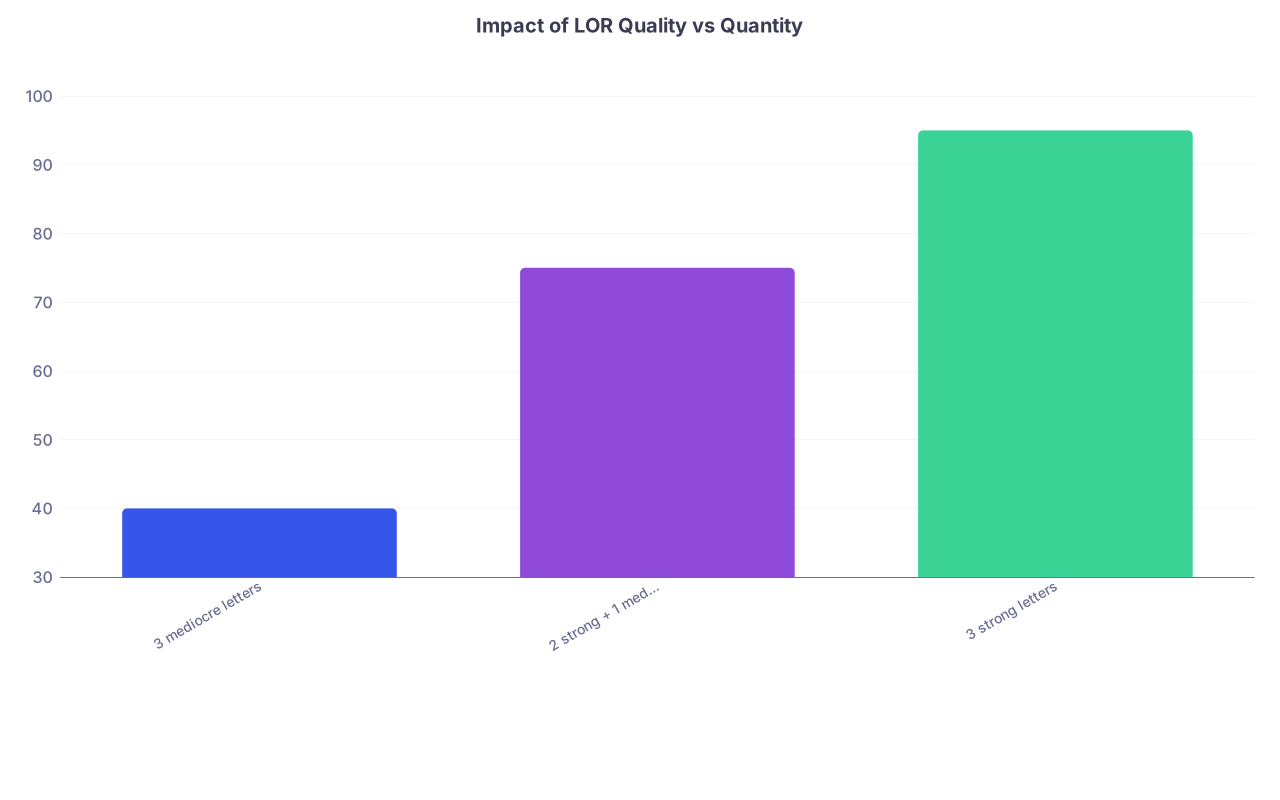
| Category | Value |
|---|---|
| 3 mediocre letters | 40 |
| 2 strong + 1 mediocre | 75 |
| 3 strong letters | 95 |

| Step | Description |
|---|---|
| Step 1 | List Current Letters |
| Step 2 | Target Current/Recent Specialty Attending |
| Step 3 | Add Strong Inpatient Attending Letter |
| Step 4 | Prioritize Clinical Letters in ERAS Assignments |
| Step 5 | Optimize Letter Sets per Program |
| Step 6 | Missing Specialty Letter? |
| Step 7 | Enough Clinical Letters? |
| Step 8 | Too Many Research/Chair Letters? |
Final Tighten‑Up Before You Click Submit
Once you have:
- Identified your main imbalance
- Secured at least one additional strong clinical or specialty letter where possible
- Decided which 3–4 letters each program will see
Do a final quick sanity check:
- Does every program see:
- At least 2 people vouching for your clinical work?
- At least 1 person from your chosen specialty (preferably 2–3)?
- Are you avoiding obvious weak links when you have better options?
- Are you using research or chair letters strategically, not by default?
If yes, you are in much better shape than when you started reading this.
Key Takeaways
- Diagnose the imbalance clearly: missing specialty letters, weak clinical coverage, or overreliance on research/chair letters.
- Use your current and recent rotations aggressively to earn 1–2 strong, specific clinical letters fast, and explicitly ask for a strong letter.
- Curate which letters each program sees; prioritize high‑content clinical and specialty letters over big names or generic endorsements.


