

The usual advice about letters of recommendation completely fails you when you switch specialties late. You do not have “years to build relationships.” You have months. Sometimes weeks. You need targeted LORs yesterday.
Here is the good news: you can manufacture strong, specialty-specific letters much faster than you think—if you stop doing what everyone else does and follow a deliberate, aggressive plan.
You are not trying to “hope they know you.” You are running a short, focused campaign to give specific attendings exactly what they need to write the right letter, on a tight clock.
Step 1: Get Clear on What Your New Specialty Expects in LORs
If you switch specialties late, your first mistake is usually thinking: “Any strong letter is fine.” Wrong. In a specialty switch, the type of strength matters more than the amount.
Programs are asking themselves two questions:
- Does this person really understand and want this specialty, or are they just fleeing something else?
- Will they function safely and effectively on Day 1 in our world, not the prior one?
That means your letters need to show:
- Specialty fit (why this field fits you)
- Clinically observed performance relevant to the new specialty
- Professionalism and work ethic
- Coachability / growth
- A credible, senior voice saying: “Yes, I would take this person into my specialty.”
Here is the core target for most major fields:
| New Specialty | Ideal # Specialty LORs | Acceptable Mix If Late | Absolute Minimum |
|---|---|---|---|
| Internal Med | 2–3 IM, 0–1 prior | 1–2 IM + 1 prior | 1 strong IM |
| FM/Peds | 2 in target field | 1 target + 1 prior | 1 target |
| Gen Surgery | 2–3 Surgery | 1–2 Surgery + 1 prior | 1 surgeon |
| Psych | 2 Psych | 1 Psych + 1 prior | 1 Psych |
| EM | 2 SLOEs if possible | 1 SLOE + 1 EM LOR | 1 SLOE or EM |
If you are very late in the cycle, your realistic goal is:
- 1–2 new specialty letters that actually know you
- 1 older, very strong letter from your previous track, repositioned to highlight transferable strengths
You build from there.
Step 2: Audit What You Already Have (And Salvage It)
Before you scramble to create new relationships, squeeze every drop out of what you have now.
A. List all potential letter writers
Make a quick, ruthless inventory:
- Attendings from core clerkships
- Sub-I / acting internship attendings
- Research mentors
- Program leadership (APDs, PDs) who know you
- Chiefs or fellows (as co-signers with attendings)
- Prior specialty attendings who actually like you
For each, quickly rate:
- How well they know your clinical work (0–3)
- How positive you think they are about you (0–3)
- Relevance to new specialty (0–3)
Anyone with total ≥ 6 is a priority target.
B. Identify letters you can reframe for your new specialty
If you already have strong letters from your prior specialty, they are not useless. They just need context.
For example, switching from surgery to internal medicine:
- A surgical attending can emphasize:
- Work ethic
- Calm under pressure
- Procedural skills translating to bedside skills (lines, codes, ICU)
- Team communication in high-acuity settings
Your job: when you ask them for an updated letter, you guide them:
“I am applying to Internal Medicine this year. I would be very grateful if you could comment specifically on my clinical reasoning on the wards, work ethic, teamwork, and reliability—qualities that would be important in IM.”
You are not rewriting their letter. You are shifting their lens.
Step 3: Engineer Short, High-Yield Contact With Target Attendings
If you are late, you do not have the luxury of a 4-week elective turning into a “maybe they will remember me.” You create deliberate, high-density exposure.
Scenario 1: You still have time to schedule 2–4 weeks in the new specialty
Your goal on that rotation is not just to “do well.” It is to win 1–2 letters. That is a different mindset.
Do this:
Identify the right attendings.
- PD, APD, or respected faculty in the specialty.
- Attendings who work closely with students/residents.
- Avoid the notoriously cynical “no one impresses me” types if you only have 2 weeks.
Signal your intention early. On Day 1 or 2, say something like:
“I am switching into [specialty] this application cycle, and I am hoping to earn a strong letter. I would really appreciate any feedback on what I can focus on during this rotation to reach that level.”
That sentence does three things:
- Puts them on notice that you are serious.
- Gives them permission to evaluate you more closely.
- Makes later letter requests much less awkward.
Ask for targeted, weekly feedback. At the end of the first week:
“Could I ask you for one or two specific things I should work on next week to be at the level of a strong residency applicant in [specialty]?”
Then actually implement those suggestions and reference them a week later:
“You mentioned last week that I should structure my presentations more tightly. I have been using the APSO format we discussed—have you seen improvement, or is there more I should adjust?”
That shows insight and growth, which letter writers love to describe.
Focus your performance on high-visibility behaviors:
- Organized, concise presentations with specialty-specific language
- Reading and applying guidelines relevant to their patients
- Reliable follow-through (labs, consults, notes done without reminders)
- Taking ownership of 1–2 patients and knowing them cold
You are building letter material in real time: clinical reasoning, professionalism, growth.
Scenario 2: You cannot get a full rotation before letters are needed
Then you manufacture concentrated exposure.
Options:
- Short elective (1–2 weeks) in the target specialty.
- ICU or consult service that works closely with the target field (e.g., cardiology consults for IM).
- Call shifts, clinics, or longitudinal experiences you can join.
For these short stints:
Pick 1–2 attendings you will actually see multiple times.
Do the same early-signaling move:
“Dr. X, I know I am only with you for a short time, but I am applying to [specialty] this year and I am hoping to earn a letter from someone in the field. Please let me know what you want to see from me over these few days to make that realistic.”
Volunteer for a bit more responsibility:
- Offer to pre-round.
- Pre-chart for clinic.
- Read on relevant topics before each day and mention it briefly when it matters.
You are compressing 4 weeks of “impression” into 5–7 working days.
Step 4: Use a Structured Pitch When You Ask for the Letter
Stop sending vague, “Would you be willing to write me a letter?” emails with no context. That is how you get generic, lukewarm nonsense.
Your ask should be:
- In person if at all possible.
- Explicitly about a strong letter.
- Accompanied by materials that make their job easy.
Here is a direct script you can adapt:
“Dr. X, I have really appreciated working with you these past [X days/weeks]. I am applying to [specialty] this cycle after [brief note about your prior path], and I am hoping to gather a small set of very strong, targeted letters.
Would you feel comfortable writing me a strong letter of recommendation for [specialty] that comments specifically on my clinical work with you, my growth during the rotation, and my suitability for this field?”
If they hesitate or say anything less than “Absolutely” / “Of course,” you politely escape:
“Thank you for your honesty. I really appreciate it—I am trying to be very intentional about who I ask.”
You cannot afford a lukewarm letter when switching late.
The “LOR packet” you hand them
When they say yes, you immediately follow with materials. This is how you turn a decent letter into a targeted weapon.
Your packet should include:
- Updated CV
- Personal statement draft for the new specialty
- ERAS/PhORCAS/VSLO summary or application summary page
- One-page “LOR helper” document with:
- Your path: 3–4 sentences explaining the specialty switch
- 3 bullet points of strengths you hope they can comment on (based on what they actually saw)
- 2–3 concrete patient or scenario reminders where you worked with them
- Your match goals (type of programs, region, career aims)
Example content for that one-pager:
- “Brief background: I initially pursued general surgery and completed [X rotations]. During that time I realized that I am most engaged by longitudinal care, complex medical decision-making, and multidisciplinary inpatient medicine, so I am now fully committed to Internal Medicine.”
- “If appropriate, it would help me greatly if you could comment on:
- My clinical reasoning and ability to formulate assessment/plan
- My reliability and ownership of patient care
- My communication with patients and the team”
- “Cases that might jog your memory:
- Ms. A (DKA): I presented and adjusted insulin regimen each day
- Mr. B (CHF): I followed up on diuretic adjustments and consults
- Night float: managed admissions on 7/15 call night”
You are not telling them what to write. You are reminding them what you did.
Step 5: Reposition Old Letters And Old Relationships
If you are switching late, some of your strongest advocates are in the old specialty. That is fine. You just need to reframe their support.
A. Ask for updated letters, not recycled ones
If a surgeon wrote you a glowing letter in April and you are now applying to EM in September, do not just reuse that letter blindly.
Reach out directly:
“Dr. Y, you wrote me a very kind letter earlier this year when I was pursuing [prior specialty]. After a lot of reflection and exposure to [new specialty] rotations, I have decided to pursue [new specialty] and I feel very confident in this choice.
Would you be willing to update your letter for this application cycle, perhaps with more emphasis on the qualities that would transfer well to [new specialty], such as work ethic, teamwork, and performance in acute settings?”
Most attendings will understand this and respect the maturity of the decision when you frame it as movement toward fit, not running away from something.
B. Explicitly address your switch in personal statement and conversations
Your letters alone cannot fix the narrative. You align everything:
- Personal statement: clearly, succinctly explain the switch and what you did to confirm the new choice.
- Letters: highlight consistent traits (work ethic, professionalism, patient care) across both specialties.
- Interviews: emphasize what you learned from the first path, not how much you hated it.
When your letters echo your story—“I saw them excel in [old specialty], and I believe those strengths will make them an excellent [new specialty] resident”—that reassures PDs.
Step 6: Build a Compressed Relationship Plan (4–8 Weeks)
You are not going to magically have a “longstanding relationship” if you decided to switch in August. But you can simulate some of that depth by being intentional and visible.
Here is a simple 6-week playbook:

| Step | Description |
|---|---|
| Step 1 | Week 1: Identify targets |
| Step 2 | Week 1-2: Signal intent on rotation |
| Step 3 | Week 2-3: Ask for feedback, show growth |
| Step 4 | Week 3-4: Provide extra value & visibility |
| Step 5 | Week 4-5: Request strong LOR in person |
| Step 6 | Week 5-6: Follow-up & maintain contact |
Week 1–2: Identify and signal
- Identify 2–3 realistic letter-writer targets.
- Informally let them know you are applying to their field and want to earn a strong letter.
- Start your “LOR helper” document with cases where you work with them.
Week 2–3: Feedback and growth
- Ask for specific feedback.
- Implement it and make sure they see the change.
- Volunteer for one extra task that makes their life easier (taking ownership of a complex patient, teaching a student, cleaning up the list).
Week 3–4: Increase your visibility
- Present one short, focused teaching point on rounds or in clinic (no rambling 20-slide talk—one-pager with guideline or article).
- Email them once with a brief, high-yield summary of an article you discussed, showing initiative.
Week 4–5: Ask for the strong letter
- Have the in-person conversation.
- Immediately follow with an email with your packet.
Week 5–6: Follow up and maintain
- Gently confirm letter submission if needed.
- Send one thank-you email before ERAS opens / rank lists lock.
- If you get interview invites, a short “thanks again, I am interviewing at X, Y, Z” email is fine.
This compressed timeline looks artificial on paper. In reality, I have seen people rescue entire application cycles this way.
Step 7: Handle the EM / SLOE and Other Specialty-Specific Weirdness
Some specialties have very specific expectations for letters. Switching late makes these tricky but not impossible.
Emergency Medicine (SLOEs)
EM programs heavily weight SLOEs (Standardized Letters of Evaluation). If you are switching late:
Get at least one SLOE from:
- A home EM rotation, or
- An away rotation at an EM site known to write SLOEs.
On that rotation:
- Every shift matters—residents and attendings all contribute to your SLOE impression.
- Tell the clerkship director or site director early:
“I am switching into EM this year and need a SLOE for this application cycle. I would really appreciate any guidance on how to perform at a level where you would feel comfortable supporting my application strongly.”
Accept that you may not get 2–3 SLOEs. One strong SLOE plus 1–2 other letters can still get you interviews if the rest of your file is decent.
Surgical fields
Surgery is ruthless with letters. If you are switching into surgery late:
You need:
- At least one letter from a surgeon who has seen you do real surgical work (OR + floor + call).
- Ideally, a letter from a PD/Chair or equivalent.
On a short sub-I or away:
- Be relentlessly early, prepared, and available.
- Let the PD or service chief know your intention in week 1.
- Ask them frankly:
“If I perform at the level you expect over the next few weeks, would you consider writing a strong letter on my behalf?”
If they say yes, you treat that rotation like a month-long job interview. Because it is.
Step 8: Fix Common Self-Sabotage Mistakes
People switching specialties late often hurt themselves more than the situation does. Avoid these:
Mistake 1: Waiting too long to ask
If you wait until the last day of the rotation, here is what happens:
- The attending is rushed.
- They barely remember specific cases.
- Your ask sounds like an afterthought.
Fix: Ask in the second half of the rotation, once they have seen you at your best but before they are overloaded with evaluations at the end.
Mistake 2: Being vague about your path
If you act cagey about why you are switching, attendings assume drama or failure. You do not owe them your entire life story, but you owe them coherence.
Good framing:
- “I realized I am more fulfilled by X than Y.”
- “I am better suited to longitudinal patient relationships / acute care / procedural work / complex diagnostics.”
- “My experiences in [specific rotation] made it clear that [new specialty] is where I can do my best work.”
Bad framing:
- “I hated [old specialty].”
- “I could not stand the people.”
- “It was too hard / the hours were terrible.”
Your letter writers will subconsciously echo your tone about this. Guide it.
Mistake 3: Sending no guidance
You are not “being respectful” by leaving your letter writer with nothing but your name. You are making their job harder and getting a generic letter.
Fix: Always send:
- CV
- Personal statement
- Target specialty, with one-line explanation
- LOR helper one-pager
Attending sees: “This person is organized and serious.” That translates straight into the letter.
Mistake 4: Ignoring non-clinical advocates
If you are very late and cannot stack multiple new specialty letters, a research mentor or prior advisor can absolutely help—if they can comment on:
- Work ethic
- Independence
- Communication
- Reliability over time
When you ask them, be explicit:
“I know your perspective is primarily research-focused, but programs tell me they value letters that can speak to my work ethic, follow-through, and ability to function on a team. If that aligns with your experience working with me, I would be very grateful for your support.”
One strong research/mentor letter can round out 1–2 new specialty letters nicely.
Step 9: Manage Timing, Uploads, and Backups
You can do everything above correctly and still get burned by logistics if you are careless.
A. Timeline reality check
Use this rough timeline to stay sane:
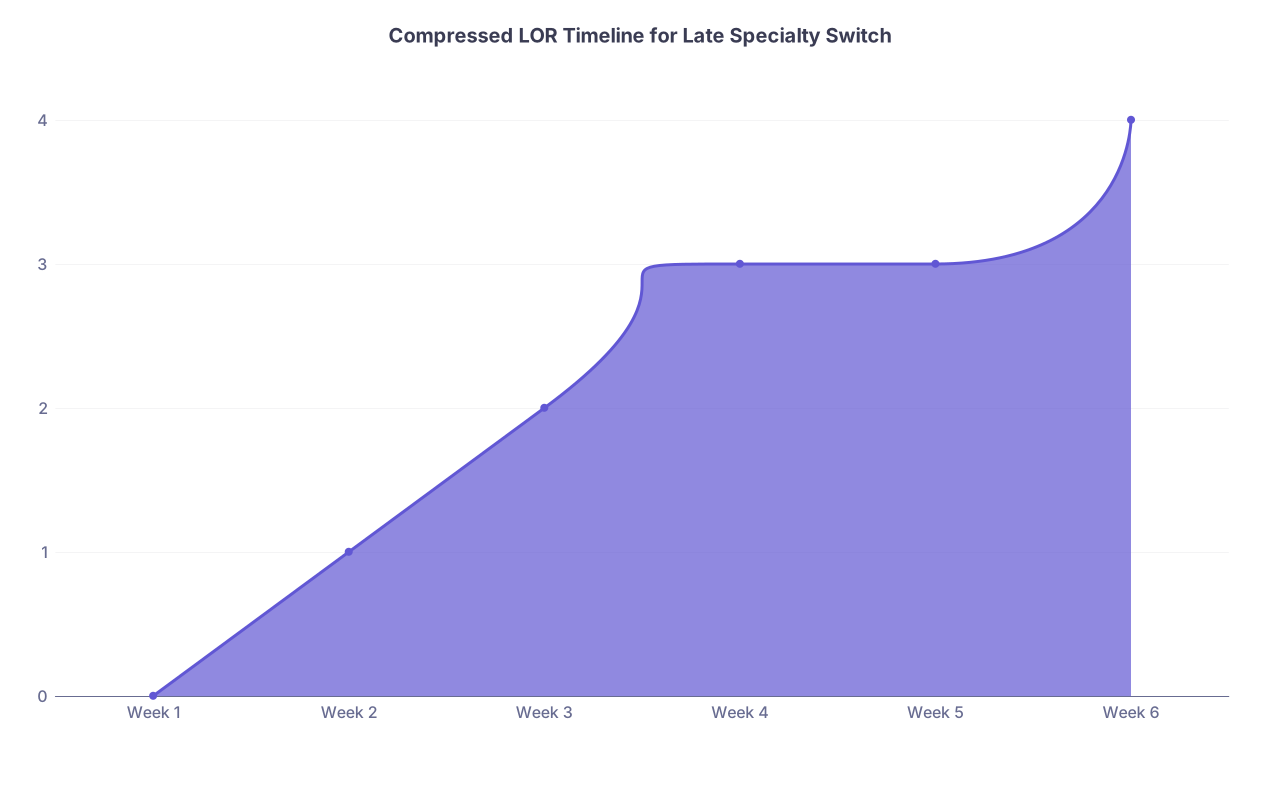
| Category | Value |
|---|---|
| Week 1 | 0 |
| Week 2 | 1 |
| Week 3 | 2 |
| Week 4 | 3 |
| Week 5 | 3 |
| Week 6 | 4 |
Interpretation:
- Week 1: Identify potential writers (0 letters requested).
- Week 2: Ask 1 person (ideally from ongoing rotation).
- Week 3: Ask second (new specialty) + one updated prior letter.
- Week 4: Confirm at least 3 letters requested.
- Week 5–6: Follow up politely; ensure uploads complete.
B. Protect yourself with an extra letter or two
Most systems let you assign only a subset of your letters to each program. That means:
- You can request 5–6 letters total.
- You then assign the 3–4 strongest / most relevant to each program.
If someone ghosts you or writes a weak letter, you are not trapped.
C. Graceful follow-up email
If you have not seen the upload by your internal deadline, send a single, respectful nudge:
Subject: LOR for [Your Name] – [Specialty] Application
Dear Dr. X,
I hope you are doing well. I just wanted to gently check in about the letter of recommendation you kindly agreed to write for my [specialty] application. ERAS opens for programs on [date], so if you are still able to submit the letter, having it uploaded by [internal deadline, usually 3–5 days before] would be very helpful.
Thank you again for your support and for the time you have already invested in this.
Best regards,
[Your Name]
Then stop. Do not keep poking. If they do not submit, you rely on others.
Step 10: On Interview Day, Use Your Letters As Ammunition
A well-crafted, targeted letter does more than just sit in ERAS. It gives you talking points.
When an interviewer says:
- “Your letters spoke very highly of your work ethic.”
- “Dr. X mentioned your growth on their service.”
You respond with specifics that reinforce the narrative:
“Yes, on that rotation we discussed my tendency to over-elaborate presentations. I worked on structuring them more tightly, and by the end of the month I felt much more aligned with the team’s style. That kind of concrete feedback-and-growth cycle is something I value a lot.”
You want them thinking: “The letters we read match the person in front of us.” That consistency is what rescues late switches.
The Bottom Line
Three points and you are done:
- You can build targeted specialty letters quickly if you deliberately engineer high-yield contact, ask directly for strong letters, and give attendings a structured packet to work from.
- Reframe, do not discard, your past; updated letters from your prior specialty that highlight transferable strengths + 1–2 new specialty letters are usually enough to keep you in the game.
- Control the narrative, not the luck; your letters, personal statement, and conversations must all tell the same coherent story about why this specialty now fits you—and why people who know your work are willing to stake their names on you.


