

You can absolutely recover from a weak first impression and still get a strong residency letter of recommendation. I have watched residents tank their first week… and still walk away with “top 5% resident” letters two months later.
The difference is not luck. It is a deliberate repair plan.
If you are reading this because:
- You were quiet and forgettable at the start of a rotation
- You looked unprepared or disorganized in front of the attending
- You missed something obvious and now feel like “that intern/student”
- Or you just realized halfway through that you need a letter from this person
…then you need structure, not self‑loathing. Here is the structure.
Step 1: Diagnose the Damage (Objectively, Not Emotionally)
Do not start with “I am terrible.” Start with: “What exactly happened, and how did it look from their side?”
1.1 Separate feeling from facts
Ask yourself, in writing if needed:
- What did I actually do or not do?
- On which days? In what context?
- Who saw it? Attending only? Residents? Nurses?
Typical patterns I see:
Unprepared pattern
- Did not pre‑read common conditions on the service
- Fumbled presentations, did not know basic lab trends
- Forgot to follow up on tests you ordered
Engagement pattern
- Quiet on rounds, no questions, looked disinterested
- Left as soon as allowed, no ask to help, no ownership
- Face in the computer / phone too often
Professionalism pattern
- Came late or barely on time
- Documentation sloppy or late
- Tone with staff a little off (even once)
Be brutally specific: “On day 2 I did not know why we ordered a CT head on our new admission” is useful. “I sucked” is useless.
1.2 Reality-check with someone who was there
Do not guess. Ask.
Find:
- Senior resident
- Chief resident
- Fellow you worked with closely
Say it plainly:
“Dr. X will be writing my LOR or at least evaluating me. I do not think I started this rotation strong. What are 1–2 specific things that hurt me in the first week, and what would you focus on improving if you were me?”
You might hear:
- “You seemed unprepared for presentations.”
- “You disappeared after rounds.”
- “You were okay; you are overthinking it. Just speak up more.”
Write down what they say. That becomes your repair checklist.
Step 2: Decide if This Attending Is Still LOR Material
Not every attending who sees you can or should write your letter. Especially if the first impression was terrible and you will not have time to repair.

Ask three hard questions:
Timeline: Do you have at least 3–4 weeks left with them?
- Less than 2 weeks and you are still invisible? Pick someone else.
Exposure: Will they actually see you work daily?
- If they round 1–2 times per week and otherwise disappear, they cannot comment meaningfully on your growth. Again, maybe not your LOR anchor.
Temperament: Are they known to be fair, or are they infamous for holding grudges?
- I have seen attendings who never update their impression after day one. “Lazy” in their head forever. You do not want a letter from that person.
If you answer “no” to any of these, your strategy shifts:
- Use this attending to generate a passable evaluation.
- Invest your real energy in another attending who can see your improvement from start to finish.
If you answer “yes” across the board, proceed. You are going to deliberately re‑shape how this person sees you.
Step 3: Reset the Relationship with a Short, Direct Conversation
You are not going to “apologize for existing.” You are going to signal three things:
- You are self‑aware.
- You are serious about improving.
- You want feedback early enough to act on it.
Script it. Keep it under 3 minutes. I like doing this right after rounds or at the end of a day when things are calmer.
Example:
“Dr. Smith, can I grab you for one minute?
I know I did not start this rotation as strongly as I should have. Specifically, my presentations were disorganized and I missed follow‑up on the CT yesterday.
I want to fix that. I would really value 1–2 concrete things you want to see from me over the next couple of weeks that would make you confident in my performance. And I would appreciate blunt feedback mid‑rotation, before the final evaluation, so I have time to correct course.”
That is it. Then stop talking.
Common outcomes:
- They soften. Most attendings like humility + a plan.
- They tell you exactly what matters to them: “Concise presentations. Know your patients’ labs. Be here 10 minutes early.”
- You now have a personal checklist directly from the person who might be writing your letter.
Step 4: Build a 2‑Week Performance Sprint
You cannot repair a weak first impression by “trying harder in general.” You need a 2‑week sprint with specific behaviors that are very visible.
We will hit four domains:
- Reliability
- Clinical preparation
- Communication and presence
- Initiative and ownership
4.1 Reliability: Become the person no one has to chase
Over the next 10–14 days:
Show up earlier than everyone expects
- If rounds start at 7:30, you are there at 7:00 with vitals, labs, and overnight events reviewed.
Close your loops
- Every task you are given: write it down, repeat it back briefly, and report when it is done.
- “I will call radiology for that CT now and let you know the timing before rounds end.” Then do it.
Zero late notes if you are responsible for documentation
- Stay 30–45 minutes later if needed. You are temporarily buying your reputation back.
You want your senior saying to the attending, without you in the room: “They get stuff done. I do not have to worry about follow‑up when they say they will do it.”
4.2 Clinical preparation: Stop showing up “cold”
You may not be the smartest person on the service. You can be the most prepared.
Pick a simple structure:
- The night before:
- Pick 1–2 topics directly relevant to tomorrow’s patients. Example: if you have multiple CHF admissions, you read 20–30 minutes on guideline‑directed therapy or diuresis strategies.
- The morning of:
- Before rounds, for each of your patients:
- Know vitals, labs, imaging, and any new consult notes.
- Have a one‑sentence “big picture” summary ready in your head: “Mr. X is a 64‑year‑old with decompensated HFrEF now euvolemic, we are optimizing oral regimen and planning discharge tomorrow.”
- Before rounds, for each of your patients:
On rounds, force yourself to say at least one evidence‑based or guideline‑based statement each day. Example:
“Given her CHA₂DS₂‑VASc score of 3, I think she should be on anticoagulation if there are no contraindications.”
You are not trying to sound like UpToDate. You are trying to show that you prepare and think in a structured way.
Step 5: Make Your Improvement Impossible to Miss
You cannot rely on the attending to “just notice” your progress. Their attention is fragmented. You must surface your improvement in ways that look natural, not desperate.
5.1 The mid‑rotation check‑in (non‑optional)
About halfway through your repair sprint (often week 2 or 3 of the rotation), you must ask:
“Dr. Smith, you mentioned at the start of the rotation you cared about concise presentations and follow‑through on tasks. I have been working on those. Am I moving in the right direction? Is there anything still keeping you from feeling fully confident in my performance?”
Two reasons this works:
- It forces them to re‑evaluate you with a more recent mental snapshot.
- If they still see a gap, you hear it with enough time to fix it.
If they say, “No, you are doing well,” you anchor that in their mind: you were weak, you took feedback, you improved.
5.2 Be strategically visible without being annoying
Do not become the person asking constant “performative questions” on rounds to show you studied. Instead:
Offer manageable help at the right time:
- “I can call the family with an update after we finalize the plan.”
- “I’ll draft the discharge summary for Mrs. X and run it by you.”
Speak once when it matters, not constantly:
- Suggest one reasonable plan change or question during rounds:
“Given his trending down creatinine and stable blood pressure, should we consider increasing the ACE inhibitor today?”
- Suggest one reasonable plan change or question during rounds:
Take ownership of a “mini‑project”:
- Example: You track discharge barriers for all patients and summarize them at the end of rounds each day.
- Or you ensure every consult question is clearly documented and followed up before sign‑out.
Ownership stands out. Lazy bodies blending into the background is the default.
Step 6: Decide How and When to Ask for the LOR
By now—if you have done the above for at least 2–3 weeks—your reputation with this attending should be: “Slow start. Strong finish. Coachable, reliable, improving.”
That profile can produce a very strong letter if you handle the ask correctly.
6.1 Timing the ask
Ideal timing:
- Last week of the rotation
- After at least one positive feedback interaction
- Not in a chaotic moment (not while they are scrubbed in, not during a code, not while they are obviously behind)
6.2 Exact phrasing that works
You will customize this, but keep the structure:
“Dr. Smith, I wanted to ask something. I am applying to [specialty] this cycle, and I would be very grateful if you would consider writing a strong letter of recommendation on my behalf.
I know I did not start the rotation as strongly as I would have liked, but I have worked hard on the areas we discussed—especially [presentations, follow‑through, patient ownership].
Based on how you have seen me progress, do you feel you could write a positive, detailed letter for my application?”
Two key pieces:
- You explicitly ask for a strong / positive letter.
- You give them a graceful exit if they are not comfortable.
If they hesitate or give a vague answer (“I can write one” without any adjectives), you thank them but do not use that letter for competitive programs. That is code for “lukewarm.”
If they say yes and sound genuine, you proceed.
Step 7: Make It Easy for Them to Write a Strong Letter
You control what they remember. You control the materials they see when they sit down to write.
You send them a very tight “LOR packet” the same day they agree.
7.1 What to include
Send one concise email with:
- Updated CV
- Personal statement draft
- ERAS ID and application deadline info
- Short bullet list: “3–5 things you have seen me do on this rotation that I hope might be reflected in your letter”
Example bullets:
- “Took ownership of complex CHF patient panel, ensuring daily follow‑up on all imaging and consults.”
- “Consistently incorporated guideline‑directed therapy into management plans and adjusted based on lab trends.”
- “Significantly improved organization and conciseness of patient presentations following your feedback.”
- “Maintained strong communication with families, including daily updates for two high‑anxiety families.”
You are not telling them what to write. You are jogging their memory about specific behaviors that support a strong letter.
7.2 Deadlines and logistics
Attach or link to the ERAS LOR portal instructions. Many attendings forget the process every year.
Your email might look like this:
Subject: LOR for [Your Name] – [Specialty] Residency
Dear Dr. Smith,
Thank you again for agreeing to write a letter of recommendation for my [specialty] residency application.
Attached are my CV and personal statement. I have also included a few bullet points highlighting aspects of my performance on your service that you have directly observed, which might be helpful as you reflect on my work.
The ERAS letter request link is below along with my AAMC ID. My target deadline for applications is [date], so if the letter could be uploaded by [earlier date], I would be very grateful.
Thank you again for your mentorship and for the feedback you gave me throughout the rotation.
Best regards,
[Your Name]
[AAMC ID]
You are organized. You are respectful of their time. This itself reinforces the image you have rebuilt.
Step 8: If You Truly Bombed: Convert the Rotation into a Neutral, Not a Disaster
Sometimes the first impression is not fixable. You showed up late. You had knowledge gaps so large they questioned if you belonged in the specialty. Or the attending just does not like you, for reasons you cannot fully repair.
Your job then is not to convert them into a letter-writer. It is to:
- Avoid a negative or damaging evaluation
- Make sure someone else, somewhere, sees the best of you and writes the letters that matter
Here is what you do in that scenario:
8.1 Secure a baseline passing eval
- Have the same short humility conversation, but do not mention LORs.
- Focus on meeting basic expectations: on time, tasks done, no drama, no laziness.
- Aim for comments like “reliable,” “pleasant to work with,” “improved over the rotation.”
These will not get you into MGH by themselves, but they will not keep you out either.
8.2 Shift your LOR strategy
Prioritize:
- Another attending on the same service who saw you more closely and liked you
- Sub‑I or AI where you can control the first impression from day one
- Research mentor who knows your work ethic well
- Program director or clerkship director who can comment on your improvement trajectory
| Priority | LOR Source |
|---|---|
| 1 | Sub-I / AI Attending |
| 2 | Program or Clerkship Director |
| 3 | Research Mentor (long-term) |
| 4 | Fellow or Co-attending |
| 5 | Weak/neutral attending LOR |
Use that poorly-started rotation as a story of growth in your personal statement or interviews, if needed:
“Early in residency I had a rotation where I realized I was not meeting my own standards for preparation. I sought feedback, created a structured plan to improve my presentations and follow-through, and by the end of the year my evaluations and letters reflected that change.”
If you are going to have a blemish, at least turn it into evidence of coachability.
Step 9: Track Your Progress Like a Project, Not a Vibe
You are overwhelmed. Rotations blur together. This is where people “feel” like they improved but cannot show it.
Treat this like a small improvement project:
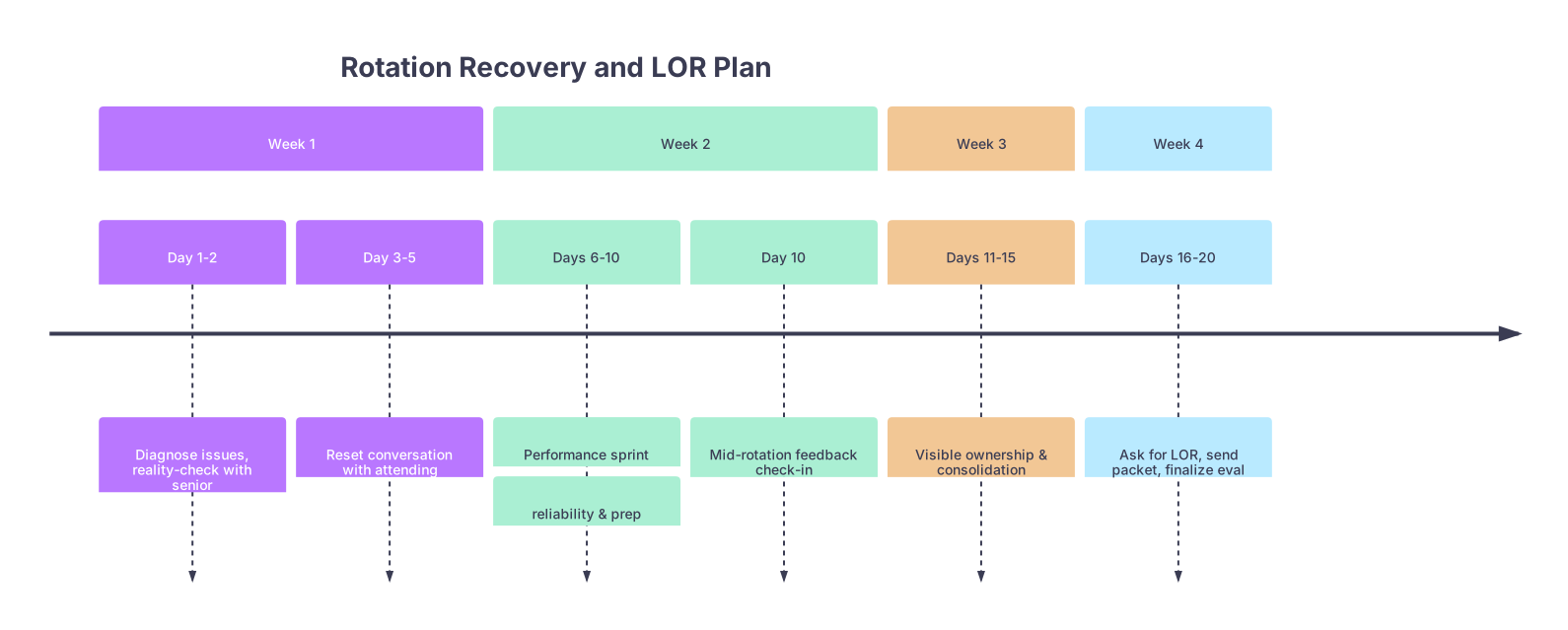
| Period | Event |
|---|---|
| Week 1 - Day 1-2 | Diagnose issues, reality-check with senior |
| Week 1 - Day 3-5 | Reset conversation with attending |
| Week 2 - Days 6-10 | Performance sprint |
| Week 2 - Day 10 | Mid-rotation feedback check-in |
| Week 3 - Days 11-15 | Visible ownership & consolidation |
| Week 4 - Days 16-20 | Ask for LOR, send packet, finalize eval |
During this time, keep a tiny running log (2–3 minutes at the end of each day):
- One thing you did well (concrete)
- One thing you will do differently tomorrow (concrete)
- One specific piece of feedback you received
This record:
- Gives you real data to self‑correct
- Provides examples you can feed back to attendings when asking for a LOR
- Keeps your brain from defaulting to “I am failing” without evidence
Step 10: Understand How Attendings Actually Remember You
Most residents wildly misunderstand this, so let me spell it out bluntly.
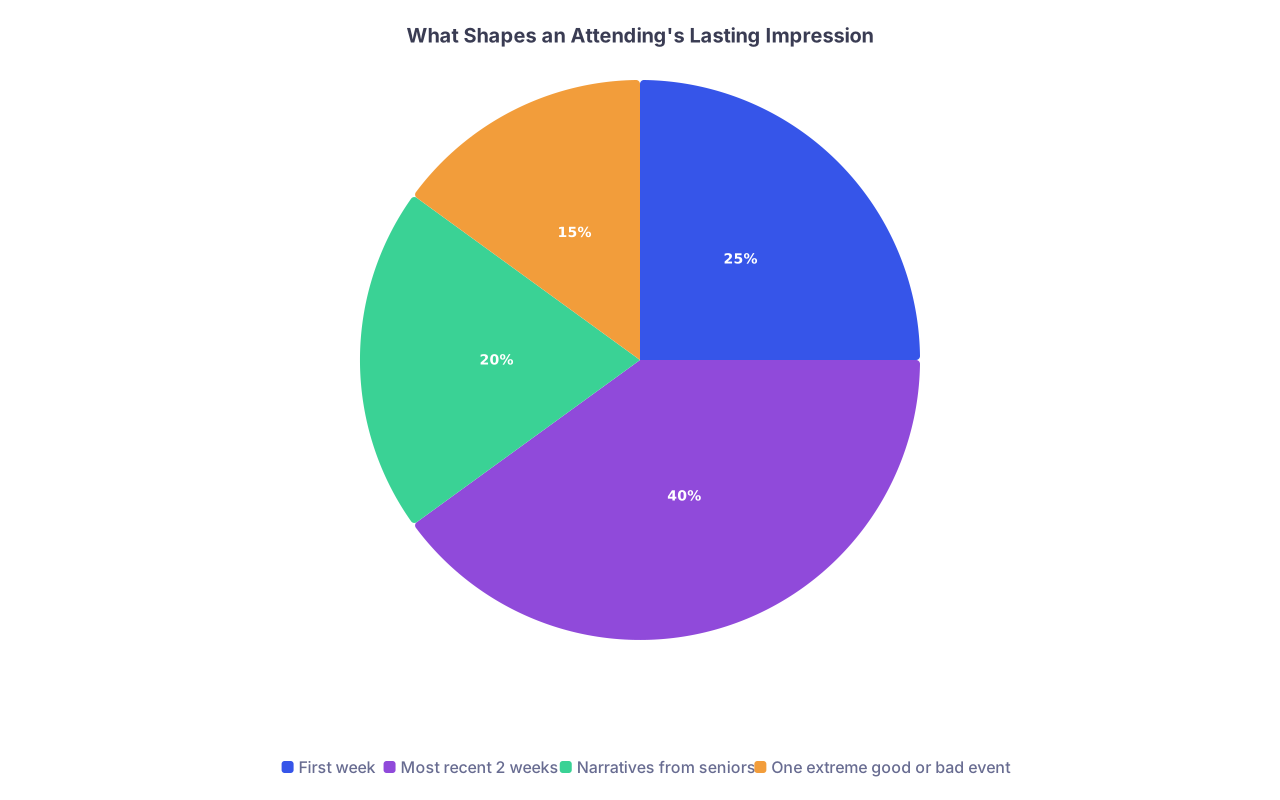
| Category | Value |
|---|---|
| First week | 25 |
| Most recent 2 weeks | 40 |
| Narratives from seniors | 20 |
| One extreme good or bad event | 15 |
How you usually live in their head:
First week (25%)
This is your problem right now. Bad start. But not the whole story.Last 2 weeks (40%)
Humans overweight recency. A strong last half of the rotation matters more than you think.What seniors say about you (20%)
If the senior resident tells them “They have really turned it around” or “They are solid and reliable,” that colors the evaluation heavily.One standout event, good or bad (15%)
Disaster: missed a critical lab, unprofessional behavior, lying, ignoring pages.
Win: staying late for a very sick patient, running family meetings well, stepping up in a crisis.
Your recovery plan is built specifically to maximize the last three categories and drown out the first.
This is why:
- You talk to your senior and get them on board early.
- You deliberately improve and make it visible in the second half.
- You avoid new disasters at all costs.
A Quick Word About Anxiety and Shame
You will be tempted to do one of two unhelpful things:
- Hide and hope they forget you were bad at the start.
- Overcompensate with constant apologizing or performative behavior.
Both are transparent. Both make you look less mature, not more.
The mature move is:
- Acknowledge you started poorly. Once.
- Ask specifically how to improve.
- Execute a clear plan for 2–3 weeks.
- Check in once mid‑rotation.
- Ask for the letter (or do not) based on real feedback.
You are not the first trainee to stumble on day one. You will not be the last. What matters is how you recover, because that is exactly what residency and practice will demand from you when things go sideways for real patients.
Final Takeaways
- A weak first impression with an attending is fixable if you treat it like a structured repair project, not a moral failure.
- Use short, direct conversations plus a 2–3 week performance sprint to make your improvement impossible to miss.
- Only ask for a strong letter from attendings who have seen your growth and can describe it specifically; otherwise, pivot to better letter-writers and keep this rotation neutral, not toxic.


