

The reason your letters of recommendation feel generic is simple: you never told your writers what you actually need.
Most applicants just “ask for a letter” and hope for magic. Then they are shocked when the result sounds like: “Hard‑working, punctual, pleasure to have on the team.” That is a polite rejection in paragraph form.
You want stronger updates. You can get them. But you will have to be direct, structured, and a bit more assertive than feels comfortable.
Here is the exact playbook and word‑for‑word scripts to turn bland letters into targeted, powerful ones that actually help you match.
Step 1: Diagnose the Problem Objectively
Before you ask for anything, you need to know whether your current letters are:
- Fine but generic
- Actively weak
- Or actually okay and you are just anxious
You usually will not see the letters. But you can still get a good sense by looking at context.
A. Signs your letters are probably generic
- You asked like this: “Would you be willing to write me a letter of recommendation?” and nothing more.
- You never sent them:
- Your CV
- Your personal statement
- A list of programs or your specialty interests
- Bullet points of specific cases, projects, or feedback
- Your interactions with them were:
- Short rotation
- Few direct encounters
- Mostly group rounds, little one‑on‑one
- They submitted the letter very quickly after you asked (same day or next day) despite being very busy. That often means template letter plus your name inserted.
If this describes you, assume “generic” until proven otherwise.
B. Signs your letter may actually be weak
- The writer hesitated when you asked:
- “I do not know you that well.”
- “I can write a standard letter.”
- “It may not be as strong as you want.”
- They missed multiple deadlines and needed repeated reminders.
- They mixed up your specialty interest in emails (e.g., think you are applying to surgery when you are going into psych).
When an attending says “standard” or “generic,” that is code for “I will not go to bat for you.”
C. When you should NOT try to get an update
Do not chase an update from someone who:
- Clearly did not like working with you
- Gave you negative or borderline evals
- Already warned you that they cannot write a strong letter
Better to let a neutral letter stand than to provoke a frustrated attending into revising something they already did not enjoy writing.
Step 2: Decide Your Strategy – Replace, Add, or Upgrade
You have three realistic options.
| Strategy | When to Use | Risk Level | Impact Potential |
|---|---|---|---|
| Replace | Weak/hesitant writer | High | High |
| Add | Have space for more letters | Low | Medium-High |
| Upgrade | Friendly writer, generic first attempt | Medium | High |
1. Replace the letter
You politely retire a weak/generic writer and recruit someone else who knows you better.
Use this when:
- You have enough time before ERAS submission / ranking
- You have other attendings who can speak more specifically about you
- The current writer never really saw you at your best
2. Add another letter
If programs accept more than you already have, sometimes the cleanest fix is to:
- Keep the generic letter (it will not sink you alone)
- Add a new, targeted, clearly strong letter
Use this when:
- Time is limited
- You are mid‑season and suddenly realize your letters are bland
- You just completed a stellar away or sub‑I and impressed someone
3. “Upgrade” the existing letter
This is the tricky one: asking the same writer to submit an updated or stronger letter.
This can work well when:
- The writer likes you but you did not give them enough material initially
- You have new concrete achievements since the original letter
- You phrase the request correctly: focused on “new updates” and “making it easier for you” rather than “your previous letter was bland”
This article focuses on the third option, but I will touch the others where they intersect.
Step 3: Prepare Before You Ask – Do Not Wing This
You get one serious shot at asking for a stronger update. If you show up unprepared and vague, you burn it.
You must have three things ready:
- Updated one‑page CV (tight, relevant to residency)
- Draft of key talking points (bullet list, not an essay)
- Concrete examples of what to highlight (Cases, projects, feedback)
A. One‑page CV checklist
Your CV should make it stupidly easy for them to brag about you.
Include:
- Name, contact, ERAS AAMC ID
- Education with graduation year and major
- USMLE/COMLEX scores (if respectable or already disclosed)
- Research (1–6 bullet items; include your role)
- Leadership roles (chief, committee, tutoring, etc.)
- Awards / honors
- Relevant volunteer work
If you are at 3 pages, you are doing too much. Cut.
B. Talking points document
Make a short document with headers like:
- “Clinical strengths you have observed”
- “Specific patient encounters we managed together”
- “Professional traits programs want to hear about”
- “Updates since we last worked together”
Under each, list 2–4 bullets.
Example:
“Clinical strengths you have observed”
- Took primary responsibility for complex DKA admissions, including insulin infusion protocol and electrolyte management.
- Consistently arrived early to pre‑round, had notes and plans completed before team rounds.
“Specific patient encounters”
- Mr. R with decompensated cirrhosis: I proposed early paracentesis, coordinated with IR, and updated family multiple times daily.
- Mrs. L with new CHF: I created discharge teaching materials and walked through them with her and her daughter.
Writers remember vibes, not details. You supply the details.
C. Concrete “ask” items
Decide exactly what you want them to emphasize. Examples:
- “My ability to manage high patient load independently”
- “Growth over the course of the sub‑I”
- “Communication with nurses and families”
- “Resilience during nights / call”
- “Fit for [specialty] specifically”
You will not demand they say these things. You will suggest they might be helpful for programs to hear.
Step 4: Scripts – Exactly What to Say and Type
Here is what you actually came for.
1. Email script to request a stronger updated letter
Use this when you already have a letter on file, and you want an updated, more specific one.
Subject line options:
- “Request for Updated Letter of Recommendation for [Specialty]”
- “Quick Request: Updated ERAS Letter (New Achievements)”
- “Follow‑up on Letter of Recommendation for Residency”
Email body template:
Dear Dr. [Last Name],
I hope you are doing well. I wanted to thank you again for supporting my residency application with a letter of recommendation earlier this season. I am very grateful for your help.
Since we last worked together, I have had several new developments that strengthen my application for [Specialty], including [briefly list 2–3: e.g., completing a sub‑internship in ___, presenting a poster at ___, assuming a leadership role in ___].
I am reaching out to ask if you would be willing to upload an updated version of your letter that incorporates some of these recent experiences and, if you feel comfortable, more specific comments about my performance on our service. I know your time is very limited, so I have attached:
– A one‑page updated CV
– A short list of concrete examples from our time working together and my new achievements that might make it easier to include details programs find helpfulIf you do not feel that you can provide a strong, detailed letter on my behalf, I completely understand and would appreciate you letting me know so I can plan accordingly.
Thank you again for your mentorship and support.
Sincerely,
[Your Name]
[Medical School & Graduation Year]
[AAMC ID]
[Phone]
You are doing three important things here:
- Respecting their time and ego
- Giving them an easy off‑ramp if they cannot write a strong letter
- Explicitly asking for “more specific comments” and “updated” content without insulting the original letter
If they say yes, you follow up with talking points.
2. Script for in‑person or Zoom request (strongest)
Face‑to‑face is better than email when possible. You can then follow with the email and attachments.
How to open the conversation:
“Dr. Smith, do you have a minute? I wanted to ask for your advice on my residency application and a possible update to my letter of recommendation.”
Then:
“First, thank you again for writing for me earlier this year. I really appreciate that you took the time.
Since then I have had a few important updates – I completed a sub‑I in [specialty] and presented our [topic] project at [meeting]. I am trying to strengthen the parts of my application that programs care about most: letters with specific, concrete examples.
Would you feel comfortable updating your letter to include some of those details from our rotation and these new developments? I put together a very short document with specific cases we managed together and bullet points of feedback you gave me that might be useful if you wanted to reference them.”
Then shut up. Let them talk.
If they hesitate or say “I can do a standard letter,” pivot:
“If you feel that you cannot provide a very strong letter, I completely understand. I value your honesty and just want to make sure the letters in my file are the best fit.”
You are not begging. You are managing your own file like an adult.
3. Follow‑up email with targeted material (after verbal yes)
Assuming they agree verbally:
Dear Dr. [Last Name],
Thank you again for agreeing to update my letter of recommendation for [Specialty]. As we discussed, I am attaching:
– A one‑page updated CV
– A brief document with specific patient cases, projects, and feedback from our time on [Rotation/Service]Program directors often comment that the most helpful letters are those with concrete examples and clear statements about readiness for residency, ability to work independently, and teamwork. I have highlighted a few of those areas where you observed me directly, in case it is helpful as you revise.
The ERAS letter portal lists the deadline as [date you want, ideally 2–3 weeks out], but if that is too soon for your schedule, please let me know and I can adjust.
Thank you again for your support.
Best regards,
[Your Name]
You are telling them exactly what PDs value without sounding like you are dictating the letter.
Step 5: What Your “Talking Points” Document Should Actually Look Like
Here is a concrete example you can mimic.
Title: “Key Points for Updated LOR – [Your Name], [Specialty]”
Section 1 – Clinical strengths you observed first‑hand
- Took responsibility for 6–8 patients daily on the [Medicine/Cardiology/etc.] service, with independently formulated assessments and plans that often required only minor adjustments.
- Managed several overnight admissions on call, including:
- DKA admission – managed fluids and insulin infusion titration with minimal supervision.
- Sepsis case – initiated broad‑spectrum antibiotics and coordinated bundle elements quickly.
- Consistently arrived before 6:00 am, had pre‑rounding and notes complete prior to attending rounds.
Section 2 – Specific patient encounters together
- Mr. J (heart failure exacerbation): I suggested an early palliative care consult due to frequent admissions and complex social situation. You later commented that this helped align treatment with his goals.
- Mrs. S (newly diagnosed cancer): I spent additional time with her and her family to explain the staging workup; the family thanked our team multiple times for clear communication.
Section 3 – Professionalism and teamwork
- Nurses frequently approached me first for updates or concerns; I made it a point to communicate changes clearly and document promptly.
- I took ownership of following up on all critical labs and imaging and updating the team during sign‑out.
Section 4 – Updates since we last worked together
- Completed sub‑internship in [Specialty] at [Institution]; received “Honors” with strong written comments about independence and clinical reasoning.
- Presented poster “[Title]” at [Conference] based on our work on [topic].
- Selected as [role] (e.g., peer mentor, student educator) for the [Class of 20XX].
You do not need flowery language. Just ammunition. They can turn bullets into prose.
Step 6: Timing, Deadlines, and Gentle Pressure
You cannot ask for miracles 3 days before ERAS locks.
A. Reasonable timelines
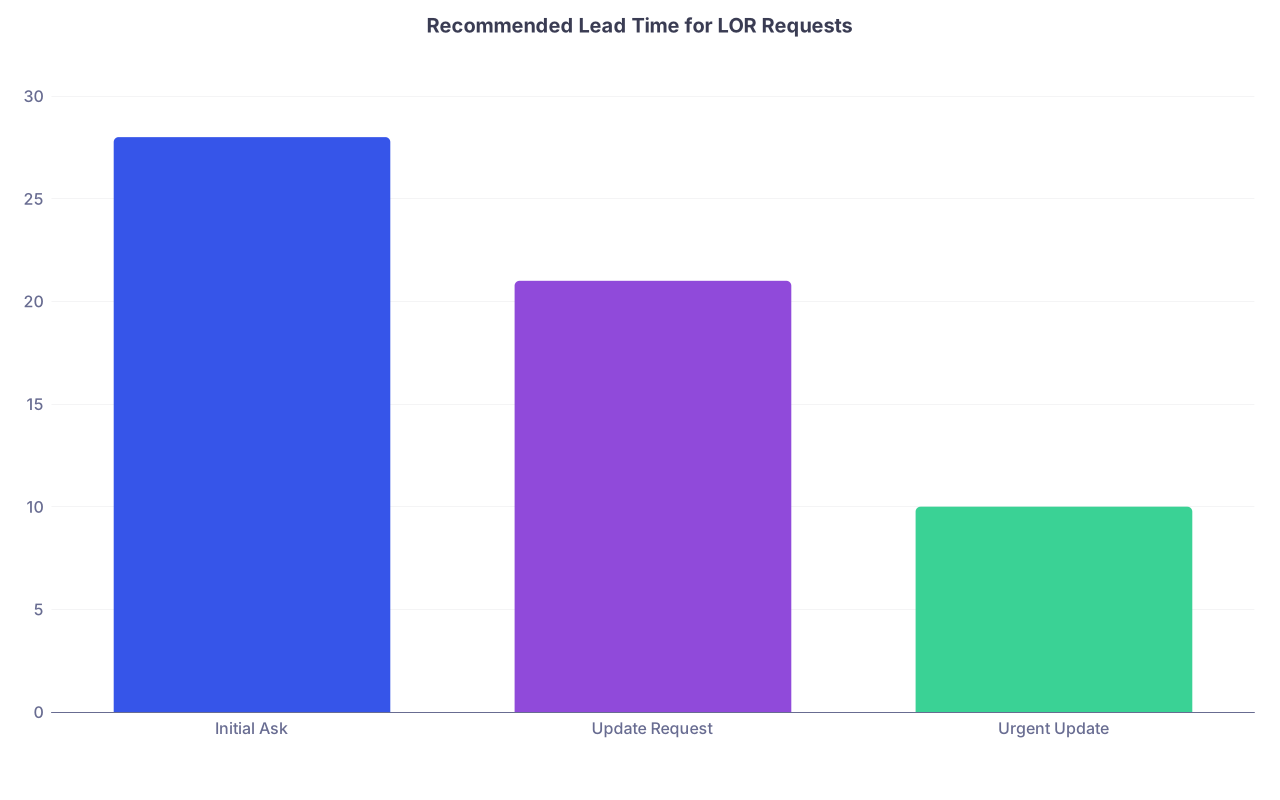
| Category | Value |
|---|---|
| Initial Ask | 28 |
| Update Request | 21 |
| Urgent Update | 10 |
- Initial letter ask: 4 weeks before you need it
- Update request: 2–3 weeks before you want it uploaded
- Absolute minimum for an update: 7–10 days (and that is pushing it)
B. Reminder script if they go silent
If they agreed but have not uploaded by 5–7 days before your internal deadline:
Dear Dr. [Last Name],
I hope your week is going well. I wanted to send a brief reminder about the updated letter of recommendation for my [Specialty] application that we discussed. ERAS will begin downloading final documents on [date], so if you are still able to upload the updated letter by then, I would be very grateful.
If your schedule has changed and it is no longer feasible, please let me know. I completely understand and appreciate the support you have already provided.
Thank you again,
[Your Name]
Do not send daily reminders. One polite reminder, then move on to backup options if needed.
Step 7: If You Need to Replace or Add Letters Instead
Sometimes the right answer is not “make this letter stronger” but “stop relying on this person at all.”
A. Who to target for replacement / additional letters
- Attending from your sub‑I in the specialty you are applying to
- Program director or associate program director from a rotation
- Research mentor who knows your work ethic and can translate it clinically
- Clerkship director who has seen you across multiple rotations
B. Script to ask a new writer, correctly
Dear Dr. [Last Name],
I very much appreciated the opportunity to work with you on the [Service/Rotation] at [Hospital] and have learned a great deal from your teaching and feedback. I am applying to [Specialty] this cycle, and I wanted to ask if you feel you know my clinical work well enough to write a strong, detailed letter of recommendation on my behalf.
During our time together, I valued your comments about my [clinical reasoning / communication / ownership of patients], and I believe your perspective would be very meaningful to residency programs. If you are comfortable supporting me in this way, I can send a one‑page CV and a brief summary of the patients and projects we worked on together to make it as easy as possible.
If you do not feel that you can provide a strong letter, I completely understand and would appreciate your honesty.
Thank you for considering this,
[Your Name]
The key phrase is “strong, detailed letter”. If they say yes after hearing that, you can be confident it will not be generic.
Step 8: What Programs Actually Want to See in “Strong” Letters
You are trying to get your writers to hit a very specific target.
Program directors repeatedly say the same thing. The helpful letters:
- Are specific
- Compare you to peers
- Describe your role clearly
- Make a clear recommendation statement

When you send talking points, you are quietly pushing writers toward these elements.
Encourage them (indirectly) by writing in your document things like:
- “You mentioned I was functioning at the level of an intern by the end of the rotation.”
- “You compared my performance favorably to prior sub‑interns.”
They can either quote themselves or ignore it. Many will quote.
Step 9: Handling Awkward Responses and Pushback
You are going to get some imperfect answers.
Scenario 1: “I already submitted a letter; I do not have time to update it.”
Response:
“Thank you for letting me know, and I appreciate the letter you have already written. In that case, I will plan to ask another attending from my recent sub‑I to add an additional letter to reflect my more recent work. Thank you again for your support.”
Translation: you are not going to keep pestering them. You will just add better material elsewhere.
Scenario 2: “I can do a standard letter.”
That is a warning. Answer:
“I appreciate your honesty. I am aiming for the strongest possible letters and it sounds like your letter might be more neutral. In that case, I may rely on other writers who have seen more of my recent work, but I am grateful for your time and support.”
Polite. Clear boundary. You are not obligated to use every letter you receive.
Scenario 3: No response to your update request
Give it 5–7 days. Then send the reminder email. If still nothing:
- Move them into the “generic but fine” category
- Focus energy on strengthening other letters instead of chasing a ghost
Do not send a third or fourth email. That just irritates them.
Step 10: Safeguards for Next Year or Future Applications
If you are still in M3 or early M4, or if you think you may reapply, fix your system now.
A. Ask the right way from the beginning
When you first ask for a LOR, say this:
“Would you feel comfortable writing a strong, detailed letter of recommendation for my application to [Specialty]?”
If they say anything other than an enthusiastic yes, move on.
B. Capture specifics in real time
End of rotation, send a thank‑you with some short bullets:
“Thank you again for the feedback that I was functioning at an intern level by the end of the month and that my notes and plans were reliable…”
This does two things:
- It helps them remember what they said.
- It gives you a paper trail you can later feed back as talking points.
C. Track who actually sees you at your best
Do not ask the most famous attending. Ask the one who:
- Saw you admit patients from scratch
- Watched you handle cross‑coverage problems
- Gave you real feedback, not just “nice work”
You can fix generic letters after the fact, but it is much easier to avoid them in the first place.
Quick Visual: Process to Strengthen Generic LORs

| Step | Description |
|---|---|
| Step 1 | Suspect Generic LOR |
| Step 2 | Prepare CV & Talking Points |
| Step 3 | Target New Writer Instead |
| Step 4 | Request Updated Letter by Email/Meeting |
| Step 5 | Send Materials & Set Deadline |
| Step 6 | Add or Replace with Stronger LOR |
| Step 7 | One Reminder if Needed |
| Step 8 | Focus on Other Application Pieces |
| Step 9 | Writer likes you? |
| Step 10 | Agrees? |
Final Points
You can fix generic LORs, but you must act like the manager of your own application, not a passive passenger.
Focus on three things:
- Be explicit – Ask for a “strong, detailed” updated letter and give them specific ammo.
- Respectfully screen – If someone hints they can only provide a standard letter, believe them and move on.
- Add strength, do not chase ghosts – One generic letter will not sink you. Use your energy to add at least one or two letters that are clearly strong, specific, and recent.
Do this correctly, and your letters will finally say what you need them to say: not “pleasant and punctual,” but “ready to be an intern on day one.”


