

The average research PI letter is clinically useless. You are not stuck with that.
If you treat your PI like a generic referee, you will get a generic letter. If you treat your PI like a clinical advocate and give them the tools to sound like one, their letter can meaningfully move your application. This is fixable, and it is mostly on you.
Let me show you exactly how.
Step 1: Decide If Your PI Should Be Writing You a Letter
Not every PI should become a “clinically useful” letter writer. Some never see you outside the lab. Some barely know your name. Some openly dislike clinical work. For those, forcing a LOR is a mistake.
You want a PI who can at least plausibly comment on:
- Work ethic under pressure
- Reliability over time
- Communication with others (lab teams, collaborators, patients if applicable)
- Judgment and integrity
If your PI is:
- A pure bench researcher who never talks about patients
- Constantly traveling and minimally engaged
- Known for one-sentence, copy‑paste letters
- Someone you only worked with for 4–6 weeks
…then your effort is better spent elsewhere.
A clinically useful PI LOR usually comes from one of these:
- A physician‑scientist who sees patients at least 1–2 half‑days per week
- A clinical researcher running trials, registries, or outcomes projects
- A basic scientist who has watched you interact with residents/attendings, present to clinical teams, or attend clinical conferences consistently
- A PI who has known you for 6+ months and has seen you handle adversity
If your current PI does not fit any of those, you have two options:
- Use them as a secondary/research letter only, not one of your “core” clinical letters.
- Actively build a more clinically flavored relationship now (clinic shadowing, clinical meetings, joint QI work) so that by the time you ask, they can speak to your clinical potential.
Stop assuming “famous PI + big name = great clinical letter.” Program directors care about content, not just letterhead. I have seen Nobel laureate letters that read like a LinkedIn endorsement.
Step 2: Engineer Clinical Exposure Into the Relationship
You cannot ask a PI to write about your clinical abilities if you have never done anything clinical with them. You need to manufacture overlap.
Tactics that actually work
Shadow their clinic (even sporadically)
Script you can use:“Dr. Smith, I am planning to apply to internal medicine and would like to better understand how you bring your research into your clinical practice. Would it be possible to join your clinic 1–2 half‑days over the next month?”
Even two half‑days of you in clinic with them creates material: your interaction with patients, how you present, how you respond to feedback.
Attend clinical or translational meetings they care about
Examples:
- Tumor board
- Heart failure conference
- Stroke conference
- M&M where their trial or project shows up on a slide
Your behavior there matters. Ask one smart question. Offer to follow up a data point. They will remember.
Connect your research to patient impact
Every time you present to them, briefly frame:
- The patient population
- The clinical decision point
- How your work might change practice
Over time, they start seeing you as “clinically thinking,” not “just a coder / bench worker.”
Volunteer for clinically adjacent work
- Help build an order set or note template for a QI project.
- Draft patient education materials tied to your study.
- Coordinate data collection from clinic charts (with proper approvals).
These tasks let your PI see you handle real patient data, HIPAA issues, communication with the clinical front line.
You are not trying to fake being a resident. You just want enough clinically flavored contact that your PI can credibly write a paragraph connecting your research behavior to bedside behavior.
Step 3: Understand What “Clinically Useful” Actually Means
Most PI letters die because they say nothing clinically relevant:
“X is one of the most productive students I have worked with. X is hardworking, intelligent, and a quick learner. I recommend them highly for your residency program.”
That is junk from a PD standpoint.
A clinically useful PI LOR does three things:
Translates research behaviors into residency behaviors
Example:- Research: “Met every weekly deadline, adapted the analysis plan when initial results were negative.”
- Residency: “Shows resilience and problem‑solving under pressure, will not crumble on call when plans change.”
Uses specific, concrete anecdotes
Not: “She is a good communicator.”
Instead: “During a multi‑disciplinary meeting with cardiology, pharmacy, and nursing, she presented complex trial data clearly enough that the team agreed to modify our protocol that same week.”Explicitly connects to clinical skills or potential
Words and phrases that mean something to PDs:- Clinical judgment
- Teamwork across disciplines
- Reliability and ownership
- Response to feedback
- Communication with patients and families
- Efficiency and organization in a busy environment
- Ethical integrity when handling sensitive data or situations
Your PI does not automatically think that way. You have to help them.
Step 4: Time the Ask Strategically (And Build a Clear Narrative)
You cannot spring this on them two days before ERAS locks.
Aim for this general timeline:
4–6 months before ERAS opens:
- Solidify your project role.
- Increase your in‑person contact (clinic, meetings).
- Deliver something tangible (poster, abstract, cleaned dataset).
2–3 months before ERAS opens:
- Have a “career conversation” meeting.
- Clarify your specialty choice and programs tier.
- Float the idea of a letter, but not as a yes/no question yet.
6–8 weeks before ERAS LOR deadline:
- Officially ask for a “strong, specific residency LOR” and outline what you hope they can address.
The ask: use the right words
Do not say, “Can you write me a letter?”
Say something like:
“Dr. Lee, I am applying in neurology this cycle, and I would value a strong, specific letter from you. I am particularly hoping for a letter that connects how I have worked on our stroke project to how I will function as a neurology resident. Would you feel comfortable writing that type of letter for me?”
This does two things:
- Gives them an out if they do not know you well enough (you want that honest no).
- Plants the seed: “connect research behavior to residency behavior.”
If they say yes, you move to the next step: equip them.
Step 5: Build a PI LOR Packet That Aims at Clinical Competencies
Most PI letters sound generic because the PI is writing from memory and a CV. You are going to make that impossible.
You will send a PI LOR packet with:
Targeted CV (1–2 pages max)
Highlight:- Clinical clerkships (with brief bullets if your school transcript is weak on narrative).
- Teaching / leadership roles.
- Any QI, clinic‑based research, patient‑facing volunteer work.
One-page “Residency Snapshot”
This is your cheat sheet for them. Sections:- Specialty + why: 2–3 sentences.
- Career path (academic, community, subspecialty interest): 2–3 sentences.
- 3 strengths you want the letter to reinforce (e.g., “ownership,” “communication under pressure,” “resilience when results are negative”).
- 1–2 weaknesses you have worked on and how (optional, can help them tell a growth story).
Clinical skills translation grid
This is how you help them turn lab behaviors into clinical language.
Translating Lab Behaviors to Clinical Competencies Your Behavior in Lab/Research Clinical Competency It Maps To Consistently met abstract deadlines Reliability and time management on call Reframed study after negative results Clinical reasoning and adaptability Led weekly data meetings with residents Team leadership and interprofessional comm Handled HIPAA‑sensitive chart review Professionalism and ethical judgment Taught juniors to use REDCap/statistics Teaching skills with peers and juniors You do not send this as a table labeled “please say this.” You send a simple, clean PDF with a short intro: “Here are a few ways I think my work in your lab reflects clinical skills residency programs care about.”
Project summary (half‑page)
- 2–3 lines: big clinical question.
- 2–3 bullet points: your specific contributions.
- 1–2 bullet points: impact (abstracts, posters, changes to practice).
Draft talking points (not a full letter)
This is key. You do not ghost‑write the letter. That backfires and reads fake.You do write 5–7 bullet points:
- “You observed me present to the HF section in March and May, where I…”
- “During the protocol deviation issue in June, you saw how I handled…”
- “When the first analysis showed no association, I proposed…”
Short, factual, and accurate. You are jogging their memory, not scripting their adjectives.
Step 6: Give Your PI Clinical Language Without Being Obnoxious
Most PIs speak in publications, grants, and h‑index. Program directors speak in “would I trust this person on my team at 2 a.m.?”
You bridge that gap.
Provide a short “PD lens” primer
In your email or a one-page attachment, include something like:
“My understanding is that residency program directors really care about:
- How we function in teams
- How we handle stress and feedback
- Evidence of ownership and follow‑through
If there are examples from my work with you that reflect those, that would be extremely helpful for my application.”
You are not lecturing them. You are explaining the game you are playing and inviting them to help.
You can even add a single example:
“For instance, the way we restructured the analysis after the original hypothesis failed might reflect adaptability and persistence under pressure.”
That phrase—adaptability and persistence under pressure—is clinical gold. A good PI will steal it and expand.
Step 7: Use Meetings With Your PI to Seed Letter Content
The worst time to influence a letter is after it is uploaded. The best time is months before, through your behavior and the conversations you have.
At your regular meetings, deliberately show:
Ownership
Instead of: “What should I do next?”
Say: “Given our timeline for the October abstract, I see three possible next steps… My recommendation is X because…”That becomes: “They think like a resident: proposes plans, not just problems.”
Clinical framing
Whenever you show a result, link it to a patient scenario:
- “This might change how we risk‑stratify the next patient in clinic with…”
- “If this holds up, it could shorten time to diagnosis for…”
That makes it easy for them to say: “Always keeps the patient at the center, even in data analysis.”
Response to feedback
When they critique your work, send a follow‑up email:
- “Thank you for the feedback on the methods section. I have attached a revised version with the points we discussed highlighted in comments 2–4.”
That is “takes feedback seriously and improves quickly,” which is a core residency competency.
Teamwork and teaching
Any time you help junior students or residents with the project, mention it briefly:
- “I met with the MS2s and walked them through our REDCap forms; here’s what we changed.”
They can easily turn that into: “Already functions as a teacher for more junior learners.”
None of this is fake. You are just speaking the residency language in front of someone who will be describing you to residency programs.
Step 8: Anchor the Letter to Your Specialty
A vague “strong resident” letter is less powerful than a targeted “strong future [specialty] doctor” letter.
You must explicitly tell your PI:
- Your specialty (and, if known, a subspecialty interest).
- Type of programs you are targeting (academic, community, research‑heavy).
- Any big goal (physician‑scientist track, clinical educator, etc.).
Then ask for alignment:
“If you are able, I would appreciate if the letter could comment on my potential specifically as an internal medicine resident, especially in research‑oriented or academic programs.”
You can even give one or two tailored translation hints:
- For surgery: highlight grit, delayed gratification, manual dexterity (if applicable), calm under stress.
- For psych: communication, empathy, curiosity about patient narratives, consistency.
- For EM: rapid decision‑making, calm in chaos, triage instincts, team direction.
- For IM: analytical reasoning, long‑term ownership, interdisciplinary collaboration.
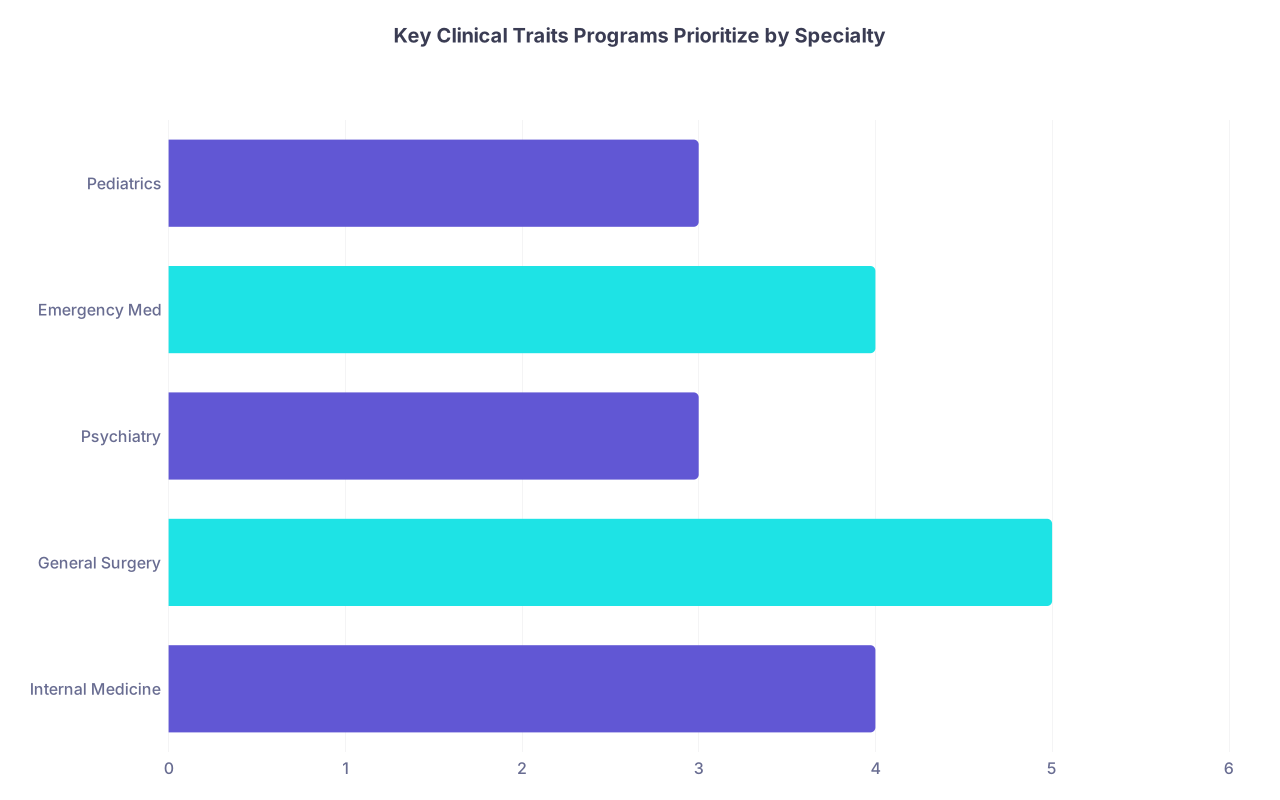
| Category | Value |
|---|---|
| Internal Medicine | 4 |
| General Surgery | 5 |
| Psychiatry | 3 |
| Emergency Med | 4 |
| Pediatrics | 3 |
(Here, think less about the numbers and more about the ranking in your own head. Tailor the narrative.)
Your PI should not be guessing what “good neurologist potential” means. You hand them a short, specialty‑flavored lens.
Step 9: Logistics: Deadlines, Reminders, and Damage Control
PIs are busy. Some are terrible with deadlines. If you want a clinically useful letter, you also need it on time.
Set clear expectations early
When they agree to write, respond with:
Exact deadlines:
“ERAS opens X date; to be safe, having the letter uploaded by Y date would be ideal.”Clear instructions:
- How they access ERAS
- That the letter is confidential
- That it can be reused if you apply to multiple programs
Offer admin help:
“If it is helpful, I can send a calendar reminder or coordinate with your assistant to make sure the ERAS link is easy to find.”
Use gentle but firm reminders
4 weeks before your ideal deadline:
- “Just a quick check‑in to see if you need anything else from me for the letter.”
2 weeks before:
- “Friendly reminder that ERAS opens in two weeks; I am extremely grateful for your support and happy to resend my packet if needed.”
If they still stall, assume they are not a reliable primary letter. Have backups (more on that next).
What if you already have a generic PI letter?
You uploaded it last year, or you know from others that they write bland letters. Then:
- Do not depend on it as one of your core 3 clinical letters. Use it as an “optional” or “research” letter if programs allow.
- Compensate with strong, narrative clinical letters from inpatient rotations, sub‑Is, away rotations.
- Strengthen your personal statement and experiences to tell the clinically relevant story the PI failed to tell.
You cannot salvage a letter once it is submitted. You can dilute its impact with better letters.
Step 10: Pair the PI Letter With the Right Other Letters
A PI’s letter rarely stands alone. It is part of a letter ecosystem.
You want:
- 1–2 letters from core clinical attendings (sub‑I, core rotation) that comment on your day‑to‑day patient care.
- 1 PI/research letter that validates your long‑term work, resilience, and academic potential.
- Optionally 1 additional letter (if ERAS/programs allow) from another clinical or leadership context.
| Letter Writer | Primary Angle |
|---|---|
| Inpatient IM Attending | Direct patient care, wards performance |
| Sub‑I Attending | Senior‑student level responsibility |
| Research PI (physician) | Scholarly ability + clinical potential |
| Optional mentor | Character / leadership (if allowed) |
You want the PI’s letter to say:
- “This person will be an outstanding resident and future academic [specialty] physician.”
And the clinical letters to say:
- “I have watched them care for patients, and they are already functioning at or above the expected level.”
When read together, PDs see a coherent, reinforced narrative.
Step 11: Example Scripts and Documents You Can Steal
Here is how this looks in practice.
Initial email to request a meeting (2–3 months before asking for LOR)
Subject: Brief meeting to discuss next steps and residency plans
Dear Dr. Rodriguez,
I hope you are well. I wanted to see if you might have 20–30 minutes in the next couple of weeks to discuss next steps for our [project name] work and also to get your advice on my plans for applying to internal medicine this fall.
Over the past year working in your lab, I have become increasingly interested in academic cardiology, and I would greatly value your perspective on how best to position myself for residency.
Thank you for considering this,
[Name]
In‑person ask during that meeting
You:
“You have seen my work over the past year, including the abstract and the way we handled the unexpected results. I am applying to internal medicine, hopefully at academic programs where I can continue outcomes research. Would you feel comfortable writing a strong, specific letter commenting on how I would function as a resident in that environment?”
If they hesitate or downgrade (“I can write you a letter, but I do not know how strong it would be”), do not push. Thank them and lean more on other writers.
Follow‑up email with packet
Dear Dr. Rodriguez,
Thank you again for agreeing to support my internal medicine residency application with a letter. I am very grateful.
I have attached a brief packet that includes:
- My updated CV (with clinical experiences highlighted)
- A one‑page summary of my residency goals
- A short overview of my specific contributions to our [project name] work
I also included a few examples of how I see my research experience translating into skills that residency programs value (teamwork, ownership, response to feedback). I hope this is helpful as background rather than prescriptive.
ERAS opens on [date], and if possible, having the letter uploaded by [earlier date] would help ensure it is available when programs start reviewing applications. If I can provide any additional information or drafts, or if another format is easier, please let me know.
Thank you again for all your mentorship,
[Name]
That is how you nudge them toward a clinically meaningful, specific letter without crossing into “I wrote this for you” territory.
Step 12: For MSTPs and Heavy Research Applicants
If you are MD/PhD or research‑heavy, your PI’s letter carries even more weight. But it can also hurt more if it only talks about pipetting skills.
You must insist (respectfully) on clinical framing:
- Ask them to explicitly address whether they think you can balance clinical and research commitments.
- Ask them to highlight times you chose patient‑facing work over easier academic choices (e.g., taking a heavier call schedule, doing a clinically intense sub‑I instead of an easier elective).
- Provide them with your clinical evaluations or at least excerpts of narrative comments to reference.
You also have one extra tool: your thesis defense or PhD presentations. Ask your PI to describe how you handled:
- Aggressive questioning
- Conflicting data
- Public speaking in high‑pressure settings
Those map directly onto residency interviews, M&M, and clinical case conferences.
Step 13: Do Not Overestimate the Letter. Or Underestimate It.
One last reality check:
- A brilliant PI letter will not fully rescue weak Step scores, failed rotations, or professionalism red flags.
- A generic, short PI letter will not automatically sink a strong application.
But a:
- Specific
- Clinically framed
- Anecdote‑driven
PI letter that matches your specialty and your other letters can absolutely bump you upward in a PD’s stack. I have watched committees move applicants up a tier on the strength of one or two lines from a PI who clearly knew the student well.

| Step | Description |
|---|---|
| Step 1 | Work with PI on research |
| Step 2 | Add clinical exposure with PI |
| Step 3 | Clarify specialty & goals |
| Step 4 | Have career discussion meeting |
| Step 5 | Request strong, specific LOR |
| Step 6 | Send targeted LOR packet |
| Step 7 | Follow up with reminders |
| Step 8 | Pair PI letter with clinical LORs |
Key Takeaways
- You can turn a research PI into a clinically valuable letter writer by deliberately creating clinical overlap and giving them the right language and examples.
- A structured LOR packet—CV, residency snapshot, project summary, and translation of research behaviors into clinical competencies—dramatically improves letter quality.
- Do not just collect letters. Architect a coherent set: strong clinical letters plus a PI who can credibly say, “I have seen how this person works—and they will be an excellent resident in your specialty.”


