

You are three months from ERAS opening. Your school has no home department in your chosen specialty. No residency, sometimes not even a formal clerkship. And yet you need 2–3 strong, specific letters from that exact specialty to be taken seriously.
You have:
- Maybe a short away rotation coming up
- A couple of general IM or surgery attendings who like you
- A registrar of “Dean’s letters” that is utterly unhelpful for this problem
Here’s what you are up against and how to fix it—step by step.
1. Understand Exactly What Programs Expect From LORs
Before you chase letters, you need to know what “good enough” actually is.
Most programs care about:
- At least one letter from your target specialty
- One letter from someone who can vouch for your clinical performance (IM, surgery, peds, etc.)
- Optionally one letter from research or a sub-specialty relevant to you
When you have no home department, programs quietly worry about:
- “Has anyone in our specialty actually seen this student work?”
- “Does this school even support this student’s specialty choice?”
- “Is this student just guessing they want this field?”
You fix that by:
- Getting specialty-specific letters even if not from your school
- Using non-specialty letters that clearly reinforce the same narrative: you show up, you work hard, you function at or above PGY-1 level
For most fields, a realistic target mix is:
| Specialty Type | Preferred Minimum | Ideal Target |
|---|---|---|
| Target Specialty Letters | 1 | 2 |
| Core Clinical Letters | 1 | 1–2 |
| Research / Subspecialty | 0 | 0–1 |
Your job now: engineer encounters that can produce those letters.
2. Use Away Rotations Strategically (Not Randomly)
No home program means your away(s) are not optional. They are infrastructure.
A. Prioritize aways where letters actually matter
You want:
- Programs with a track record of taking “outside” students seriously
- Rotations where you’re with a consistent small team (not floating every day)
- Services known to be education-focused, not just service black holes
Red flags:
- You’re one of eight rotators on a service with one overwhelmed attending
- Residents tell you, “Yeah, students don’t usually get letters from here”
- You’re only with faculty 1–2 times per week
B. Design your rotation to set up LORs
On day 1–2, have a script:
- “I am a visiting student from [School]. We do not have a home [specialty] department or residency, so my away rotations are where I am hoping to get letters to support my application. I plan to work hard and would value any feedback along the way that would make me a stronger applicant.”
You are not asking for a letter yet. You are:
- Signaling intent
- Giving attendings permission to watch you closely
- Setting up an easier letter ask later
Then, behave like someone worth writing about:
- Show up early. Know your patients cold.
- Volunteer for the non-glamorous tasks: follow-up calls, notes, consents
- Ask for mid-rotation feedback: “What’s one thing I can improve this week?”
If they give you a concrete skill to improve and you actually improve it, that is letter gold.
C. How and when to ask for the away rotation letter
Ideal window: last 3–5 days of the rotation.
Script:
- “Dr. Smith, I have really valued this rotation, and I am applying in [specialty]. Because my home school does not have a [specialty] department, aways are critical for me to get strong letters. Based on what you have seen, would you feel comfortable writing a strong letter of recommendation for my residency application?”
Two key words: “strong letter”.
If they hesitate: thank them, do not push, and move on.
If they agree, follow immediately with:
- “That means a lot. I am happy to send you my CV, personal statement draft, and bullet points of specific cases I worked on here that might be helpful.”
Then you actually send that email within 24 hours.
3. Mine Your School’s Network (Even if They Pretend It Does Not Exist)
Most “no home department” schools still have:
- Alumni in your specialty
- Adjacent departments with dual-trained faculty (e.g., IM–Rheum, Neuro–Psych, FM–Sports)
- Community preceptors in the specialty who take students
Your admin office will not automatically connect these dots for you. You push it.
A. Find existing specialty contacts
Concrete actions:
Ask your Dean’s/student affairs office specific questions
- “Which alumni from the last 5 years matched into [specialty]?”
- “Do we have any affiliated hospitals where [specialty] faculty take our students?”
- “Who coordinates community preceptors for [specialty-related clinics]?”
Use LinkedIn and program websites
- Search: “[Your med school] [specialty] residency”
- Identify 5–10 alumni. Note where they trained and where they work now.
Email alumni directly
Simple message:- “I am an MS3 at [School]. We do not have a home [specialty] department. I saw that you trained in [specialty] and I would appreciate brief advice on structuring my rotations and LOR strategy. Could we schedule a 15–20 minute call?”
You are not asking for a letter at this stage. You are asking for intel. Sometimes they will volunteer:
“If you rotate with us next year, I am happy to work with you.”
B. Leverage adjacent departments
Examples:
- Applying to Derm: use Rheumatology, Allergy/Immunology, Pathology attendings
- Applying to Ortho: use Sports Medicine, PM&R, Trauma Surgery
- Applying to Rad Onc: use Medical Oncology, Radiation Physics, Heme/Onc
You make it explicit in the letter ask:
- “Because my school does not have a [specialty] department, letters from closely related fields are particularly important for me. You have directly observed my clinical reasoning and patient care with complex [relevant] cases. Would you feel comfortable writing a strong letter commenting on those skills for my [specialty] application?”
You are not pretending they are in the specialty. You are leaning into their credibility for specific competencies.
4. Build Letter-Worthy Relationships in 4–6 Weeks
You do not need a year-long mentorship for a good LOR. You need a focused block where someone actually sees you work.
A. How to act on rotation to “earn” a letter
Focus on three things faculty write about:
Work ethic / reliability
- Pre-round without being asked
- Volunteer to stay late when there is work unfinished
- Own your patients; follow up even if it is “not your job”
Teachability
- When you miss something and get corrected, you fix it the very next day
- You ask concise, well-thought questions, not constant “teach me everything” noise
- You incorporate feedback and occasionally mention it: “After your feedback on my H&P structure, I have been trying to lead with the assessment. Can you tell me if that landed better today?”
Team behavior
- Nurses trust you, not roll their eyes when you walk up
- Residents know that if something is assigned to you, it will be done
- You do not bad-mouth anyone. Ever. (You’d be amazed how many letters mention this.)
B. Make it very easy for people to say yes
By the time you ask for a letter, the attending should:
- Know your name
- Associate you with at least 2–3 specific patients or situations
- Have given you feedback at least once
Then your follow-up email contains:
- Updated CV
- Personal statement draft (even rough is fine)
- ERAS ID (once you have it)
- A 1-page “LOR helper” document:
- 3–5 bullet points of cases where you think you demonstrated core skills
- Your career interests (academic vs community, any subspecialty leanings)
- A short paragraph on your school’s lack of home department and why aways mattered
You are not writing your own letter. You are giving them raw material.
5. Replace “Home Chair Letter” Without Looking Weak
Some fields expect or “prefer” a chair/program director letter (IM, surgery, psych, etc.). You do not have that option.
You can still present something structurally similar:
Option 1: Department surrogate from your away
If you did an away at a place with a big-name department:
- Ask the attending who knows you best:
“Would you be comfortable if your letter serves as my ‘equivalent of a department chair letter’ since my home school does not have a [specialty] department?”
They may:
- Add one line explicitly addressing this
- Mention that you functioned at the level of their own students or interns
- Reference your lack of home program to frame their support as intentional
Option 2: Program Director / Clerkship Director in a related field
Example:
- You are applying Anesthesia. Your school has no Anesthesia department.
- But you have a very strong relationship with the Surgery Clerkship Director who has seen a lot of students over a decade.
Script:
- “Although this is a different specialty, Dr. X has supervised my clinical work more extensively than any other faculty member and can compare me directly to many graduating classes.”
Ask them to:
- Comment specifically on your clinical performance vs peers
- Describe your professionalism, reliability, and improvement over time
- Mention that your school lacks a [specialty] department
Programs will understand. They see this every cycle.
6. Research Letters: When They Help and When They Waste Space
Research letters can be valuable if:
- The PI knows you as a person, not just as “the student who ran the regression”
- They can speak to persistence, ownership of work, and communication
- The project is at least loosely related to your target field or skills (stats, QI, etc.)
They are weak if:
- “X worked in my lab for one month and did what they were asked.”
- The PI barely knows your last name
- It reads like a certificate, not an endorsement
If you lack specialty letters, a strong research letter is still better than a generic clinical one that says nothing.
But do not use 3 research letters. Aim for:
- 1–2 specialty or clinically focused letters
- 0–1 research letter that actually says something unique
7. Make Sure Programs Understand Your “No Home Program” Situation
You do not want programs guessing. You want them informed.
You clarify this in three places:
A. MSPE / Dean’s letter
Meet with student affairs and say this plainly:
- “Because we do not have a home [specialty] department or residency, my away rotations and external mentors have played a central role in my preparation. I would appreciate if that context could be briefly acknowledged in my MSPE so programs understand the structure here.”
Sometimes they will, sometimes they will not. Ask anyway.
B. Personal statement
One sentence. That is all you need.
- “Our school does not have a home [specialty] department, so I sought out [aways/research/mentorship] at [institutions] to gain focused training in [specialty].”
You are not complaining. You are showing initiative.
C. LORs themselves
When you send your “LOR helper” to attendings, include this line they can choose to use:
- “Because [Student]’s medical school does not have a [specialty] department or residency, I am one of the primary [specialty] faculty who has directly observed their clinical performance in this field.”
Now the context appears in multiple places. Programs stop wondering why your letters look different.
8. Timeline: What To Do Month by Month
Let’s lay out a simple, aggressive timeline assuming you are late MS3 / early MS4.
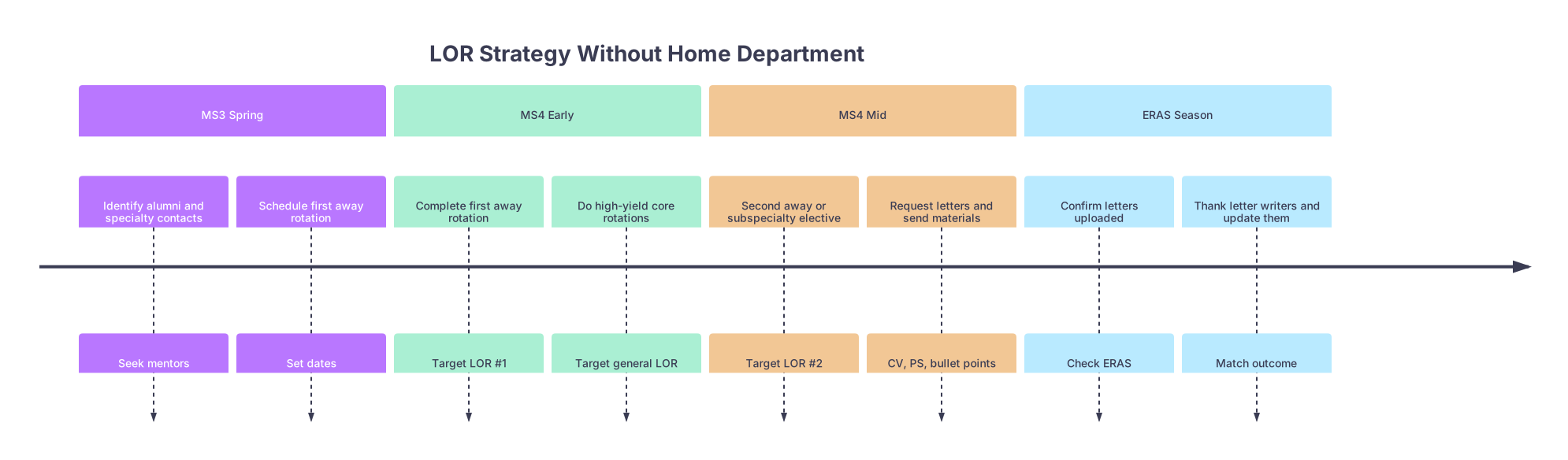
| Period | Event |
|---|---|
| MS3 Spring - Identify alumni and specialty contacts | Seek mentors |
| MS3 Spring - Schedule first away rotation | Set dates |
| MS4 Early - Complete first away rotation | Target LOR #1 |
| MS4 Early - Do high-yield core rotations | Target general LOR |
| MS4 Mid - Second away or subspecialty elective | Target LOR #2 |
| MS4 Mid - Request letters and send materials | CV, PS, bullet points |
| ERAS Season - Confirm letters uploaded | Check ERAS |
| ERAS Season - Thank letter writers and update them | Match outcome |
You want all requested letters 4–6 weeks before ERAS opens.
Faculty procrastinate. Build the lag into your plan.
9. Concrete Email Templates You Can Adapt
You do not need to reinvent the wheel. Adjust these, do not copy-paste blindly.
A. Initial “can we meet / can I rotate with you?” to alumni or external faculty
Subject: M4 at [School] interested in [Specialty]
Body:
Dear Dr. [Last Name],
My name is [Name], and I am a fourth-year medical student at [School]. I am applying to [specialty] this cycle. Our institution does not have a home [specialty] department or residency, so I have been proactive about seeking mentors and clinical experiences in the field.
I saw that you [trained at / practice at] [Institution] and completed residency in [specialty]. I would be very grateful for 15–20 minutes of your time for brief advice on structuring my rotations and letters of recommendation strategy.
I understand you have a busy schedule and would be glad to accommodate any time that is convenient for you, or to correspond by email if that is easier.
Thank you for considering this,
[Name]
[Year] Medical Student, [School]
[Phone]
[Email]
B. LOR request after away rotation
Subject: Letter of recommendation request – [Your Name], [Specialty] applicant
Body:
Dear Dr. [Last Name],
Thank you again for the opportunity to rotate with you on [Service] at [Institution] in [Month/Year]. I learned a great deal from caring for patients such as [one brief case reference if appropriate] and appreciated your feedback on [specific skill].
I am applying to [specialty] this cycle. Because my home medical school does not have a [specialty] department or residency, my away rotations are particularly important sources of specialty-specific letters. Based on your observations during my rotation, I was wondering if you would feel comfortable writing a strong letter of recommendation in support of my application.
If so, I will send along my CV, personal statement draft, ERAS ID, and a brief summary of my work on your service that may be helpful. ERAS will send you a link to upload the letter directly.
Thank you for considering this, and for the time and teaching you invested during my rotation.
Sincerely,
[Name]
Then actually send exactly what you promised.
10. How Programs Actually Read These Letters (Reality Check)
Let me be blunt: most letters are mediocre. Even from home programs.
Program directors scan for:
- Clear statement of support strength (“without hesitation,” “top 10%”)
- Concrete comparative phrases (“among the best students I have worked with in 10 years”)
- Specific examples (a case, a crisis, a patient interaction)
- Evidence the writer actually knows you
What they do not care about:
- Three paragraphs of the writer’s CV
- Generic “X is a pleasure to work with” with no substance
- Flowery adjectives unsupported by examples
When you lack a home department, your advantage is this:
You must be intentional. No autopilot.
By carefully choosing who you work with, being explicit about your situation, and making it easy for them to write something real, you often end up with stronger letters than classmates at big-name programs who just collected the default chair letter.
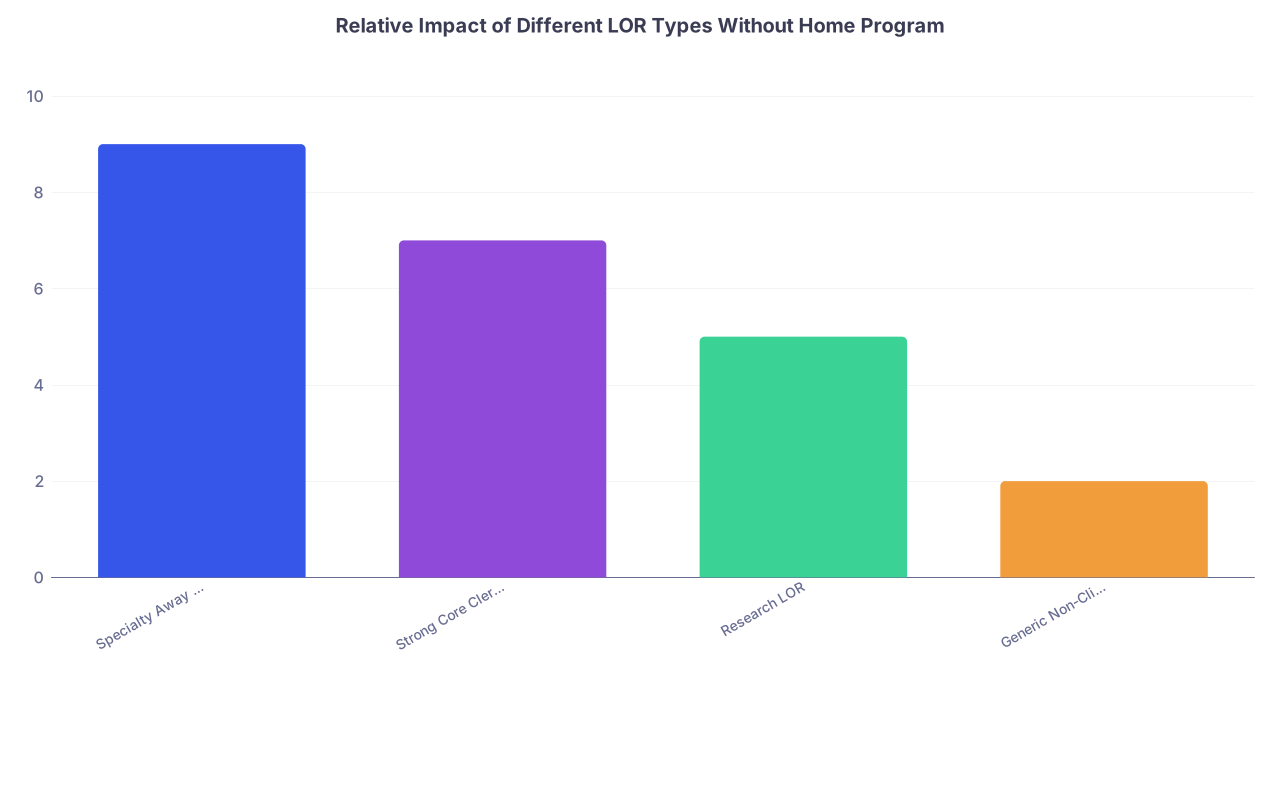
| Category | Value |
|---|---|
| Specialty Away LOR | 9 |
| Strong Core Clerkship LOR | 7 |
| Research LOR | 5 |
| Generic Non-Clinical LOR | 2 |
Interpretation:
- Aim for at least one 9/10 away LOR
- Back it up with 7/10 solid core clinical letter
- Use research letters to fill gaps, not to replace direct clinical observation
11. Common Pitfalls and How To Avoid Them
A quick hit list.
Pitfall 1: Waiting too long to ask
- If you email for a letter 4 months after a rotation, they barely remember you
- Fix: Ask in the last week, or within 1–2 weeks after the rotation ends at worst
Pitfall 2: Asking the wrong person
- A world-famous name who barely saw you is useless
- A mid-career, education-focused attending who knew you well is far better
- Residents cannot write primary letters, but they can influence what attendings write if they vouch for you
Pitfall 3: Not clarifying your no-home-program situation
- Programs assume you chose not to get specialty letters if you never explain
- Fix: Cover the context in your PS, MSPE if possible, and LOR helper doc
Pitfall 4: Overloading with non-specialty letters
- Four letters from general IM for an EM application looks odd
- You want at least one letter that clearly touches your target field


| Step | Description |
|---|---|
| Step 1 | Finished Rotation |
| Step 2 | Do NOT ask for letter |
| Step 3 | High-priority LOR |
| Step 4 | Medium-priority LOR |
| Step 5 | Did attending see your work directly? |
| Step 6 | Would they likely be positive? |
| Step 7 | Is this target or related specialty? |

FAQs
1. If my school has zero faculty in my specialty, what is the minimum acceptable mix of letters I should aim for?
Aim for at least:
- 1 strong away rotation letter from your target specialty
- 1 strong core clerkship letter (IM, surgery, or relevant field)
- 1 additional letter from either research or a related subspecialty who knows you well
Three total is usually enough. If you can get a second specialty letter from another away or elective, even better. Quality beats sheer number.
2. Should I ever explain my “no home department” situation directly in interviews?
Yes, briefly and confidently when asked about your letters, aways, or school structure. A simple answer works:
- “Our school does not have a [specialty] department or residency, so I arranged aways at [Institutions] and sought mentorship through [alumni/adjacent departments]. That is why most of my specialty exposure and letters come from those settings.”
Then pivot to what you learned on those rotations. No complaining, no self-pity. Just facts and initiative.
Key points:
- You compensate for no home program by being surgical about aways, who you work with, and when you ask for letters.
- You make it easy for attendings and mentors to advocate for you by giving context, materials, and specific examples.
- You explicitly but briefly explain your lack of home department in your application so programs interpret your letters correctly.


