

It is September 10th. ERAS is open, your friends are bragging about “a strong chair’s letter,” and you are staring at your Letters of Recommendation section with a pit in your stomach.
No chair letter. No obvious path to getting one in time. Maybe:
- You never rotated on your home department’s service.
- The chair barely knows you and you refused to accept a generic, meaningless template.
- Your school does not even do traditional chair letters.
- The chair is “on sabbatical” or perpetually “behind on letters.”
And now you are wondering: Is this going to quietly sink my application?
Let me be blunt: for the vast majority of applicants and specialties, missing a chair’s letter is not fatal. But ignoring the gap and hoping no one notices? That will hurt you.
You fix this with intent: strategic alternatives, smart communication, and a clear plan for what you will upload and when.
I will walk you through that plan.
Step 1: Get Clear on Whether a Chair’s Letter Is Actually Required
Before you panic, verify the reality instead of the rumor mill.
1. Identify your specialty’s culture
Some specialties care a lot about chair letters. Some barely register them.
Here is a rough hierarchy I see year after year:
| Specialty | Chair Letter Importance |
|---|---|
| Radiation Oncology | High |
| Neurosurgery | High |
| Orthopedic Surgery | Moderate-High |
| General Surgery | Moderate |
| Internal Medicine | Moderate |
| Pediatrics | Low-Moderate |
| Family Medicine | Low |
This is not gospel. But it matches feedback from PDs and what I have watched in real application cycles.
2. Check the actual program requirements, not Reddit
Go to:
- Program websites (often under “Application Requirements” or “Residents → Apply”)
- FREIDA listing for each program
- ERAS “Program Signals” / filters where available
You are looking for exact phrases like:
- “Chair letter required”
- “At least one letter from the department chair”
- “One letter must be from an internal medicine faculty member at your home institution”
If you see “strongly preferred,” treat it as:
- “We will not auto-reject you without it, but you are at a disadvantage. Fixable with context.”
If you see nothing about a chair’s letter, assume:
- It is nice-to-have, not mandatory.
3. Decide which bucket you fall into
You are in one of three groups:
- Chair’s letter truly required for several of your target programs.
- Chair’s letter preferred, but not explicitly required.
- No mention; chair’s letter is optional.
Why this matters: Your recovery plan is different for each.
Step 2: Understand Why Programs Like Chair Letters (So You Can Replace the Function)
A chair’s letter is not magic. It serves a few specific purposes that you can replicate.
Programs like them because:
They signal that the department “vouches” for you.
Translation: Someone high up is not warning them away.They confirm you are not a problem.
Not a professionalism disaster. Not a known nightmare.They provide context within your home institution.
How you compare to peers. Any red flags that are resolved. Any major positives.
Your goal is not “get a document with ‘Chair’ in the signature line.”
Your goal is “cover those functions with the letters you do have.”
If you do that, many programs frankly do not care what the title on the letterhead says.
Step 3: Build a Replacement LOR Portfolio That Actually Works
Here is how you construct a strong, chair-less letter set that still answers the questions PDs care about.
Core principle
You want:
- At least three strong, specific clinical letters
- Ideally two in your chosen specialty
- At least one from a senior person (program director, associate program director, division chief, or well-known faculty)
Acceptable alternatives to a chair’s letter
Ranked from strongest to weakest “chair-equivalent”:
Program Director (PD) letter in the specialty
If you rotated at your home institution or an away and impressed the PD, that can be as strong or stronger than a chair letter.Associate Program Director (APD) or Division Chief letter
“Associate Program Director, Department of Internal Medicine” reads very well to PDs. So does “Chief of GI” or “Chief of Hospital Medicine.”Clerkship Director or Core Rotation Director in your specialty
Especially if they run the main clerkship where all students are evaluated. They can compare you to the entire class.Strong subspecialty faculty in your field who worked closely with you
Example: An interventional cardiologist for IM. A hand surgeon for ortho. A neonatologist for peds. Depth beats title if the letter is specific and enthusiastic.Respected faculty from another institution during an away rotation
This is extremely valuable because it tells programs:- You can function outside your home system
- You performed well in a “try-out” environment
What I do not recommend as “alternatives” to a chair letter:
- Generic, template letters where your name might as well be a mail merge field
- Research PI letters that barely mention clinical performance for core clinical specialties
- Letters from non-physicians (PhDs, MPs, etc.) as substitutes for a missing departmental voice
Research letters have their place, but they are not a substitute for clinical performance evaluation in most residency applications.
Step 4: If a Chair’s Letter Is Required, Use the “Late, With Explanation” Strategy
Sometimes you simply must have a chair letter because multiple programs on your list explicitly require one.
Fine. Then your job is not to pretend you do not need it. Your job is:
- Get it as soon as possible.
- Make sure programs know it is coming.
- Fill the gap with other strong letters in the meantime.
1. Lock in a chair letter, even if the chair barely knows you
If you have any path to a chair letter, use it:
Ask your clerkship director, PD, or a senior faculty who knows you:
“Would you be comfortable recommending me to the chair for a departmental letter for residency applications?”Send the chair or their assistant a tight email:
- Who you are
- Your specialty
- That you need a chair’s letter for residency applications
- Who can vouch for you internally (attach your CV and personal statement)
Offer them:
- Your CV
- Your personal statement
- Your ERAS experiences list
- A short bullet-point summary of your performance and any notable achievements
Yes, the chair might write a somewhat generic letter. That is still better than “no chair letter where one is required.”
2. Use a placeholder strategy in ERAS
Here is the common pattern that works:
- Upload and assign your three or four strongest clinical letters now.
- As soon as the chair letter is uploaded, add it and reassign letters where needed.
Programs know letters arrive on a rolling basis. They do not sit there refreshing your file on day one and then refusing to look again.
3. Proactively communicate with programs that explicitly require it
For programs that literally state “chair’s letter required,” consider:
- A brief email to the program coordinator, copied to the program’s general email:
Subject: Chair’s Letter Status – [Your Name], ERAS ID [XXXX]
Dear [Program Coordinator Name],
I am applying to your [Specialty] residency program this season. I noticed that a chair’s letter is listed as a required component of the application.
My department chair has agreed to write this letter, and it is currently in progress but not yet uploaded to ERAS. I wanted to let you know that I will assign it to your program as soon as it becomes available.
In the meantime, I have submitted letters from [PD/division chief/other senior faculty] who have worked closely with me clinically.
Thank you for your consideration,
[Name]
[School]
[ERAS ID]
Do not write an essay. You just want them not to auto-screen you out as “application incomplete.”

| Step | Description |
|---|---|
| Step 1 | No Chair Letter |
| Step 2 | Build Strong Alternative Set |
| Step 3 | Request Chair Letter ASAP |
| Step 4 | Upload Other Strong Letters |
| Step 5 | Notify Programs Its Coming |
| Step 6 | Assign Chair Letter When Ready |
| Step 7 | Required by Programs? |
Step 5: For Most Applicants – Make Your Non-Chair Letters Do More Work
If your programs do not formally require a chair letter, your real job is:
Make your existing letters so strong that no one cares about the missing chair.
What a replacement letter needs to include
Ask your letter writers to explicitly address the things a chair letter would:
Global comparison to peers
- “Among the top 10% of students I have worked with in the past five years.”
- “One of the strongest sub-interns on our service this year.”
Professionalism / reliability
- “Dependable and mature; I would trust them with my own family member’s care.”
- “No issues with professionalism or teamwork; well liked by nurses and staff.”
Clinical reasoning and growth
- “Showed steady improvement, incorporated feedback, and was independently managing 4–6 patients by the end of the rotation.”
Clear support for residency and specialty choice
- “I give [Name] my strongest recommendation for [specialty] residency.”
You do not need to tell writers how to write. But you can guide what they emphasize.
How to ask without being awkward
Email something like this:
Dear Dr. [Name],
Thank you again for agreeing to write a letter of recommendation for my [specialty] residency applications.
Some of the programs I am applying to traditionally see a chair’s letter, but our department process has made that challenging. Because of that, your letter will likely serve as one of the main departmental voices for my application.
If you are comfortable, it would be very helpful if your letter could comment on:
- My performance relative to peers you have worked with
- My professionalism and reliability on the team
- My suitability for a career in [specialty]
I have attached my CV, personal statement, and a brief summary of my work on your service, in case that is useful.
Thank you again for your support,
[Name]
You are not scripting them. You are giving them the angles that matter most.
Step 6: Handle the “My Chair Does Not Do Letters” or “Small / No-Home-Program” Problem
I see this a lot:
- You are at a community-based school with minimal academic structure.
- You are an international medical graduate (IMG) with no U.S. home department.
- Your school’s department policy is “No individual chair letters, only a dean’s letter/MSPE.”
Here is how you fix that.
1. Use your MSPE and dean’s letter as part of the “department voice”
For many schools, the MSPE is effectively the comprehensive departmental / institutional comment. Programs know this.
If your school’s culture is “no chair letters,” programs that recruit heavily from your school already know this. They do not expect what does not exist.
2. Upgrade at least one letter to “senior faculty” status
If you are missing a chair and PD letter, you must have at least one of:
- Division chief
- Clerkship director
- Course director
- Department vice chair
Even if they were not your day-to-day attending, ask someone who has read your evaluations and knows the context of your performance.
3. For IMGs and schools without U.S.-style chairs
Then your priority is:
- Get strong U.S. clinical letters from reputable sites (university affiliates, major teaching hospitals).
- Ensure at least one letter clearly states something like:
“I am aware [Name] does not have a home department in the U.S. system. I have supervised their clinical work directly and can attest that they are ready for residency training in the U.S.”
That one sentence tells PDs: this is not a red flag, this is a structural reality.
Step 7: Addressing the Missing Chair Letter in Interviews (If It Comes Up)
Most of the time, it will not. PDs are busy and your file is one of hundreds.
But if someone asks directly, you need a clean, non-defensive answer.
Do not say:
- “The chair does not know me.” (Implies you were invisible or low-performing.)
- “I did not have time.” (Translates to “I did not prioritize my own application.”)
- “I heard they write bad letters.” (You just insulted your own department.)
Do say:
Pick the option that is true for you.
If your school does not do chair letters:
“Our department does not provide individual chair letters for residency applications. Instead, they structure feedback through the MSPE and standardized rotation evaluations. Because of that, I prioritized letters from faculty who worked with me extensively clinically, including Dr. X and Dr. Y.”
If the chair was unavailable / delayed:
“Our department chair had a significant volume of letters and administrative work this season, and by the time my application cycle started it was not clear the letter would be ready in a reliable timeframe. I wanted to ensure programs received detailed letters from attendings and our program director who knew my work closely on the wards. If a chair letter becomes available later in the season, I am happy to have it added to my file.”
If you are an IMG / no home program:
“I do not have a traditional U.S. home department chair, so I focused on letters from U.S. faculty who supervised me directly in clinical settings, such as Dr. X at [Hospital] and Dr. Y at [Institution]. They evaluated both my clinical performance and my readiness for U.S. residency training.”
Short. Factual. Zero drama.
Step 8: Strategic Letter Mix – What You Should Actually Upload
Let us get concrete. Here is what a functional letter set looks like with no chair letter.
Example: Internal Medicine applicant with no chair letter
You aim for:
- 1 letter from your Internal Medicine Program Director or Clerkship Director
- 1 letter from a sub-internship attending who supervised you closely
- 1 letter from an away rotation IM attending or APD
- (Optional 4th) 1 letter from a research PI who can comment on work ethic and scholarship, if it is strong and relevant
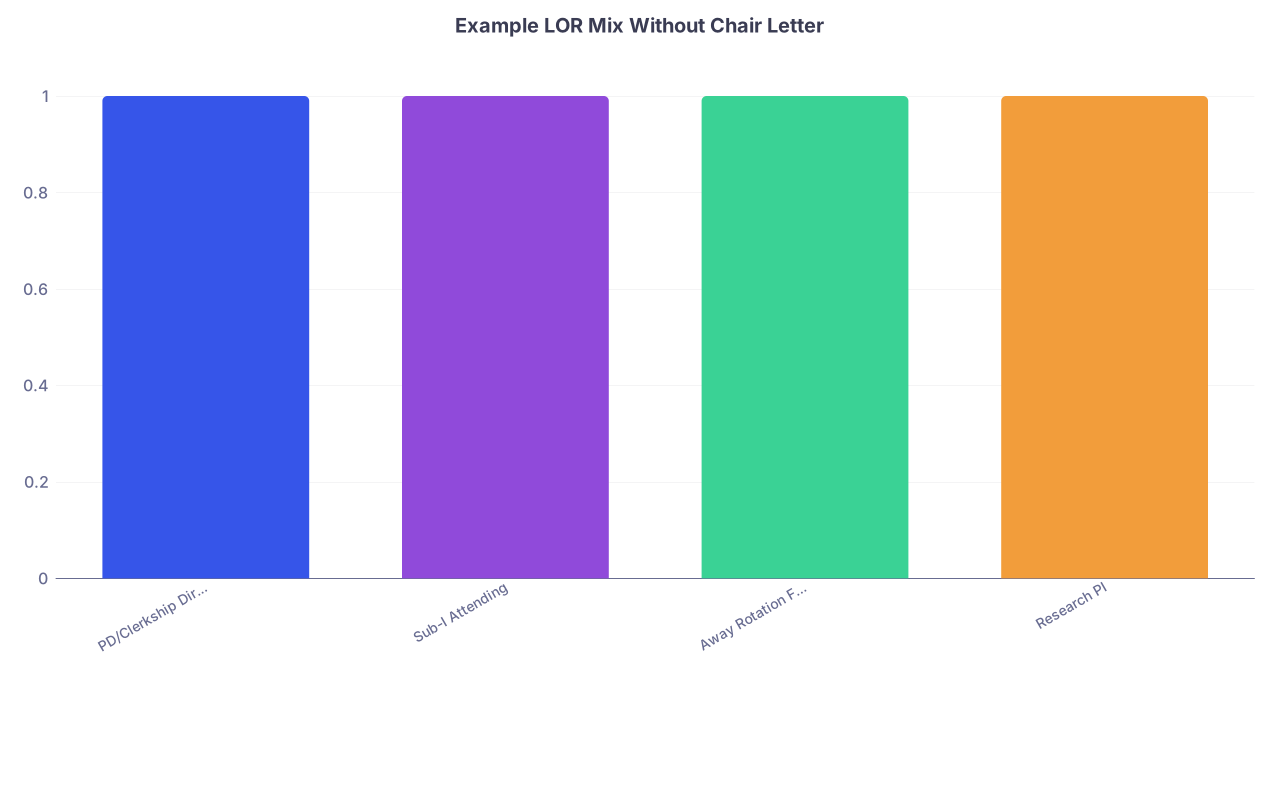
| Category | Value |
|---|---|
| PD/Clerkship Director | 1 |
| Sub-I Attending | 1 |
| Away Rotation Faculty | 1 |
| Research PI | 1 |
Example: Surgery applicant without a chair letter
You aim for:
- 1 letter from a home program PD or associate PD
- 1 letter from your surgery sub-I / acting internship
- 1 letter from an away rotation at a reputable surgery program
- 1 backup letter (another home faculty or strong subspecialty surgeon)
Notice the thread: PD-equivalent + direct supervising attendings who can talk about your actual work.
Step 9: Fixing This Late in the Season vs. Early in the Season
The realistic options change depending on where you are in the application timeline.
If it is June–July (early)
You still have options to:
- Schedule a home sub-I on the department’s main service and get seen by leadership.
- Arrange a meeting with the chair early and signal your interest in the specialty.
- Ask your PD/clerkship director to facilitate a chair introduction.
You can often still get a genuine, not totally generic letter if you move now.
If it is September–October (applications already in)
Do not blow up your application trying to fix this retroactively. Instead:
- Focus on:
- Strengthening the letters you do have.
- Making sure they are assigned correctly to all programs.
- If a chair letter finally comes in:
- Add it as an extra letter to programs that require or heavily value it.
- Do not unassign a strong clinical letter just to wedge in a mediocre chair letter.
Late, weak chair letter < early, strong clinical letter.
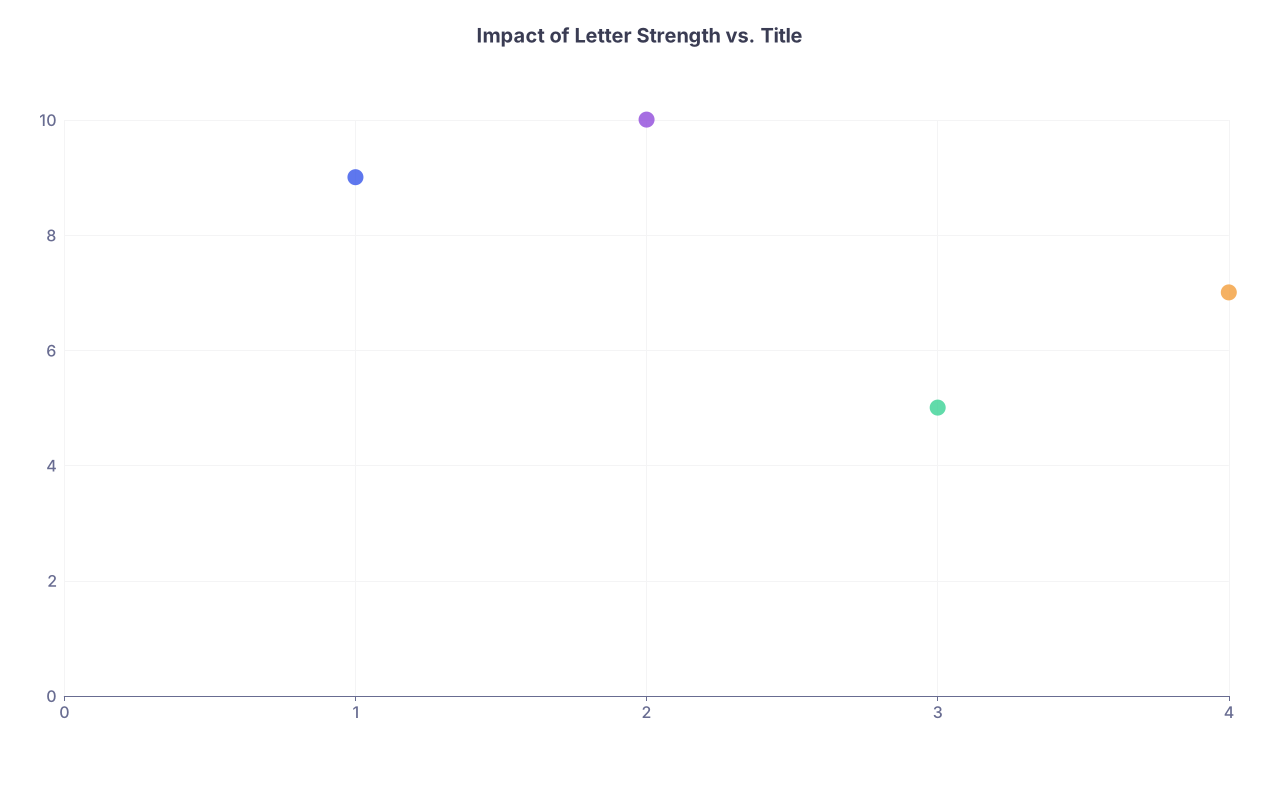
| Category | Value |
|---|---|
| Strong Attending | 1,9 |
| Strong PD | 2,10 |
| Weak Chair | 3,5 |
| Average Faculty | 4,7 |
(X-axis: letter type, Y-axis: impact on PD perception, rough scale 1–10)
The point: a powerful letter from someone who truly knows you beats a lukewarm letter with a fancy title.
Step 10: Common Mistakes That Actually Hurt You More Than the Missing Chair Letter
I have seen students torpedo themselves not because they lacked a chair letter, but because they panicked and made worse decisions.
Avoid these:
Overloading your application with weak letters.
Four okay letters are not better than three excellent ones. Programs will read the worst one too.Letting a generic chair letter replace your strongest clinical letter.
Do not unassign the letter from the attending who watched you crush a sub-I to insert a form letter that says nothing specific.Trying to explain the missing chair letter in your personal statement.
That looks defensive and draws attention to something most programs would have ignored.Trash-talking your department or chair in interviews.
That is an instant red flag. People imagine you doing the same to their program later.Ignoring explicit requirements.
If a program says “chair letter required” and you never send one, they may never even read your file. Either get one or be realistic and do not apply there.
What You Should Do Today
Do not just close this and go back to doomscrolling forums. Take one practical step now.
Here is a concrete move you can make today:
Open your ERAS “Documents → LoRs” page, list your current and potential letter writers, and label each as:
- Chair-equivalent (PD/APD/division chief)
- Core specialty attending (direct supervisor)
- Secondary/other (research, non-core specialty, multidisciplinary)
Then:
- Identify if you have at least one chair-equivalent and two strong core specialty attendings.
- If you do not, send one email today to a senior faculty member (PD, APD, clerkship director, or division chief) who has seen your evaluations, asking if they would be willing to write on your behalf.
- In that same message, give them the context: that their letter may effectively serve as your department’s primary endorsement for residency.
You cannot go back in time and manufacture a chair relationship. But you can control the quality, clarity, and seniority of the letters you send.
Do that well, and the missing chair letter becomes background noise instead of the headline.


