
The obsession with “big name” letters of recommendation is wildly overblown—and it’s messing with your head more than it’s hurting your application.
Let me just say the quiet part out loud: yes, programs notice names. They do. If someone has a letter from the department chair at MGH or a Nobel laureate, eyes will pause on it. You’re not hallucinating that.
But here’s the piece everyone conveniently leaves out when they’re flexing about their “rockstar” letters: a famous name on a weak or generic letter is worse than a normal name on a strong, specific one.
I’ve seen it. Committee members flipping through ERAS saying things like, “Yeah, this is from [famous person] but it’s basically a template. Next.” That’s the part that never makes it into the group chat.
Let’s untangle this before you spiral yourself straight into insomnia.
How Much Do “Big Name” LORs Actually Matter?
Short answer: they matter… but not nearly in the way your anxiety is telling you they do.
Here’s what programs actually care about when they read letters:
- How well the writer knows you
- The strength and specificity of what they say
- The credibility of the writer in that specialty
- Consistency with the rest of your application
“Famous” only really plays into #3. And only to a point.
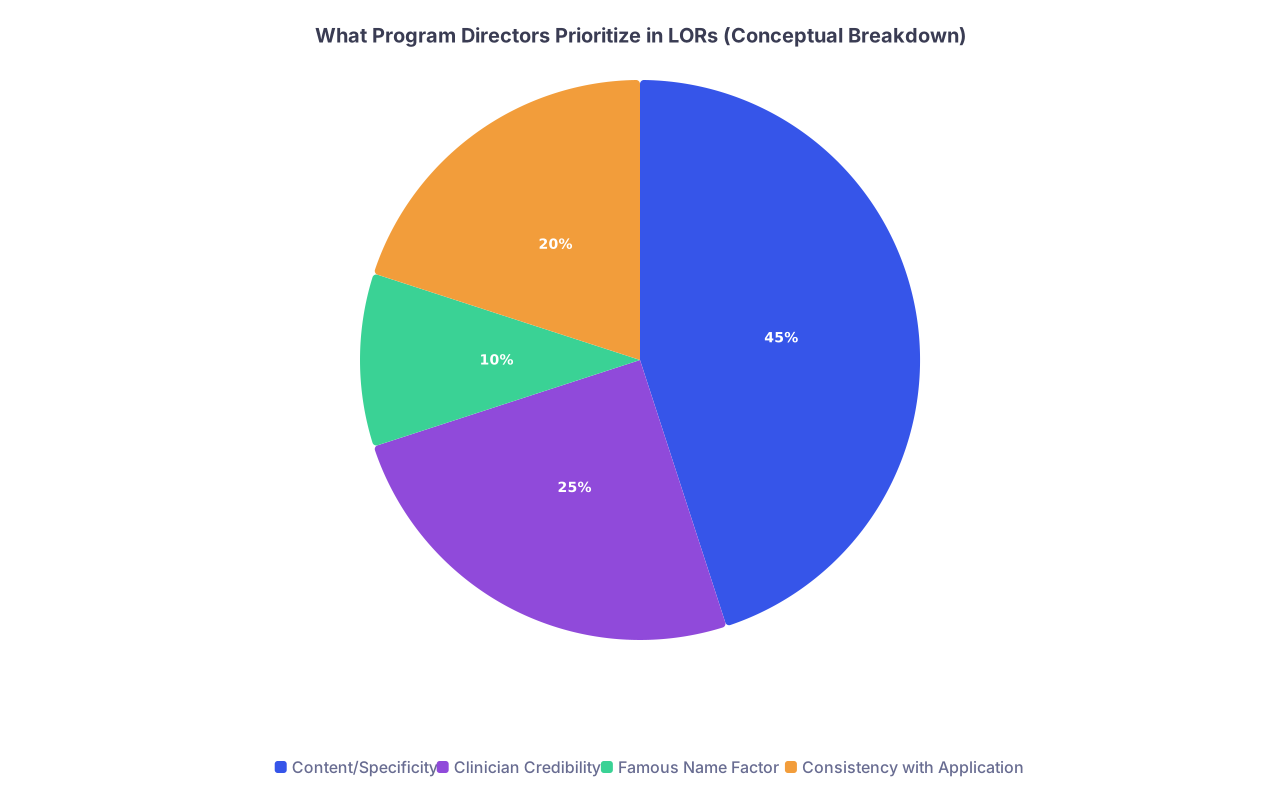
| Category | Value |
|---|---|
| Content/Specificity | 45 |
| Clinician Credibility | 25 |
| Famous Name Factor | 10 |
| Consistency with Application | 20 |
So no, you’re not doomed because you don’t have some world-renowned PI writing, “This is the best student I’ve seen in 20 years.” That line shows up way more in people’s humblebrags than in reality.
What counts more:
- Concrete examples of your work ethic, judgment, reliability
- Statements ranking you among peers (top 10%, top 5%, “among the best I’ve worked with”)
- Clear support for your chosen specialty (“I strongly recommend them for internal medicine residency”)
A letter from a mid-level faculty who knows you really well and can write, “They stayed late every night on our inpatient service; I trusted them to follow up on critical results without supervision,” carries more weight than a big-name chair who barely remembers your face and writes three generic paragraphs.
That doesn’t mean big names are useless. But they’re not the magic golden ticket your classmates make them out to be.
The Worst-Case Scenarios You’re Imagining (And What’s Real)
Let’s just say what you’re actually scared of.
You’re probably thinking:
- “My classmates all have chairs and program directors writing for them. My letters are from ‘random’ attendings. I’m going to look like the weak one.”
- “Programs are going to assume no big name means no one thought I was impressive.”
- “They’ll just auto-rank my classmates higher because their letter writers are well-known.”
Here’s the reality I’ve watched in admissions discussions:
Scenario: Candidate A has a letter from a major name at a big academic center. But it’s vague: “Pleasure to work with, solid clinical skills, a team player.” No rankings. No stories. Very template-y.
Candidate B has a letter from a community hospital attending:
“They arrived early to preround, often stayed past sign-out to help with discharges. They handled a complex GI bleed case overnight with poise and appropriate escalation. I’d be thrilled to have them as a resident.”
Committee reaction? They talk about Candidate B. They barely mention Candidate A’s big name except as a one-liner.
Name recognition might make someone pause for 5 seconds. Content makes them actually care.
What would be concerning is:
- Letters that sound lukewarm (“performed at the level expected of their training”)
- Letters that contradict your stated interest (e.g., you say you love surgery, letters all say “primary interest in radiology”)
- Letters from people who clearly don’t know you (“I worked with them briefly…”)
But “not a famous person” is not a red flag. It’s… normal.
How Programs Actually Read Your Letters
Picture this: faculty, tired, 40+ applications deep in one sitting, flipping through ERAS.
They’re not sitting there whispering, “Ah, Dr. X from Hopkins… the prestige.” They’re doing a quick scan like this:
- Who wrote it (specialty? role? PD? chair? faculty?)
- How strongly are they recommending you
- Any red or yellow flags
- Does this fit the rest of what we see

| Step | Description |
|---|---|
| Step 1 | Open ERAS Application |
| Step 2 | Check Writers Role/Institution |
| Step 3 | Skim for Strength of Language |
| Step 4 | Concern/Discuss at Committee |
| Step 5 | Look for Specific Examples |
| Step 6 | Decide: Strong vs Average vs Weak Support |
| Step 7 | Integrate with Scores, CV, Personal Statement |
| Step 8 | Any Red Flags? |
Chair/PD letters do help in one specific way: they signal, “The department leadership knows this person and is willing to put their name on the line.” That’s not nothing.
But here’s the part to remember: a strongly written letter from a regular attending in your chosen specialty is often weighted just as heavily as a generic PD letter.
And committees are used to context. Community programs, smaller schools, less research-heavy places—of course their applicants don’t all have brand-name letters. No one is shocked.
What raises eyebrows more than “no big name” is “why does this applicant’s home department chair not know them at all?” That’s more a question of pattern than prestige.
Real Talk: When a Big Name Letter Actually Helps
There are times when the famous name thing genuinely helps. Let’s not pretend otherwise.
It tends to matter most when:
- You’re applying to a very academic, very competitive specialty (derm, ortho, plastics, ENT, neurosurg, etc.)
- Your stats are borderline for that tier of program and you need any bump you can get
- The writer is well known within that exact specialty and is clearly vouching hard for you
- You rotated at a top program and the letter basically says, “We’d be happy to have them here”
In those situations, the combo of name + content can move you up in the pile.
But note: it’s the combo. A big name with lukewarm content does not cancel out weaker scores or a patchy transcript. It just… doesn’t.
And here’s another under-discussed reality: programs know some “famous” people write the exact same letter for half their students. Their credibility gets discounted over time. People talk.
I’ve literally heard in a meeting: “Yeah, Dr. ___’s letters are always like this. Doesn’t mean much.”
So you stressing that your classmate got a letter from That One Person might be you panicking over something the committee already mentally downgraded.
What You Can Control Right Now (Even If Your Letters Are Already Requested)
If your letters are already in motion and there’s no chance you’re suddenly rotating with a fancy person, here’s where you still have leverage.
1. Make sure your letter writers actually know you
Sounds obvious. It’s not. I’ve watched students send a one-line email and hope for the best.
If you haven’t already, send them:
- Your CV
- A short “letter packet” or bullet points: what you want emphasized, key cases you worked on, projects you did with them
- Your personal statement draft (so they can align with your story)
Give them raw material so the letter doesn’t turn into: “They were on my team. They did fine.”
2. Aim for specialty alignment, not just prestige
For residency, a well-known within-specialty faculty letter is more impactful than a world-famous cardiologist writing for your anesthesia application.
Typical strong combo for many fields:
- 2 letters from attendings in your chosen specialty (home or away)
- 1 letter from someone who’s seen you a lot clinically (sub-I, inpatient rotation)
| Specialty | Minimum Strong Setup | Nice-to-Have Bonus |
|---|---|---|
| Internal Med | 2 IM attendings | PD or chair if they know you |
| Surgery | 2 surgery attendings | Subspecialty surgeon from away |
| EM | 2 SLOEs (EM faculty) | Extra non-EM clinical letter |
| Psych | 2 psych attendings | Research mentor in psych |
| Peds | 2 peds attendings | Sub-I or NICU/PICU letter |
Notice how none of that says “must be a nationally famous person.”
3. Repair the part of your application that really moves the needle
Uncomfortable truth: if you’re using letters as your imagined savior, you’re probably ignoring bigger factors:
- Class rank
- Shelf scores / Step 2
- Clinical narrative from MS3/MS4 evaluations
- Your personal statement actually sounding human
A great set of letters can nudge someone up. They rarely resurrect a catastrophic file.
So if Step 2 isn’t taken yet, that’s where your limited energy goes. If your personal statement is generic, fix that before obsessing about titles on letterhead.
The Social Comparison Trap (aka The Group Chat Is Toxic)
You know why this “big name” thing feels so awful? Because you’re seeing the highlights of everyone else and comparing them to your internal worst-case script.
Your group chat says:
- “Got a letter from the chair at Mayo!”
- “My away rotation PD offered to write one!”
Nobody posts:
- “My attending said they ‘don’t really write strong letters’ and offered a generic one.”
- “The person I thought would write for me never replied to my email.”
You only see the flexes. So you start building this mental picture that everyone has powerhouse letters and you’re the only one with “normal” ones. That’s just not how the averages shake out.
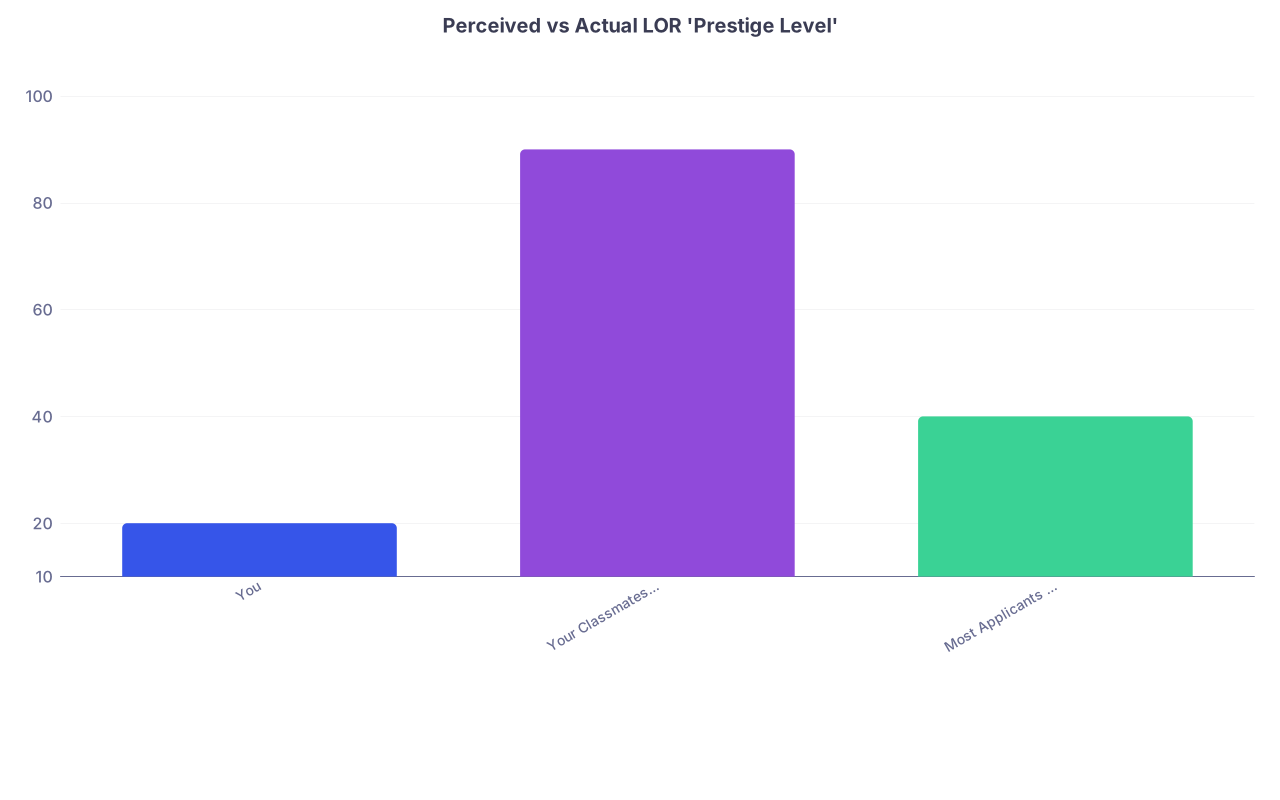
| Category | Value |
|---|---|
| You | 20 |
| Your Classmates (in your head) | 90 |
| Most Applicants (reality) | 40 |
Your brain fills in the gaps with: “Programs will see my letters and just… shrug.”
Reality: most applicants have a mix of solid but not earth-shattering letters. Programs know this.
You’re not competing against the imaginary class of people with three PD letters from Harvard, Hopkins, and UCSF. You’re competing in a giant pool where most people have:
- One solid specialty letter
- One decent but generic letter
- One that’s somewhere in between
If you can get even two letters that are specific, enthusiastic, and coherent, you’re already in pretty good shape.
How to Know if You’re Actually in Trouble (Brutal but Helpful)
You’re not in danger just because:
- None of your writers are nationally famous
- You don’t have a letter from your home PD or chair
- Your classmates keep name-dropping their letter writers
You might be in a weaker position if:
- Your only letters are from non-specialty folks (e.g., all IM letters for a surgery app)
- You know your strongest clinical mentor said they were too busy to write for you
- You had professionalism issues and the one person who knows you best is lukewarm
If that’s you, the move isn’t to chase celebrity names. It’s to:
- Add an away rotation with someone who will actually watch you work
- Ask for an honest read: “Can you write me a strong letter, or would someone else be better?”
- Add at least one more letter writer who’s seen you closely, even if they’re not fancy
And yes, it’s terrifying to ask if someone can write a “strong” letter. But that question has saved more applications than any last-minute scramble for a big name.
Final Perspective Before You Spiral Again Tonight
Here’s the thing I want you to hold onto:
Residency programs are not building a roster of letter writers. They’re trying to build a functional team of residents they trust at 3 a.m. when someone is crumping.
When they look at your LORs, they’re asking:
“Does this person sound like someone I want on my team, taking care of my patients, not making my interns miserable?”
A famous name can’t answer that on its own. A normal attending who actually knows you can.
Years from now, you won’t remember which of your classmates bragged about their “big name” letters. You’ll remember the patients, the overnight calls, and the fact that you showed up anyway—even when your brain was convinced you were already behind.
FAQ (Exactly 6 Questions)
1. Do I need a letter from my department chair or program director to match well?
No. It’s helpful if they know you and can write a genuinely strong letter, but it’s not mandatory at most programs, especially outside of ultra-competitive specialties. A sincere, detailed letter from a non-chair faculty who supervised you closely on a sub-I or core rotation is often treated just as seriously. Committees care far more about content than job title alone.
2. Will programs assume I’m weak if I don’t have any “big name” letter writers?
They won’t jump to “weak,” they’ll look for patterns. If you have zero letters from your chosen specialty, or all your letters sound generic and distant, that raises questions. But “no celebrity faculty” is not itself a problem. Most applicants don’t have national experts writing for them. Programs are used to that and adjust their expectations accordingly.
3. How can I tell if a letter is strong if I’m waiving my right to see it?
You can’t read it—but you can read the situation. Did the faculty seem genuinely enthusiastic when you asked? Did they work with you closely over time? Did they say something like, “I’d be happy to write you a strong letter”? Those are good signs. If they hesitated, seemed lukewarm, or said, “I can write you a letter” with zero qualifier, that’s when you might consider asking someone else as well.
4. Is it bad if one of my letters is from a non-specialty attending (e.g., IM for a psych app)?
No, not if the rest of your letters cover your target specialty. A non-specialty letter can be great to show your general clinical performance, professionalism, and teamwork. What you don’t want is only non-specialty letters. Aim for at least one (ideally two) attendings in your chosen field, then fill the remaining slot with someone who knows you very well, even if they’re in a different department.
5. Should I try to swap out a “normal” letter for a famous name if I barely worked with the famous person?
Honestly? Usually no. A superficial letter from someone who barely interacted with you is often obviously generic, and committees can tell. You’re better off keeping a detailed, specific letter from a “normal” attending who supervised you for a full month than chasing a prestige name that adds nothing concrete. If you can get both—and both know you—that’s fine. But don’t sacrifice substance for status.
6. Can a bad or lukewarm letter ruin my application, even if the writer is a big name?
Unfortunately, yes. A negative or clearly lukewarm letter from a high-profile person can hurt more than a similar letter from someone less known, because committees assume that big names are used to writing strong letters for excellent students. If they don’t for you, that stands out. That’s why you always ask, “Would you feel comfortable writing me a strong letter of recommendation?” and listen carefully to the answer—name recognition doesn’t save a weak endorsement.