
Your application is not doomed. But you’re right to be stressed.
This is one of those quiet fears almost everyone has and almost no one admits. In the group chat, people brag about “three glowing letters” from big-name attendings. Meanwhile, you’re sitting there thinking: “I have one truly strong clinical letter. The rest are… fine. Maybe weak. Maybe generic. Am I dead in the water?”
Let me say this bluntly: programs reject a lot of applicants with three “solid” letters and invite a lot of applicants who really only have one standout letter carrying the weight. The system is messier than people pretend.
Let’s walk through what’s actually going on, what’s fixable, and what you can stop losing sleep over at 2 a.m.
What Programs Actually Do With Your LORs
First reality check: most programs are not doing some hyper-detailed line-by-line literary analysis of every letter for every applicant. They don’t have time.
Here’s how it usually goes behind the scenes on first pass:
- They look at your Step scores, clinical grades, school, any red flags.
- They glance at your MSPE (Dean’s letter).
- They scan your letters for obvious themes and red flags.
- They move on.
Your letters live in that awkward space between “really important” and “we have 3 minutes per file.”
What matters most about your letters is usually:
- Does at least one person clearly, strongly vouch for you clinically?
- Do any letters contradict each other or the rest of your application?
- Are there red flags: “with appropriate supervision,” “some concerns,” “needs improvement,” or obviously lukewarm, coded language?
So no, you’re not doomed because two of your letters are boring or generic. You’d be in real trouble if:
- Your only strong letter is from a non-clinical person in a very clinical-heavy specialty (e.g., only strong letter is from a PhD researcher and you’re going for surgery).
- One letter is quietly negative.
- All letters sound like the writer barely knows you.
But one strong clinical LOR that is clearly enthusiastic? That can absolutely anchor your application.
How Bad Is It Really To Have Only One Strong Clinical Letter?
Let’s not sugarcoat: more strong letters is better. Obviously. But you’re not competing against some idealized applicant with three gushing, specific, senior-attending letters written by people who know you like a family member. You’re competing against real people whose letters often sound like they were dictated in 4 minutes between cases.
Here’s what I’ve seen over and over:
People overestimate how strong other people’s letters are and underestimate their own.
You imagine everyone else’s letters say things like:
“Top 1% of all students I’ve worked with in my 25-year career. I would trust them with my family’s care tomorrow.”
The reality? A lot of letters sound like:
“X was a pleasant, hardworking member of the team. They were punctual and demonstrated appropriate knowledge for their level.”
That’s not a “bad” letter. But it’s not doing much heavy lifting.
The difference-maker is often that one letter that actually pops, especially in your chosen specialty. The one that says, explicitly or implicitly:
- I would rank this person strongly.
- I would happily work with them as a colleague.
- They are one of the better students I’ve seen in recent years.
If you have one like that, you are not doomed. You are in better shape than a lot of people who have three forgettable, “nice but bland” letters.
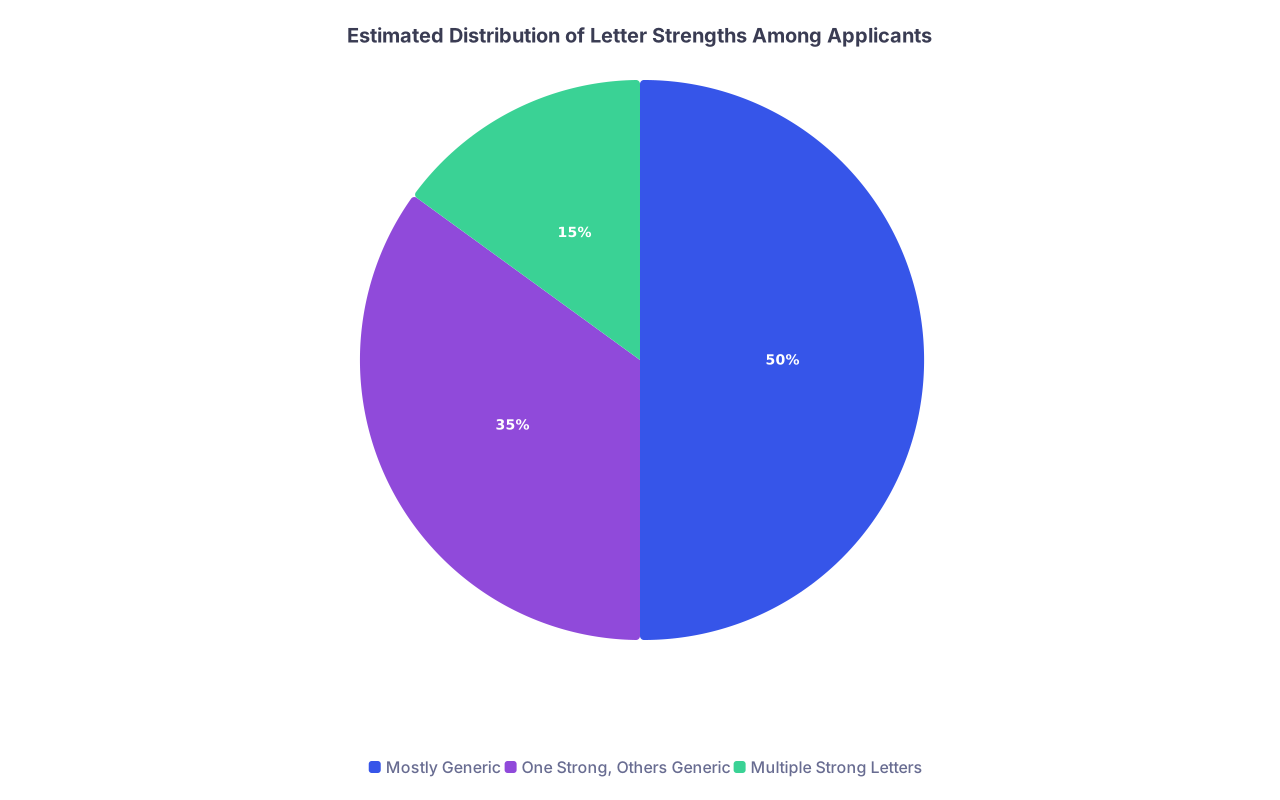
| Category | Value |
|---|---|
| Mostly Generic | 50 |
| One Strong, Others Generic | 35 |
| Multiple Strong Letters | 15 |
That’s more or less how the real world looks. You’re probably in the middle slice, not the bottom of the barrel.
Clinical LORs vs. Research vs. Character: What Actually Matters?
You’re worried about “only one strong clinical letter” for a reason. And you’re right: clinical letters usually matter more than research or “character” letters, especially for residency.
Hierarchy, roughly (varies by specialty, but this is the general pattern):
- Strong clinical letter in your specialty from someone who actually supervised you
- Strong clinical letter from another specialty who knows you really well
- Strong non-clinical/research/mentor letter that’s specific and detailed
- Generic “they were on my team” clinical letter with no specifics
- Anything lukewarm/negative/coded critical
So if your “one strong” letter is:
- From your specialty
- Detailed, specific, with clear praise
- From someone reasonably well known or at least clearly experienced
Then you’ve basically checked the box that programs care about the most. The rest of your letters just need to not drag you down.
Are multiple strong clinical LORs a plus? Of course. But programs aren’t going to say, “Well, this person has one fantastic letter calling them top 5% and a great fit, but we’ll reject them because their other two letters are just okay.” That’s not how it works.
What If Your Other Letters Are Weak or Generic?
This is where the anxiety spikes. You know one attending loves you. The others? You honestly have no idea what they wrote. Maybe you barely worked with them. Maybe you did fine, but not spectacularly.
Worst-case scenarios running through your head probably look like:
- “What if they low-key sabotaged me?”
- “What if my generic letter makes them think my strong letter is a fluke?”
- “What if programs think I could only convince one person I was competent?”
Here’s the calming counterpoint: most faculty are not out to hurt you. If they don’t feel strongly, they write something safe, standard, and professional. Generic, yes. But not lethal.
What is dangerous is a letter from someone who didn’t know you well and secretly had concerns. If you chose writers who at least seemed neutral-to-positive, the odds are high their letters are fine, even if they aren’t game-changers.

If you’re still in the phase where you can influence things, here’s what people almost never do but absolutely should: send your letter writers a short, focused email with bullet points.
Stuff like:
- A couple of specific cases or moments you worked on with them
- Your intended specialty and why
- A few traits you hope they can comment on: work ethic, teamwork, clinical reasoning, teachability
You’re not writing the letter for them. You’re jogging their memory and giving them an easy template to say something substantive. That can turn a generic letter into a decent one.
If the letters are already submitted and locked? Then your job now is not to magically rewrite them in your head. It’s to make the rest of your application so coherent and strong that even if two letters are just “fine,” programs still feel confident inviting you.
How To Make Your One Strong Letter Work For You
If you’ve got one excellent clinical letter, the question becomes: how do you align the rest of your application so it echoes and amplifies what that letter says?
You want your application to feel internally consistent. Your strong letter says you’re a reliable, thoughtful, good teammate who cares about communication? Your personal statement, experiences, and interview stories should all hum that same tune.

| Step | Description |
|---|---|
| Step 1 | Strong Clinical LOR |
| Step 2 | Personal Statement Themes |
| Step 3 | Activities & Experiences |
| Step 4 | Interview Talking Points |
| Step 5 | Coherent Impression |
If that attending praised you for:
- Owning your patients
- Following up diligently
- Being calm under pressure
Then you don’t go write a personal statement about nothing but research and leadership without mentioning those things. You lean into that identity. You show that this is who you are consistently, not just on that one rotation.
Because here’s what happens on committees:
Someone will say, “Look at this letter from Dr. X. They really went to bat for this student.”
Then they look for either confirmation or contradiction in the rest of the file.
You can’t control your other letters. But you can control the story everywhere else.
Should You Ask For More Letters? Or Replace Weak Ones?
If you’re still before ERAS submission or just early in the season, you might be wondering if you should scramble to get more letters to “hide” the weaker ones. This is a reasonable panic move—but you’ve got to be strategic.
Things to consider:
- Some programs only look at the first 3–4 letters they see. Dumping 6 letters into ERAS doesn’t guarantee they read the good ones first.
- A mediocre letter from someone big-name in your field is NOT always better than a strong letter from someone less “famous” who actually knows you well.
- Late, rushed letters are often the worst ones.
If you’re still on rotations and have the chance to work closely with someone who might write a genuinely strong clinical letter in your specialty, that may be worth pursuing. Especially if right now your strong letter isn’t from your target field.
But don’t go around begging every semi-random attending you’ve seen twice to write you a letter “to have more.” Volume doesn’t fix quality.

Be honest with yourself: who has actually seen you:
- Present patients
- Make decisions (even as a student)
- Follow through with tasks
- Interact with staff and patients
Those are the people who can write something that sounds like they truly know you. That’s what programs care about.
Specialty Differences: When One Letter Matters Even More
Not all specialties weigh letters the same way. Some quick generalizations:
| Specialty | LOR Importance | Notes |
|---|---|---|
| Dermatology | High | Research + strong specialty LOR |
| Orthopedic Surg | Very High | Need strong support from surgeons |
| Internal Med | Moderate-High | One strong IM letter goes far |
| Psychiatry | Moderate | Fit and personality matter a ton |
| Family Med | Moderate | Global fit and communication |
If you’re going into something competitive like ortho, derm, ENT, neurosurgery, then yes, letters carry more weight, especially from people in that field. In those contexts, you really do want at least one strong specialty-specific letter—and ideally more.
But even there, nobody is expecting every letter to be Olympic-level. They’re looking for at least one or two people willing to clearly say: “This person fits in our specialty, and I’d want them as a resident.”
If your one strong letter is from your target specialty, that’s actually a huge deal. If it’s not, then your anxiety is justified, but not final. You compensate with:
- Strong performance and comments in that specialty on your MSPE
- Clear specialty commitment in your personal statement and experiences
- Good interview performance that shows you “fit” the culture of that field
How Much Damage Can One Mediocre or Weak Letter Do?
This is the nightmare scenario: you chose someone who didn’t like you as much as you thought, or barely knew you, and now they’ve dropped a lukewarm letter into your ERAS that program directors will secretly use to bin you.
Let’s be clear: a truly negative letter can hurt you a lot. Phrases like:
- “Below expectations”
- “Requires substantial supervision”
- “I have some concerns about…”
Those are bad. No way around it.
But most “weak” letters aren’t like that. They’re just… blah. They say you did what was expected. That you were fine. That you’re competent.
Those letters don’t help you stand out, but they also don’t blackball you at most places, especially if something else in your file is strong: Step scores, your one excellent letter, solid narrative in the MSPE.
Programs don’t usually reject someone solely because of one bland letter in an otherwise reasonable application. They just may not be as excited to pull you up if you’re on the bubble.
That’s uncomfortable, but it’s not doom. It just means you have to push your strengths harder elsewhere.
Quick Reality Check on Where You Actually Stand
You’re probably asking yourself: “But how bad is it that only one of my letters is truly strong?” Let me translate your fear into something more like reality.
Most residency applicants fall into one of these groups:
- 1 standout clinical letter, 1–2 generic but fine, maybe 1 non-clinical = very common, totally viable
- 0 standout letters, all generic = more concerning than your situation
- 2–3 powerhouse letters = excellent, but rare, and they probably have other strengths too
You’re in that first, very normal, very human category.
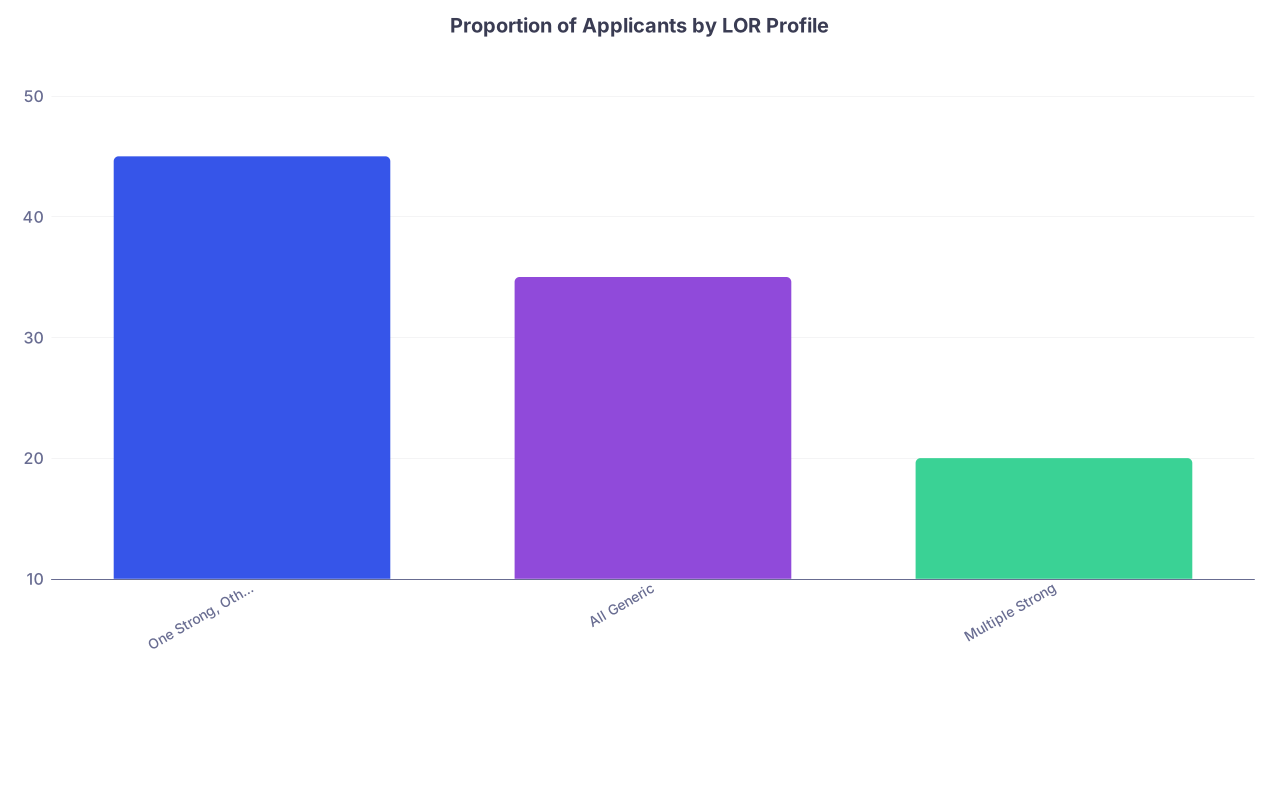
| Category | Value |
|---|---|
| One Strong, Others Generic | 45 |
| All Generic | 35 |
| Multiple Strong | 20 |
If you’re obsessing over this, you’re probably also the kind of person who cared a lot on rotations, tried hard, took feedback seriously, and will show that maturity in interviews. Program directors care a lot about that, even if it never gets verbalized.
FAQs
1. If I only have one strong clinical LOR in my specialty, should I still apply broadly?
Yes. Apply broadly and smartly. Your one strong specialty letter is actually a big asset. Pair it with a well-written personal statement and a realistic list of programs (a mix of reach, mid, and safety), and you’re still in the game. Don’t self-reject based purely on letter paranoia.
2. Should I waive my right to see my letters, or will that hurt me?
Waive it. Always. Programs expect you to waive, and non-waived letters can look suspicious, like the writer wasn’t comfortable being honest. Waiving doesn’t mean they’ll trash you; it usually frees them to be more direct—and often, more positive.
3. Is a strong research letter better than a mediocre clinical letter?
If you’re going into a highly research-heavy, competitive field (derm, rad onc, some academic IM tracks), a strong research letter from someone who knows you deeply can be very helpful. But for most specialties, especially those that are highly clinical, a mediocre but decent clinical letter is still more relevant than a glowing research letter that says nothing about you as a clinician.
4. What if my best, strongest letter isn’t from my chosen specialty?
Then you lean hard into everything else: your rotations in that specialty, your MSPE comments, your personal statement, and any electives or sub-Is you’ve done. That strong letter still proves you can be an excellent trainee. It doesn’t “not count” just because it’s from a different field. It just means you need to show commitment to your specialty in other ways.
5. Can I email programs to explain that one of my letters might be weak?
Don’t do that. You’ll only draw attention to a problem they might not have even noticed. Unless there’s some extreme circumstance (like a clear documented conflict, or the wrong letter was uploaded), you do not want to preemptively apologize for your letters. Focus on strengthening the parts of your application that you still control: your interview prep, your narrative, and your school’s support.
Key things to walk away with:
- One strong clinical LOR—especially in your specialty—can absolutely carry more weight than you think.
- Generic letters are common and usually not fatal; truly negative letters are rare but dangerous.
- You’re not doomed. You’re anxious, which is normal. Now focus on making every other part of your application reinforce the version of you that your strongest letter already sees.