
What if your dream program never sees your strongest letter because your attending just… doesn’t upload it in time?
Welcome to the exact anxiety spiral most of us hit at some point in residency applications. You’re refreshing ERAS every 10 minutes, your other letters are in, but that one crucial LOR says “Requested” and the deadline is staring right at you.
Let’s walk through what actually happens, what’s catastrophic vs just uncomfortable, and what you can still do right now before you completely melt down.
First: Are You Actually Going To Miss The Deadline?
Before going full disaster-brain, you have to sort out which “deadline” you’re worried about. Because not all of them are real brick walls.
| Deadline Type | How Hard It Really Is |
|---|---|
| ERAS opens to programs (Sept) | Soft |
| Program “priority review” date | Soft-ish |
| Program absolute LOR deadline | Hard |
| Rank list certification date | Very hard |
Here’s the uncomfortable truth: most of the time, your letter doesn’t have to be uploaded by the date you think is make-or-break.
Some realities:
- Programs can receive letters after you submit your ERAS.
- They can review updated applications throughout the season.
- A missing letter on day one ≠ instant rejection.
- But… being late can absolutely hurt you at some places, especially competitive specialties or reach programs.
You’re not crazy for panicking. But there’s usually more wiggle room than your brain is allowing right now.
What Actually Happens If A LOR Is Missing?
Let’s play out the nightmare you’re imagining, because honestly, that helps.
You submit on time. One letter is still missing.
Worst possibility in your head:
“They’ll see 3 letters instead of 4, think I’m irresponsible, and auto-reject me in 5 seconds.”
What actually happens (at most programs):
- They see 3 letters. If that’s their minimum, they can still review you.
- Some programs review once then don’t really re-open your app, even if more letters arrive. That can happen.
- Others periodically update, and that late letter actually does get read later.
- A small number of programs hard-filter if you don’t meet their stated LOR number by their stated date. Those are the real risks.
So yeah, missing a letter isn’t ideal. But it’s not, “Your career is over” level unless you already have a fragile application and you’re banking heavily on this one letter to redeem it.
Where it really stings:
- You only have 2 letters uploaded and the third is crucial.
- This is your only specialty-specific letter (e.g., only EM SLOE, only surgery letter).
- It’s from the PD or chair where you rotated, and every program in that field basically expects one from them.
If that’s you, I’m not going to sugarcoat it: you have more at stake. But you’re also not powerless.
Step-By-Step: What To Do Right Now
1. Be Honest About Your Situation
Ask yourself:
- How many letters are already in ERAS?
- Do you meet the absolute minimum most programs require (usually 3)?
- Is this missing one:
- Another generic letter?
- Or your only strong specialty-specific anchor letter?
If you already have 3 decent letters including at least one solid specialty letter, and the missing one is “nice but not critical,” your stress is 10/10 but the actual risk is more like 4/10.
If you have 1–2 letters total and this was supposed to be your main specialty letter, your stress and your risk are a lot closer together.
2. Email Your Letter Writer (Again), But Do It Strategically
You’ve probably already emailed them once. Maybe twice. Now it feels awkward. You’re scared of annoying them.
Do it anyway. But write like a functioning adult, not like the panicked internal monologue running in your head.
Something like:
Subject: Brief LOR Follow-Up – [Your Name], [Rotation/Service & Dates]
Dear Dr. [Name],
I hope you’re doing well. I wanted to follow up regarding the residency letter of recommendation you kindly agreed to write for me for [specialty] residency.
ERAS applications are now being reviewed by programs, and I’m hoping to finalize my application by [DATE]. I know your schedule is extremely busy, but I wanted to check in and see if there’s any additional information I can provide to make the process easier (CV, draft personal statement, bullet list of cases we worked on together, etc.).
The letter request should be in your email from ERAS under [email address]. If you don’t see it, I’d be happy to resend.
Thank you again for your support and for all I learned on your service.
Best regards,
[Your Name], [Medical School]
AAMC ID: [ID]
Key things you’re doing:
- Clear timeline (“by [DATE]”) without sounding threatening.
- Offering to make it easier for them.
- Reminding them how to find the ERAS email.
- Including your AAMC ID in case they need it.
Yes, follow up even if you feel annoying. People forget. People think they submitted when they didn’t. People mean well and are drowning.
3. Add a Backup Letter Writer. Today.
You need redundancy. I’ve seen too many people put all their hope into The Famous Attending who… never uploads.
Ask yourself: who else could credibly write for you now?
Possibilities:
- Another attending from the same rotation or a different one in the same specialty
- A subspecialist in your field who supervised you in clinic or consults
- A non-specialty attending who just knows you really well and can vouch for your work ethic and character
- Your department’s APD or PD from your home institution, if they know you at all
You’re not “cheating” on the original writer. You’re protecting your application.
Email template for a backup writer when it’s this late in the game:
Dear Dr. [Name],
I’m applying to [specialty] residency this cycle and am finalizing my ERAS application. I realize this is a late request, but I wanted to ask if you’d be willing to write a letter of recommendation based on our work together on [rotation/service, dates].
I really appreciated [specific thing you did with/learned from them], and I felt you got to see me closely in [situations: inpatient/OR/clinic/call]. I completely understand if your schedule doesn’t allow for it on this timeline, but even a brief, honest letter would be extremely helpful.
I’m happy to send my CV, personal statement, and a short summary of my contributions on your service to make this as easy as possible.
Thank you for considering this, and regardless, I’m grateful for your teaching.
Best,
[Your Name]
[Medical School]
AAMC ID: [ID]
Some will say no. Some will ghost you. You just need one person to say yes and actually upload.
4. Decide: Submit Now or Wait?
Here’s the uncomfortable decision: do you submit with fewer letters and hope the rest appear later, or hold your whole app hostage hoping this one letter comes in?
Most of the time, this is the right move:
- Submit your ERAS application by your target date with the letters you have.
- Keep the missing letter slot assigned so that when/if it arrives, it’ll auto-attach.
- Keep pushing your writer and your backup.
Submitting late is usually worse than submitting on time with one missing letter that may still arrive.
Programs don’t sit there waiting for “perfect” apps. They sort by submission date, filters, Step scores, etc., and pull in waves. You want to be in the early wave, even if you’re not 100% “complete.”
5. Use Programs’ Own Requirements Against Your Anxiety
You can actually calm some of the panic by looking at what programs officially require from you.
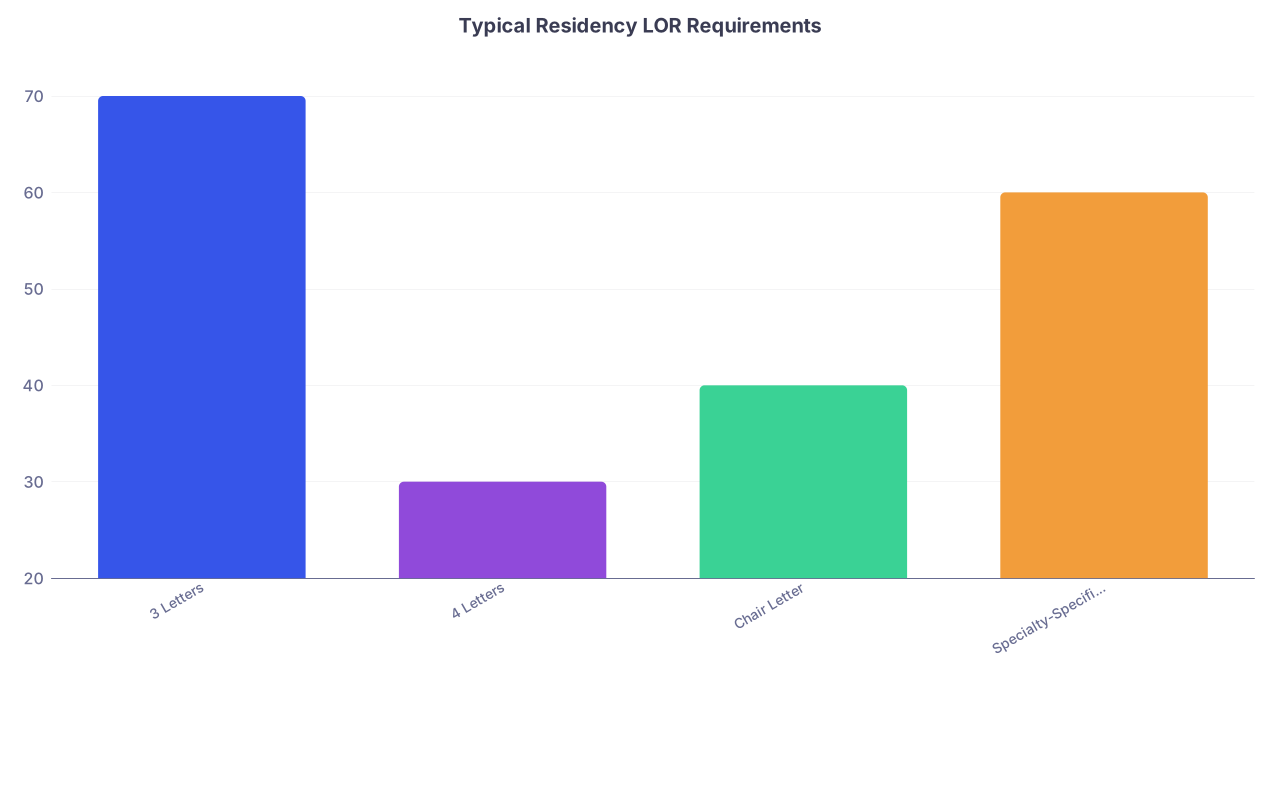
| Category | Value |
|---|---|
| 3 Letters | 70 |
| 4 Letters | 30 |
| Chair Letter | 40 |
| Specialty-Specific Required | 60 |
(This isn’t exact for every specialty, but it’s roughly what I see across programs.)
Go to a few of your most important programs’ websites and check:
- Minimum number of letters (not the “we prefer 4,” the minimum)
- Whether they mandate a chair/PD letter
- Whether they specifically say “application will not be reviewed until complete”
You’ll probably discover that at many places:
- You’re technically reviewable with 3.
- That missing 4th is “strongly recommended” but not absolutely required.
- The “priority” deadline is early, but they keep reviewing into the season.
For the rare programs that say, “We will not review applications without X letter by Y date,” be honest: those might not be realistic this year if your letter isn’t in. And that sucks. But it doesn’t mean all your chances are gone.
How Bad Is It For Different Scenarios?
Let’s sanity-check a few common situations you might be in.

Scenario 1: You Have 3 Letters In, Missing 1 Generic Attending
Risk level: Annoying, but not catastrophic.
- Submit on time.
- Keep nudging the missing writer.
- Add a backup if you can get one quickly.
- You will still get interviews if the rest of your app is solid.
Scenario 2: You Have 2 Generic Letters, Missing Your Only Specialty Letter
Risk level: Higher, especially in competitive fields.
- Immediately add a backup specialty letter writer.
- Submit on time anyway, as long as you’ll hit 3 letters total.
- Hope at least one specialty letter comes through early.
- Expect some programs to be harsher, especially top-tier or big-name academic centers.
Scenario 3: You Have 1–2 Letters Total and No Backup Options Yet
Risk level: This is rough, I won’t sugarcoat it.
Your priority:
- Get to at least 3 letters, even if one isn’t ideal or specialty-specific.
- Ask anyone who actually saw you work: hospitalists, subspecialists, clinic attendings.
- Accept that this will constrain where you realistically have a shot, especially this cycle.
But you still submit. A “weaker” complete application is better than a beautiful, imaginary one.
How To Handle The Guilt And Awkwardness With Letter Writers
You’re probably feeling:
- “I’m bothering them.”
- “They’ll think I’m ungrateful.”
- “What if pushing them makes them write a worse letter?”
Honestly? The biggest risk isn’t that they’ll get annoyed. The biggest risk is they’ll forget you exist in the chaos of their life and never upload anything.
You can stay respectful and persistent.
If they agreed to write you a letter, they accepted a responsibility. You are not the villain for reminding them about a professional commitment that directly affects your career.
If someone truly can’t or doesn’t want to write it, a direct, “I’m actually not able to do this this cycle” is better than silence. Silence just kills your chances quietly.
You deserve clarity, even if that clarity sucks.
How Programs See Late or Missing LORs
I’ve heard variations of this from people who’ve sat in residency selection meetings:
- “If they have 3 letters, I don’t really care if a 4th trickles in later.”
- “I rarely go back to reread applications after the first pass.”
- “If their only specialty letter isn’t in when I first see the app, they start off weaker in my mind.”
No one is sitting there going, “Wow, their attending is late, they must be irresponsible.”
They’re just trying to compare 800 people using the information in front of them.
So yes, being “complete” earlier helps. But late letters don’t scream, “This applicant is unprofessional.” They scream, “This attending is busy and disorganized,” which… welcome to medicine.
Contingency Planning: If The Letter Never Comes
Let’s go full worst-case: your writer never uploads. Backup either doesn’t happen or is also late. You submit with what you have and end up short one letter or short one strong specialty voice.
What then?
- You might get fewer interviews than you hoped.
- You might lean heavier on:
- Away rotation letters
- Home PD/Chair letter
- Personal statement and experiences
- You may need to be more open geographically, or to community vs big-name academic programs.
- Worst case: you don’t match and you reapply with stronger letters the next year.
Reapplying is miserable. But it’s not the end of your career. I’ve seen reapplicants match into solid programs after fixing exactly this problem (better, earlier LORs; more organized ask; more redundancy).
What You Can Do Tonight (That Will Actually Help)
Let’s get out of the abstract.
Tonight, you can:
- Send one clear, concise follow-up email to your missing writer.
- Identify 1–2 realistic backup letter writers and email them.
- Check 5–10 of your most important programs’ actual LOR requirements.
- Decide your personal “submit by” date and commit to submitting, no matter what’s missing, by then.
- Draft a short bullet list of your strengths and key cases for any writer who says yes.
And then, honestly, you need to stop refreshing ERAS every 3 minutes. Check once a day. Twice max. Past that, you’re just torturing yourself.

| Step | Description |
|---|---|
| Step 1 | Realize LOR Missing |
| Step 2 | Check current letters & requirements |
| Step 3 | Email original writer with clear date |
| Step 4 | Identify backup writers |
| Step 5 | Request backup letters politely |
| Step 6 | Submit ERAS by chosen date |
| Step 7 | Monitor for late LOR uploads |
| Step 8 | Adjust expectations & strategy |
FAQs – Letters Not Uploaded & Residency Deadlines
1. If I submit my ERAS before all letters are in, will programs see new letters automatically?
Yes. Once you’ve assigned a letter to programs, any letter that gets uploaded later will automatically attach to those programs. You don’t have to “resubmit” your application. The catch: some programs won’t go back and re-review later-added letters, especially if they’ve already screened you out or in. But technically, yes, the letters do appear.
2. Is it better to wait and submit a week or two late so my LOR is in?
Usually no. Being late with your entire application is generally worse than being on time with one missing letter that might come in later. Programs start pulling apps early. You want to be in that early batch if you can. Unless a program explicitly says, “We will not review your application until all required letters are present,” submit on time with what you have.
3. How many reminder emails to a letter writer is “too many”?
As a rule of thumb:
- 1 initial request
- 1 reminder about 2–3 weeks later
- 1 “deadlines are now” reminder about 1 week before your submit date
- Optional: 1 final short nudge if the deadline is literally tomorrow
If they don’t respond at all after that, you assume they can’t or won’t do it and rely on backup writers. You are not a bad person for following up 3–4 times across several weeks. You’re just a med student stuck in a broken system.
4. What if my strongest letter writer says they’ll write it but it’ll be late in the season?
You still say yes. A late strong letter is better than no strong letter. Request it, assign it, and understand it’ll probably help more with mid-to-late season interview offers and with programs that review continuously. Just don’t delay your whole application waiting for them. Submit on time with whoever you have and let the strong letter come when it can.
5. Can I tell programs directly that a letter is missing because of my writer, not me?
Usually no, and it doesn’t help you. Sending programs an email like, “My attending hasn’t uploaded my letter yet” just looks messy and puts them in an awkward spot. The only time I’d even consider reaching out is if a program explicitly tells you your file is incomplete because of a missing required letter, and you’re clarifying when it might realistically arrive. Even then, keep it short and professional.
6. What if I think my writer bailed and isn’t going to write at all?
Assume that’s the case after multiple reminders and no response. Don’t keep building your whole strategy around someone who might never come through. Secure backup letters, submit with what you have, and mentally release that original person. Annoying? Yes. Career-ending? No. Programs will judge you on the letters you do have, not the mysterious one that never appeared.
Open your email right now and send one clean, respectful follow-up to your missing letter writer—and in the same sitting, identify and message at least one backup writer so you’re not hanging everything on a single person’s inbox.