
Last cycle I watched a program director read through an otherwise stellar application: 260+ Step 2, honors in medicine and surgery, glowing dean’s letter. He was nodding along, half-distracted, until he opened the third letter. He read quietly for about twenty seconds, then said one sentence that decided that student’s fate: “Yeah… I don’t trust this file anymore.” The application never made it to the interview pile.
Let me walk you through why. And why one mediocre letter—sometimes not even “bad,” just lukewarm—can quietly kill you while everything else on ERAS screams “strong candidate.”
How Programs Really Use Letters (Not What the Brochures Say)
You’ve heard the sanitized line: “We review applications holistically and letters are just one component.” That’s what we tell students on interview day. What happens behind closed doors is different.
On most selection committees, letters are not used to build an application. They’re used to confirm or destroy it.
Here’s the real sequence on a typical screening session:
- Someone on the committee opens the file.
- They glance through:
- Scores
- Transcript / clinical grades
- MSPE / dean’s letter
- CV highlights (research, leadership)
- A silent mental verdict forms: “probable interview,” “maybe,” or “no.”
- Only then do they read the letters to answer one question:
“Does this person seem as strong—as safe—as the rest of this file suggests?”
Letters are the trust check.
If your numbers and CV say “top 10–20% applicant” but your letters read like you’re a third-quartile student, people in that room don’t blend the difference into “average overall.” They reframe the entire file as suspicious. Over-sold. Inflated.
That’s how a single mediocre letter does real damage. It doesn’t sit next to the rest of your application. It reinterprets it.
What a “Mediocre” Letter Looks Like to a Program Director
Most applicants have no idea what their letters actually sound like on the receiving end. You just see “Letter uploaded” on ERAS and hope for the best. I’ve read hundreds, sat with directors reading thousands. Let’s translate.
A strong letter, in PD language, does three things:
- It clearly places you in a comparative group:
“Top 10% of students I’ve worked with in the past five years.” - It gives concrete clinical behaviors:
“I trusted her to pre-round independently on a complex panel of patients by week two; her notes needed minimal edits.” - It contains a few specific, memorable anecdotes or phrases that stick:
“He stayed two hours past his shift to walk a terrified patient through his new cancer diagnosis.”
A mediocre letter is not obviously negative. That almost never happens because faculty are conflict-avoidant and know their letters might be seen by you eventually. Instead, a mediocre letter sounds like this:
- “I worked with John on his medicine clerkship. He was punctual, dressed professionally, and interacted appropriately with patients and staff.”
- “He is dependable and will do well in residency.”
- “I recommend him for your program.”
What the PD hears reading that:
- This writer has nothing memorable to say.
- No ranking language. No “top.” No “excellent.” No comparison group.
- No statement of “I would strongly recruit this student to our program.”
That’s what “mediocre” looks like from the inside. Polite. Harmless on the surface. Lethal in context.
And there are some specific red flag phrases that quietly tell us: “This student is not among my best.”

Here are a few:
- “Met expectations.”
- “Solid performance.”
- “Average among students at his level.”
- “I expect she will be a competent resident.”
- “I have no reservations in recommending…”
(Without any positive superlative around it.)
Those phrases, in the middle of an otherwise glowing application, are like a siren. You won’t see it in ERAS. But everyone in that committee room hears it.
Why One Weak Letter Carries More Weight Than Two Strong Ones
You’re probably thinking: “But if I have two great letters and one so-so, surely that balances out?”
No. Here’s the ugly truth: negative or lukewarm information is weighted disproportionately. That’s not just bias—it’s baked into how committees protect their programs.
From the PD side, the risk equation looks like this:
- A truly excellent resident makes my life slightly easier, my program look good, and maybe helps our match reputation.
- A problematic resident costs me time, faculty goodwill, patient safety risk, ACGME headaches, and potentially jeopardizes our accreditation if they start failing milestones.
So the risk of being wrong on the positive side is tolerable. The risk of missing a warning sign is not.
That’s why one mediocre letter overrides two glowing ones. The logic in the room goes like this:
“Two people loved this student. But one person who actually supervised them clinically felt they were just ‘solid’ and had nothing specific to praise. Either they’re inconsistent or those two strong letters are from cheerleaders. I can’t take the risk when I have hundreds of files with all strong letters.”
This is especially true when:
- The mediocre letter is from an in-specialty attending at a core rotation.
- The stronger letters are from research mentors or non-clinical faculty.
- The writer of the mediocre letter is known to be vocal, honest, and not a “soft grader.”
And yes, faculty have reputations among PDs. We know which letter writers are inflated, which are stingy, and which never write for weak students. That context changes how each letter is interpreted.
The Hidden Power Hierarchy of Letter Writers
Not all letters count the same. Students love to chase “big names” and department chairs. What actually matters more often is who is speaking in the language the PD trusts.
Here’s roughly how program leadership tends to value letters, especially in competitive fields:
| Letter Writer Type | Typical Impact on PD Decision |
|---|---|
| In-specialty PD or APD | Very High |
| In-specialty core clinical faculty | High |
| Home institution department chair | High if specific, Low if generic |
| Away rotation in-specialty attending | High |
| Research PI (clinical in specialty) | Moderate to High |
| Non-specialty clinical faculty | Moderate |
| Basic science / non-clinical mentor | Low to Moderate |
A mediocre letter from a random outpatient attending in an unrelated field is not ideal, but it usually will not sink you alone.
A mediocre letter from:
- The PD of your home department
- The attending on your sub-I in that specialty
- Your away rotation in that specialty
…carries far more weight than any glowing research letter. Because those are the people who see you doing exactly what you’re applying to do.
If your home program PD writes, “She will be a competent resident who will contribute positively to your program,” and your away rotation PD writes, “He performed at the level expected for a student on this rotation,” you’re finished at most solid programs in that field. Even with a 260.
That’s the brutality no one tells you.
Subtle Ways Mediocre Letters Undermine Your Story
A residency application is a narrative, whether you like it or not. You’re selling one coherent story:
“I am a high-performing, reliable, teachable, and safe future resident who fits this specialty.”
Most applicants do ok stitching that story together in their personal statement and CV. Where the story often cracks is the letters.
Here’s how a single lukewarm letter shatters the narrative:
1. It contradicts your self-presentation
Your personal statement says you’re the resident who “goes the extra mile,” “hungry to learn,” and “deeply invested in patient care.” Then your letter says:
- “He completed all assigned tasks.”
- “She was receptive to feedback.”
Do you see the disconnect? You claim passion and going above and beyond. Your closest evaluator describes… basic functioning. PDs notice that mismatch instantly.
2. It undermines your “trajectory”
Programs love a story of upward trajectory: maybe your preclinical years were average, but third and fourth year you “turned it on.”
If your MSPE and transcript show improvement, but your fourth-year sub-I letter is barely positive, the story flips: “No, this is not an upward trend. They hit their ceiling.”
3. It exposes professionalism or interpersonal issues without saying them
The savvier letter writers know how to hint. They don’t write, “She was unprofessional and difficult to work with.” They write things like:
- “She was generally well-liked by most members of the team.”
- “He responded appropriately when given direct feedback about his communication.”
Those phrases look safe to a student. To a PD they scream: personality or professionalism problem. One veiled concern like that will override a page of “hardworking” and “knowledgeable.”
How These Letters Are Actually Discussed in the Room
You probably imagine long, detailed conversations about each applicant. That’s fantasy. There’s too much volume. Here’s what really happens.
Someone (often the PD or an APD) is scrolling through the letters aloud in a meeting. They don’t read every sentence. They skim and summarize:
- “Chair letter—standard, positive.”
- “Medicine PD—strong, top 10%.”
- “Sub-I attending—‘performed at expected level,’ ‘solid fund of knowledge,’ ‘met expectations.’ Hmm.”
Then comes the offhand comment that decides your status:
- “Why are their letters so vague if they’re this strong on paper?”
- “Something doesn’t add up.”
- “I don’t want to risk it; we’ve been burned before by this exact profile.”
And that’s it. Your file gets shifted from “likely interview” to “no,” or from “rank middle” to “bottom of the list” or “do not rank.”
You’ll never know it was that one letter. The email you get just says: “Thank you for your interest…”
How To Avoid Getting Killed by a Mediocre Letter
You can’t control everything. But you have far more control over your letters than most students use.
1. Stop asking for letters blindly
The biggest mistake I see: students asking, “Could you write me a strong letter?” at the end of a rotation with minimal relationship or feedback.
You should be asking a more honest version:
“Based on how I performed on this rotation, would you feel comfortable writing a strong, enthusiastic letter for [specialty] residency for me? If not, I completely understand and would actually prefer you say no.”
And then—and this is where most of you fail—you need to listen. Closely. The hesitation, the half-second pause, the “Well, I can certainly write you a letter…” That’s your warning sign.
Anyone who does not immediately say something along the lines of:
- “Absolutely, I’d be happy to.”
- “Yes, I can write you a very strong letter.”
…should not be writing for you. I don’t care how big their name is.
2. Use mid-rotation feedback as surveillance
Your goal isn’t just to get through rotations. It’s to identify who will go to bat for you and who won’t. Mid-rotation is when you find out.
Ask specific questions:
- “Are there things I should do differently to be at the level of your strongest students?”
- “Compared to other students at this stage, how am I doing?”
If you’re truly in the top tier, most attendings will tell you. They like talking about their strong students. If what you hear is “You’re doing fine, keep it up,” that’s not a strong-letter signal. That’s “average / slightly above average” territory.
3. Curate your letter mix strategically
Most specialties want at least 3 letters, sometimes 4. You don’t get bonus points for collecting every possible letter. You get points for coherence.
You want:
- At least two in-specialty clinical letters that are truly strong.
- One additional letter that shows something unique about you (research, sub-specialty experience, or a different clinical setting) if it’s strong.
What you don’t want is:
- A shaky in-specialty letter because you felt obligated to get one from that rotation.
- A generic chair letter that says nothing specific, when you already have 3 good letters.
If you have 3 excellent letters and one “fine” one, you don’t need to submit all four everywhere. You can and should leave the “fine” one off, unless a specific program requires that writer type.
What To Do If You Suspect You Already Have a Mediocre Letter
This is where it gets tricky. You waived your right to see it (as you should have, because PDs distrust non-waived letters), so you’re guessing based on:
- The way the attending responded to your request
- Their feedback to you
- Scuttlebutt from prior students about how “strong” their letters usually are
If you have that gnawing doubt, here’s the practical play:
1. Add, don’t replace—then choose strategically
You can’t delete a letter that’s already in ERAS. But you can choose which ones go to each program.
So if you think Letter X is mediocre:
- Hustle to get an additional strong letter from someone else who genuinely knows your work.
- For most programs, do not assign the suspected mediocre letter unless you absolutely have to for some requirement.
2. For required letter types, control the context
If you must send a certain letter (for example, some programs that require a letter from your home PD in that specialty), your best defense is to flood the rest of the file with consistent, stronger signals:
- A sub-I letter from a highly respected attending who clearly ranks you top-tier.
- An away rotation letter that calls out specific, advanced clinical behaviors.
- A personal statement that’s mature, grounded, and not over-sold.
You’re not erasing the mediocre letter. You’re trying to downgrade it mentally from “warning sign” to “old-school conservative writer.”
Where This Matters Most (And Where It Matters Less)
Is every mediocre letter fatal? No. Context matters. Some specialties and situations are less cutthroat.
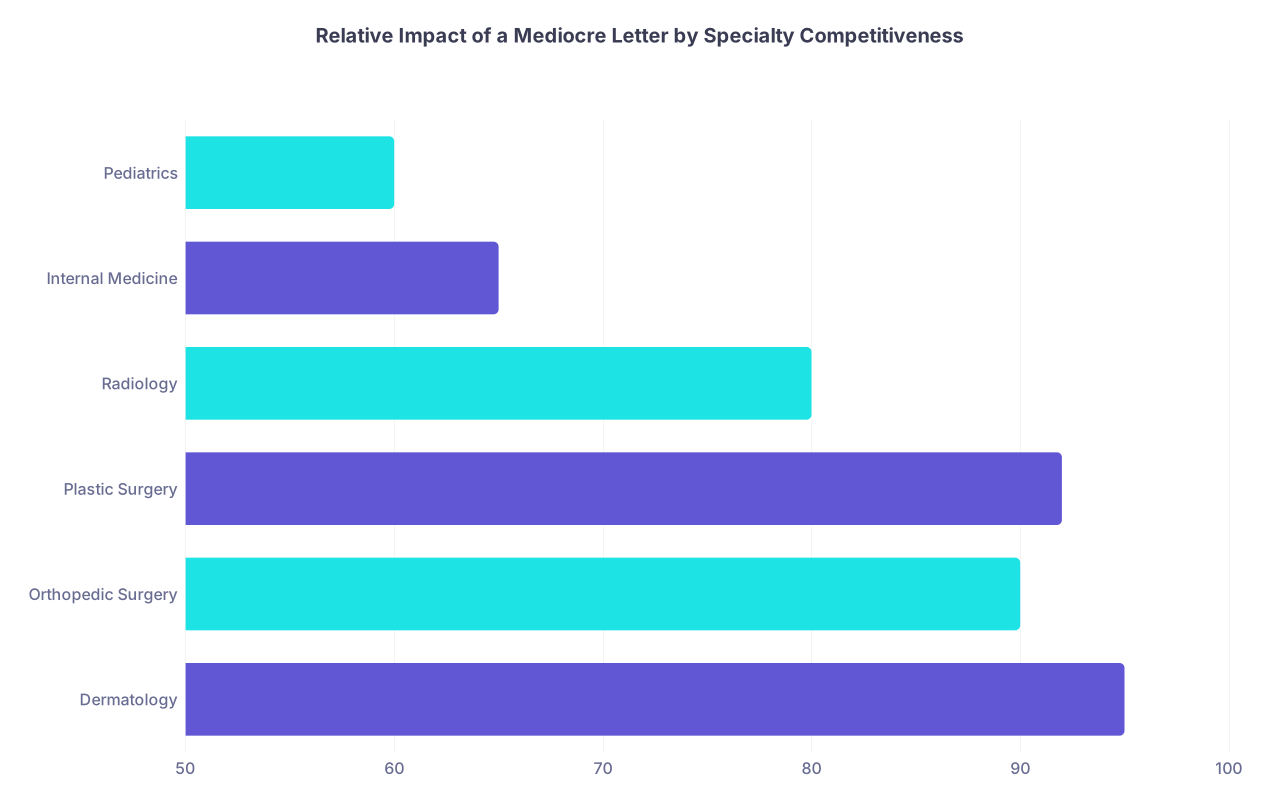
| Category | Value |
|---|---|
| Dermatology | 95 |
| Orthopedic Surgery | 90 |
| Plastic Surgery | 92 |
| Radiology | 80 |
| Internal Medicine | 65 |
| Pediatrics | 60 |
Highly competitive fields—derm, ortho, plastics, ENT, neurosurgery—are brutal. A single lukewarm in-specialty letter will quietly eliminate you at most top programs because they have stacks of applicants with strong letters across the board.
In “middle” competitiveness fields—EM, radiology, anesthesia, OB/GYN—it depends more on the rest of your profile and who wrote the letter.
In broader fields—internal medicine, pediatrics, family medicine—a mediocre letter won’t necessarily kill your chances across the board. But it will keep you out of the top programs, and it will hurt if it comes from a PD or core in-specialty faculty.
The deeper truth: the more applications a program receives per available spot, the less tolerance they have for any red or yellow flags in letters. They just don’t need to take the risk.
The Part No One Admits: PDs Remember the Burned Ones
Why so much paranoia about one off letter? Because every serious PD has a story. Or ten.
The resident who showed up with a 260, AOA, and three glowing letters… and turned out to be toxic, unreliable, or clinically unsafe. When they go back and re-read that file in hindsight, there’s often one letter that was a little cooler. A little more generic. A phrase that, in retrospect, was a warning.
Once that happens, PDs start reading every slightly lukewarm letter as that potential warning. They become risk-averse. They’d rather lose a few good residents they passed over than take on one more disaster that poisons the program for three years.
You are competing against that memory. Not just your classmates.
FAQs
1. Is a generic chair letter always a problem?
Not always. Many chairs barely know the students they’re “writing” for and rely on boilerplate plus input from the clinical team. Committees know this. So a bland chair letter doesn’t usually sink you if the in-the-trenches clinical letters are clearly strong.
It’s a problem when the chair clearly does know you—maybe you did research with them, worked closely—and still writes something generic. Or when your other letters are also soft. Patterns matter more than any single data point.
2. What if my home program culture is to never use “top 10%” language?
PDs who read hundreds of files get a feel for institutional style. If every letter from School X avoids explicit rankings but the language is still rich, specific, and enthusiastic, that’s fine.
The danger is when you assume “that’s just how they write” to soothe yourself. You can partially reality-check this by talking to recent grads from your school who matched well: Did their letters actually read like that when shared later? Many will have gotten access informally after the match. Ask them. Quietly.
3. Does it help to have more letters than required to “average out” a weak one?
No. Quantity doesn’t rescue quality. Four letters where one is mediocre is not “75% strong.” It’s “four letters, with one conspicuous weak link.” Programs are not doing math; they’re scanning for risk. It’s usually smarter to send three unequivocally strong letters than to tack on a fourth that might dilute the message.
The only exception is when a program explicitly allows or prefers four and you truly have four strong advocates who know you well in different settings. That’s rare. Don’t force it.
4. Should I ever not waive my right to see a letter so I can protect myself?
If you don’t waive, you’ve already hurt yourself. Most PDs interpret non-waived letters as less candid and less trustworthy because the writer may be self-censoring. You gain almost nothing and lose credibility.
Your real protection isn’t reading the letter later. It’s upstream: choosing letter writers carefully, asking the right permission question, listening to the hesitation, and being willing to walk away from a “polite yes” that’s not actually enthusiastic.
You only get one shot at how your letters hit that committee room. The scores, the grades, the CV—they get you into the conversation. The letters decide whether anyone in that room believes the story you’re telling about yourself.
If you handle this right, your letters become the chorus backing your solo, making you sound exactly as good as you hope you are. If you handle it lazily, one well-placed mediocrity will undercut all of it.
You’re heading into the season where these choices matter. Start thinking like the people reading your file, not the people filling in the boxes. Once you do that, you’ll be much more careful about who you let speak for you—and which voices you allow into the room when your application is quietly being judged. The next step is making sure your behavior on rotations earns the kind of letter you think you deserve, but that’s its own conversation.