
Most residency applicants do not realize how many “polite compliments” in a letter of recommendation actually mean: do not rank this person.
I’m going to walk you through what faculty say, what they really mean, and how your file gets treated in the room when these phrases show up. This is the stuff you only hear if you’ve sat through rank meetings and watched people translate letters like a second language.
How Letters Are Really Read in Committee
Let me destroy one myth right away: no one in a serious residency program is reading your letters word-for-word like a novel.
On a busy rank night, this is what actually happens:
- Someone skims the first and last paragraph.
- Their eyes go hunting for superlatives, comparison language, and red-flag phrases.
- They glance at where you’re placed relative to other students the writer has known.
- They listen to the “tone” more than the adjectives.
If there’s any doubt, a senior person at the table says something like, “Read the key lines,” and someone rattles off two or three sentences that decide your fate.
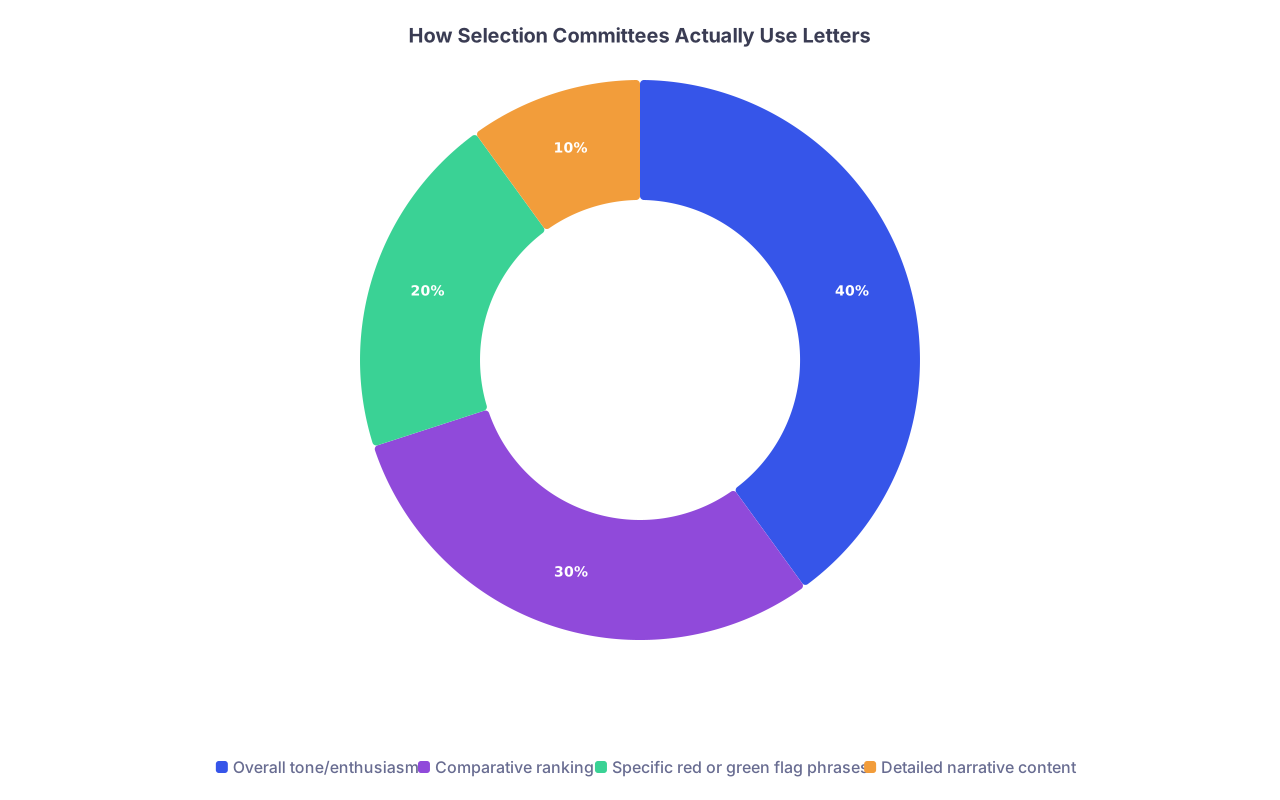
| Category | Value |
|---|---|
| Overall tone/enthusiasm | 40 |
| Comparative ranking | 30 |
| Specific red or green flag phrases | 20 |
| Detailed narrative content | 10 |
Your danger is not the obvious negative letter. Those are rare. The real killers are the coded, “polite” phrases that look positive to you and your dean, but to program directors sound like: back-up list at best, maybe not on the list at all.
Let’s translate them.
The Polite Assassins: “Positive”-Sounding Phrases That Sink You
These are the phrases that get read out loud in rank meetings with a smirk, followed by, “So… that’s a no.”
1. “I expect [Name] will be a solid resident.”
You think this sounds good. It’s not.
Here’s the translation in selection-committee language: “They’ll probably show up, won’t get fired, but I’m not sticking my neck out for them.”
When attendings love you, they use words like:
- outstanding
- exceptional
- star
- among the best I’ve worked with
“Solid” is code for: average, safe, unexciting. In a competitive specialty, “solid” is basically “do not waste a rank slot.”
I’ve heard this exact exchange in a rank meeting:
Reader: “Letter says, ‘He’ll be a solid intern.’”
PD: “Ok, so not a top-tier candidate. Where is he on their class list?”
Someone flips a page, sees you in the middle third, and your name quietly slides down the board.
“Solid” is not neutral. It’s damning with faint praise.
2. “With appropriate supervision, [Name] will develop into an excellent clinician.”
This one is almost always a soft red flag.
No one writes “with appropriate supervision” about their stars. Of course interns get supervision. That phrase only appears when the writer wants to signal: “Don’t let this person work independently. Watch them closely.”
Real-life meaning:
- Questionable judgment
- Slower to pick things up
- Possibly unsafe when stretched
I’ve watched faculty circle this phrase with a pen during committee and say, “That’s a concern,” then drop a candidate out of the top half of the list.
If your letter has this line, that program is unlikely to rank you aggressively, especially in high-acuity fields like EM, surgery, anesthesia.
3. “I am confident [Name] will meet the expectations of any residency program.”
Translation: they will not exceed them.
It sounds supportive. It is not. When program directors read this, what they hear is:
- Won’t be a superstar.
- Won’t embarrass us.
- Not someone I’m excited to fight for.
You’ll notice what’s missing: no “strongly recommend,” no “without reservation,” no “among the best.” It’s about meeting expectations, not surpassing them.
This exact phrasing often appears when the letter-writer doesn’t know you well or doesn’t want to lie by overselling you.
In the room, these candidates get compared to someone whose letter says, “She is in the top 5% of students I’ve worked with in the last 10 years.” Want to guess who moves up the rank list?
4. “I had limited opportunity to work with [Name], but in that time…”
Everyone on the committee knows what this means: “I’m not staking my reputation on this person.”
Sometimes it’s innocent—the faculty truly only saw you for a week. But from the program’s side, it reads like a weak, generic letter. If a PD is on the fence, this line is enough to push you into “maybe” instead of “must have.”
Here’s how people react:
“So they barely know them.”
“Do we have any letters from someone who actually worked with this applicant?”
If the answer is no, your file feels soft, even if your scores are fine. Top programs want someone who made a strong enough impression that a faculty member could write from direct, extended experience.
5. “I am pleased to provide a letter in support of [Name]’s application.”
This is the template sentence from every lazy letter. It says nothing. Committees ignore it.
It becomes a problem when that’s the only enthusiasm in the entire letter. If the opening is bland and the closing isn’t stronger, that tells the room: this resident or student did not leave a strong impression.
Compare:
- Weak: “I am pleased to provide a letter in support of her application to your program.”
- Strong: “I give her my highest recommendation for your residency program and would be thrilled to work with her as a colleague.”
No one quotes the first sentence in discussion. They absolutely quote the second.
6. “[Name] is quiet but hard-working.”
I’ve watched introverts get quietly punished by this phrase over and over.
It usually means: good enough worker, but so disengaged or low-profile that the writer could not think of more specific strengths.
Sometimes it’s trying to soften, “This person disappears on rounds.” Committees know that. They map it to: might struggle to function as a leader, might not advocate for patients, might not assert themselves.
If the rest of the letter doesn’t counterbalance this with things like “excellent team player,” “takes initiative,” “strong leadership,” then “quiet but hard-working” is a yellow flag.
In some surgical programs, it might as well say: “Will not thrive here.”
7. “Given time, I expect [Name] will continue to grow and develop as a clinician.”
Every intern grows with time. That’s not a compliment.
This is often hidden remediation language. It signals that right now, today, this person is not where they should be. The writer is predicting improvement, not endorsing current performance.
Committees read this as:
- Currently behind peers
- Potential, but not ready
- Needs more scaffolding than average
If you see “given time” or “with further training” and not much else, that letter is not helping you.
8. “[Name] was well-liked by patients and staff.”
On its own, this is neutral. But when it’s the strongest thing in the letter, it’s a problem.
It tends to show up when the writer cannot honestly praise your fund of knowledge, your work ethic, or your clinical skills, so they default to “well-liked.”
In a stack of 800 applications, “well-liked” is not enough. Committees want to hear you’re effective, not just pleasant.
The internal monologue in those meetings goes: “That’s nice. But can they manage a service at 2 a.m.?”
9. “I have no reservations in recommending [Name] for a residency position.”
This sounds strong. It’s not. The missing word is “enthusiastic” or “highest.”
“No reservations” is the baseline. It means: “Not unsafe. Not a problem.” It does not say “top,” “outstanding,” “without hesitation,” or “to your program specifically.”
You’ll sometimes hear someone at the table say, “That’s the standard line. Anything more?” If there isn’t, your letter is classified as “fine, not special.”
In competitive specialties, “fine, not special” equals low rank or no rank.
10. “I anticipate [Name] will do well in a residency program that is supportive and structured.”
Now we’re into clear red-flag territory.
Nobody writes “supportive and structured” about the residents they trust to hit the ground running. That phrase points at:
- Needs more hand-holding than average
- Might struggle in high-autonomy environments
- Better suited for a gentle community program than a high-pressure academic center
I’ve literally seen a PD say, “We are not that program,” and move on.
If your goal is a cushy, very nurturing environment, that may actually be aligned. But you need to understand how sharply this pushes you away from more demanding programs.
Subtle Negative Comparisons: Where You Fall in Their Mental Rank List
Letters that crush you do not necessarily contain negative phrases. They simply place you in the middle of the pack.
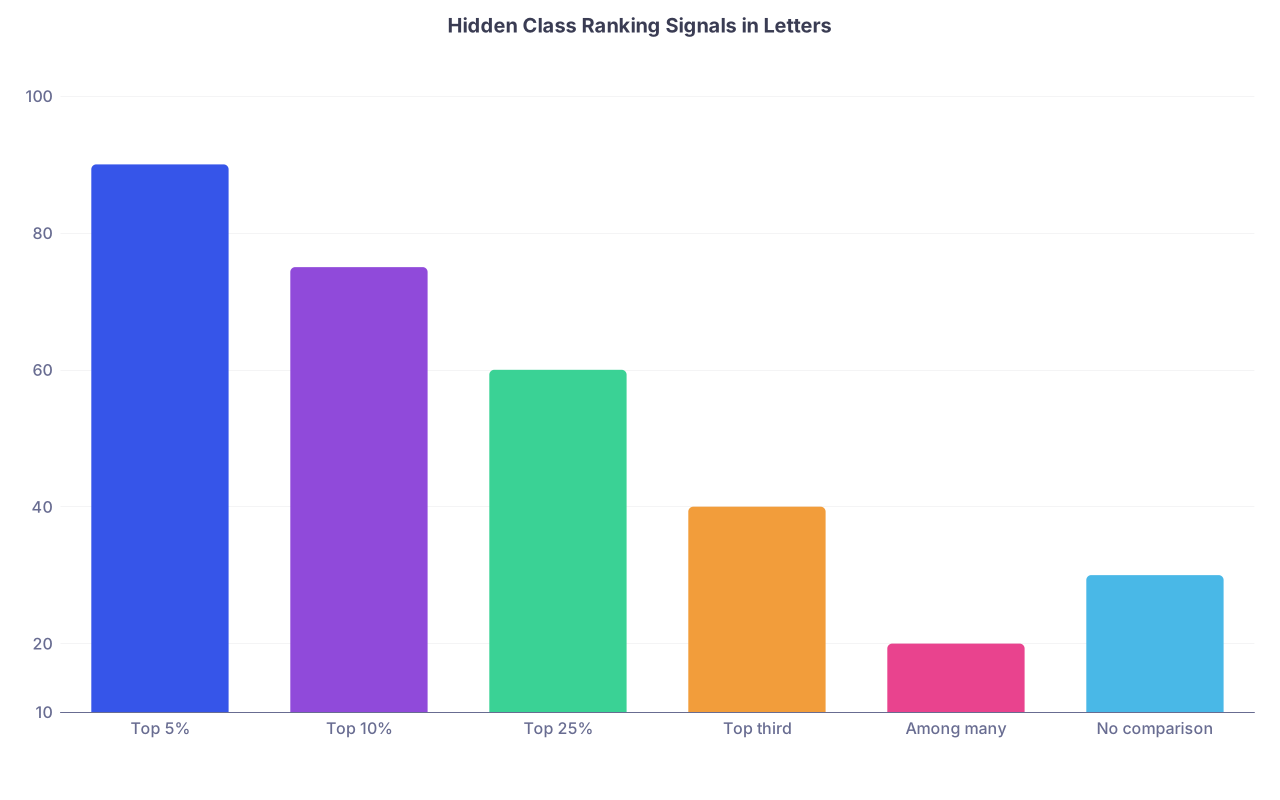
| Category | Value |
|---|---|
| Top 5% | 90 |
| Top 10% | 75 |
| Top 25% | 60 |
| Top third | 40 |
| Among many | 20 |
| No comparison | 30 |
Here’s how these phrases are silently decoded:
- “Among the top students I have worked with” → good, but vague. Better if quantified.
- “Among the top 10% of students I’ve worked with in the last decade” → very strong.
- “One of many excellent students I have worked with” → you just disappeared into the crowd.
- “In the top third of students I have taught” → in a competitive pool, borderline.
- “Compared with his peers, his performance was satisfactory” → soft negative.
In discussions, I’ve heard things like:
“Do they actually rank them?”
“They say ‘top third’—that’s not a top candidate for us.”
If a letter doesn’t give some sort of comparative strength, your application is competing against people whose letters clearly say “top 5–10%.” They win.
Tone, Length, and Specificity: The Non-Verbal Language of Letters
The actual words are only half the story. Committee members are reading between the lines constantly.
The Too-Short Letter
Half-page, generic, full of stock phrases, no specific examples. Most senior people interpret that as: this writer either doesn’t care or doesn’t have anything memorable to say about you.
I’ve seen applications with a 2-page letter full of concrete examples get ranked above someone with higher scores and a 7-line letter.
The Vague Story
“[Name] did a good job on our service. They participated in rounds and took good care of their patients.”
This says nothing. There are no memorable anecdotes, no “I watched them do X in a crisis” lines. No details = no advocacy.
The Flat Tone
You can “hear” when a writer is not invested. No exclamation points, no clear positive adjectives, no “I would be delighted to have them in our program.”
That flatness, even with technically positive words, often lands you in “meh” territory.
How These Phrases Actually Affect Your Rank Position
Let’s talk about what really happens in that back conference room when your name comes up.

| Step | Description |
|---|---|
| Step 1 | Open Applicant File |
| Step 2 | Consider for Upper Tier |
| Step 3 | Lower Tier or Remove From List |
| Step 4 | Middle or Lower Tier |
| Step 5 | Letter Tone Strong? |
| Step 6 | Red Flag Phrases? |
| Step 7 | Comparative Language Top 10-20%? |
Here’s the behind-the-scenes reality:
- A single glowing letter with strong comparative language can bump you up a tier even if your Step score is average.
- One lukewarm or coded-negative letter, especially from your home department, can quietly move you down a tier or off the list completely.
In borderline discussions, people literally quote the letter:
“Her PD says, ‘I give her my strongest recommendation without reservation.’ That’s enough for me.”
vs
“Their chair says, ‘He will be a solid resident who will meet expectations.’ We have 30 others with stronger letters.”
Guess who gets the spot.
How to Avoid Being Buried by Polite Phrases
You can’t rewrite the letter, but you can influence what ends up in it. This is where savvy applicants separate themselves.

Choose Letter Writers Strategically
The worst strategy is “ask the most famous name.” The better strategy: ask the person who will write about you with specific, enthusiastic detail.
You want someone who:
- Saw you work closely.
- Has seen many students/residents and can compare you favorably.
- Actually likes you and says so in person.
Ask the Right Question
Do not ask, “Can you write me a letter?” That traps them into a yes.
Ask: “Do you feel you can write me a strong and supportive letter for [specialty]?” Then shut up and watch their face.
If they hesitate, or say something vague like, “Yes, I can write a letter,” without the word “strong” coming back at you, that’s a hint not to use them.
Give Them Ammunition
When you request a letter, you should hand them:
- A short bullet list of specific cases where you performed well.
- Your CV and personal statement.
- A reminder of concrete moments: difficult patient, teaching session, research contribution.
You’re not writing the letter for them, but you’re making it easy for them to recall details so they don’t fall back on generic code words.
If You Suspect a Weak Letter
If someone lukewarm insists on writing you a letter—especially at your home institution—you have three lines of defense:
- Minimize its importance. Use it as your generic MSPE/required letter, but make sure your key specialty letters are from strong advocates.
- Overwhelm it with better letters. A truly glowing chair letter and a strong away-rotation letter can dilute the impact of one soft home letter.
- Apply smartly. You might not be competitive at the ultra-elite programs, but there are many programs where a “solid resident” letter is enough for a decent rank.
What Strong Letters Actually Look Like
To make sense of all this, you need contrast. Here’s how standout letters signal “definitely rank this person” in just a few lines.
| Aspect | Weak / Coded Negative | Strong / Rank-Boosting |
|---|---|---|
| Overall endorsement | "Will be a solid resident." | "I give her my strongest possible recommendation." |
| Comparative language | "In the top third of students." | "In the top 5% of students I've worked with in 15 years." |
| Autonomy | "With appropriate supervision..." | "Functions at or above the level of a beginning resident." |
| Fit | "Will meet expectations of a residency program." | "I would be thrilled to have him as a resident in our own program." |
| Tone | Flat, generic, no specifics | Energetic, specific anecdotes, clear enthusiasm |
You want your letters to sound much more like the right-hand column than the left. If you’re not sure how your potential writer sees you, that’s what mid-rotation feedback and direct conversations are for.
FAQ: Behind-the-Scenes Answers

1. Do program directors really care this much about letters in the Step 1 pass/fail era?
Yes. More than before. With Step 1 now pass/fail, letters and narrative comments have become one of the main ways to separate “good” from “top.” I’ve heard PDs say outright: “Now the real currency is what your home institution says about you.”
2. How many bad or lukewarm letters does it take to tank my application?
One truly bad letter from your home department can be fatal at competitive programs. One lukewarm letter can be overcome if the others are excellent. But if all your letters are in that “solid, will meet expectations” territory, you’ll struggle to crack the upper half of rank lists at strong programs.
3. Can away-rotation letters save me if my home letter is coded and lukewarm?
Sometimes. If an away letter from a respected program director or chair says, “Among the best students we’ve had in years,” many committees will give that more weight than a generic home letter. But if your home letter has clear red-flag language (“needs significant supervision,” “supportive and structured environment”), you’re still fighting uphill.
4. Should I ever ask to see my letter or worry about waiving FERPA rights?
If you don’t trust someone enough to waive your right to see the letter, you probably shouldn’t be asking them for one. Most PDs are suspicious of non-waived letters; they assume writers pulled punches. Your better play is to choose writers carefully and ask explicitly for a strong letter, rather than trying to police the content later.

Bottom line:
- Many “nice” phrases in letters are coded signals that you’re average, risky, or not worth a top rank.
- Committees care far more about tone, comparative strength, and specific enthusiasm than about generic compliments.
- Your job is to pick letter writers who truly know you, explicitly ask for a strong letter, and avoid the people who would describe you as “solid” and nothing more.