
Last fall, I watched a program director read a letter that was glowing on the surface: “hard‑working, reliable, pleasant to work with.” She read two sentences, snorted, and tossed the application onto the “no” pile. “Translation,” she said to me quietly, “good soldier, won’t drive the team, probably needs hand‑holding.” On paper, it looked fine. Between faculty, that letter was a giant warning sign.
Let me be blunt: your letters of recommendation are not describing who you are as a student. They are forecasting who you will be at 2:17 a.m. on a Tuesday in January when everything is falling apart and everyone is tired. Faculty and program directors read them as behavioral prediction reports. And the language has a code.
You’re not supposed to know that code. I’ll show it to you.
The Hidden Job of a Residency LOR
Students think LORs say, “This person is smart and nice.” Faculty think LORs say, “Here’s exactly how this person will behave under pressure, with power, and with fatigue.”
On selection committees, we don’t read a letter and ask, “Did the writer like them?” We ask:
- What will this person be like on call as a PGY‑2 with an intern and two medical students under them?
- Will I trust them to tell me when they’ve screwed up?
- Will they quietly sink or will they trigger alarms early?
- Will they poison the team dynamic?
That’s the game. Scores tell us whether you can pass boards. Your personal statement tells us if you can string together paragraphs. Your letters tell us whether we’re going to regret giving you a hospital badge and a pager.
And here’s the part no one says out loud: most letters sound the same. So the few real signals? They get magnified.
How Faculty Actually Read Your Letters
Imagine three attendings in a conference room with ERAS open. We’ve got 300 applications and an hour before afternoon clinic. We’re not doing literary criticism. We’re scanning for behavior.
We read in this rough order:
- Who wrote it?
- Overall tone in the first 2–3 sentences.
- Any hard behavioral claims.
- Any red‑flag hedges.
- Concrete examples (or lack thereof).
Let me walk you through how this really plays out.
1. Who Wrote It: The Unspoken Hierarchy
Like it or not, the letter writer’s identity is a signal all by itself.
| Writer Type | Typical Impact on How Seriously We Read |
|---|---|
| Home PD / Chair in same specialty | Very high |
| Known subspecialist in same field | High |
| Core clerkship director | High |
| Generic attending in field | Moderate |
| Non-core specialty / elective faculty | Low–moderate |
You don’t control how they’re perceived, but you do control which faculty you ask and whether they actually know you well enough to say something beyond “pleasant and reliable.”
What program directors are thinking:
- Home PD letter: “This is how their own shop is vouching for them.” This is interpreted as: Does their home institution trust them with their own name?
- Big‑name letter: “This person exposes residents nationally; they know who sinks and who swims.”
- Random attending from an outside elective: “Maybe the student didn’t impress anyone closer to home.” Not always true, but that’s the bias.
Now, if an unknown assistant professor writes a specific, detailed, behavior‑heavy letter, that can absolutely outweigh a vague note from a “name.” Specificity trumps title. But if the letter is generic and the writer is unknown? We mentally discount it within seconds.
The Behavior Code Hiding in “Standard” Phrases
You’ve probably heard that “strong” means “strong” and “excellent” means “excellent.” That’s not how veteran readers interpret it. We read letters in dialect.
Here’s the translation faculty actually use, whether they admit it or not.
Category 1: Work Ethic and Reliability
What faculty want to know is: will you show up, follow through, and not crumble?
Common phrases and what they secretly signal:
“Hard‑working, reliable, dependable”
Baseline. This is the minimum expectation. If this is in the first line, and nothing stronger shows up, you’re a safe mid‑tier resident, not a leader.“I never had to worry about whether the work would be done”
Good. Signals independence and trustworthiness. PDs like reading this for people who will take night float and heavy call.“Always willing to help” / “team player”
Filler, unless backed with real examples. Overused. Committees mostly skim past it unless the letter writer is known to be stingy with praise.“Met all expectations”
That’s basically a C. This is a quiet downvote.
What makes attendings lean forward is concrete behavior:
- “On multiple occasions, they stayed after hours without being asked to ensure a safe handoff of critically ill patients.”
- “When our intern called out, they voluntarily stayed and assumed many of the intern-level responsibilities while still a student.”
That’s future‑resident behavior described in real time.
Category 2: How You Handle Stress, Uncertainty, and Complexity
Residency is one long stress test. Faculty use your letter to guess whether you’ll be a stabilizer or a liability.
Watch for this language:
“Remains calm under pressure”
Mildly positive. Everyone claims this. If it’s not tied to a specific story (Code, rapid response, angry family), it means less than you think.“Demonstrated maturity beyond their level of training”
Strong signal. That’s code for: I’ve watched them deal with ugly situations (death, conflict, error) and they behaved like a resident, not a student.“Accepts feedback well”
Baseline. Everyone should do that. The upgraded version is: “Actively seeks feedback and implements it quickly.”“Improved significantly over the rotation”
This one is tricky. Sometimes positive—shows growth. But on a select committee, people ask: improved from what? If paired with “initially struggled with…,” we assume you started below average.
The gold standard line here is something like:
“After a complex overnight call with multiple admissions and limited supervision, I trusted them to prioritize tasks, communicate effectively with nursing, and call for help appropriately. This is not praise I give lightly to a student.”
That sentence gets people ranked higher. Every time.
Category 3: Autonomy and Judgment – the Real Currency
This is what programs care about the most: will you use appropriate judgment when no one is standing next to you?
Faculty give away the answer in how they talk about your independence:
“Needed minimal supervision” / “functioned at the level of an intern”
Very strong. Those phrases are the residency equivalent of a “buy” rating on a stock.“With appropriate supervision, they…”
Neutral. This is just legal/ethical boilerplate. We are supposed to supervise you. No one gets credit for that phrase alone.“Knows when to ask for help”
Sneakily important. Committees are terrified of the resident who doesn’t call. When a trusted faculty member explicitly says this, it bumps you up.“Sometimes hesitant to make independent decisions”
That’s a problem if you’re applying in acute fields (EM, surgery, anesthesia, ICU). That line will get discussed in ranking meetings.
Then there are the tiny hedges that make everyone’s radar ping:
- “With time, I expect them to become…”
- “Given the right environment, they could…”
These are all future‑conditional. Translation: Not there yet. In a competitive specialty, those may quietly kill your chances.
Category 4: Interpersonal Dynamics – Will You Poison the Team?
Here’s the dirty secret: faculty will tolerate a slightly weaker clinical performer over someone who’s potentially toxic. Programs would rather remediate knowledge than fix a broken culture.
This is how faculty signal your interpersonal behavior, often indirectly:
“Beloved by patients and staff”
Strong. Nurses did not complain. That matters more than you think.“Well-liked by peers”
Mildly positive. We read that as: not a problem.“Gets along with everyone”
Neutral. It often means, “I didn’t get any complaints.”“Has a strong personality” / “can be outspoken”
Yellow flag. Signals possible conflict, especially if not paired with “in a constructive way.”“Can be intense at times” / “very driven”
Context-dependent. In surgical fields, this sometimes flies. In fields that care a lot about warm bedside manner, it’s more problematic.
When someone writes, “I would be happy to have them as a resident on my team,” it’s one thing. When they write what we call the anchor line:
“I would want this resident taking care of my own family.”
or
“I would be delighted if they matched at our program.”
That’s different. That’s personal endorsement. PDs heavily weight that.
The Silent Red Flags Faculty Slip In
Most overtly negative letters never make it into ERAS because students screen who they ask. So problems come in through faint praise and careful wording.
Here’s what experienced PDs and faculty look for:
Resumes the CV instead of describing behavior
If a letter spends 70% of the space rehashing your research, publications, and leadership roles without commenting on how you actually functioned on the rotation, we assume the writer didn’t see you enough clinically—or wasn’t impressed enough to talk about it.Overemphasis on intelligence
“One of the brightest students I’ve worked with” sounds good, yes. But if the letter is all brain and zero behavior—nothing about teamwork, reliability, resilience—we notice the hole.Time‑frame hedges
“Over the short time I worked with them…” often means the writer doesn’t want to commit to a strong statement.Vague negatives through omission
A medicine letter that never once mentions patient care? Or an EM letter that never says a word about how you handle stress? That’s not accidental.
There are harsher, more direct signals too:
“Would perform well in a structured environment.”
Read: needs their hand held.“Best suited for a program with strong support systems.”
Read: will struggle if left to manage complexity.
I’ve seen applications sink over a single line like that. Not immediately, but when you’re ranking 40 people for 12 spots, borderline language decides who lands at 13.
How Letters Feed Directly Into Rank Lists
You need to understand the choreography behind the scenes.
Typically, here’s how selection really works:

| Step | Description |
|---|---|
| Step 1 | Applications Reviewed |
| Step 2 | Scores & Filters Applied |
| Step 3 | File Review by Faculty |
| Step 4 | Interview Invitations |
| Step 5 | Post-Interview Discussion |
| Step 6 | Rank Meeting |
| Step 7 | Closer Scrutiny |
On file review, a solid letter will help you clear the bar to get an interview, especially if your scores are not spectacular. But the real effect of letters shows up after interview day.
Here’s the part applicants never see:
We’re in a ranking meeting. Names are on a board with colored dots or numbers for interview performance, academic metrics, and “intangibles.” Now someone says:
- “Her interview was fine, but did you read the sub‑I letter? The attending basically said she needed a lot of support.”
- Or: “This guy’s scores are average, but his ICU attending wrote that he functioned like a resident and handled a brutal night calmly. I’d bump him up.”
That’s where letters move you from 18 to 9. Or from 9 to 22.
Letters are the tie-breaker when everyone broadly looks the same. And most of you look the same on paper.
What You Can Actually Control About Your LORs
You don’t write your letters. But you absolutely shape what gets written.
1. Who You Choose – and When
You want writers who have:
- Watched you on the wards or in clinic over time.
- Seen you under some level of stress or complexity.
- A reputation, at least locally, for writing substantive letters.
Waiting until the last week of a rotation and then asking, “Can you write me a strong letter?” after doing the bare minimum is how you end up with “pleasant, reliable, met expectations.”
Instead, early in a rotation, behave like someone who will ask that attending for a letter. Take ownership of patients. Volunteer for the unglamorous tasks. Show you can be trusted.
Then, halfway through, ask something like:
“I’m thinking of applying to X. I’d really like to grow into someone who can function like an intern by the end of this rotation. What would you need to see from me to feel comfortable saying that in a letter?”
You just told them exactly what matters to you—and to us.
2. How You Tee Up the Letter
When you ask for the letter, do not just say, “Can you write me a letter for residency?” Say:
“I’d be honored if you could write me a strong letter focusing on how I functioned on the team and any ways I showed I’m ready to be an intern.”
And then give them a one‑page “brag sheet” that is not just your CV. It should include:
- 2–3 specific patient care situations where you took initiative or handled something complex.
- Any times you stayed late, came early, or took on extra to help the team.
- Feedback you requested and then applied.
Now you’re feeding them behavioral examples. Most faculty are busy. They will absolutely pull from what you give them.
3. Your On‑Service Behavior: The Script They’ll Use
Everything you do on a rotation can be translated into LOR language. Here’s how your behavior becomes their code:
You pre‑round thoroughly, follow through on orders, and anticipate needs.
Letter becomes: “Highly reliable; I never had to double‑check whether tasks were completed.”You call the resident or attending early when a patient looks off, even if you’re not sure.
Letter becomes: “Demonstrates sound clinical judgment and knows when to ask for help.”You maintain composure when a patient crashes, and you jump in without being dramatic.
Letter becomes: “Remains calm under pressure and focuses on the task at hand.”You help interns with scut late at night without complaining or vanishing.
Letter becomes: “Prioritizes team needs and is the kind of colleague everyone wants on their service.”
You can’t script their words. But you can feed them the behaviors that translate into the phrases you want.
How Different Specialties Read the Same Phrases
Here’s another layer most students miss: the same sentence lands differently in different fields.
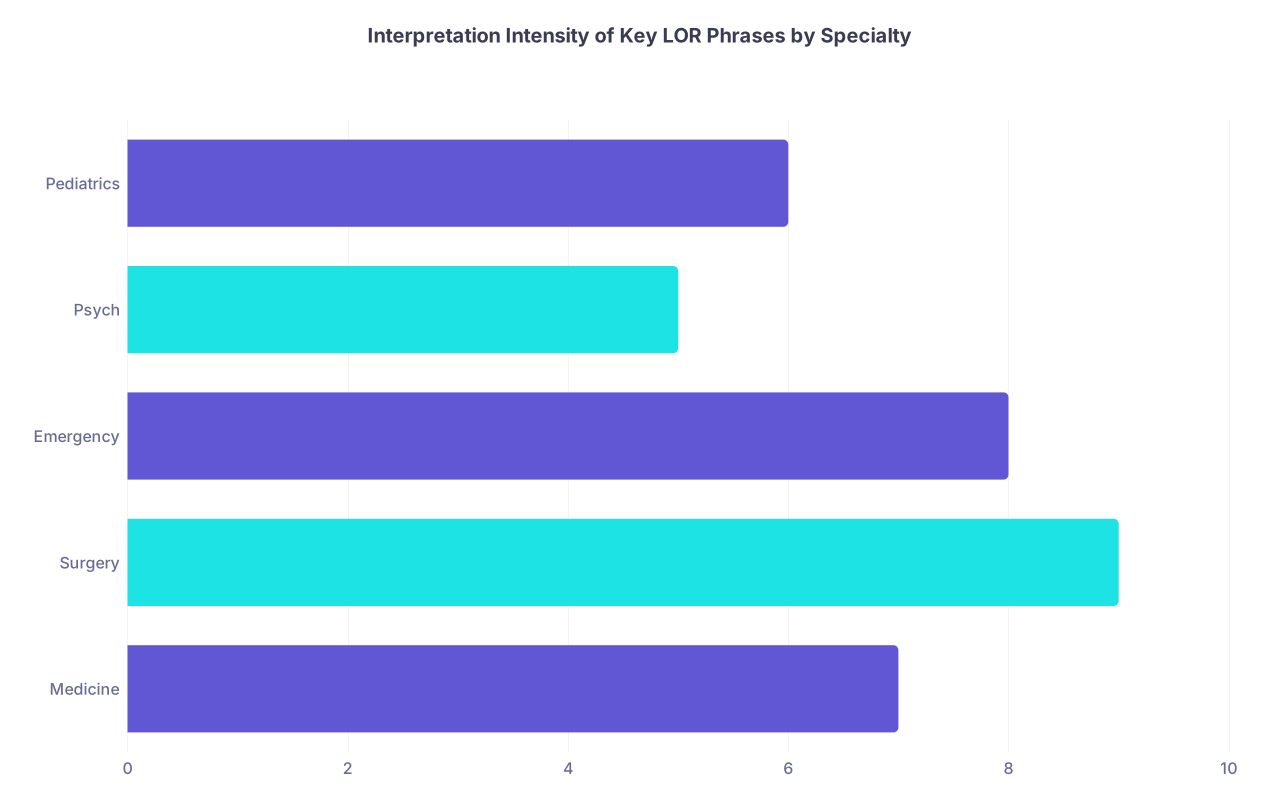
| Category | Value |
|---|---|
| Medicine | 7 |
| Surgery | 9 |
| Emergency | 8 |
| Psych | 5 |
| Pediatrics | 6 |
Think about a phrase like “assertive and confident in their decisions.”
- In surgery: often a plus. Signals someone who will take ownership in the OR.
- In EM: mixed; we want confidence but also humility and good triage sense.
- In psych or peds: that same phrase, without a softening counterbalance, might worry people about rapport and empathy.
Or “very sensitive and thoughtful with patients”:
- In psych/peds/family: strong positive.
- In EM or ICU: still good, but if it’s all empathy and nothing about decisiveness, you’ll look a bit soft.
If you’re applying to a field that lives in the acute lane (EM, surgery, anesthesia, ICU), you want language about judgment, handling stress, call performance. If you’re going into fields that center long‑term relationships (psych, peds, FM), you want relational and communication language plus reliability.
You don’t get to dictate this, but your choice of rotation and attending matters. Sub‑I on the ICU with a letter that never mentions stress or complexity? Wasted opportunity.
What Faculty Say About You When You’re Not in the Room
After interview day, we sit around a table with a list of names. The letters are open, the interview notes are fresh, and everyone’s tired. The real conversation sounds like this:
“Her Step is fine. Her interview was solid. But her sub‑I letter basically calls her ‘dependable and nice’ for two paragraphs. Anyone see anything that suggests she’ll lead a code at 3 a.m.?”
Or:
“His numbers are mediocre, but read the ward attending’s letter. ‘Best student I’ve had in 10 years, functioned like an intern, nurses loved him.’ I’d take that over a 250 with a lukewarm letter any day.”
Or, less kind:
“Look, the PD letter is clearly trying not to tank him, but ‘would do well in a very supportive environment’ is all I needed to hear. We don’t have that kind of hand‑holding.”
This is where your LORs are no longer “letters.” They’re character witness statements. Predictive police reports about your future behavior.
You can scream about fairness if you want. Or you can understand the game you’re in.
FAQ: Behind-the-Scenes Answers You Won’t Hear on Zoom Panels
1. Do PDs actually call letter writers to clarify concerns?
Yes. Not for every applicant. But if there’s something weird in a letter—subtle hedge, hint of professionalism issues—and you’re otherwise strong, PDs absolutely pick up the phone. And when they do, the conversation is blunt. “Would you rehire this person as a resident?” If the answer is anything less than an enthusiastic yes, you drop.
2. How many “meh” letters does it take to sink an otherwise strong file?
One truly bad letter can do it in a competitive specialty. In less competitive fields, two lukewarm, generic letters without specific praise or examples will push you down the rank list. Remember, you’re not being judged in a vacuum; you’re being compared to people with enthusiastic, behavior‑heavy letters.
3. Is it better to get a letter from a famous name who barely knows me or a junior faculty who knows me well?
Take the junior faculty who knows you well almost every time. A generic “pleasant and smart” from a big name is background noise. A vivid, detailed letter from a no‑name attending that clearly describes you functioning like a resident moves the needle.
4. How much do research letters matter compared to clinical letters?
Research letters predict how you’ll behave in a lab or academic setting. Clinical letters predict how you’ll behave on the wards. Most PDs care far more about the latter for residency. A research letter can help for academic programs—if it comments on your reliability, initiative, and ability to own work. If it’s just “good pipetting, many abstracts,” it’s mostly decorative.
5. What if I already have a vague or weak letter in ERAS—am I doomed?
No, but you’re on thinner ice. If you suspect a letter is weak and you still have time, add stronger letters from rotations where you shined. PDs don’t weigh every letter equally—if there’s one glowing, substantive clinical letter, it can offset a generic one. But if every letter is vague, you look vague. And vague behavior is exactly what terrifies residency faculty.
You don’t need perfect letters. You need letters that honestly show you behaving like the resident you’re trying to become. The faculty reading your file are not trying to be gatekeepers for fun; they’ve seen what happens when they misjudge someone’s behavior and hand them a pager.
Use your remaining rotations to give your attendings the raw material to write the right story about you. The story where, when your name comes up in that cramped conference room, someone quietly says, “I’d be comfortable with them on my team at 3 a.m.”
That’s when you stop being an applicant on paper and start looking like a future colleague. And once you cross that line, everything else—scores, personal statement, CV—becomes supporting evidence, not the main act.
Get those foundations into place now. The file review is just the first trial; the interviews and rank meetings are coming, and they’ll be reading every word of who you are.