
What if the letter you are counting on to “seal the deal” for your dream program is actually the reason your file keeps getting pushed into the maybe pile?
Letters of recommendation do not usually blow up your application loudly. They kill you quietly. With faint praise. With generic wording. With the wrong writer. And most of that damage is baked in at the request stage, long before anyone uploads anything to ERAS.
Let me walk you through the 10 LOR request mistakes that quietly hurt applicants every single cycle—and how to avoid stepping on them.
1. Asking the Wrong Person Just Because They Are “Big Name”
The classic disaster: you chase the department chair with 30 residents, three fellowships, and a national reputation… who barely remembers your name.
I have seen this letter more times than I can count:
“Ms. X rotated in our department. I support her application to residency.”
That is the entire first paragraph. No detail. No story. No conviction. Translation for program directors: this student was not remarkable to me and I am signing this as a courtesy.
You make this mistake when you:
- Prioritize title over relationship
- Assume a “Chair” or “Program Director” letter is always stronger
- Ignore the fact that this person never saw you present, never watched you pre-round, never got feedback from your team about your work
Programs would rather see:
- A detailed letter from an APD or core faculty who worked with you closely
- A strong letter from a subspecialist on your home rotation who can give real examples
- An away-rotation attending who actually supervised you and remembers you clearly
Ask yourself one brutal question before you request a letter:
“Could this person, right now, without looking anything up, tell a detailed story about my performance?”
If the answer is no, do not ask for a letter. Big title will not save a vague LOR. It will just make the vagueness more visible.

2. Requesting a Letter When You Were Average… Or Worse
You know the rotation. You were tired. Your notes were late. Your presentations were scattered. Mid-rotation feedback was “doing fine” said with that flat tone that means “not great, not terrible.”
And then at the end, you ask that attending for a letter because you “need one more.”
This is how you end up with the most dangerous kind of letter: lukewarm and honest.
Comments that quietly wound you:
- “She completed tasks assigned to her.”
- “He was consistently punctual and professional.”
- “With continued training, I expect he will become a competent resident.”
None of these phrases are technically negative. But they are the language of the bottom half of the class. Program directors read between the lines.
Here is the move that students avoid because it feels uncomfortable, but it saves you:
Ask directly: “Do you feel you can write me a strong letter of recommendation?”
Not just “a letter.” A strong letter. The word forces honesty. If they hesitate, hedge, or say something like, “I can write you a letter describing your performance,” back out politely.
Something like:
“Thank you so much. I may ask someone else who worked with me more closely for this cycle, but I really appreciate your time and teaching on the rotation.”
You will feel awkward for 30 seconds. That is better than a weak letter quietly dragging down every program you apply to.
3. Waiting Until September (or Later) to Ask
You finish the rotation in June. You think, “I will ask in August once ERAS opens.” Then August becomes September. Suddenly it is October and your letters still are not in.
By that time, your attending has:
- Worked with dozens of other students
- Started a new academic year
- Forgotten the specifics about you
- Received ten other LOR requests
Late letters do two kinds of damage:
- Content damage – the later you ask, the fuzzier their memory, the more generic your letter.
- Timing damage – incomplete LORs delay when your application is truly reviewable, and early review matters.
Programs often start screening applications as soon as they are complete. You want your letters in within the first couple of weeks after ERAS submission, not mid-season.
Here is a sane timeline expectation:
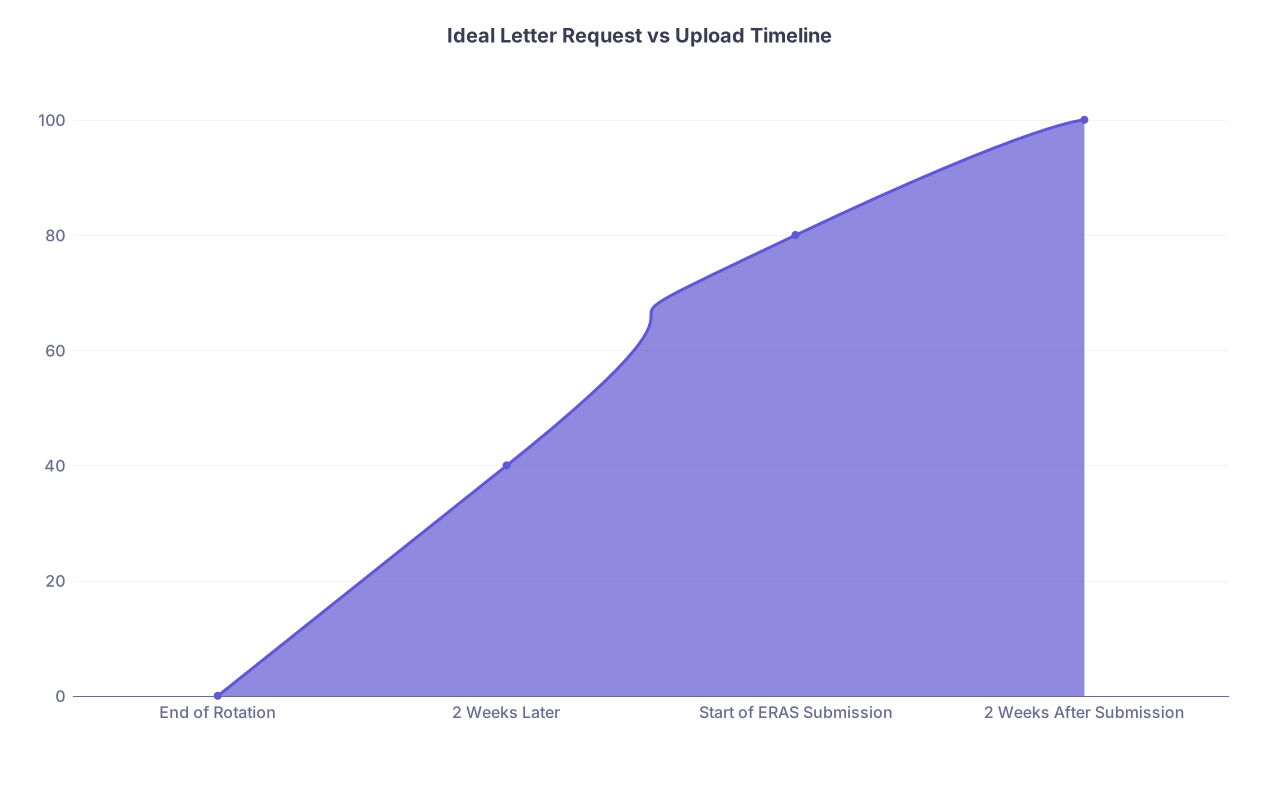
| Category | Value |
|---|---|
| End of Rotation | 0 |
| 2 Weeks Later | 40 |
| Start of ERAS Submission | 80 |
| 2 Weeks After Submission | 100 |
Think of “100” as: letters are in, application is fully ready, you are competitive for early look. You get there by:
- Asking at the end of the rotation, while they still remember details
- Sending a reminder 2–3 weeks before ERAS opens
- Sending ONE polite follow-up if the letter is not uploaded by your internal deadline
Asking late is usually a sign of poor planning. Programs will not see that planning directly, but they will see your file missing strong, timely LORs.
4. Being Vague About Your Specialty (or Asking for the Wrong One)
A surprisingly common mess: you ask your medicine attending for a letter “for residency” when you are actually applying to anesthesia, EM, or radiology.
You assume they will “keep it general.” They often do not. They will write something like:
“Ms. A will make an excellent internal medicine resident…”
Or they will emphasize things IM cares about that your specialty does not value as highly, and ignore the traits your chosen field is obsessive about.
Two bad outcomes:
- The letter sounds misaligned with your specialty
- Or worse, you send that letter to multiple specialties with contradictory messaging
You avoid this by being explicit at the time of the ask:
- “I am applying to internal medicine and would be honored to have a letter specifically for IM.”
- “I am applying to emergency medicine and need SLOE-style letters focusing on X, Y, Z.”
- “I am applying to anesthesia but believe your internal medicine perspective on my clinical performance would be very valuable.”
Do not ask for “a generic letter I can use anywhere.” That is how you get a generic letter. And generic letters are death in competitive fields.
Also, be careful about cross-specialty letters. A strong letter in your target field usually beats a generic one from a different department, unless that writer knows you very well.

| Step | Description |
|---|---|
| Step 1 | Need LOR |
| Step 2 | Do NOT ask |
| Step 3 | Ask for specialty-specific letter |
| Step 4 | Ask only if they know you very well |
| Step 5 | Did this attending work with you closely? |
| Step 6 | Was your performance clearly strong? |
| Step 7 | Matches your specialty? |
5. Giving Your Writer Nothing to Work With
You finally ask for the letter. They say yes. Then you vanish and assume they will magically recall every detail of your rotation.
So they do what overworked attendings do: pull up a previous LOR, change the name, swap a few adjectives, and produce a letter that says almost nothing specific about you.
You caused that. By giving them no raw material.
Strong letters are built on:
- Concrete patient encounters
- Specific feedback moments
- Patterns over time (growth, reliability, initiative)
- Your trajectory and goals
When you ask, you should hand them a short, focused packet. Not a 20-page shrine to your life. Just enough to trigger their memory and give them usable language.
That packet should include:
- One-page CV (not 8 pages)
- Your personal statement draft or at least a paragraph on why this specialty
- A bullet list (5–8 bullets) of specific cases, moments, or feedback from that rotation
Things like:
- “First patient I pre-rounded on independently – elderly man with CHF whose case I later presented at noon conference.”
- “You gave me feedback on improving my assessment/plan structure on day 3, and I changed my template accordingly.”
You are not writing your own letter. You are reminding them why they liked working with you. When you do not, you get generic fluff, and generic fluff hurts.

6. Not Clarifying Logistics and Deadlines Up Front
Here is a quiet but deadly administrative mistake: you ask verbally, they say yes, and then… nothing. No follow-up email. No deadline. No ERAS instructions. Chaos.
Two problems:
- They forget you asked. You were one of six students that month.
- You end up sending panicked reminder emails two days before your submission date.
Program directors see timestamps. When a letter arrives on October 28 for an application that was “submitted” on September 15, they know your file was incomplete for weeks.
Your initial ask should always be followed by a concise email that includes:
- Your full name and AAMC ID
- Whether this will be uploaded through ERAS (and how)
- The internal deadline you are aiming for (earlier than the real one)
- Attachments: CV, personal statement, bullet list
Something like:
“I am submitting ERAS on September 10 and would be grateful if the letter could be uploaded by September 1 so my application is complete early in the season.”
Then, if you have heard nothing by a week before your internal deadline, send one polite follow-up. Not five.
Do not make the mistake of being so afraid of “bothering” your writers that you let your whole application sit half-finished.
7. Ignoring Red Flags in How They Respond to Your Request
The way someone responds to your LOR request is data. You should pay attention to it.
Red-flag responses you should not ignore:
- “Sure, but I am very busy and my letters tend to be brief.”
- Long silence after you ask, then a lukewarm “I guess I can.”
- “I did not work with you that much, but I can write something.”
These are people telling you, in polite academic language, that your letter will be mediocre.
You are allowed—actually, you are smart—to pivot. You can say:
“I appreciate your honesty. Given how important these letters are, I may ask someone who saw more of my work on the rotation, but I am very grateful for your time and teaching.”
The mistake is pretending you did not hear the warning and proceeding anyway because you “need letters.” You do not need that letter.
A shorter but enthusiastic letter from a more junior faculty member who actually liked working with you is safer than a reluctant half-page from someone more senior.
| Response Type | What You Hear | What It Usually Means |
|---|---|---|
| “I’d be happy to write you a strong letter.” | Clear enthusiasm | Likely detailed, positive LOR |
| “Sure, I can write you a letter.” (with specifics offered) | Neutral but engaged | Probably okay to good letter |
| “I did not work with you much, but I can do something.” | Distance, hedging | Risk of generic or weak LOR |
| “My letters are usually brief due to time.” | Pre-emptive excuse | Likely short, low-impact letter |
| Long delay, no reply | Low priority | Do not rely on this person |
8. Using “Friend of the Family” / Non-Clinical Letters in the Wrong Way
Someone in your family knows a famous cardiologist at a big-name program. Or your neighbor is an alumnus of your dream residency. The temptation: ask for a letter.
If that person has not supervised you clinically, their letter will often sound like this:
“I have known John since childhood. He is hard-working, intelligent, and kind.”
Program directors know exactly what that is: a character reference, not a clinical evaluation. It carries very little weight for residency selection. Sometimes almost none.
The mistake is sending that as one of your core letters, especially in competitive specialties, and assuming it is equivalent to an attending who actually worked with you on the wards.
Where these letters can occasionally help:
- As an extra letter, clearly labeled as a character / mentorship letter
- For programs where that person is deeply embedded and can personally advocate beyond the formal LOR
But do not let a family friend’s vague praise displace a hard-earned clinical letter from someone who watched you grind through a tough service.
If your “connection” has never seen you present, examine a patient, write a note, or respond to a cross-cover page, they should not be one of your main LORs.
9. Not Aligning Letters With Program Expectations
Different specialties and even different programs have norms and sometimes explicit requirements for letters. Ignoring those is an unforced error.
Examples I have seen:
- EM applicants who did not prioritize SLOEs (Standardized Letters of Evaluation) from EM rotations
- Surgery applicants with only one surgical letter and three medicine letters
- IM applicants to academic powerhouses with zero letters mentioning research or academic potential
If your specialty expects a certain letter pattern and you do not meet it, programs make assumptions:
- You could not get the right letters
- You did not understand how the field works
- You are not serious about that specialty
Before you request letters, know the norms. At a minimum:
- How many letters total are typically competitive
- How many should be from your chosen specialty
- Whether standardized formats (like SLOEs) are strongly preferred or required
Then build your LOR strategy deliberately instead of just asking whoever is convenient.
Do not assume “all strong clinical letters are equal.” They are not.
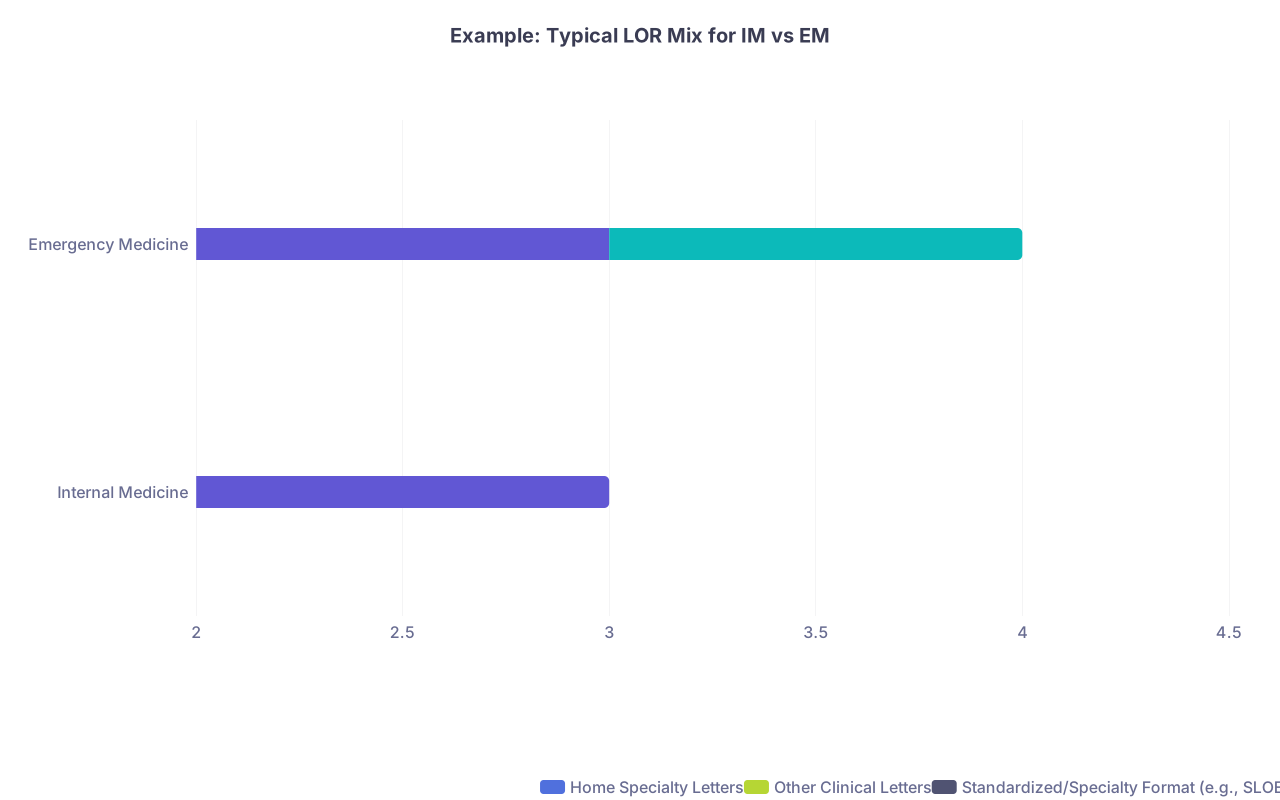
| Category | Home Specialty Letters | Other Clinical Letters | Standardized/Specialty Format (e.g., SLOE) |
|---|---|---|---|
| Internal Medicine | 2 | 1 | 0 |
| Emergency Medicine | 2 | 1 | 1 |
10. Never Closing the Loop (and Burning Quiet Bridges)
Final landmine: you get the letter, it uploads, you match… and you never speak to that letter writer again.
That does not hurt your current match, but it quietly damages your future. Because you are probably going to need letters again—for fellowships, jobs, visas, promotions.
People remember who vanishes once they get what they want.
The immediate mistake at the request stage is acting purely transactional. You drop in, ask for a huge favor that requires time and professional reputation, and then disappear.
You avoid this with three simple actions:
- Thank them properly when they agree.
- Thank them again when you know the letter is uploaded.
- Email them on Match Day with your result and explicit appreciation.
Something like:
“I wanted to share that I matched at [Program]. Your support and letter were a critical part of my application, and I am very grateful.”
That is it. Fifteen seconds to type. But it changes how they remember you. And it makes them far more willing to write the next letter you will inevitably need.

How to Ask Without Stepping On Any of These Landmines
Let me give you one clean template that avoids most of the mistakes above. You can adapt the tone, but keep the structure.
In person (best):
“Dr. Smith, I have really valued working with you this month, especially your feedback on my presentations and notes. I am applying to internal medicine this cycle, and I wanted to ask if you feel you could write me a strong letter of recommendation for IM.”
If yes:
“Thank you, I would be honored. I can send you my CV, personal statement draft, and a short list of cases we worked on together to jog your memory. ERAS opens on [date], and I am aiming to have all my letters in by [internal date].”
Then follow with a concise email the same day.
By email (if in-person is truly impossible):
Subject: Letter of Recommendation Request – [Your Name], [Rotation/Date]
“Dear Dr. Smith,
I hope you are well. I am writing to ask if you would feel comfortable writing a strong letter of recommendation for my internal medicine residency application.
I greatly appreciated working with you on the [service] rotation in [month/year], especially your feedback on [specific example]. I learned a lot from [brief detail that proves you remember and valued their teaching].
I am planning to submit my ERAS application on [date] and would be grateful if the letter could be uploaded by [internal date] so my application is complete early. I will attach my CV, a brief personal statement paragraph, and a short list of cases and moments from the rotation to help jog your memory.
Thank you for considering this, and for your teaching and mentorship.
Best regards,
[Name]
[AAMC ID]”
This is how you show respect for their time, clarity of your ask, and seriousness about the process. It also telegraphs to any program director who hears about you that you are not careless.

The Bottom Line: Protect Yourself From Quiet Damage
Three key points to carry out of this:
- The letter request is where most of the damage happens. Weak, vague, late, or misaligned letters almost always come from sloppy or fearful requests. Fix the front end.
- Ask only people who know you, liked working with you, and can be specific. A smaller title with real enthusiasm beats a famous name with faint praise every time.
- Be explicit, organized, and respectful. State your specialty, use the phrase “strong letter,” give them materials, set clear deadlines, and follow up like a professional.
If you handle your LOR requests with the same care you give to your personal statement or rank list, you will quietly avoid one of the most common—and most avoidable—ways applicants hurt their match.