
Program directors are tired of reading useless shadowing-only letters of recommendation.
If your LORs sound like you followed an attending around with a clipboard and a polite smile, you are wasting one of the most valuable parts of your residency application.
Let me be blunt: a generic “shadowing” LOR will not save a weak application, will not distinguish a strong one, and can actively hurt you in competitive fields. PDs have read thousands of them. They know the pattern. They skip them mentally the second they see certain phrases.
You are in the letters of recommendation phase now, not the “I got an email from a premed advisor” phase. The bar is higher. Observing is not enough. And shadowing, by itself, usually produces the weakest letters in the entire stack.
Let me walk you through the specific mistakes that get shadowing-only letters ignored—or worse, dismissed—and how to avoid them so you do not sabotage your residency application.
Mistake #1: Using Pure Shadowing as a “Clinical” LOR
The first and biggest error: treating a pure shadowing experience like a legitimate clinical LOR. It is not.
Program directors want letters that show how you functioned as a team member, not a spectator. Shadowing is, by definition, passive. You observe. You do not own patients. You do not write notes that actually matter. You are not held accountable.
So when PDs see a letter and realize it is based on shadowing only, they mentally downgrade it immediately.
You know the red-flag phrases. They show up again and again:
- “I had the opportunity to have [Name] shadow me in clinic.”
- “During the time [Name] observed my practice…”
- “Although [Name] did not have direct responsibility for patient care…”
By the time the PD hits the second line, they already know: this letter is fluff.
Here is the core problem: PDs are not asking, “Did this person see patients?” They are asking:
- Did this person contribute to patient care?
- Did they function under pressure?
- Could I trust them at 3 a.m. on call?
- Did they take feedback and improve?
Shadowing cannot answer those questions. So when you use a shadowing-only letter as one of your primary required clinical letters, you are basically telling the PD: “No one saw me in a real working role, so here is the best I could do.”
Do not do this unless you are absolutely forced to—and if you are, you need to be very strategic about it (more on that later).
Mistake #2: Choosing Letter Writers Who Barely Know You
The second fatal error: chasing “big names” instead of depth of relationship.
PDs would rather read a specific, grounded letter from a community physician who supervised you meaningfully than a vague, hollow letter from a famous division chief who barely remembers your face.
I have seen this many times:
You shadow someone well known, maybe a department chair, for five half-days. You ask them for a letter. They agree. You feel thrilled. Name recognition! Prestige!
Then the letter arrives, and it is three paragraphs of generic word salad:
“[Name] is a pleasant, motivated, and intelligent student. During their time shadowing in my clinic, they demonstrated a strong interest in internal medicine. I believe they will make a fine resident and future physician.”
Program directors see right through this. It screams, “This person spent minimal time with the student and is writing this as a favor.”
Contrast that with a community hospitalist who worked with you for two months, saw you on nights, watched you manage cross-cover pages, saw how you handled a crashing patient, and can write:
“On our second week of nights, a patient became acutely hypotensive and hypoxic. Before I even arrived at the bedside, [Name] had already called RT, started fluids, placed the patient on nonrebreather, and was calmly presenting the situation to the MICU fellow. Their situational awareness and poise under pressure were impressive.”
That letter has no big-name power. But it carries credibility and detail. PDs believe it.
If your “relationship” with the letter writer consists of:
- Watching them see patients
- Chatting in the hallway
- One debrief lunch at the end
…you do not have a strong LOR writer. You have a nice attending who knows your name. That is not enough.

Mistake #3: Allowing “Empty Adjectives” to Dominate the Letter
Shadowing-only letters are notorious for being stuffed with flattering but meaningless adjectives:
- “Hardworking”
- “Enthusiastic”
- “Motivated”
- “Pleasant”
- “Curious”
Alone, these words do not move the needle. PDs see them in almost every letter. They are the residency equivalent of “team player” on a corporate resume.
The real problem: shadowing experiences rarely give attending physicians concrete behaviors to write about. There is no daily note-writing, no team handoffs, no admitting flow, no cross-cover, no on-call performance. So the letter writer falls back on adjectives.
The worst offenders are letters that sound like this, start to finish:
“[Name] is a very motivated, hardworking, and compassionate student. During their time shadowing me, they demonstrated a sincere interest in my specialty. They were always punctual, enthusiastic, and eager to learn. I am confident they will be an asset to any residency program.”
That letter could be copied and pasted into any other student’s file with just the name changed.
Program directors are not counting adjectives. They are looking for behavior. Concrete, specific, verifiable behavior.
Shadowing-only relationships tend to produce letters heavy on adjectives and light on evidence. That ratio kills their credibility.
Mistake #4: Using Shadowing LORs in Competitive or Clinical-Heavy Specialties
Trying to break into a competitive specialty or a very clinical-heavy program with shadowing-only letters is like showing up to a surgical skills exam having only watched YouTube videos. You may be interested, but you have not proven you can actually do anything.
Certain specialties and program types essentially expect strong, behavior-based, non-shadowing letters:
- Surgery (especially categorical general surgery and competitive subspecialties)
- Emergency Medicine
- Anesthesiology
- OB/GYN
- Any program with heavy acute care
In these fields, PDs want to see that someone has already seen you:
- Handle pressure and time constraints
- Take ownership of tasks
- Communicate with nurses, consultants, and patients
- Work in a chaotic environment
Shadowing cannot show that. So when your application to EM has:
- 1 letter from an EM rotation attending who supervised you
- 2 letters from physicians you “shadowed in the ED”
…you look under-tested. Like someone who stood in the back of the trauma bay and nodded along.
Here is what PDs think when they see shadowing-only letters in competitive fields:
- “Could this student not get a real rotation-based letter?”
- “Did no one actually want to write for them?”
- “Were they not trusted with direct responsibilities?”
None of those questions are good for you.
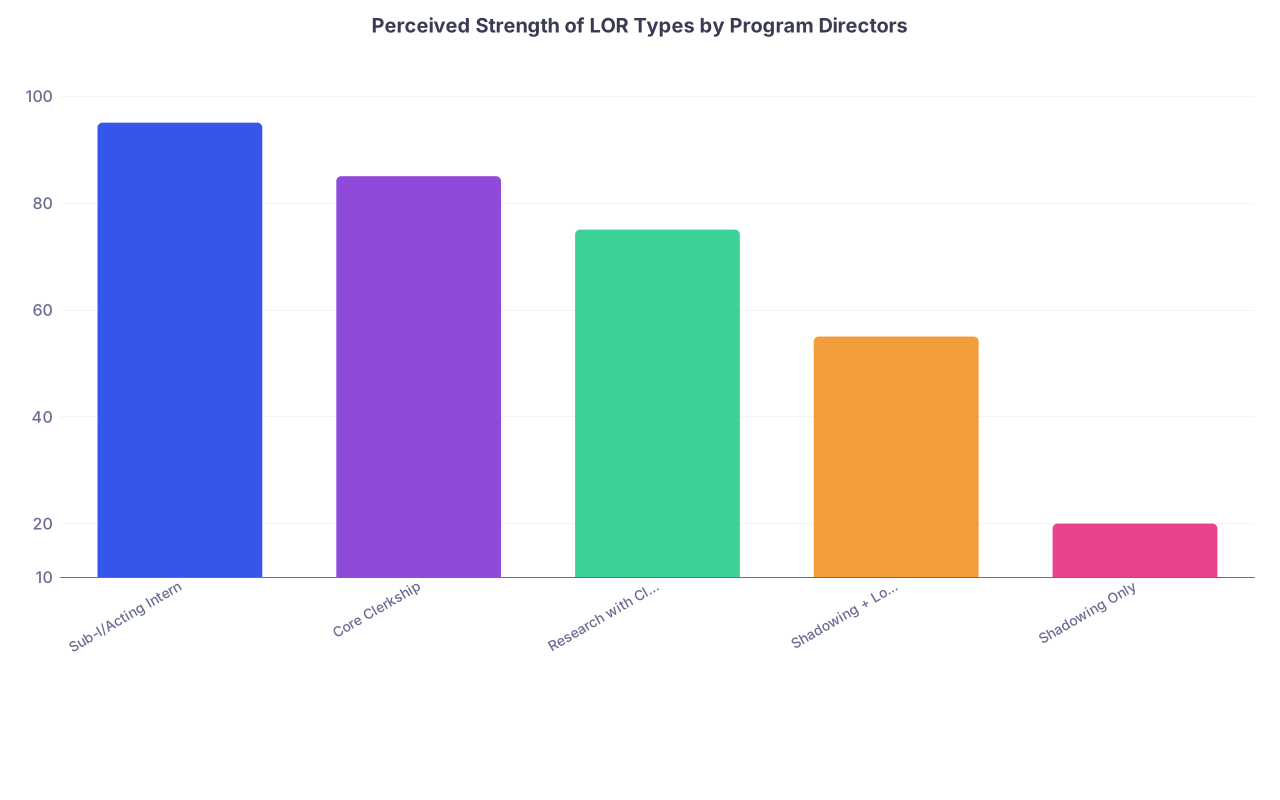
| Category | Value |
|---|---|
| Sub-I/Acting Intern | 95 |
| Core Clerkship | 85 |
| Research with Clinical Work | 75 |
| Shadowing + Longitudinal | 55 |
| Shadowing Only | 20 |
Mistake #5: Failing to Turn Shadowing into Real Engagement
Shadowing by itself is weak. Shadowing used as a door into deeper involvement can be powerful. Most students never make that transition.
They show up, stand quietly, ask a few questions between patients, say thank you, and then ask for a letter at the end of two or three days. That is a mistake.
If all you did was observe, then your letter writer has almost nothing to work with beyond your personality and punctuality. That is thin content for a residency LOR.
Here is how students waste shadowing:
- They do not ask to help with anything (even small tasks).
- They do not show up consistently enough to be remembered.
- They do not follow up with the attending after the experience.
- They ask for a letter via a single email months later.
If you are already stuck with mostly shadowing time with someone, you must upgrade that relationship if you want any chance of a usable LOR. That means:
- Returning multiple times, not just one afternoon
- Asking to observe case discussions, M&M, tumor board, teaching rounds
- Offering to help with a small project: chart review, QI idea, patient education materials
You cannot magically turn shadowing into a 1:1 Sub-I, but you can create more touchpoints and more opportunities for the attending to see your work ethic and follow-through.
Most students do not. So their letters are vague, thin, and forgettable.
Mistake #6: Requesting a Letter Without Screening Its Strength
One of the most preventable errors: asking for a letter without explicitly asking whether it will be “strong and supportive.”
If all you did was shadow, you must be twice as careful about this. Because the default letter from a shadowing relationship is lukewarm.
You should never phrase the request as:
“Could you write me a letter of recommendation?”
You should ask:
“Would you feel comfortable writing me a strong, supportive letter of recommendation for [specialty] residency, based on your experience working with me?”
That phrasing forces the attending to think about the strength of the letter, not just the logistics of writing it. It also gives them an easy exit if they only feel comfortable writing something generic.
If they hesitate, or they say something like “I can write you a letter describing your time shadowing me,” that is a red flag. That means no depth, no specifics, no real advocacy. Thank them, but go find someone else.
Do not be so desperate for “any” letter that you accept a weak one. A bland, tepid, obviously-shadowing-only letter is worse than not having that letter at all in many cases.
Mistake #7: Letting the Letter Advertise Your Lack of Clinical Responsibility
Shadowing-only letters often accidentally reveal that you never did much. PDs pick up on this.
Some dangerous phrases that quietly undermine you:
- “Although [Name] did not have direct patient care responsibilities…”
- “Because this was a shadowing experience, I did not have the opportunity to assess their clinical decision-making…”
- “I did not formally evaluate [Name] in the role of a clerkship student or acting intern…”
Every one of those sentences is a bullet to the letter’s credibility.
Now, attending physicians are sometimes just being honest about the limits of their relationship with you. That is appropriate. But from the PD perspective, those lines instantly downgrade your letter into the “nice but not meaningful” pile.
Your job is to reduce how often letter writers need to say those things. If all you ever do with them is watch from the back of the room, then those sentences are inevitable and accurate.
This is why pure-shadowing letters should be:
- Supplementary at best (not primary clinical letters)
- Focused on specific domains: professionalism, ethics, communication, curiosity, longitudinal commitment
If you cannot avoid having a shadowing-only letter, at least make sure it is not pretending to be something it is not. Let it occupy the “character witness” niche, not the “clinical performance” niche.
How to Salvage a Shadowing-Only Situation
Maybe you are in a small school without strong home rotations in your specialty. Maybe you changed fields late and mostly have shadowing in your new interest area. Maybe your school’s structure is weak. Fine. You still have options.
Here is how to upgrade a weak shadowing-only setup into something PDs will not immediately dismiss.
1. Convert Shadowing into Longitudinal Involvement
Instead of a single short block, turn it into a recurring relationship.
Ask:
“Would it be possible for me to continue coming to your clinic one half-day every week or two over the next couple of months? I am very interested in understanding this specialty more deeply.”
That longitudinal exposure allows the attending to see:
- Your reliability over time
- Your growth in understanding
- Your consistency and follow-through
It is still technically shadowing, but it now has more substance. The letter can truthfully say:
“Over the course of six months, [Name] returned to my clinic regularly and consistently, demonstrating sustained interest and commitment.”
Better than “three mornings in July.”
2. Attach Concrete Work to the Relationship
Do not just be a body in the corner. Ask about small but real contributions:
- Helping with a chart review for a QI or research project
- Drafting patient education handouts
- Developing a small literature summary on a frequently encountered condition
- Assisting with data entry or organization for an ongoing study
Then the letter can say:
“In addition to observing my clinical practice, [Name] took initiative to help with a chart review project examining our diabetic readmission rates. They independently reviewed over 120 charts, maintained meticulous data logs, and followed up on questions we raised during our meetings.”
That is infinitely stronger than “They shadowed me and asked good questions.”
3. Pair the Shadowing LOR with Strong, Non-Shadowing Clinical Letters
Do not let a shadowing-only letter stand alone as the main representation of your clinical abilities. It should be a bonus, not the foundation.
For example, in a 3-letter setup:
- Letter 1: Acting internship / Sub-I in your intended specialty
- Letter 2: Core clerkship (IM, surgery, etc.) with real responsibilities
- Letter 3: Shadowing + project letter in your intended field (positioned as evidence of long-term interest and professionalism, not your only “clinical” reference)
Then the PD reads your file and thinks:
“Ok, I have two real clinical letters that speak to performance. This third one shows sustained interest in [specialty] and good character. Fine.”
That is acceptable. The danger is when all or most of your letters are shadowing-based.

| Step | Description |
|---|---|
| Step 1 | Start: Shadowing Only |
| Step 2 | Create Longitudinal Clinic Presence |
| Step 3 | Increase Engagement During Current Block |
| Step 4 | Join Small Research/QI Task |
| Step 5 | Focus on Observation + Insightful Questions |
| Step 6 | Ask for Strong, Supportive LOR Emphasizing Commitment + Initiative |
| Step 7 | Can you extend duration? |
| Step 8 | Project or QI Opportunity? |
When a Shadowing-Only LOR Is Actually Useful
Let me be fair. Shadowing letters are not always useless. They are just misused.
They can have value in a few specific situations:
- You are switching specialties late, and this letter documents your genuine, sustained interest in the new field.
- The letter writer is a nationally respected leader in the specialty who has actually spent serious time with you and can credibly speak to your character, even if not your direct clinical performance.
- The letter highlights longitudinal commitment (six months to a year of repeat engagement) rather than a brief rotation.
In those cases, the letter has a job: to show that you are not just casually browsing this specialty. That you have shown up. That someone in the field knows who you are and believes you are serious.
But that does not replace real clinical performance letters. It supplements them.
| Feature | Shadowing-Only LOR | Strong Clinical LOR |
|---|---|---|
| Direct patient care assessment | Weak/None | Strong |
| Ownership of tasks | Rare | Expected |
| Specific behavioral examples | Limited | Multiple |
| Longitudinal observation | Possible but rare | Common in Sub-I |
| PD perceived usefulness | Low | High |
The Bottom Line: PDs Dismiss What You Allow to Be Weak
Your letters are not random. They reflect your strategy—or your lack of one.
If you load your ERAS with shadowing-only LORs full of adjectives, short on specifics, written by people who barely know you, PDs will assume:
- You did not prioritize meaningful clinical roles.
- You did not build strong relationships where you actually worked.
- No one has really tested you yet.
That is the opposite of what you want them to think.
Your job is to make shadowing the smallest and least important part of your LOR portfolio. If it is going to be there, you upgrade it: longitudinal involvement, concrete projects, and very careful selection of who writes and how you frame the request.
Do not let laziness, anxiety, or over-reliance on “big names” push you into letters that do nothing for you.
You worked too hard in medical school to be undone by weak, dismissible letters.
FAQ (Exactly 3 Questions)
1. I only shadowed in my chosen specialty and have no formal rotation there. Should I still get a shadowing letter?
Yes, but treat it as a secondary letter, not a core clinical LOR. Pair it with your strongest rotation-based letters (IM, surgery, Sub-I) that show real clinical performance. Ask the shadowing attending to emphasize your sustained interest, professionalism, reliability, and any concrete work (projects, longitudinal involvement), not your “clinical skills” they did not truly witness.
2. Is a strong shadowing letter from a famous department chair better than a detailed letter from a lesser-known attending who supervised me on a Sub-I?
For most PDs, no. Content beats title. A specific, behavior-rich letter from someone who directly supervised you clinically carries more weight than a vague, generic letter from a big name who only saw you observe. The only time the big-name shadowing letter helps is when your clinical letters are already strong and this serves as an extra vote of confidence and interest in the field.
3. How can I politely avoid a weak shadowing letter if an attending offers to write one?
Thank them genuinely, then redirect. For example: “I really appreciate your offer. Since we mainly worked together in a shadowing capacity and I want my required clinical letters to focus on direct patient care, I am planning to ask my Sub-I and core clerkship attendings for those. If it is alright with you, I may reach out later for a supplemental letter to support my interest in [specialty].” This preserves the relationship and avoids locking yourself into a weak primary LOR.
Open your current letter writer list right now and mark each as “shadowing-only” or “true clinical supervisor.” If more than one of your key LORs is shadowing-only, your next step today is to identify at least one attending who actually supervised your work and ask them—explicitly—for a strong, supportive letter.