
What’s quietly killing your residency LORs before they’re even written?
Not your Step score. Not your CV.
Your emails.
I’ve watched strong applicants sabotage excellent potential letters of recommendation with a single weak sentence in their request email. Same faculty. Same rotation. Two students. One gets a powerhouse letter. The other gets a vague, lukewarm paragraph that might as well say, “I barely know this person.”
The difference? How they asked.
Let me walk you through the email phrases that quietly make attendings roll their eyes, mark your request as “later” (which becomes never), or mentally downgrade how strongly they’ll write for you.
Stop using these. Today.
1. “I was wondering if you’d be willing to write me a letter…”
This one looks polite. Safe. But it does three bad things at once:
- It sounds tentative.
- It makes your request sound optional or low-stakes.
- It gives the writer an easy psychological out.
I’ve literally heard an attending say, staring at an email like this:
“Yeah… they’re ‘wondering,’ and I’m wondering when I’m supposed to find the time.”
The problem phrases:
- “I was wondering if…”
- “I’m hoping you might be willing to…”
- “If it’s not too much trouble…”
These are classic softeners, and in everyday conversation that’s fine. In an email for a residency LOR, they make you look:
- Unsure of yourself
- Unsure of the relationship
- Slightly apologetic for asking
You’re not asking for a random favor. Letters are a normal, expected part of academic medicine. Acting like you’re imposing makes you look like you do not belong in that world yet.
Stronger alternative:
- “I am writing to ask if you would be willing to write a strong letter of recommendation for my residency applications in [specialty].”
- “I would greatly appreciate your support with a strong letter of recommendation for my applications to [specialty] this cycle.”
Notice: direct, clear, and specific. No “wondering.” No “if it’s not too much trouble.”
If that feels too bold to you, that’s the point. Residence program directors are not shy people. They respond better to trainees who sound like they believe they deserve to be there.
2. “Any letter you could provide would be appreciated.”
This one is a quiet disaster.
You think you’re being polite and non-demanding. What you’re actually saying is:
“You can send a generic, lukewarm, template letter and I’ll still be grateful.”
So guess what a busy attending under time pressure does? Exactly that.
I’ve seen faculty literally say, “They said any letter, so I’ll just do my standard one-pager.” Translation: recycled phrases, no detail, no strong advocacy.
Worst offenders:
- “Any letter you can provide would be appreciated.”
- “Even a short letter would be great.”
- “I know you’re very busy, so anything you can write is fine.”
You’ve just:
- Lowered the bar for how much effort they feel they need to put in.
- Signaled you either don’t understand how crucial letters are, or you’re desperate.
- Removed the social pressure for them to say no if they can’t be strong.
Never invite a weak letter.
Use this instead:
- “If you feel you can write a strong, detailed letter on my behalf, I would be very grateful for your support.”
- “If you do not feel you can write a strong letter, I completely understand and would appreciate your honesty.”
That second line saves more applications than you realize. It gives them a face-saving way to decline instead of writing you a bland, “This student completed the rotation without issue” death letter.
3. “You probably don’t remember me, but…”
Don’t ever open your LOR request by insulting your own significance.
If you think they truly don’t remember you, why on earth are you asking for a letter?
This phrase plants doubt in the writer’s mind before they’ve even finished the sentence:
- Are you forgettable?
- Were you unremarkable on service?
- Were you one of 15 students that month who did nothing notable?
Even if they do remember you, you’ve forced them into a little mental diagnostic: “Do I remember them well enough?” That hesitation alone can downgrade the strength of the letter.
Phrases to delete:
- “You probably don’t remember me…”
- “You may not recall, but I was a student on your service…”
- “I don’t know if you remember me from [rotation]…”
If you’re asking for a letter, your job is to jog their memory confidently, not apologize for existing.
Better framing:
- “I was a third-year medical student on your [service] rotation in [Month, Year], and we worked together on several patients including [brief reminder].”
- “I rotated with you on [service] in [Month, Year], where I particularly appreciated your teaching on [specific topic].”
You’re not begging them to remember. You’re anchoring their memory with specifics. That’s how you get: “Oh, right, that was the student who stayed late for the complex discharge.”
4. “I know you’re really busy, but…”
This one sounds humble. It’s actually counterproductive.
Yes, attendings are busy. Residents are busy. Everyone in the hospital is busy. Leading with this line:
- Reminds them they don’t have time for this.
- Frames your request as an extra burden.
- Makes you sound like you expect to be an inconvenience.
Some faculty will help anyway. But you’ve set the tone as: “This is a favor. An annoyance. Something you squeeze in at 11:30 p.m. after signout.”
Guess what kind of letter gets written under that mental framing?
Skip these:
- “I know you’re really busy, but…”
- “I hate to bother you…”
- “Sorry to take up your time…”
You think you’re being courteous; you’re actually telling them to de-prioritize you.
More effective approach:
You can acknowledge their time respectfully without centering the email on their busyness:
- “I appreciate your time and consideration with this request.”
- “I know letters require thoughtful effort, and I’d be grateful for your support.”
See the difference? Respectful, but not apologizing for existing.
5. “I need a letter for my application” (and nothing more)
“I need a letter” is barely a request. It’s a statement of your problem.
Faculty see this kind of email all the time:
“I am applying to internal medicine this year and need a letter of recommendation. Would you be able to write one for me?”
Technically clear. Strategically weak. Here’s why:
- No mention of “strong” or “detailed” → invites generic.
- No signal that you value their perspective specifically.
- No reminder of what you did with them, how you performed, or what you’re aiming for.
You sound like you blasted the same template to six people and don’t care who responds.
What’s missing that you MUST include:
- Why them: “Based on our work together on [rotation/service]…”
- What you’re applying to: “for my applications to categorical internal medicine programs.”
- What kind of letter: “a strong, detailed letter.”
- How you performed (brief reminder): 1–2 sentences.
Example of a much better core ask:
“Based on our work together on the cardiology service in May, I am writing to ask if you would be willing to write a strong, detailed letter of recommendation for my applications to internal medicine this year.”
Then you follow it with 1–2 lines reminding them who you were on that team:
“I especially appreciated your feedback on my presentations and your guidance on managing our complex CHF admissions, and I’m grateful for your support as I pursue a career in academic internal medicine.”
Polite. Clear. Not needy.
6. “By the way, the deadline is next week…”
Last-minute LOR requests don’t just annoy people. They brand you as disorganized and disrespectful of others’ time.
Some common horrible phrases:
- “The deadline is this Friday, sorry for the short notice…”
- “I know this is late notice, but my ERAS is due soon…”
- “I forgot to reach out earlier, but I’m hoping you can still write a letter…”
Here’s what attendings hear:
- “I didn’t plan ahead.”
- “Your time management can compensate for mine.”
- “This letter isn’t important enough for me to treat it like a real deadline.”
Even if they say yes, you are enormously increasing the chance they:
- Rush the letter.
- Use a generic template with your name swapped in.
- Quietly resent you, which bleeds into the tone of the letter more than you think.
You want someone who feels invested, not someone typing resentfully between cases.
Better practice (and language):
- Ask 4–6 weeks before you want it submitted. Earlier if it’s a big-name specialty, or they’re a department chair.
- Build in your own internal deadline 1–2 weeks before the real one.
Then use language like:
- “Letters are due in ERAS by [date], but I’m happy to provide materials earlier if that’s helpful.”
- “I realize this is a busy time of year, so I’m reaching out now in advance of the [date] deadline.”
If you are truly late (and it happens), own it without drama:
- “I apologize for the short notice—this is entirely due to my own poor planning. I understand completely if the timing makes it difficult to write a strong letter.”
Sometimes, accepting a “no” is better than forcing a rushed, weak “yes.”
7. “To Whom It May Concern” / “Dear Sir or Madam”
Nothing screams “out of touch” like Victorian-era salutations in 2026.
For LOR request emails to physicians, use normal professional greetings:
- “Dear Dr. [Last Name],”
- “Dear Professor [Last Name],”
You don’t need to overthink it.
Avoid:
- “To Whom It May Concern,”
- “Dear Sir or Madam,”
- “Hello,” with no name (unless this is a very familiar person and you already email casually).
Small thing, but it frames you as someone who understands how this world works. Sloppy or archaic salutations make you look like you copied something from Google without context.
8. “I’m applying broadly, so I just need a general letter.”
This sounds efficient. It’s actually dangerous.
Residency LORs are strongest when they:
- Reflect specific strengths.
- Match your specialty choice.
- Show clear alignment with your goals.
When you say “just a general letter,” you’re telling the writer:
“Don’t worry about tailoring this. Just describe me in vague, portable terms.”
That yields:
- “Hard-working”
- “Team player”
- “Pleasure to work with”
All the filler phrases PDs skim right past.
Even if you’re applying broadly, don’t advertise that as your main point. Tailoring can still be general but anchored:
- “I’m applying to both internal medicine and transitional year programs, and would be grateful for a strong letter that focuses on my clinical performance on your service.”
If you truly need a letter usable across specialties, at least focus it on clinical and interpersonal strengths, not emptiness.
Better framing:
- Bad: “I just need a general letter for my applications.”
- Better: “I would be grateful for a strong letter highlighting my clinical reasoning, work ethic, and teamwork skills as you observed on [service]. This letter will be used for my applications to [X, Y].”
9. “If you could just say something about my work ethic and being a team player…”
This is the part where you try to “help” by telling them what to write. And you choose the exact same clichés PDs are tired of reading.
You’re not wrong to offer guidance. The mistake is guiding them toward generic fluff.
Empty buzzwords that weaken your ask:
- “Hard-working”
- “Team player”
- “Enthusiastic”
- “Passionate about medicine”
- “Caring and compassionate”
Everyone claims those. They don’t differentiate you.
Instead, you want to give them concrete prompts they can convert into specific stories:
- “If helpful, you might comment on my ability to manage complex patients, my growth over the rotation, and any specific cases where I took on additional responsibility.”
- “I’d be especially grateful if you could speak to my clinical reasoning and communication with patients and the team.”
You’re nudging them toward behaviors and examples, not adjectives.
And absolutely avoid sounding like you’re scripting their letter:
- Bad: “It would be great if you could mention that I’m one of the top students you’ve worked with.”
- Bad: “If you can say I’d be an excellent resident, that would really help.”
- Bad: “Please include that I always went above and beyond.”
You can be confident without being cringe.
10. “Let me know if you need anything else.” (and then you send nothing)
This is laziness disguised as openness.
You should not make your letter writer dig for your information. When you say “let me know if you need anything else” but don’t proactively send materials, you’re creating extra work for them:
- They have to remember to reply to ask for your CV.
- They have to search their email for your ERAS ID.
- They have no reminders of what you did on their service.
This increases the chance they procrastinate or write a thinner letter.
Don’t do this. Instead, attach key documents from the start:
- CV
- Personal statement (or at least a short paragraph about your goals)
- ERAS AAMC ID and where to submit
- Bullet list of 3–5 things you did with them that you’re proud of
Now your email sounds like this:
“I’ve attached my current CV and personal statement, as well as my ERAS AAMC ID and submission instructions. I’ve also included a brief summary of the clinical work we did together in case it’s helpful in drafting the letter.”
Then if you still want the polite closing line, fine:
“Please let me know if any additional information would be helpful.”
But only after you’ve done your part.
| Situation | Weak Phrase | Strong Alternative |
|---|---|---|
| Opening the request | "I was wondering if you’d be willing..." | "I am writing to ask if you would be willing to write a strong..." |
| Letter quality | "Any letter you can provide would be appreciated" | "If you feel you can write a strong, detailed letter..." |
| Memory jog | "You probably don’t remember me..." | "I was a student on your [service] in [Month, Year] where we..." |
| Time pressure | "Sorry this is last minute, but..." | "Letters are due by [date], so I’m reaching out now in advance..." |
| Help with content | "Please say I’m hardworking and a team player" | "You might comment on my clinical reasoning and growth on service" |
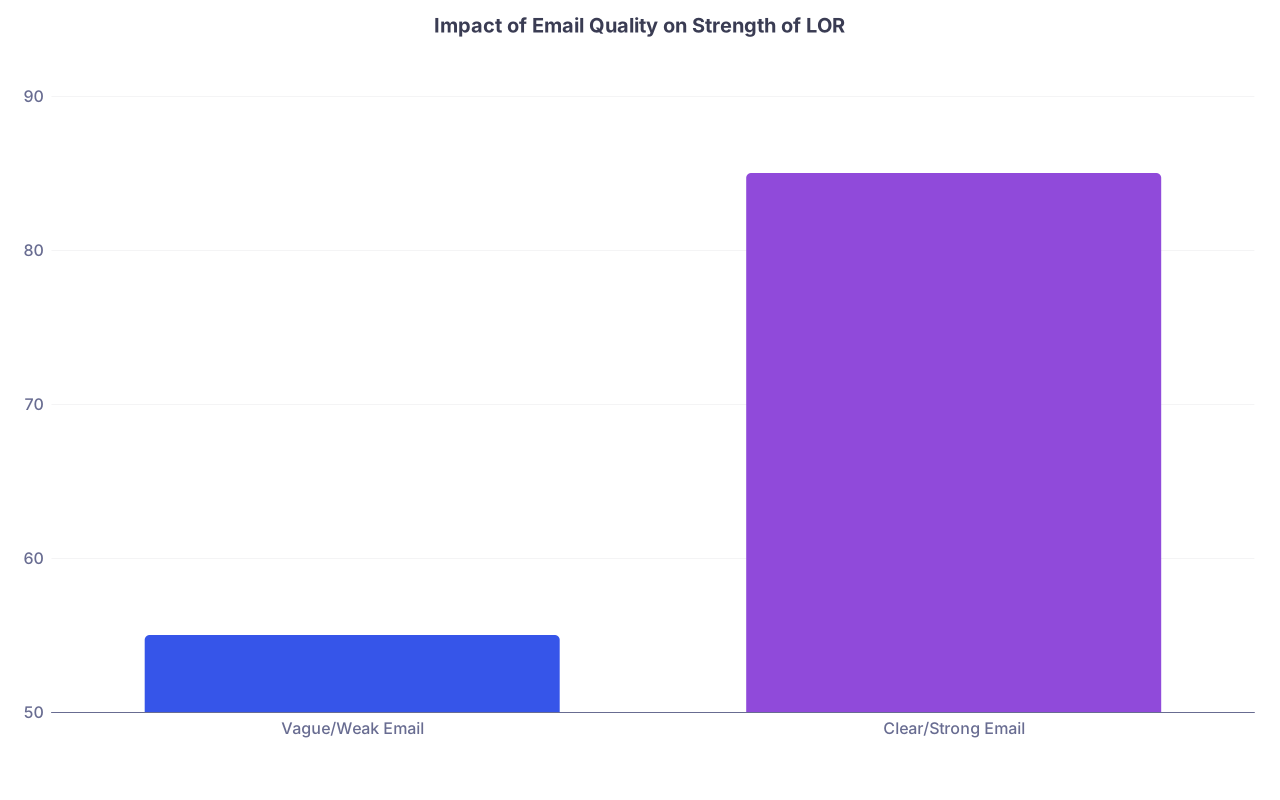
| Category | Value |
|---|---|
| Vague/Weak Email | 55 |
| Clear/Strong Email | 85 |
(Illustrative: average “perceived strength” out of 100 as rated by faculty in advising sessions—stronger emails tend to yield stronger letters.)
11. “Thanks in advance!” (and then radio silence)
“Thanks in advance” is fine if you follow it with actual gratitude and follow-through.
Common mistake:
You send a request. They say yes. You disappear until you panic three days before ERAS and send a “just checking in” nudge that sounds more like desperation than professionalism.
Here’s how you weaken your whole ask:
- No confirmation email after they agree.
- No polite reminder 1–2 weeks before the deadline.
- No thank-you note after the letter is submitted.
You want this person positively inclined toward you up to Match Day. Burning that goodwill with silence is dumb.
Better pattern:
- Right after they agree
Short reply:- “Thank you very much, I really appreciate your support.”
- 1–2 weeks before deadline (if not yet submitted)
- “Just a brief reminder that ERAS letters are due by [date]. Please let me know if you need any additional information from me.”
- After submission
- “Thank you again for writing on my behalf. I’m very grateful for your support during this process.”
No groveling. Just adult-level courtesy.

| Step | Description |
|---|---|
| Step 1 | Identify Potential Letter Writer |
| Step 2 | Draft Strong, Direct Email |
| Step 3 | Attach CV, PS, ERAS Info |
| Step 4 | Send 4-6 Weeks Before Deadline |
| Step 5 | Writer Responds Yes |
| Step 6 | Send Thank You + Confirm Details |
| Step 7 | Send Gentle Reminder 1-2 Weeks Before Deadline |
| Step 8 | Letter Submitted |
| Step 9 | Send Final Thank You |
Key things to remember
- Weak, apologetic phrases in your email invite weak, generic letters.
- Ask directly for a strong, detailed letter, and give the writer a graceful way to decline.
- Respect their time by being early, organized, and clear—and stop undermining yourself with language that makes you sound unsure you belong in this profession.