
Your letters of recommendation can quietly kill your application without you ever seeing the weapon.
That’s the nightmare, right? You hit submit on ERAS… and then spend three months wondering if one lukewarm attending just torpedoed your entire residency chances while you’re refreshing your email every 6 minutes.
Let’s be honest: the “you waive your right to see the letter” thing feels like a horror movie setup. They tell you, “Oh, it’s standard. Programs expect it.” And your brain hears: “Cool, now someone who barely knows me can bury my career in a confidential PDF.”
So let’s go straight at the fear that’s probably keeping you up:
- What if one of my LORs is actually hurting me?
- How would I even know?
- Should I replace it?
- Is it too late?
I’m going to walk through the actual red flags that a letter might be weak or damaging, what’s mostly in your head, and what you can still do about it this application cycle versus next one. No sugarcoating. But also not the doom spiral your brain is trying to drag you into.
First Reality Check: One Letter Rarely Destroys a Solid Application
Before diving into the paranoia pool, here’s the blunt truth:
A single mediocre letter almost never ruins an otherwise strong application.
I’m not saying it can’t hurt you. It absolutely can. But most of the time what wrecks people isn’t “one secretly toxic letter,” it’s:
- Across-the-board weak clinical comments
- No one really going to bat for you
- Obvious professionalism concerns that show up in multiple places
Program directors are pattern-recognizers. They’re not sitting there like, “Wow, this applicant has a 260 Step 2, honors in rotations, strong personal statement… but this one bland letter? Rejected forever.”
That’s not how it works.
What does raise their eyebrows is when letters are:
- All short
- All generic
- All lukewarm
- Or clearly trying to say, “I’d rank this person low” in polite academic language
The goal isn’t perfection. The goal is to avoid obvious landmines.
Signs Your Letter Might Be Hurting You
You can’t read the letter. But you’re not totally blind either. There are clues. And some of them are actually pretty loud if you stop trying to gaslight yourself into “it’ll probably be fine.”
Here are the big ones.
1. The Attending Clearly Didn’t Know You Well
You can still get a strong letter from someone you worked with for 2–4 weeks… if:
- They saw you consistently
- They gave you feedback
- They trusted you with real responsibility by the end
Red flag territory is more like:
- You barely worked with them on the team
- They can’t remember specific patients you took care of
- They never gave you feedback because they barely interacted with you
- You’re reaching back to someone from M3 who you saw twice, “because they’re big-name”
If your request conversation went like this:
You: “Hi Dr. X, I was on your service last year and was wondering if you’d be willing to write a letter…”
Them: “Remind me when that was again?”
That’s not automatically fatal, but your risk of getting a generic, vague, “filler” letter just shot up.
2. They Hesitated When You Asked
This is one of the biggest tells, and people ignore it all the time because they want the name or the specialty.
Typical phrases that should make you nervous:
- “I can write you a letter, but it might be more neutral than strong.”
- “I don’t know you as well as some other students, but I’m happy to provide something.”
- “I can write a letter confirming you were on my team.”
You know what programs don’t need? A letter confirming you physically existed on a team.
A strong response when you ask looks more like:
- “Yes, absolutely, you did a great job on the rotation.”
- “I’d be happy to—remind me of your CV so I can include everything.”
- “Yes, I remember you were very proactive on rounds; I can definitely speak to that.”
If your gut sank when they answered, that was data. Don’t ignore it.
3. Your Performance on That Rotation Was… Rough
Be honest with yourself here. Not catastrophizing. Just honest.
Think about that rotation:
- Were you late more than once?
- Did you get direct feedback about organization, follow-through, or professionalism?
- Did something major happen—missed labs, wrong orders, conflict with staff?
- Did they ever have to “talk to you” privately in that deadly calm attending way?
If you know that rotation was your worst performance of the year, and that attending is now carrying one of your 3–4 letters… yeah, the risk is higher.
Will every attending write a hit piece? No. Some are surprisingly kind and protective. But if they had to call the clerkship director about you, they’re not writing, “Top 10% student I’d love to have as a resident.”
4. You Didn’t Give Them Any Supporting Material
This is the quiet, boring reason letters end up generic.
If you just said, “Can you upload a letter to ERAS?” and they said “Sure,” and that was the end of the conversation, then you’ve basically handed them a blank page and said, “Good luck remembering who I am.”
You should have given them:
- Your CV
- Your personal statement (or a draft)
- A short bullet list of patients/projects where you worked closely with them
- Your specialty and why you’re going into it
If you didn’t, the letter may not be harmful, but it’s likely weak, short, and nonspecific. And in competitive fields, “harmless” letters are quietly harmful.
5. You’re Getting Fewer Interviews Than Your Stats Suggest
This one’s painful but useful.
No, you won’t know for sure if letters are the problem. But if:
- Your Step 2 and grades are solid
- You applied broadly and on time
- Your personal statement and CV are reasonably okay (no obvious disasters)
- And your interview count is way below what your peers with similar stats are getting
Then yes, letters slide higher on the suspect list.
They’re not the only reason. But they’re on the shortlist.
When You Should Seriously Consider Replacing a Letter
So, do you just nuke all your questionable letters and start over? No. That’s the panic move.
You consider replacing when:
- You have clear, believable reason to think the letter is weak or negative
- You have a realistic alternative that could be stronger
- You still have time for them to write and upload it before it actually matters
Let’s make that less vague.
Strong reasons to replace:
- The writer explicitly warned you it would be “neutral” or “not as strong as others”
- You had real, documented professionalism issues on that rotation
- You’ve since done a rotation where you absolutely crushed it and the new attending is excited to write for you
- The original writer barely knew you, and you now have someone who supervised you closely, gave you praise, and knows your strengths
Shaky reasons to replace:
- “I just have a bad feeling” but no concrete evidence
- “They weren’t very warm as a person, so they probably hate me”
- “Their emails were short, so they must dislike me”
- “My friend got fewer interviews and we think it might’ve been their letter writer, so now I’m spiraling about mine”
You don’t need perfect certainty—you're never going to get that. You just need enough rational concern plus a better option.
Timing Reality: When It’s Too Late vs Still Worth It
Here’s where the anxiety collides with the calendar.
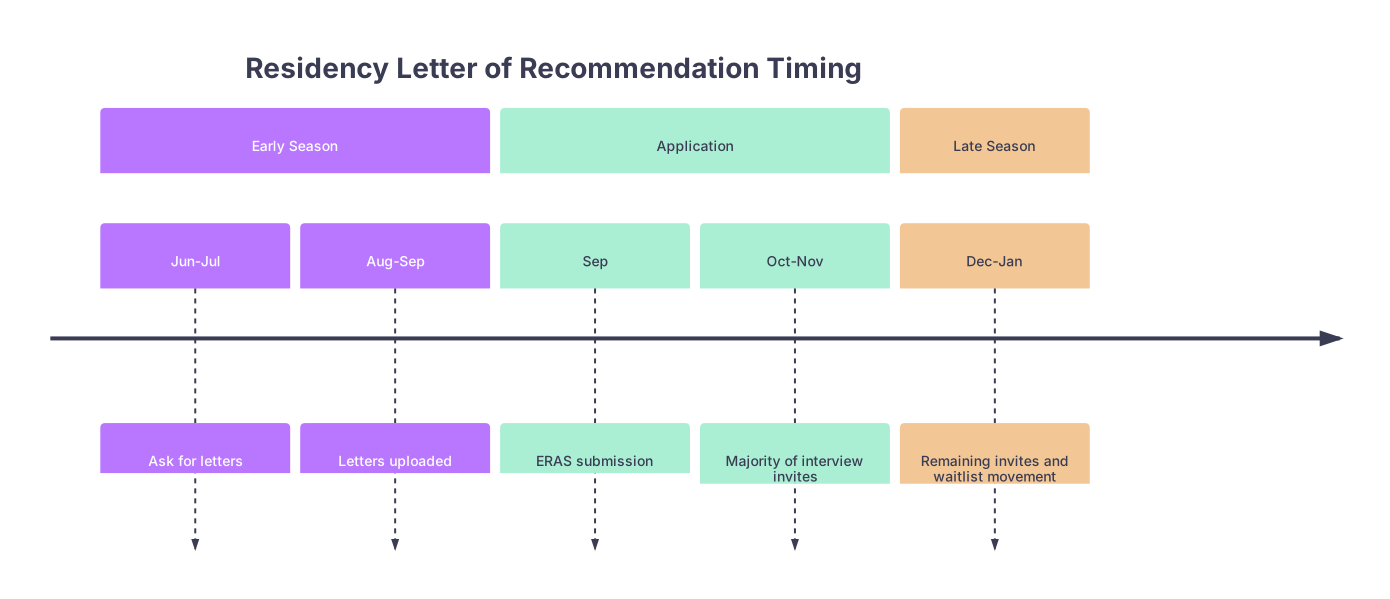
| Period | Event |
|---|---|
| Early Season - Jun-Jul | Ask for letters |
| Early Season - Aug-Sep | Letters uploaded |
| Application - Sep | ERAS submission |
| Application - Oct-Nov | Majority of interview invites |
| Late Season - Dec-Jan | Remaining invites and waitlist movement |
Roughly:
- Best time to secure letters: late spring – early fall
- Programs really digging into files: October–November
- After most interview invites go out: the marginal impact of updating letters drops
Can you still replace a letter after you’ve submitted ERAS? Yes.
But:
- Programs won’t be notified you updated unless they go back into your file
- Some will, some won’t
- For programs that haven’t looked at your file yet, it can still help
If it’s early in the season (September/early October):
Replacing a questionable letter with a clearly better one is usually worth it.
If it’s late in the season (December/January):
Focus your energy on interviewing well and considering a parallel plan rather than desperately swapping letters. The horse has mostly left the barn.
How to Replace a Letter Without Burning Bridges
This is the part people overcomplicate. You’re not sending a breakup text.
ERAS lets you:
- Assign different letters to different programs
- Stop using a specific letter for new program assignments
- Add new letters as they’re uploaded
Realistically, your options:
Quietly stop assigning the risky letter
- Don’t remove it from ERAS entirely; just stop clicking it for future programs
- For programs that already received it, you’re stuck, but for new ones, you control things
Add a new, stronger letter and prioritize it
- If you had 4 letters and 1 was weak, you can still add another and choose which 3–4 each program sees
- Some programs only allow 3 letters—so pick your best 3
You do not email the original letter writer saying, “I’m replacing your letter because I think it might hurt me.” That’s how you manufacture drama where there was none.
How to Actually Ask: “Can You Write a Strong Letter?”
If you’re still in the asking stage (or asking for a replacement), you need to stop tiptoeing.
You should be saying something like:
“Dr. Smith, I really enjoyed working with you on the cardiology rotation. I’m applying to internal medicine, and I was wondering if you’d feel comfortable writing me a strong letter of recommendation.”
If they reply with:
- “Yes, I’d be happy to write you a strong letter.” → Good.
- “I can write you a letter, but I’m not sure how strong I can make it.” → That’s a pass. You thank them and do not assign that letter.
If you’re circling back for a new letter to replace a suspect one, frame it around your growth:
“I’ve grown a lot clinically since my rotation with you, and I felt like I worked closely with you and your team. I was wondering if you’d feel comfortable writing a strong letter to support my application to [specialty].”
You’re not required to confess, “I think another letter might be bad.” You’re just upgrading your file.
What Programs Actually Hate in a Letter
You want to know the worst-case scenarios? Here they are. The stuff that really makes PDs raise an eyebrow.
| Letter Type | Typical Impact |
|---|---|
| Strong, specific | Helps, can offset minor weaknesses |
| Generic, short | Neutral to mildly negative |
| Clearly lukewarm | Hurts, especially in competitive fields |
| Backhanded compliments | Serious red flag |
| Explicit concerns | Major red flag |
Backhanded compliments
- “With continued supervision, I’m confident they’ll be able to function as an intern.”
- Translation: I would not trust them unsupervised.
Damning comparisons
- “Not among the top students I’ve worked with this year, but clearly dedicated.”
- In a stack of hundreds, that’s brutal.
Professionalism concerns
- “There were occasional issues with timeliness/communication, but they were receptive to feedback.”
- Programs are already short on patience. They don’t want projects.
Vague, one-paragraph letters
- “X was a student on my service. They were polite and punctual. I wish them the best in their future pursuits.”
- That’s basically a “no comment,” which reads like a quiet “no.”
You can’t control all of this retroactively, but you can avoid choosing writers who:
- Barely interacted with you
- Already had concerns about you
- Gave you clearly mixed or negative feedback during the rotation
What To Do If You’re Already Submitted and Panicking
Let’s say the worst: You submitted weeks ago. You’re staring at your letter writers list and convinced one of them just sabotaged you.
Here’s how I’d triage that anxiety.
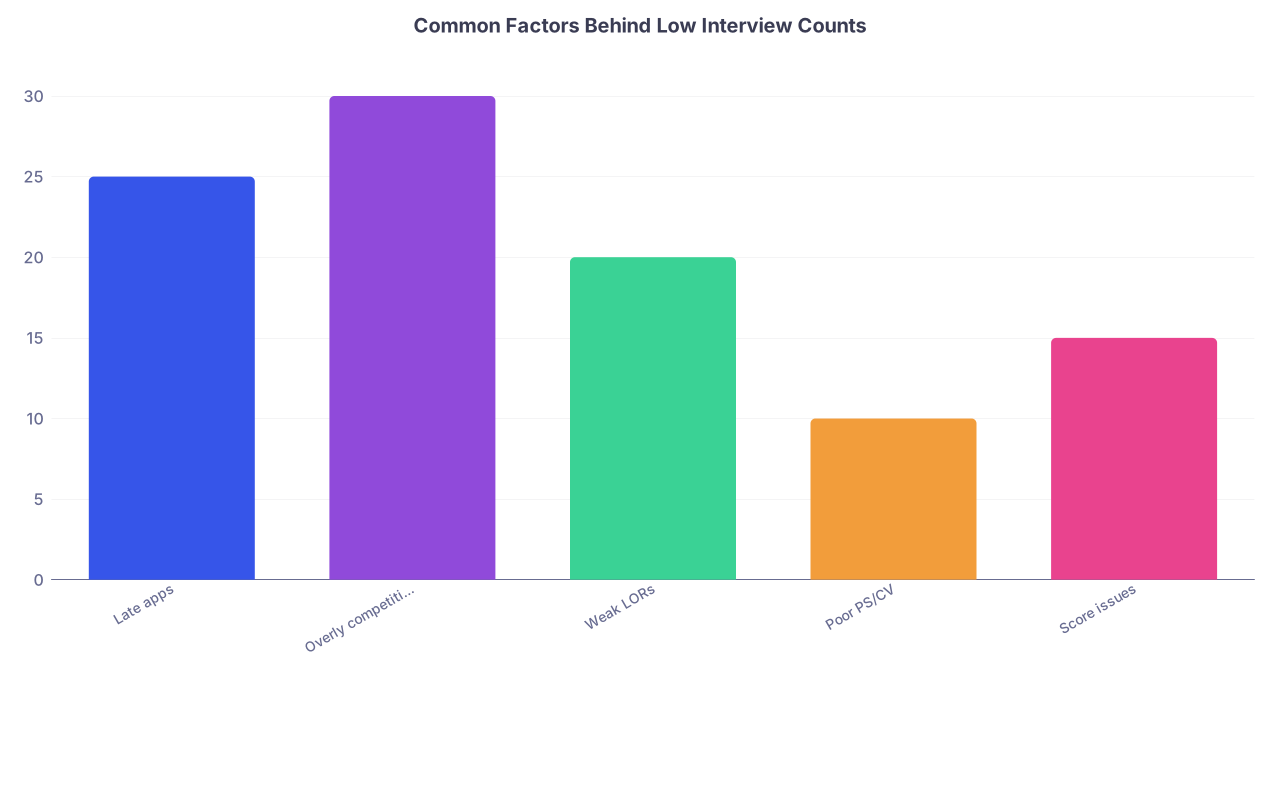
| Category | Value |
|---|---|
| Late apps | 25 |
| Overly competitive list | 30 |
| Weak LORs | 20 |
| Poor PS/CV | 10 |
| Score issues | 15 |
Be honest about all risk factors
Are you sure it’s the letter? Or is it:- Late application?
- Very competitive specialty?
- Geographic restrictions?
- No home program?
If it’s still early:
- Identify your strongest rotation this year
- Ask that attending for a strong letter now
- Once uploaded, prioritize assigning that letter moving forward
If it’s late in the game:
- Focus on crushing the interviews you do have
- Start thinking about a reapplication strategy that includes working with attendings who will advocate for you next time
- Or consider a backup specialty that fits your profile better
The scariest part is feeling completely powerless. You’re not. You just don’t control everything anymore this cycle.
How to Protect Yourself for Future Letters
Because this isn’t just about this season. You’re going to need letters for:
- Fellowships
- Jobs
- Future training positions
So start building better habits now.
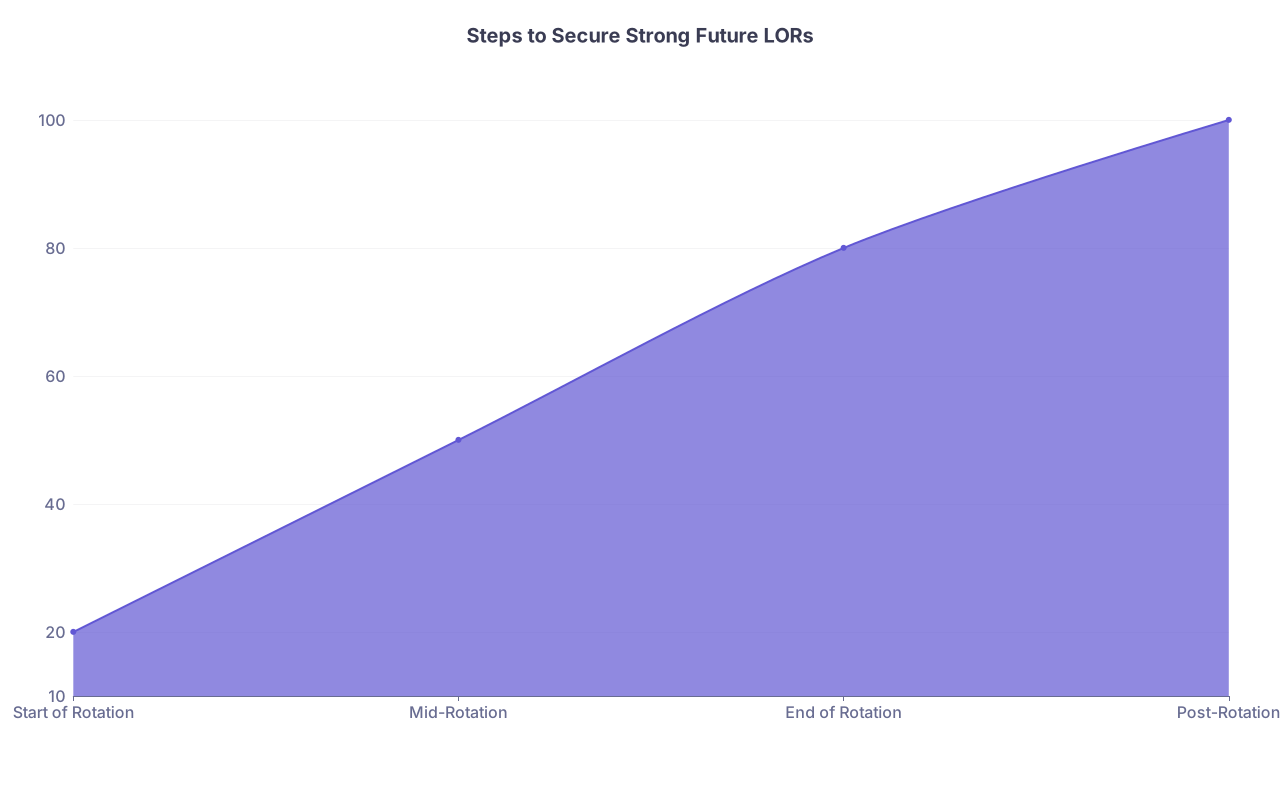
| Category | Value |
|---|---|
| Start of Rotation | 20 |
| Mid-Rotation | 50 |
| End of Rotation | 80 |
| Post-Rotation | 100 |
Concrete moves:
- Ask attendings early, “What can I do on this rotation to earn a strong letter from you?”
- Ask for mid-rotation feedback and actually fix what they mention
- Keep a running list of attendings who praised you specifically, not generically
- Right after a strong eval, say: “Would you feel comfortable writing me a strong letter in the future?”
You want people who light up when they talk about you as a learner. Not people who squint trying to remember your name.
FAQ: Letters of Recommendation Panic Edition
1. If one letter is bad, am I definitely not matching?
No. One bad or mediocre letter can hurt, especially in small programs or competitive specialties, but it’s rarely the sole reason someone doesn’t match. Programs look at your whole application: scores, grades, personal statement, interviews, and patterns across letters. A single outlier isn’t great, but consistent mediocrity across all letters is much more damaging than one possible weak link.
2. Should I ever ask a writer directly if their letter was strong?
Not after it’s written. Before they write, you should ask: “Would you feel comfortable writing me a strong letter?” If they hesitate, that’s your answer. But once the letter is uploaded, it’s awkward and pointless to ask. They may not even remember exactly what they wrote, and they’re unlikely to say, “Oh yeah, it was bad.” Focus forward instead of relitigating what’s already in ERAS.
3. Is a shorter letter automatically a bad letter?
No, but it’s suspicious. Many program directors have said they worry when a letter is extremely short and generic, because it suggests the writer didn’t know the applicant well or didn’t care enough to put in effort. A one-page, specific, example-filled letter is better than a half-page of vague compliments. But there are attendings who just write short, strong letters as their style. You can’t judge length alone—only risk.
4. Is it better to have a letter from a big-name person who barely knows me, or a mid-level person who loved working with me?
Take the person who loved working with you. Every time. PDs would much rather see a detailed, enthusiastic letter from an associate program director, hospitalist, or core faculty who clearly knows you than a vague, name-droppy letter from some famous researcher who calls you “this student” and talks mostly about themselves. Big names don’t save bad content.
5. What’s one concrete thing I can do today if I’m worried about my letters?
Make a list of your rotations in the last year and next to each, write: “Strong letter,” “Neutral,” or “Don’t know.” Then pick one attending from the “Strong” category (or your best guess) and email them today asking if they’d feel comfortable writing you a strong letter—attach your CV and personal statement. That’s it. One email. One potential upgrade to your file.
Open your ERAS letter assignments page today and look at each writer’s name. For each one, ask yourself: “Do I have real reason to believe they’d advocate for me strongly?” If the answer is anything less than a cautious yes, decide now whether you’re going to replace them, supplement them, or accept the risk and shift your energy to the rest of your application.