
The most stressful part of letters of recommendation isn’t chasing them. It’s being asked to write your own.
Wait… Is This Even Allowed?
Let me rip off the band‑aid: yes, this happens all the time. No, you’re not the only one. And no, it does not automatically doom your application or make the letter fake or unethical.
Programs aren’t naïve. They know a solid percentage of attending-written LORs were actually “drafted” by the student and then edited, rephrased, and signed by the faculty. It’s an open secret.
But your brain probably went where mine does:
- “Is this dishonest?”
- “What if I sound too braggy and they think I wrote it?”
- “What if I write it badly and ruin my own chances?”
- “What if this means my letter writer doesn’t care about me and it’ll be obvious?”
You’re not wrong to worry about all of that. But you’re also not stuck.
Here’s the reality: the ethics and the quality hinge on what you do next.
What Your Attending Is Really Saying When They Ask You To Draft It
They’re not confessing laziness (well, sometimes they are, but that’s not the whole story). Most of the time, it means some combination of:
- They’re overloaded and don’t have time to stare at a blank document.
- They don’t remember every case you were on, and they want you to remind them.
- They want to be supportive but need a starting framework.
- They assume you “know what programs want” more than they do.
It doesn’t mean:
- “I don’t actually support you.”
- “I’ll just rubber‑stamp whatever nonsense you write.”
- “I want to trick programs.”
I’ve watched attendings say this almost word-for-word: “Draft something with your rotations and strengths; I’ll heavily edit it.” And they do. They change adjectives, add specific cases, sometimes rewrite whole paragraphs.
So no, you’re not forging anything. You’re giving them clay so they can sculpt.
The real dangers are different:
- You write something generic and bland.
- You over‑inflate yourself and it sounds fake.
- You accidentally contradict your own ERAS materials.
- You make it impossible for them to personalize because you never gave them specifics.
Those are fixable problems. Let’s fix them.
Step One: Clarify The Ground Rules (Without Sounding Awkward)
You’re allowed to ask for direction. In fact, you should. It protects you.
Here’s an email you can basically copy‑paste:
Dear Dr. [Name],
Thank you again for agreeing to write a letter on my behalf. I’m happy to put together a draft to help get things started.
Would you prefer that I:
– Focus mainly on specific clinical examples/encounters I had with you, and
– Highlight particular qualities (e.g., work ethic, team communication, clinical reasoning) that you’ve observed?Also, do you have a preferred length or format you like to use for residency letters?
I really appreciate your support and will send you a draft by [date].
Best,
[Your Name]
Why this is smart:
- You push them toward specific observations they actually saw.
- You subtly remind them they’re supposed to be the one vouching, not you inventing.
- You create a deadline so this doesn’t drag on forever.
If they respond with, “Write what you think is best,” okay. Annoying, but now at least you tried. You’ve covered yourself on the ethics side.

| Step | Description |
|---|---|
| Step 1 | Asked to draft LOR |
| Step 2 | Clarify expectations by email |
| Step 3 | Collect rotations & examples |
| Step 4 | Outline letter structure |
| Step 5 | Write balanced draft |
| Step 6 | Cross-check with ERAS materials |
| Step 7 | Send draft with thanks & flexibility |
Step Two: Gather Ammo So You Don’t Just Make Stuff Up
This is where most people freeze: “I don’t know what to say about myself.”
Fine. Treat it like charting. You’re not inventing data; you’re documenting.
Make a quick list (literally on a scratch document) of:
- Which rotation/block you worked with them and dates.
- Typical hours / call shifts you did with them (ballpark, not exact).
- 3–5 specific patient encounters where:
- You took real ownership.
- You followed up on results.
- You advocated for the patient.
- You presented well on rounds.
- Any feedback they gave you:
- “You’re very thorough with your notes.”
- “You did a really nice job with that family.”
- “You’ve grown a lot in your differential building.”
Also pull your personal statement and ERAS CV up on screen. You want alignment. Not copy‑paste, but the same story.
Your nightmare scenario of “what if letters and ERAS contradict each other” becomes much less likely if you literally look at them side‑by‑side.
Step Three: Use A Structure So You Don’t Ramble Or Write A Novel
Most decent residency LORs have roughly the same skeleton. Use it. This keeps you from overthinking every sentence.
Here’s a simple, safe structure:
Opening paragraph
- Who the writer is (title, department).
- How they know you (role, rotation, time frame).
- Clear statement of support (“strongly recommend”).
Clinical performance paragraph
- Clinical reasoning.
- Work ethic, reliability.
- Ability to work in a team.
- Concrete examples.
Personal qualities paragraph
- Communication, professionalism.
- How you handle feedback.
- Growth over the rotation.
Fit for specialty / future potential
- Why you’ll be a good [specialty] resident.
- How you compare to peers (if they’re willing).
Closing
- Reaffirm recommendation.
- Contact info.
You’re not reinventing the genre. This is genre-writing. Like a good H&P, there’s a standard format for a reason.
| Section | Purpose |
|---|---|
| Intro | Context & strength of support |
| Clinical Skills | Describe performance & examples |
| Personal Traits | Character & professionalism |
| Specialty Fit | Match to field & peers |
| Closing | Final recommendation & contact |
Step Four: What Do You Actually Say About Yourself?
Here’s the anxiety: “If I praise myself, it’s braggy. If I don’t, it’s weak.”
The trick is to sound like an attending, not an applicant. That means:
- Use measured language.
- Anchor compliments to behaviors.
- Avoid over-the-top fluff like “best student of my career” unless they actually said that.
Examples of safe, realistic lines:
- “[Name] consistently arrived prepared for rounds, having thoroughly reviewed patient charts and anticipated next steps in management.”
- “On our inpatient service, [Name] quickly became a reliable member of the team, often staying late to ensure tasks were completed.”
- “Compared to other students at their level, [Name] demonstrates above-average clinical reasoning and an eagerness to seek feedback.”
If you feel yourself typing, “exceptional,” “outstanding,” “the best I’ve ever worked with” — stop. Ask: did they ever actually hint at that? If not, tone it down.
What you want: “solid to strong, believable, specific.” Not “Nobel candidate.”
Step Five: Add Specific Cases So It Doesn’t Sound Template-Generated
This is where your letter can go from “generic and forgettable” to “actually helpful” — without you inventing anything.
Pick 1–3 concrete examples:
- A complex admission you presented and followed closely.
- A family meeting where you communicated clearly.
- A time you caught a medication error or followed through on abnormal labs.
Write it like this:
“During our cardiology rotation, [Name] took primary responsibility for a patient admitted with decompensated heart failure. They independently gathered a thorough history, presented a focused assessment, and followed the patient over several days, adjusting the differential as new data emerged. They consistently updated the team and demonstrated growing understanding of heart failure management.”
Notice what this does:
- It anchors your abilities in real scenarios.
- It doesn’t sound like AI mush (“X is a hardworking, compassionate student…” repeated 5 times).
- It gives the attending something to tweak instead of invent.
Worst-case scenario fear: “What if I describe a case wrong and they’re annoyed?”
Answer: you’re sending a draft. They can delete anything that doesn’t feel right. That’s their responsibility as the signer.
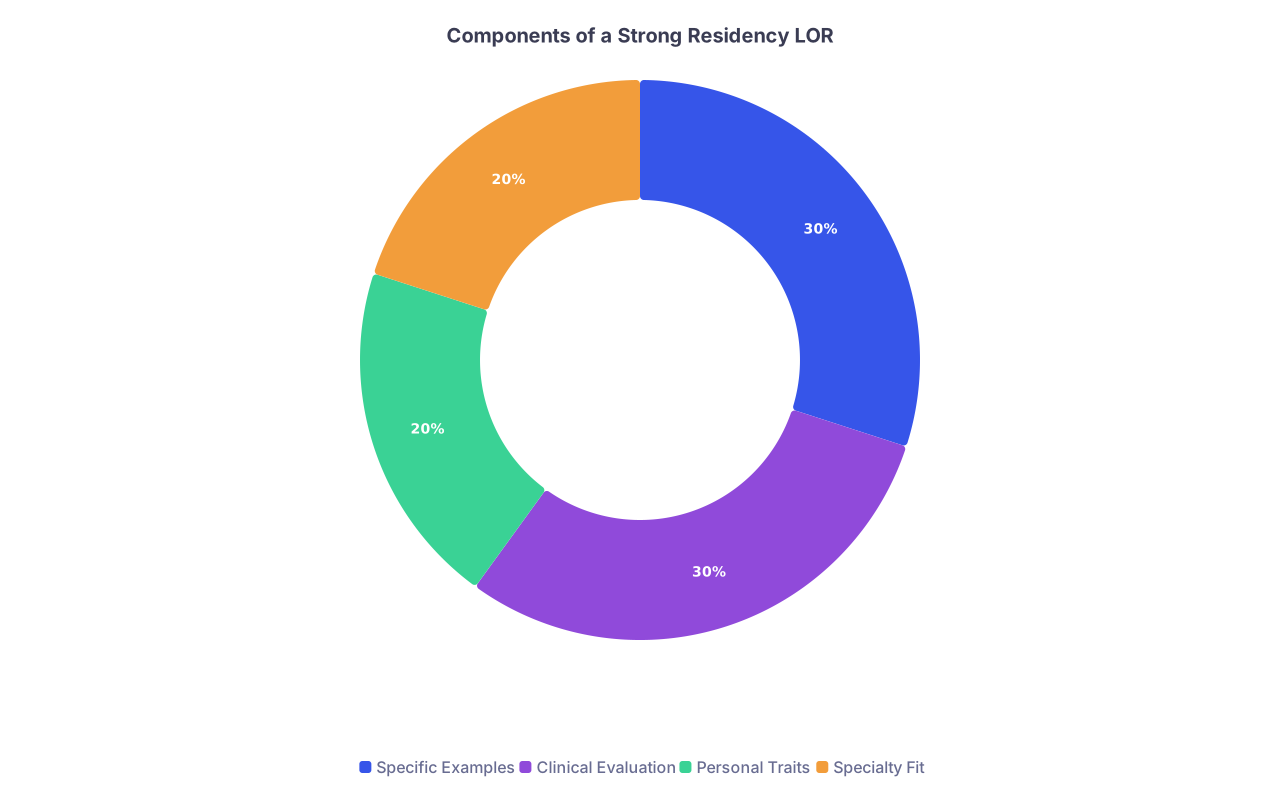
| Category | Value |
|---|---|
| Specific Examples | 30 |
| Clinical Evaluation | 30 |
| Personal Traits | 20 |
| Specialty Fit | 20 |
Step Six: Don’t Accidentally Undercut Yourself
There are subtle ways you can hurt your application without realizing it. Watch for these traps:
Backhanded compliments
- “Although [Name] was initially quiet, they improved over time.”
- “Despite limited experience, they did adequately.”
Just… don’t. Don’t put yourself down in your own letter. If they truly felt that, they can add it. You don’t volunteer it.
Over-explaining weaknesses
You don’t need a “but” after every strength.- Not: “They work hard, but sometimes they can get overwhelmed.”
- Just: “They work hard and show resilience during busy days.”
Contradictions with your ERAS story
If your personal statement plays up leadership and teamwork, don’t write a letter that only talks about you as a solo workhorse who stays late in silence. Make sure it’s the same person.Sounding like you wrote it as a student
Avoid casual language:- No: “Honestly, they’re great and super nice to patients.”
- Yes: “They consistently treated patients and staff with respect, even during high-stress situations.”
If a sentence feels like something you would say to a friend, rephrase it into something a mid-career attending would say to a program director.

Step Seven: The Email That Sends It All Off (Without Sounding Desperate)
Another anxiety point: “How do I send this without sounding like I’m telling them what to say?”
Use something like this:
Dear Dr. [Name],
Attached is a draft letter that summarizes my time on your [service/rotation] and highlights some of the qualities I believe you’ve observed in me. Please feel free to modify, add, or remove anything so it accurately reflects your perspective and comfort level.
Thank you again for supporting my application to [Specialty]. I’m very grateful for your time and help.
Best regards,
[Your Name]
AAMC ID: [XXXXXXX]
You’re:
- Signaling you expect them to edit.
- Respecting their authority as the actual author.
- Making it easy for them to sign and upload without extra back‑and‑forth.
Do they always heavily edit? No. Some barely touch it. That’s their choice and their name. Not yours.
But Is This Ethical? The Part Your Brain Won’t Let Go
Here’s my blunt take:
If you:
- Stick to things they actually saw or could reasonably infer.
- Give them every opportunity to edit or reject the draft.
- Don’t fabricate rankings like “top 1% of students in my career” out of thin air.
Then you’re on solid ethical ground.
The unethical stuff is:
- Ghostwriting a letter and pushing someone who barely knows you to sign it.
- Stuffing it with false claims or invented roles.
- Pretending it was written independently when you strong‑armed them.
Asking, “Would you be comfortable signing something along these lines?” in person or via email is a good gut-check line. If they say yes, that’s on them.
Residency programs are not sitting there running forensics on every adjective. They care: is this consistent, believable, and supportive? That’s it.
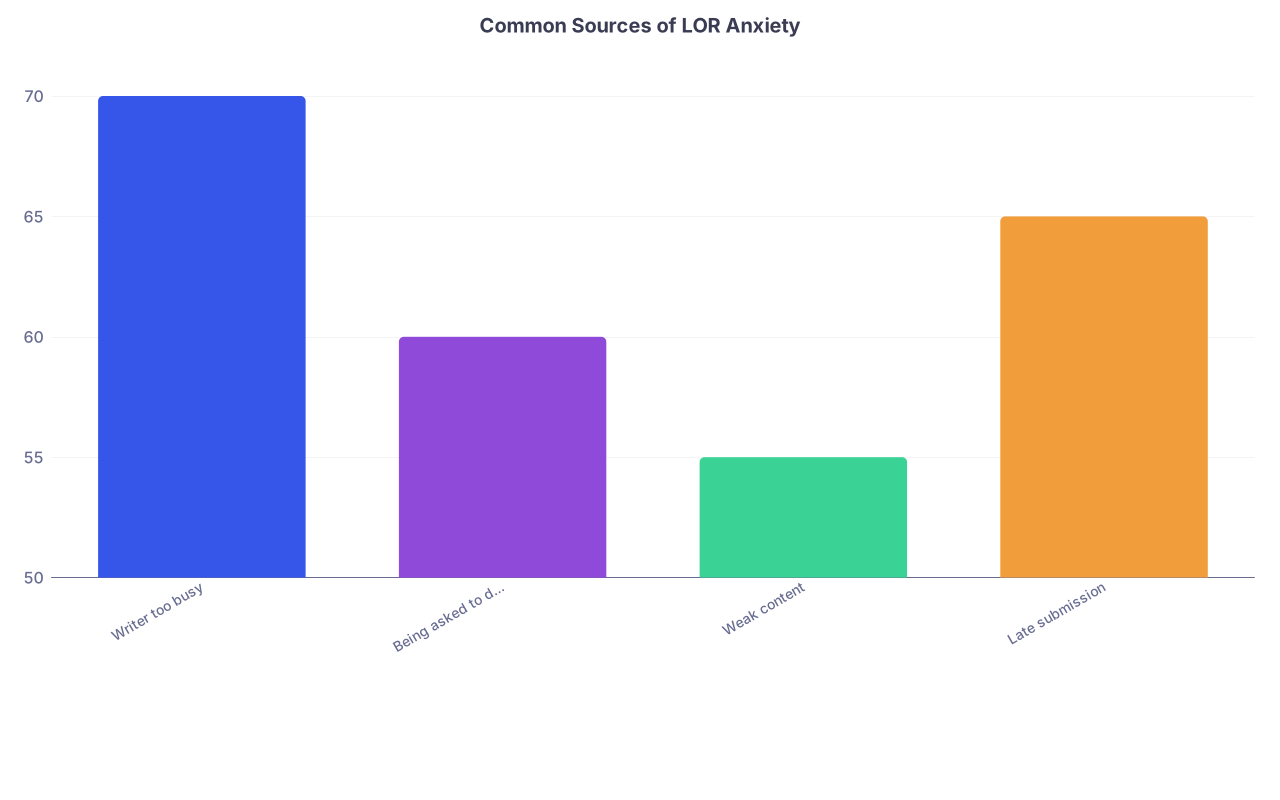
| Category | Value |
|---|---|
| Writer too busy | 70 |
| Being asked to draft | 60 |
| Weak content | 55 |
| Late submission | 65 |
Micro‑Checklist Before You Hit Send
Very fast mental checklist:
Does the letter:
- Clearly state who they are and how they know you?
- Use realistic, measured language (not over-the-top superlatives)?
- Include at least 1–2 specific examples?
- Align with your personal statement and ERAS?
- Avoid obvious student-y phrases?
And equally important:
- Does it sound like something this specific attending might say?
If you can say “yes” to those, you’re fine. Really.

FAQ (Exactly 5 Questions)
1. Will programs be able to tell I drafted my own letter?
Not unless you make it obvious. If the tone matches what an attending in that specialty would normally write, and it’s not wildly different from your other letters, they’re not going to single it out. Remember, committees read hundreds of these. They’re looking for clear red flags, not trying to guess authorship.
2. What if my attending doesn’t change a single word and just uploads it as-is?
Then they are taking responsibility for that choice. You gave them a draft, clearly invited edits, and they signed it. Ethically, that’s on them. Practically, as long as the content is solid, you’re okay. The real risk is if you wrote something exaggerated or fake — that’s why you keep it honest and moderate.
3. My attending barely knows me and still asked me to draft it. Should I even use this letter?
If they truly barely know you, that’s more concerning than the “please draft it” part. In that case, make the letter very factual and neutral, and consider whether you can get a stronger, more personal letter from someone else. You don’t need four weak letters; three strong ones beat that every time.
4. Can I reuse the same draft for multiple attendings?
Not as-is. That’s how you end up with transparently generic letters. You can reuse structure and some phrasing, but the cases, rotations, and details should fit that attending. If they supervised you in clinic vs wards vs OR, the examples need to reflect that specific context.
5. What if I already submitted a very basic, generic draft — is it too late?
No. You can still send a follow‑up email with “extra context” or an updated version if they haven’t submitted yet: “I realized I didn’t include specific examples from my time on your service, so I’ve attached a revised draft that may be more helpful.” Worst case, they use the original. That’s not fatal. It just means that letter won’t be a major asset — but it won’t single‑handedly sink you either.
Years from now, you’re not going to remember sweating over every adjective in this letter draft. You’re going to remember the patients you took care of and the co-residents who had your back — and this will just be one more awkward, survivable step that got you there.