

You are here
You just got the email.
“Spot opened for August. Can you start Monday?”
It is a last‑minute away rotation at a big‑name place. The kind of institution that actually moves the needle for residency. You scramble to book flights, figure out housing, and get your vaccines and forms in.
Then the next thought hits:
“I need a strong letter of recommendation out of this. And I have 4 weeks. Maybe less.”
You are not walking in with months to build a reputation. You might not even be on the service with the “letter writer” you had hoped for. You cannot change the timing. You cannot slow down the pace. But you can absolutely run a deliberate playbook to maximize your odds of a high‑impact LOR from this away.
This is that playbook.
Step 1: Pick the Right Target (Day 0–2)
You do not get a letter “from the department.” You get a letter from a human being who:
- Actually worked with you
- Actually remembers you
- Actually writes strong letters
So the first fix: identify the right human.
1.1: Rapid attending/recommender scouting
During your first 1–2 days:
- Ask senior residents quietly:
- “Who on this service writes strong letters for applicants?”
- “If you were applying here, whose letter would you want?”
- Watch behaviors:
- Which attendings actively teach instead of disappearing?
- Who gives specific feedback (not just “good job”)?
- Who interacts with students more than 30 seconds per day?
You want someone who:
- Sees you frequently (not just one rounding day per week)
- Engages with your work (clinic, consults, notes, presentations)
- Has a recognizable name or role (PD, APD, division chief, or respected clinician-educator)
If you have to choose between:
- Famous but barely sees you
vs. - Less famous but works closely with you every day
Pick the second. A detailed, specific letter from a mid‑level faculty beats a generic letter from a famous stranger every single time.

1.2: Decide your primary and backup letter writers early
By the end of Week 1, you should have:
- 1 primary target: the person you most want a letter from
- 1 backup: another attending or possibly a fellow who knows you well and whose letter would still matter
Write these names down. Your behavior for the rest of the rotation is now optimized around making these two people see your best work.
Step 2: Front‑Load Your Performance (First 7–10 Days)
On a short away, “I had a slow start but finished strong” is useless. Evaluations and impressions get formed absurdly early. People mentally decide “strong student vs. average student” in the first 3–4 days, then everything else just confirms or slightly adjusts that.
You need to hit the ground sprinting.
2.1: Master the unspoken expectations fast
First 48 hours, your job is to figure out:
- What time do residents actually show up?
- Who prerounds? On how many patients?
- What does a “good” note look like here?
- How are presentations structured? SOAP vs. problem-based? Bullet vs. narrative?
The script that works:
“I know every service does things a bit differently. Can you walk me through what a really solid student looks like on this rotation? Notes, presentations, and how many patients you like us to carry?”
Ask a senior resident. Not the attending. Residents know the real rules.
Then you mirror those expectations aggressively.
2.2: Build your reputation in 3 concrete domains
You do not need to be perfect everywhere. But for letters, three domains reliably get noticed:
Preparedness
- You know your patients well (labs, imaging, meds without looking every 2 seconds)
- You pre‑read common conditions for your service (CHF, cirrhosis, COPD, etc.)
- You anticipate questions (“I checked his last echo—EF 35%. Started GDMT.”)
Work ethic and ownership
- You volunteer: “I can call the family with the update.” “I will track that lab.”
- Your follow‑through is flawless. If you say you will do something, it is done.
- You stay until the team is done, not when “student hours” end.
Team skill / no drama
- You help interns and juniors with scut without complaining.
- You do not gossip about other students or residents. Ever.
- You ask, “Anything else I can help with before I head out?” at the end of the day.
Attending letters are filled with these phrases. “Hard‑working,” “reliable,” “team player,” “prepared.” You are deliberately feeding them those adjectives.
Step 3: Make Yourself Easy to Evaluate (Weeks 1–3)
Letters are not written from vague impressions; they are written from concrete moments. Your job is to create those moments and make them easy to recall.
3.1: Engineer “showcase” moments
You need 2–3 specific, memorable things your attending can later describe. For example:
A short, sharp teaching presentation
- “Could I give a 5‑minute review on hepatorenal syndrome tomorrow before rounds?”
- Make it: brief, organized, clinically relevant, with one or two primary literature callouts at most.
A well‑done admission or consult
- Ask to do the full H&P on a new admission.
- Present it cleanly.
- Have a clear problem list and a basic management plan, even if rough.
A follow‑through moment
- You catch a med error and fix it.
- You coordinate with PT/OT or social work to remove a barrier to discharge.
- You update a worried family in a compassionate, clear way.
When those happen, attendings remember you as “the student who did X” instead of “one of the students on that service.”
3.2: Ask for early, targeted feedback
Middle of Week 2, you ask your primary target:
“Dr. Lee, I am really trying to get the most out of this month and improve rapidly. Could I get 2–3 minutes of feedback on how I am doing and what I should focus on for the rest of the rotation?”
You are listening for:
Are they positive and specific?
“Your presentations are strong, you take good ownership, just tighten up your assessments” → good sign for a letter.Or are they vague and lukewarm?
“You are doing fine, keep reading” → might not be your best letter writer.
If feedback is lukewarm, you still improve. But mentally, you start grooming your backup as well.
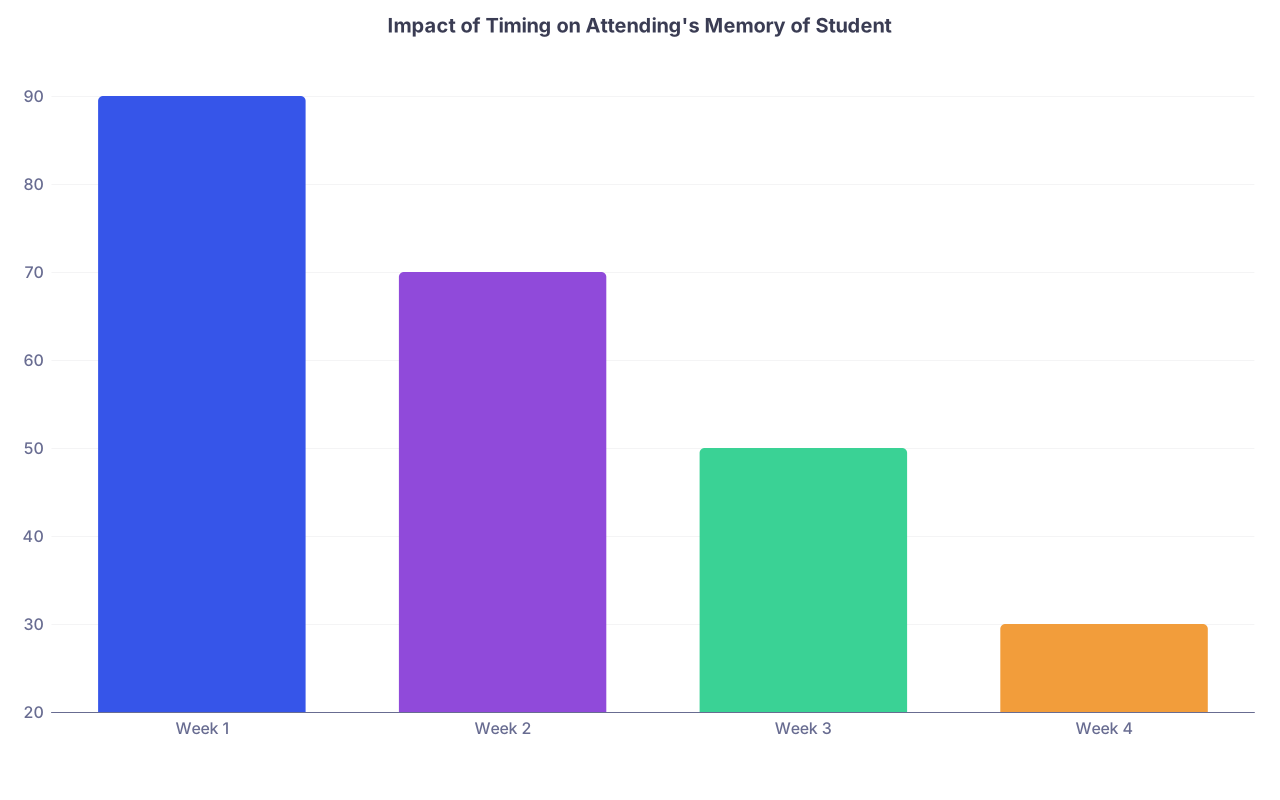
| Category | Value |
|---|---|
| Week 1 | 90 |
| Week 2 | 70 |
| Week 3 | 50 |
| Week 4 | 30 |
(That is how attending memory really works: the earlier and more frequently they see peak performance, the more it sticks.)
3.3: Make your strengths visible to the right person
Too many students impress residents but stay invisible to attendings. That is death for letters.
Fix it:
- Pre‑round with residents, but present to attendings like you own those patients.
- When you do extra work (call a family, coordinate discharge), give a one‑line mention on rounds:
- “I spoke with his daughter yesterday evening; she understands the plan and is on board with rehab.”
- When you give a teaching talk, make sure the attending is actually there.
You are not bragging. You are making sure your attending sees what you actually contribute.
Step 4: Timing and Tactics for Asking for the LOR
Now the delicate part. You have maybe 3–4 weeks. You need to ask at the right time, in the right way, with the right materials.
4.1: When to ask
Optimal window: Last 3–5 days of the rotation, after they have seen your best work, but before they mentally move on.
You do not wait until months later. People forget. Details fade. Letters get generic.
If it is truly a 2‑week away (neuro, EM, some subspecialties), you ask late in Week 2. Same logic.
4.2: How to ask (exact script)
In person is best. After rounds or clinic, when things are calmer:
“Dr. Patel, I have really appreciated working with you this month and have learned a lot from your feedback. I am applying into internal medicine this cycle and was wondering if you would feel comfortable writing a strong letter of recommendation for my residency applications?”
The key words: “strong letter of recommendation.” That gives them permission to say no honestly if they cannot.
If they pause or hesitate strongly, that is a soft no. You thank them and pivot to your backup. Do not try to rescue it.
If they say yes, you immediately follow with:
“Thank you very much. I can email you my CV, personal statement draft, and a short summary of my work this month to make things easier. Is there anything specific you would like me to send?”
Then you send it that same day.
Step 5: Build the LOR Packet That Makes Their Job Easy
You are going to pre‑package your rotation story so the letter basically writes itself.
5.1: Your LOR packet components
Email subject line example:
Subject: LOR materials – [Your Name], Sub‑I in [Service], [Month Year]
Contents:
- Short, structured email body
- CV (PDF)
- Personal statement draft (PDF or Word)
- Rotation summary / “brag sheet” (1 page max)
5.1.1: Example email body
Dear Dr. Patel,
Thank you again for agreeing to write a strong letter of recommendation on my behalf. I truly appreciated the chance to work with you on the inpatient cardiology service this August.
I have attached:
– My current CV
– A working draft of my personal statement
– A one‑page summary of my work on this rotation and a few goals for residencyERAS opens for letter uploads on [date], and my target for having letters completed is [earlier date] if possible. My AAMC ID is [ID].
Please let me know if there is any additional information that would be helpful.
Sincerely,
[Full Name]
[Medical School], MS4
[Phone] | [Email]
Clean. Respectful. Easy.
5.1.2: Rotation summary / brag sheet structure
Keep it to 1 page. Bulleted. Concrete. Something like:
- Rotation: Inpatient Cardiology, [Institution], [Dates]
- Role: Acting intern carrying 3–5 patients daily
- Clinical responsibilities:
- Pre‑rounded and presented on 3–5 patients per day
- Wrote daily progress notes and discharge summaries (when permitted)
- Completed [X] new admission H&Ps and presented management plans
- Specific contributions:
- Delivered a 7‑minute teaching talk on management of acute decompensated heart failure (Aug 12)
- Coordinated with case management and PT/OT to arrange safe discharge for a patient with advanced heart failure and mobility limitations
- Identified and helped correct a medication dosing discrepancy on a patient’s anticoagulation
- Strengths I am working to highlight in my application:
- Ownership of patient care and follow‑through
- Strong communication with patients and families
- Interest in [subspecialty/research area] and academic medicine
You are not making things up. You are curating what you actually did into a format that reminds them: “Oh right, this student actually carried weight.”

5.2: Institutional requirements and logistics
Some programs or schools have:
- Online request systems for LORs
- Forms the recommender must sign
- Deadlines for “home institution” letters
Before you ask for letters, you:
- Check your school’s LOR policy and portals.
- Confirm the exact ERAS/AAMC ID and how your recommender will upload (ERAS portal or institution portal).
- Include any required forms as attachments.
You remove friction. The easier you make it, the more likely the letter gets done on time and with care.
Step 6: If You Have Only 2 Weeks (or Less)
Sometimes a last‑minute rotation is not a full month. EM, some electives, or schedule chaos leaves you with 10–14 days.
It is still salvageable, but you need an even tighter playbook.
6.1: Compress the timeline
Reality for a 2‑week away:
- Day 1–2: Learn the system + identify potential letter writer
- Day 3–4: Deliver your first “showcase” moment (strong presentation, good admission)
- Day 5–7: Ask for early feedback; course‑correct
- Day 8–10: Second “showcase” moment
- Day 11–13: Ask for the letter
You cannot have a slow warm‑up. You walk in acting like an acting intern who knows what an away means.
6.2: Use the service structure to your advantage
In EM or consult‑heavy rotations:
- You might see many patients, but briefly.
- Attending contact can be fragmented.
Fixes:
- Stick with one attending for as many shifts as possible if schedules allow (trade shifts with another student if needed, politely and fairly).
- Before or after a shift, ask:
- “Could I get quick feedback on how I am doing compared with other students on this rotation?”
- Ask for the letter from the attending who:
- Has seen you over multiple shifts
- Has given you the most direct feedback
- Actually knows your name without looking at the schedule
| Feature | Full Month Rotation | 2-Week Rotation |
|---|---|---|
| Time to build reputation | 7–10 days | 3–4 days |
| Number of showcase moments | 2–3 | 1–2 |
| Feedback timing | Mid-week 2 | End of week 1 |
| LOR ask timing | Last 3–5 days | Last 2–3 days |
| Backup letter option | More feasible | Often limited |
Step 7: If Things Are Not Going Well
Not every away goes smoothly. You get placed with a checked‑out attending. The team is toxic. You get sick. Or you just have an off month.
You still need a plan.
7.1: Diagnose the problem early
By the end of Week 2 (or end of Week 1 for a 2‑week rotation), you ask yourself:
- Has any attending or fellow seen me at my best more than once?
- Has anyone given me specific positive feedback?
- Do I feel like I have actually “clicked” with at least one faculty member?
If the answer is no across the board, do not force a letter from this away. A mediocre letter from a big name hurts more than it helps.
7.2: Salvage options
Shift the goal of the rotation
- Use it as “fit assessment” and networking instead of letter generation.
- Ask for advice and mentorship instead of a formal LOR:
- “I am applying in [specialty]—could I get your perspective on my application strategy?”
Aim for a fellow or junior faculty letter
- They may have worked with you more closely.
- If they are respected clinically and known by the PD, their letter can still be powerful.
- Do not discount a strong, detailed letter just because the author is not a full professor.
Reinforce your home program letters
- Double down on getting stellar letters from your home institution where people know you well.
- A strong home PD letter + 1–2 strong subspecialty letters can offset a neutral away.
Step 8: Maximize the “Signal” Value of the Letter
One away letter is not just content. It is also a signal: “This applicant went to X program and did not sink.”
You can subtly influence how that signal gets framed.
8.1: Share your target programs and goals
In your email packet or in conversation:
“I am primarily applying to mid‑size academic internal medicine programs in the Northeast and Midwest, with a strong interest in cardiology and medical education.”
This helps your letter writer angle statements like:
- “I am confident [Name] will excel in a rigorous academic internal medicine residency.”
- “I strongly recommend [Name] for any academic program, including our own.”
You are telling them explicitly what world you want to be in.
8.2: If you are applying to that same institution
Be clear but not desperate.
- Before asking for a letter:
- “This program is one of my top choices for residency because of [specific, real reasons].”
- After they agree to write:
- “I will be ranking [Institution] very highly. If you feel comfortable, any comments on my fit for this program specifically would be very meaningful.”
You are not begging. You are inviting them to advocate.
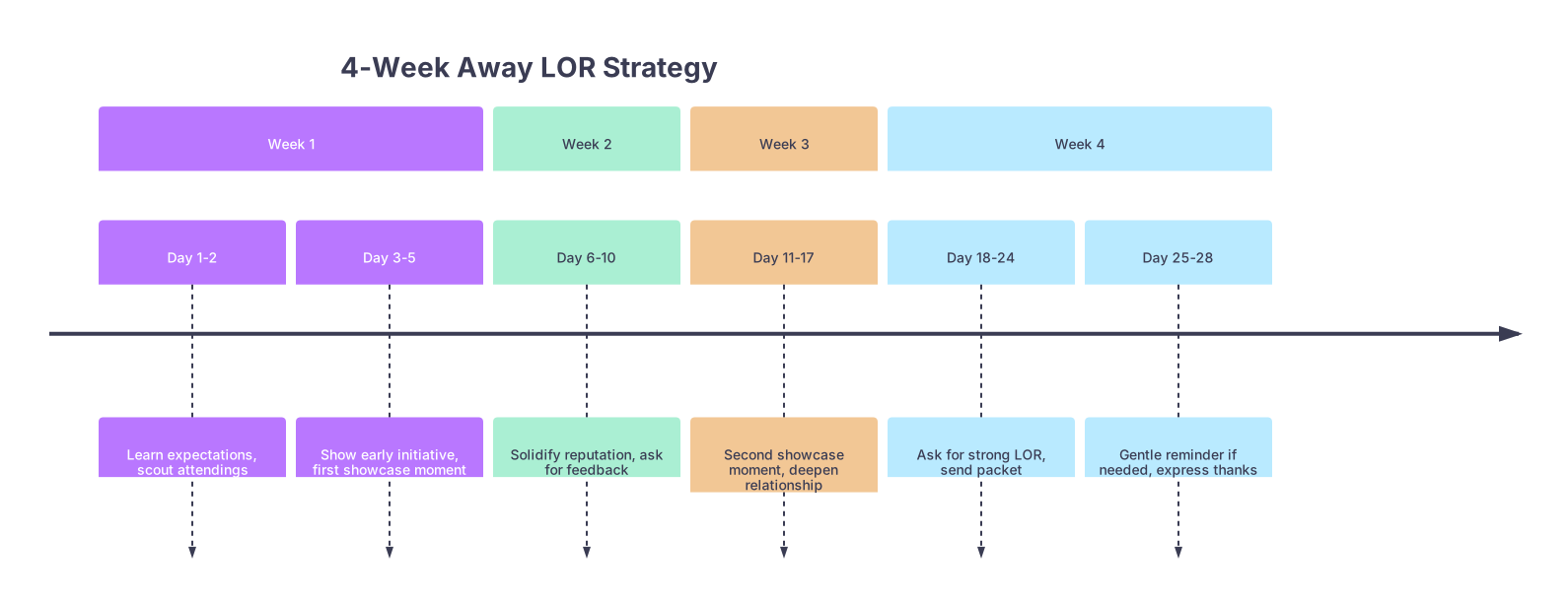
| Period | Event |
|---|---|
| Week 1 - Day 1-2 | Learn expectations, scout attendings |
| Week 1 - Day 3-5 | Show early initiative, first showcase moment |
| Week 2 - Day 6-10 | Solidify reputation, ask for feedback |
| Week 3 - Day 11-17 | Second showcase moment, deepen relationship |
| Week 4 - Day 18-24 | Ask for strong LOR, send packet |
| Week 4 - Day 25-28 | Gentle reminder if needed, express thanks |
Step 9: Follow‑Up and Damage Control
You asked. They agreed. You sent materials. Now what?
9.1: Gentle reminders
If your target “soft deadline” is, say, September 15:
- Ask for the letter in late August.
- Send a single reminder about 7–10 days before your deadline:
Dear Dr. Patel,
I hope your week is going well. This is a brief reminder that ERAS letters for my application will ideally be uploaded by [date].
I remain very grateful for your support and am happy to resend any materials if needed.
Best regards,
[Name]
No weekly pestering. One reminder. That is it.
9.2: If the letter is delayed
If your application is going live and the letter is still missing:
- Submit your application on time; letters can follow.
- Send a final, polite nudge:
- “I submitted my ERAS application this week and wanted to again thank you for your willingness to support me with a letter. If you are still able to upload it, it would be very helpful even after today.”
If it never comes, move on. Programs understand not every promised letter materializes.
Step 10: Common Dumb Mistakes (Avoid These)
You are already under time pressure. Do not sabotage yourself.
Being invisible the first week.
You “hang back” to “get a feel for things.” Meanwhile, the other student starts presenting, volunteering, and owning tasks. Guess who gets remembered.Asking for a letter over a rushed hallway interaction.
“Uh, could you maybe write me a letter?” as the attending is leaving. No. Schedule 2 minutes. Ask like an adult.Sending a 6‑page brag packet.
Attending sees that, closes the email. One CV, one PS, one‑page summary. Done.Waiting 2–3 months to request the letter.
You think you’re “being polite.” In reality, they barely remember you. The letter becomes vague filler.Assuming big name = good letter.
Some big names write garbage letters. Some “unknown” faculty write gold. Ask residents who actually helps students.Being fake nice only to attendings.
If you are rude to nurses or residents, that will get reported. And you can forget a strong letter.

The Real Goal: Convert 4 Weeks into a Story, Not Just a Signature
A high‑impact away rotation letter does not read like:
“[Name] was a medical student on our service and did well. They were pleasant and hard working. I recommend them.”
That letter might as well not exist.
You are aiming for something closer to:
“[Name] functioned at the level of an intern on our inpatient cardiology service at [Institution]. They consistently took ownership of 3–4 patients, anticipated next steps, and communicated effectively with families and consultants. I was impressed by their initiative in delivering a concise teaching presentation on acute decompensated heart failure, and by their reliability in following through on tasks without prompting.
I would be very happy to have [Name] as a resident in our program and recommend them without reservation.”
You cannot write that letter for them. But you can generate all the raw material and hand it to them in a compressed, visible, impossible‑to‑ignore way.
That is the point of this playbook.
Your Next Step Today
Do not wait until you land on the away service to figure this out.
Right now:
Make a 1‑page “rotation summary / brag sheet” template for yourself.
- Open a document.
- Add headings: Rotation, Role, Clinical responsibilities, Specific contributions, Strengths I want highlighted.
- Leave it blank for now, but formatted and ready.
When you start your away, update that document every 3–4 days with bullet points of what you actually did. By the final week, turning that into your LOR packet will take 10 minutes instead of an hour of anxious guesswork.
Start that document now. The letter you get later will be sharper because of it.


