

Weak Clinical Rotation? The recommendation letter is not dead. You just cannot treat it like a normal ask and hope for the best.
You had a mediocre rotation. Maybe you were quiet. Maybe you were late once or twice. Maybe your attending never really saw you at your best. Now you are staring at ERAS and thinking: “There is no way this attending can write me a strong letter of recommendation.”
Wrong. They might be able to—if you handle this strategically.
This is salvageable. But it will not fix itself. You need a plan and you need to execute it like you would manage a crashing patient: systematically, no denial, no magical thinking.
Here is how you salvage a strong LOR from a weak clinical rotation.
Step 1: Diagnose why the rotation felt weak
Before you touch the LOR question, you need brutal clarity about what went wrong. Not vibes. Specifics.
Ask yourself, in writing, not in your head:
Was it low exposure?
- Few shifts with the attending
- Mostly worked with residents/fellows
- Big service, many students, you were “background”
Was it performance-related?
- You were disorganized, slow, or underprepared early on
- You missed a key concept or had a bad patient interaction
- You got specific negative feedback
Was it relationship-related?
- Attending was distant, not very teaching-oriented
- Personalities did not mesh
- You never really had a direct conversation about your goals
Was it documentation-only weak?
- Verbal feedback was fine
- But your written eval was “meets expectations” and generic
Write it out plainly:
“On my IM sub‑I, I only worked directly with Dr. X for four days, I was slow with notes the first week, and I never told him I was applying to IM.”
You are not doing this to beat yourself up. You are doing this because each problem requires a different salvage strategy.
Step 2: Decide if this attending is even salvageable
Some rotations are weak. Some letter writers are just bad. You need to separate the two.
Ask these questions:
Did they ever see you do good work?
- Present a clear assessment/plan
- Handle a difficult family conversation
- Come in early or stay late to follow a patient
- Take feedback and improve over time
Did they show any positive signals?
- “You’ve improved a lot since the first week.”
- “Good job on that presentation.”
- “Your note structure has gotten much better.”
Do they regularly write letters?
- Core clerkship or sub‑I director
- Known in the department as a common letter writer
- Program leadership (PD, APD, clerkship director)
Here is the simple rule:
- If they never saw you at your best and you have other attendings who did, make this a backup LOR at most.
- If they did see at least a few strong moments, and they are an important name in the department or specialty, this is worth trying to salvage.
You are not trying to turn a disaster into a glowing novel. You are trying to convert “generic shrug letter” into “respectable, decently strong, specific letter.”
Step 3: Re‑engage the attending before asking for the letter
Most students screw this up. They vanish after the rotation and then fire off a “Can you write me a strong letter?” email months later. Weak rotations cannot survive that.
You need a bridge.
A. Send a concise follow‑up email
Within 1–4 weeks of the rotation ending (if possible):
- Thank them for specific things you learned.
- Mention 1–2 concrete changes you made because of their feedback.
- Briefly state your specialty goal.
Example:
Subject: Follow‑up and thanks from your medicine sub‑I
Dear Dr. Patel,
I wanted to thank you again for the opportunity to work with you on the inpatient medicine service last month. I’ve been applying your feedback about structuring assessment/plan by problem, and it has already made my presentations clearer on my current cardiology rotation.
Working on your team confirmed my interest in applying to internal medicine. I especially appreciated seeing how you walked families through complex decisions in plain language.
Thank you again for the teaching and for pushing me to be more precise in my clinical reasoning.
Best,
[Name], MS4
Why this matters:
It reframes their memory of you from “quiet student on a busy service” to “reflective, coachable student who improved and appreciated feedback.”
B. If time has passed, still reconnect
If it has been 3–9 months, still do something similar but include:
- A reminder of when/where you worked together.
- A quick update on what you have done since (sub‑Is, research, leadership).
You are refreshing the mental file they have on you.
Step 4: Decide how to ask: email vs face‑to‑face
For a marginal rotation, a generic email ask is a bad move. You want as much interpersonal context as possible.
Best options (in order):
- In person (if you are still at the same institution and can find them)
- Video or phone call (set up via email)
- Highly personalized email (if the first two are impossible)
Script for in‑person / video
You are going to be direct and honest without self‑sabotage.
“Dr. Patel, I want to ask you something directly. I’m applying in internal medicine and I’d be honored to have a letter from you. I know I was slower at the beginning of the rotation but I felt that I improved a lot with your feedback by the end.
Do you feel you know my clinical work and growth well enough to write me a supportive letter for residency?”
Key points:
- You acknowledge reality (you had a slow start).
- You remind them you improved.
- You use the word supportive, not “strong” (attendings interpret “strong” differently; “supportive” is clearer and easier to agree to honestly).
- You give them an easy out if they cannot.
If they hesitate or waffle
Pay attention to the response:
- “I think so” + starts mentioning specifics → probably fine.
- Long pause, vague “Hmm, I guess I could write something” → treat this as a no.
- “Honestly, I did not work closely enough with you” → thank them and move on.
You want enthusiasm or at least comfort. Anything below that is a red flag.
Step 5: Stack the deck with a killer LOR packet
Weak rotations cannot afford vague letters. You must make it nearly impossible for them to write something generic.
You are going to send a tight, organized packet. Not a dump of your CV and personal statement.

What to include (and how to frame it)
Cover email (short, structured)
Example template you can adapt:Subject: LOR materials – [Your Name], [Rotation, Month/Year]
Dear Dr. Patel,
Thank you again for agreeing to support my residency application with a letter. I have attached a brief packet to make this as easy as possible:
- A one‑page summary of my work on your service and specific cases we shared.
- My ERAS CV.
- A short paragraph on my goals in internal medicine and the qualities I hope to bring to residency.
If helpful, I also included a few bullet points highlighting areas where your direct feedback led to improvement (presentations, notes, and follow‑through on patient care).
ERAS will send you a separate email with upload instructions. My AAMC ID is [#######]. The ideal deadline is [date ~3–4 weeks ahead], but if you foresee any issues with that timing I am happy to adjust.
Thank you again for your time and support.
Best,
[Name]One‑page rotation recap (gold for weak rotations)
This is the single most important salvage tool. It reminds them of specific, positive, defensible things to write.Structure:
- Header: Your name, rotation, dates, hospital.
- Section 1: “Scope of Work”
- Types of diagnoses commonly on your list
- Call / weekend responsibilities, if any
- Section 2: “Representative Cases We Managed Together”
- 3–5 bullet points:
- “54‑year‑old with decompensated cirrhosis and SBP – I presented initial assessment/plan and followed daily; adjusted diuretics based on your teaching on volume status.”
- “Complex discharge planning for elderly COPD patient – coordinated with PT/OT and social work, wrote discharge summary and reconciled meds.”
- 3–5 bullet points:
- Section 3: “Growth and Feedback”
- 3 bullets:
- “Early feedback: notes too long, unclear problem prioritization → by week 3, consistently used problem‑based A/P with succinct daily updates.”
- “Initially hesitant to call consults → by end of rotation independently called renal and ID consults after pre‑briefing plan with you.”
- 3 bullets:
You are not writing the letter for them. You are giving them handles to grab onto.
Short “strengths you can speak to” bullets
Keep this to 5–7 bullets max. Phrase them in a way that invites them to confirm, not invent.
Examples:
- Reliability and follow‑through with tasks and patient updates
- Responsiveness to feedback (especially on presentation structure and note clarity)
- Respectful, calm communication with patients and families
- Ownership of assigned patients and comfort with day‑to‑day management by the end of the rotation
- Interest in internal medicine as a long‑term career with focus on [e.g., hospitalist work, oncology, etc.]
If your rotation was truly weak at the beginning but better at the end, emphasize trajectory. Many attendings will write a positive letter if they can honestly say: “This student improved rapidly and responded well to feedback.”
Step 6: If you had a mistake or bad episode, contain it properly
A lot of students fixate on one bad moment: wrong dose, missed lab, awkward patient encounter. You think that single event doomed your letter.
It does not have to.
You handle this by reminding the attending of what happened next.
If you had a clear mistake and you know they remember it:
- Own it briefly in your one‑pager or conversation:
- “I know I initially missed documenting the low sodium in Mr. X’s problem list. After your feedback, I started checking daily labs before prerounds and building a simple checklist; I have kept that habit on subsequent rotations.”
Now they have a ready‑made narrative:
- “Yes, the student stumbled early. Then they changed their process and did not repeat the mistake.”
Residency programs respect that story. A lot.
What you want to avoid is a letter that remembers the error but cannot honestly point to growth. You fix that by showing growth and then reminding the attending it happened.
Step 7: Compare this “salvaged” letter to your alternatives
You have to be strategic about where to use a salvaged letter. It might not be your flagship.
| Letter Type | Strength | When to Use |
|---|---|---|
| Stellar home sub‑I LOR | Strong | Always include |
| Solid away rotation LOR | Strong | Use for that specialty especially |
| Salvaged weak rotation LOR | Moderate | As 3rd/4th letter if content good |
| Generic preclinical LOR | Weak | Avoid unless required |
Basic rule:
- If you have 3 strong letters already (2 clinical in specialty + 1 more), your salvaged letter is backup.
- If you have 2 strong letters and the third is mediocre or non‑clinical, a well‑salvaged moderate LOR from a meaningful rotation can absolutely help.
If this attending is:
- Program Director, APD, Clerkship Director, Department Chair, or
- From a highly regarded institution in your specialty
Then even a “moderate but specific” letter is often better than a glowing but irrelevant letter (e.g., from a basic science PI for a clinical specialty like EM or FM, unless you are very research‑heavy).
Step 8: Use timing and extra contact to your advantage
You are not powerless after the rotation. You can shape how they remember you.
A. Ask for a brief meeting to discuss your application
A 15–20 minute meeting where you:
- Share your specialty list and career goals.
- Ask for their perspective on your competitiveness.
- Mention 1–2 specific skills you are actively working on.
This does three things:
- Signals maturity and insight.
- Lets them see you in a different light than the rushed wards.
- Gives them fresh material for the LOR: “The student is reflective about their growth areas and proactively sought feedback about their career path.”
B. Use ongoing updates (lightly)
If there is a significant positive update after they agree to write:
- Step 2 score (if solid)
- Honors in a related clerkship
- Acceptance to AOA or Gold Humanism
You can send a 2–3 sentence email:
“I wanted to share a quick update since we last spoke: I scored a 244 on Step 2 CK and honored my ICU sub‑I. I am continuing to work on my efficiency and clarity in oral presentations, using many of the strategies I first practiced on your service. Thank you again for supporting my application.”
Do not spam them weekly. One well‑timed update can nudge their tone upward.
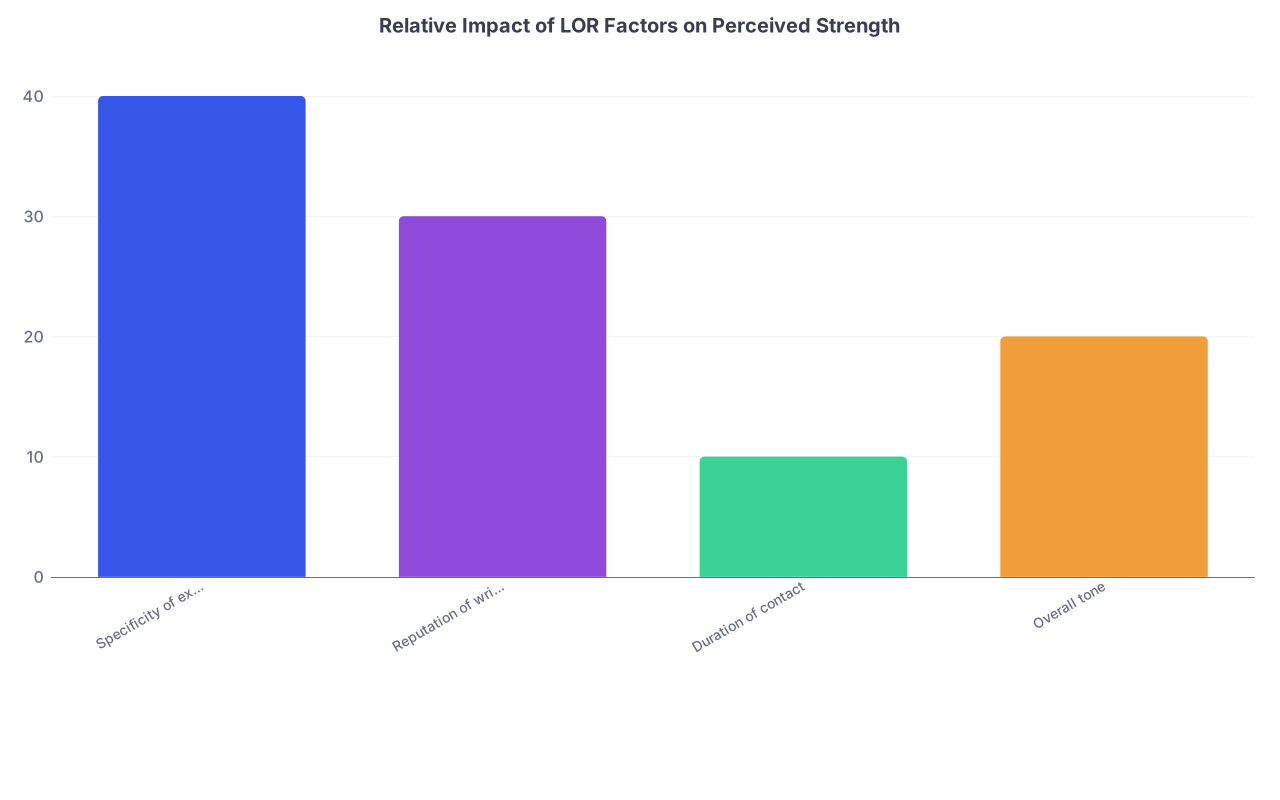
| Category | Value |
|---|---|
| Specificity of examples | 40 |
| Reputation of writer | 30 |
| Duration of contact | 10 |
| Overall tone | 20 |
The specific, concrete stories you feed them matter more than the total weeks you rotated.
Step 9: Know what a “salvaged but good” LOR actually looks like
You are not aiming for mythical perfection. You are aiming for:
Clear, concrete examples of:
- Patient ownership
- Response to feedback
- Professionalism
- Communication skills
Positive adjectives that are firm but not over‑the‑top:
- “Reliable,” “thoughtful,” “steadily improving,” “calm under pressure,” “excellent team player”
A clear recommendation line:
- “I recommend [Name] without hesitation for an internal medicine residency position.”
- “I am confident [Name] will be a capable and conscientious resident.”
What you want to avoid:
- Vague, lukewarm phrases:
- “Pleasant to work with.”
- “Completed all assigned tasks.”
- “Will do fine in residency.”
Your whole salvage strategy is aimed at giving the attending language and stories that push them toward the first group and away from the second.
Step 10: Protect your future rotations from becoming “weak” in the first place
You are trying to fix the past. Good. But also learn from it so you do not repeat it.

| Step | Description |
|---|---|
| Step 1 | Weak Rotation Realized |
| Step 2 | Diagnose why |
| Step 3 | Re-engage Attending |
| Step 4 | Ask for Supportive LOR |
| Step 5 | Provide LOR Packet |
| Step 6 | Use Strategically in ERAS |
| Step 7 | Adjust Approach Next Rotation |
| Step 8 | Clarify Expectations Week 1 |
| Step 9 | Seek Mid-rotation Feedback |
| Step 10 | Ask Early About LOR Potential |
For your next rotations:
Clarify expectations in week 1
- “Dr. X, I am applying to [specialty]. By the end of this rotation, what would you need to see from me to feel comfortable writing a supportive letter?”
Schedule or provoke mid‑rotation feedback
- “I would appreciate any feedback on how I am doing so far and what I could change in the next two weeks to be more helpful to the team.”
Be explicit sooner if you might want a letter
- “If by the end of the rotation you feel you know my work well enough, I may ask if you would be willing to support my residency application.”
This is how you avoid being “the quiet, forgettable student” ever again.
Quick Special Cases
Case 1: You honored the rotation but your relationship felt distant
Use the grade as leverage. Your problem is not performance; it is familiarity.
Emphasize data:
- Honors grade
- Strong shelf score (if relevant)
- Positive comments from residents
Your packet should highlight:
- Specific praise you got from team members
- Concrete tasks you handled independently
Often, attendings who grade you highly will be comfortable writing a strong letter if you remind them what justified that honor.
Case 2: You were average early, strong at the end
This is actually a fantastic LOR narrative. Many PDs like this more than “perfect from day one.”
- In your one‑pager, frame the arc:
- “Early: struggled with X → Feedback from you: Y → Implemented: Z → End: consistently doing A, B, C.”
You are basically seeding their letter with the phrase “rapid learner” or “demonstrated clear upward trajectory.”
Case 3: The attending barely knows your name
This one is often unsalvageable. If the attending:
- Does not remember you clearly after prompts, and
- Did not work closely with you at any point
Do not push it. Use residents or other attendings who actually supervised you. Weak content from a big name is not better than specific, strong content from a lesser‑known faculty member.
The bottom line
A weak or messy rotation does not automatically equal a weak letter. What kills letters is:
- No relationship
- No specifics
- No reminder of your growth
You can fix all three with:
- Honest diagnosis of what went wrong.
- Direct, respectful re‑engagement with the attending.
- A surgical LOR packet full of cases, growth, and concrete strengths.
- Strategic use of that letter alongside your stronger ones.
Do not just hope your letters will “work out.” They rarely do by accident.
Open a blank document right now and write a one‑page recap of your weakest rotation—dates, scope, 3–5 key patients, and 3 moments of growth. That document will either rescue a potential letter this year or guarantee you never repeat the same mistakes next year.


