

42% of program directors say letters from away rotations “rarely change” how they rank an applicant.
That’s from NRMP and specialty-specific PD surveys over the past decade. It already kills the myth that away-rotation letters are some magical golden ticket. They are not.
You’ve probably heard some version of this:
- “You must get a letter from your away rotation or it looks like you didn’t impress them.”
- “Home letters are biased and PDs ignore them.”
- “Big-name away LORs beat anything your home program can offer.”
All three are wrong in the ways that actually matter.
Let me walk you through what program directors actually do with your letters — and when home vs. away really makes a difference, and when it absolutely does not.
What Program Directors Actually Read (and Care About)
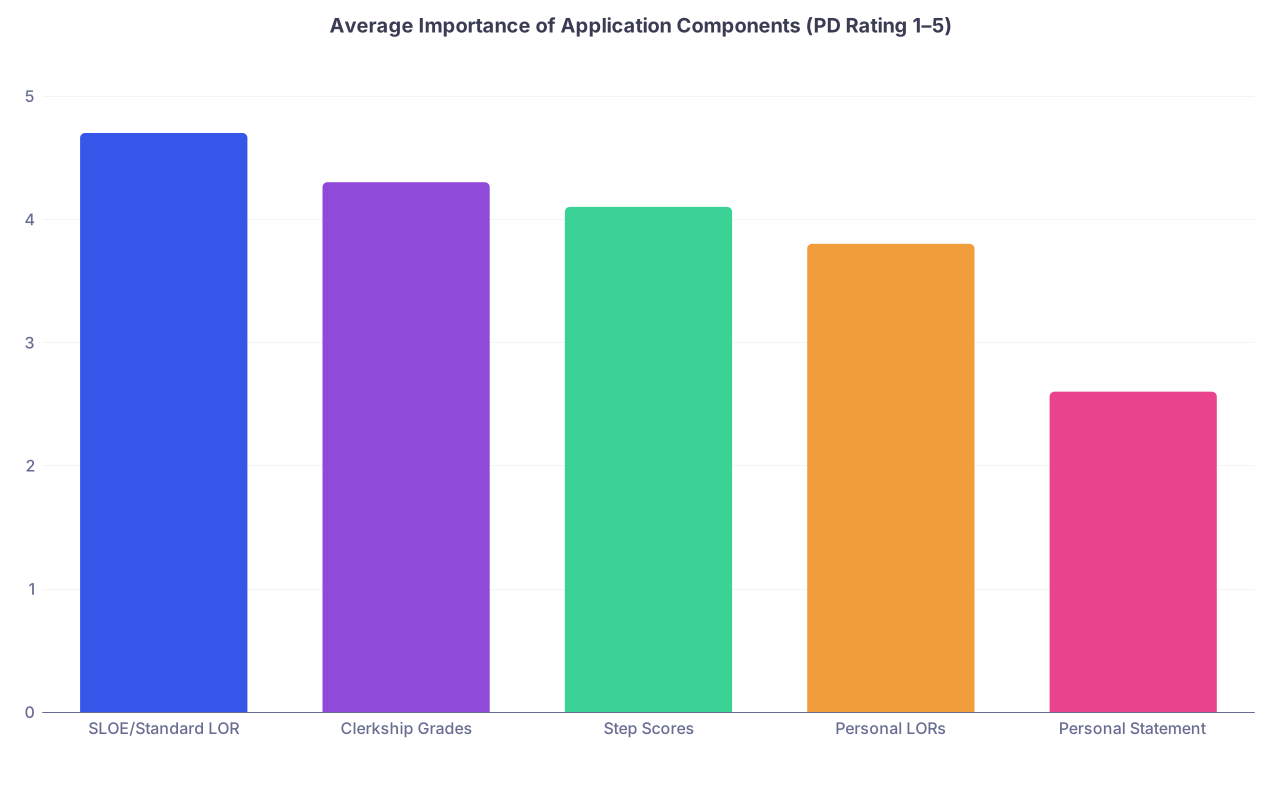
| Category | Value |
|---|---|
| SLOE/Standard LOR | 4.7 |
| Clerkship Grades | 4.3 |
| Step Scores | 4.1 |
| Personal LORs | 3.8 |
| Personal Statement | 2.6 |
Across multiple NRMP Program Director surveys, standardized letters (like EM SLOEs) and detailed clinical letters top the list of what PDs actually care about. Not whether they came from your home or away. The content and format matter far more than geography.
Here’s the part most applicants miss: PDs are not sitting there saying, “Ah, home letter, automatic discount.” They’re asking three very specific questions of any clinical LOR:
- Does this letter compare you to peers in the same specialty?
- Does it describe your work ethic, reliability, and how you function on a team?
- Does the writer actually know you or just remember your name?
If the answer to #3 is weak, the letter is weak — home or away.
I’ve watched letter-writing attendings scroll through an evaluation system, can’t quite place the student, then churn out three paragraphs of generic fluff. It happens at home. It happens on aways. The badge on the attendings’ ID doesn’t fix that.
The Biggest Myth: “Away LORs Are Always Stronger”
Let me be blunt: an away LOR is more variable, not automatically stronger.
You’re in a new hospital. Different EMR. Different culture. Often a shorter block. You’re starting from zero social capital while also trying to learn the system. Not exactly the setting where everyone’s at their best.
Home rotations:
- You often get longer exposure (4–8 weeks vs 2–4).
- Faculty may have seen you more than once (core + sub-I).
- There’s institutional incentive to support you because your success reflects on them.
Away rotations:
- You’re on a 2–4 week “audition” with high pressure and little room for a bad day.
- Faculty may work with you for 1–3 shifts or a couple of call nights and that’s it.
- Some attendings are letter-writing machines. Others actively avoid it.
The data? Emergency medicine has the clearest numbers because of SLOEs. Multiple EM studies show that away SLOEs are not uniformly stronger; in many cases, home SLOEs are equal or slightly more favorable on global assessment and comparative rankings.
For non-EM specialties, the research is thinner but the pattern is similar in surveys: PDs rate detailed, comparative letters as high value, and don’t consistently rank away LORs above home ones.
So no, an away letter is not a tier above a home letter by default. The writer and the depth of observation matter more than the ZIP code.
When Home Program Letters Quietly Outperform
Here’s the uncomfortable truth no one advertises: if you have a solid home program in your specialty, a strong home letter is usually more trusted than a random away letter.
Why?
Because PDs read patterns. They know who tends to inflate, who is brutally honest, and which institutions write meaningful letters vs. three-paragraph Mad Libs. A PD may think:
- “I know this home PD; they don’t over-hype. If they say ‘top 1/3 of residents,’ that’s real.”
- “This away attending? Never heard of them. One month of contact. Harder to calibrate.”
Here’s where home letters often beat away:
- Longitudinal evaluation: You did core clerkship, then sub-I, maybe even research or extra shifts. That’s months of data.
- Clear comparison group: Your home program can say, “Top 10% of students we’ve seen in the last 5 years.”
- Insight into trajectory: They can comment on your growth. “Came back stronger on the sub-I, much more efficient and independent.”
Compare that with the typical away scenario: “I worked with Alex for six shifts. Alex was motivated, pleasant, and worked well with the team.” That’s nice. Also useless.
If your home PD or key faculty is known in the field and writes a high-signal letter, that can outweigh a generic away note from a “big name” institution where the writer hardly knows you.
When Away Rotation Letters Actually Matter
Now, let’s flip it. There are situations where an away LOR carries real weight. But they’re narrower than most students think.
They matter more when:
You don’t have a strong home program in the specialty.
No home program, tiny program, or one with a poor reputation? Then PDs look harder at away letters to figure out if you can function in a “standard” environment.You’re region- or program-targeting.
Rotating at MGH because you want New England academic IM? A strong letter from there can act as a proxy signal for programs in that ecosystem: “If they liked you, we’ll take a closer look.”You’re trying to counterbalance a weak home narrative.
If home evals are lukewarm or you suspect a home PD letter won’t be strong, a clearly enthusiastic away letter can reassure PDs you’re not universally mediocre.The specialty explicitly expects it.
EM historically wanted 2 SLOEs (often home + away). Some surgical subspecialties highly value an away letter at a “home base” program. You follow the norms of that field.
But even in these scenarios, it’s still not “away automatically > home.” It’s “away can fill in gaps or give extra confirmation.”

The Real PD Preference: Signal, Not Location
Program directors care about signal strength. Not whether the logo at the top of the letter matches your school.
Signal strength comes from:
- Specific comparison: “Top 10% of students I’ve worked with in 10 years.”
- Concrete behaviors: “Stayed late to help admit a complex patient without being asked.”
- Reliability & judgment: “We would be happy to have them as a resident here.”
Weak signal:
- Vague praise: “A pleasure to work with, hard-working, and caring.”
- No comparison: “Among the better students” (what does that even mean?).
- Generic filler that could apply to any halfway decent student.
To make this concrete:
| Scenario | Home LOR | Away LOR | Which Helps More? |
|---|---|---|---|
| Strong home PD, knows you well | Detailed, comparative | Generic, short exposure | Home |
| No home program | N/A | Detailed with comparison | Away |
| Lukewarm home support | Bland, faint praise | Strong, enthusiastic | Away |
| Both strong writers | Detailed, specific | Detailed, specific | Both (location irrelevant) |
| Big-name away, barely knew you | Brief, generic | Name-recognition only | Home |
Read that table and notice something: the deciding factor in every case is content, not “home vs away.”
The “No Away Letter = Red Flag” Myth
Another favorite myth: “If you did an away and didn’t get a letter, PDs will assume you failed.”
Reality: PDs do not have a hidden spreadsheet of your rotations. ERAS does not display “places you rotated but didn’t get a letter.” No one is cross-matching your VSLO history against your letters.
The only time “no letter from X” gets attention is when:
- It’s well-known in that field that everyone gets a SLOE or formal letter from that rotation, and you conspicuously don’t have one.
- You loudly advertised your away at that specific program in emails or interviews, and it’s clear you were gunning for them and… nothing came.
Even then, most PDs are too busy to investigate your letter politics. They’re trying to figure out if you’ll show up, work hard, and not fall apart on call. They’re not CSI-ing your VSLO trail.
If you did an away that went “fine but not glowing,” and you have better options for letter writers, you’re not sabotaging yourself by skipping that away LOR.
What PDs Complain About in Letters (That You Can Actually Control)
Here’s what I hear from PDs and selection committee members when they roll their eyes at LORs:
- “This is completely generic. Could be anyone.”
- “No rank, no comparison. Just vibes.”
- “Three paragraphs about ‘I enjoy teaching’ and two sentences about the student.”
- “Zero discussion of reliability, ownership, or how they respond to feedback.”
Notice what’s missing from that list: “This is a home letter, so we downgrade it.” They don’t have time for that kind of performative cynicism. They’re drowning in applications.
You do have some control here:
- Ask people who saw you work closely and repeatedly.
- Choose writers who understand residency expectations in that specialty.
- Prefer writers who have written successful letters for prior applicants.
Home vs away is a secondary consideration after those three.

Specialty-Specific Nuances (Where Myths Usually Start)
A lot of confusion comes from people extrapolating one specialty’s culture to everything else.
Emergency Medicine
EM is the poster child for standardized away letters: SLOEs.
- Historically: 1 home SLOE + 1 away SLOE was the “ideal.”
- What PDs actually say: they want at least 1–2 good SLOEs. Home vs away matters less now, especially in the post-COVID, fewer-aways environment.
- Some EM studies show home SLOEs slightly more favorable; away SLOEs can be more “conservative” because faculty are calibrating against a national pool.
Translation: in EM, it’s about getting enough SLOE signal, not a religious requirement for an away one.
Surgical Subspecialties (Ortho, ENT, etc.)
Here the culture is: aways as extended interviews. Programs absolutely look at your performance there. But again:
- A glowing letter from your home chair plus a solid away letter is ideal.
- An away letter that’s just “fine” doesn’t beat a home chair letter that says “we’d be thrilled to have them as a resident.”
The dangerous myth is thinking: “I’ll tank at home but fix it with aways.” That almost never works. PDs talk. And letters get read side-by-side.
Internal Medicine, Pediatrics, Family Med, Psych
For these, away letters are much less critical. Many applicants match with:
- Strong home sub-I letter.
- Department chair or clerkship director letter.
- One additional faculty letter (home or away or research).
The away letter here is more of a nice-to-have for exploring regions/programs, not some secret requirement.
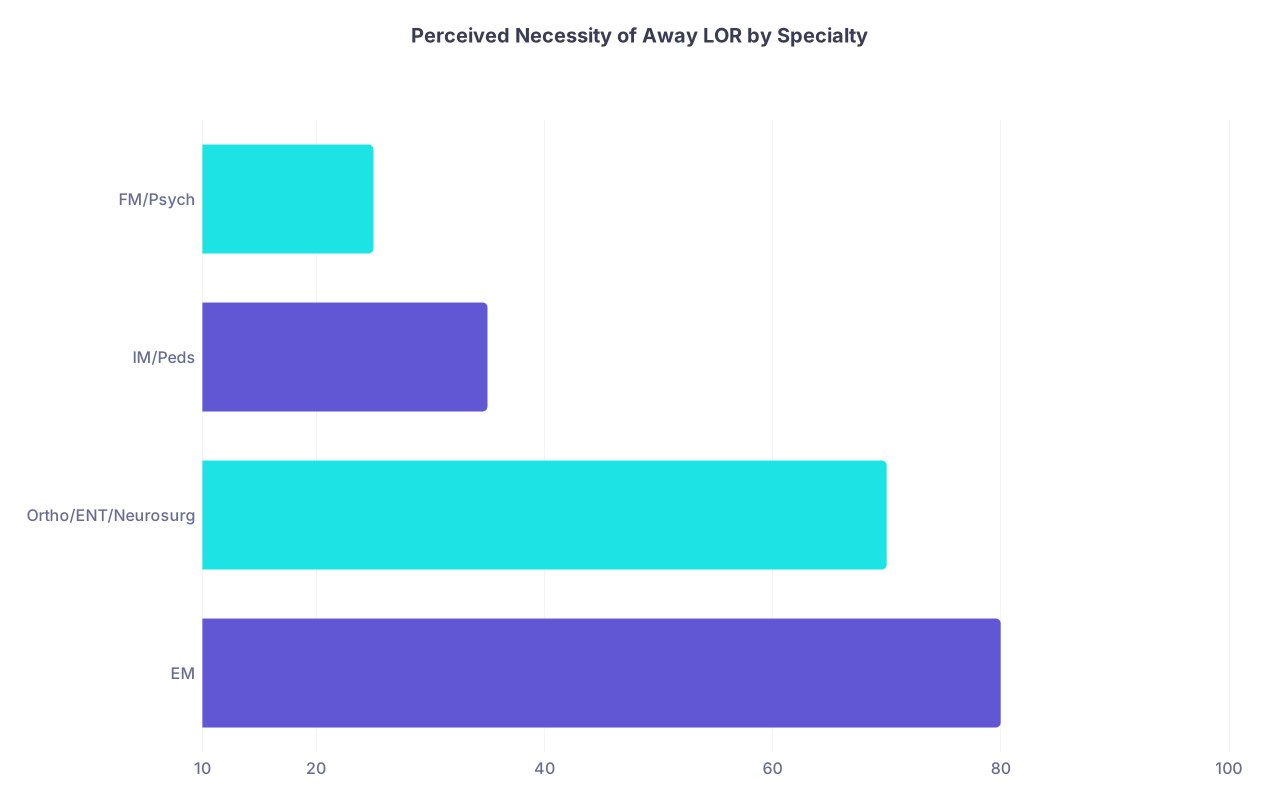
| Category | Value |
|---|---|
| EM | 80 |
| Ortho/ENT/Neurosurg | 70 |
| IM/Peds | 35 |
| FM/Psych | 25 |
(Values represent rough percentage of PDs who say away letters are “important” in their specialty based on survey trends and reported norms.)
How You Should Actually Decide: Home vs Away LORs
So what do you do with all this?
Use this decision sequence:

| Step | Description |
|---|---|
| Step 1 | Identify Needed Letters |
| Step 2 | Prioritize required formats (e.g., SLOEs) |
| Step 3 | Focus on strongest clinical letters |
| Step 4 | Rank by strength of relationship & depth of observation |
| Step 5 | Use strongest home letters |
| Step 6 | Pick strongest combination, ignore geography |
| Step 7 | Specialty expects standardized letters? |
| Step 8 | Who saw you work closely & often? |
| Step 9 | Home vs Away? |
You don’t start with “I must have one away and one home.” You start with: Who can write the most powerful, specific, comparative letters that reflect how I actually perform?
Then you check: does my specialty have norms (like EM SLOEs, surgery chair letters) I have to satisfy? And you layer home vs away on last.

Years from now, you won’t remember which letter came from which hospital logo; you’ll remember who actually believed in you enough to put their name behind your application. Pick those people. The rest is noise.


