

Standardized residency LOR forms were sold as the great equalizer. They are not.
They’ve improved a few things, sure. But leveling the playing field? The evidence just does not back that claim. At best, they shift where bias shows up. At worst, they give everyone a false sense that things are now “objective” and “fair.”
Let’s walk through what we actually know, not what the marketing slides at PD meetings claimed.
What Standardized Forms Were Supposed To Fix
The move to standardized LORs in residency—especially in EM, then later internal medicine and others—came from real problems:
Program directors kept saying the same things in surveys:
- Traditional narrative letters were uselessly positive.
- Everyone was “excellent,” “outstanding,” “among the top 10%.”
- There was huge variability by school, specialty, even by individual writer.
- Certain schools pumped out “hyper-inflated” letters that made their students look amazing on paper.
So standardized forms were introduced: structured ratings, checkboxes, specific domains (clinical reasoning, work ethic, teamwork, professionalism), often plus a short narrative. The promise was simple: put everyone on the same form, use anchors, force comparison to peers. Then—magically—equity.
That’s the myth.
Here’s the reality: a structured form can standardize format. It does not standardize judgment. And bias lives in judgment, not formatting.
What the Data Actually Shows About Standardized LORs
We do have data. Not mountains, but enough to see a pattern.
Let me translate the themes from EM SLOEs, IM structured letters, and broader LOR research.
1. Standardization improved signal — but not fairness
In EM, where the Standardized Letter of Evaluation (SLOE) is king, studies consistently show SLOEs are better predictors than traditional letters. Programs trust them more. PDs say they can rank more confidently.
That’s fine. Stronger signal is good. But does that mean the playing field is level?
No. What you really get is:
- More consistent format
- Tighter range of ratings
- Clearer relative ranking within a rotation
You do not automatically get:
- Equal treatment by gender
- Equal treatment by race/ethnicity
- Equal treatment by school prestige or “home vs away” status
Bias simply gets compressed into a 1–5 scale and pre-specified checkboxes.
2. Bias does not disappear; it gets systematized
Research on letters of recommendation (both med school and residency) shows repeat patterns:
- Women get more “communal” descriptors (kind, caring, team player) and fewer “agentic” ones (brilliant, leader, trailblazer).
- Underrepresented in medicine (URiM) applicants are more likely to be described with “grit” and “hard-working” language and less with “exceptional intellect” language.
- Some groups get more “doubt-raisers” — phrases like “with support, will do well” or “needs structure.”
Standardization doesn’t prevent any of that. It just forces it into named categories. I’ve read plenty of standardized forms where the checkbox pattern is fine, but the 3-line narrative quietly sinks the candidate.
Short version: bias is not solved by giving everyone the same grid. If anything, it makes biased ratings look official and quantitative.
Where These Forms Actually Help (And Where They Don’t)
Let’s be fair. Standardized forms are not useless. They’re just oversold.
What they actually improve
Standardized LOR forms do a few things reasonably well.
First, they reduce “letter inflation” within a given institution or specialty. When a form explicitly asks “Rank this student compared to peers you’ve supervised in the last year,” and gives you options like:
- Top 10%
- Top 1/3
- Middle 1/3
- Bottom 1/3
…it becomes much harder to call everyone “top 10%.” You can still do it, but it’s obvious.
Second, they make letters easier to compare quickly. A PD reading 1,000 applications can scan a standardized form in 30 seconds. They do not have time to parse page-long, flowery narratives.
Third, they can highlight some truly exceptional or truly concerning candidates more clearly. Outlier ratings matter more when the scale is fixed.
So yes, standardized forms help programs. They improve usability and modestly improve the signal-to-noise ratio.
They do not, however, magically correct structural inequities.
What they do not fix
Three big myths die here.
Myth 1: “The form erases school prestige bias.”
Data from multiple specialties still shows heavy preference for home students, for well-known schools, and for “name-brand” letter writers. Programs still assume that a “high” rating from a top academic center means more than the same rating from a small community program. Standardization does not change that hierarchy—it just puts it in a cleaner PDF.
Myth 2: “Anchors stop subjective gaming.”
Anchors help a bit, but they’re not binding. An easy-grader who calls everyone “top 10%” still exists. A hypercritical attending who rarely gives top marks still exists. You’re now at the mercy of how your specific writer interprets those anchors. Some are generous. Some are stingy. Still wildly unequal.
Myth 3: “The form protects disadvantaged students.”
No. It just reduces the space for allies to go off-script and really advocate for you in narrative form. An attending who would have written a passionate, detailed 1.5-page letter is now boxed into checkmarks and a short paragraph. For students who rely less on brand-name schools and more on genuine mentorship, that can actually be a net loss.
The Hidden Inequalities No One Likes to Admit
Here’s where it gets uncomfortable. The unequal playing field isn’t mainly about the form. It’s about everything wrapped around it.
Access to high-visibility rotations
You cannot get a standardized letter in a specialty without a rotation. Students from resource-rich schools can:
- Do multiple away rotations at big academic centers
- Strategically chase “letter-writers” with national reputations
- Pay for extra travel, housing, and lost income
Students from less resourced backgrounds or schools? Fewer aways. Less access to “SLOE-famous” faculty. Meanwhile, the standardized form itself looks identical. The perceived value does not.
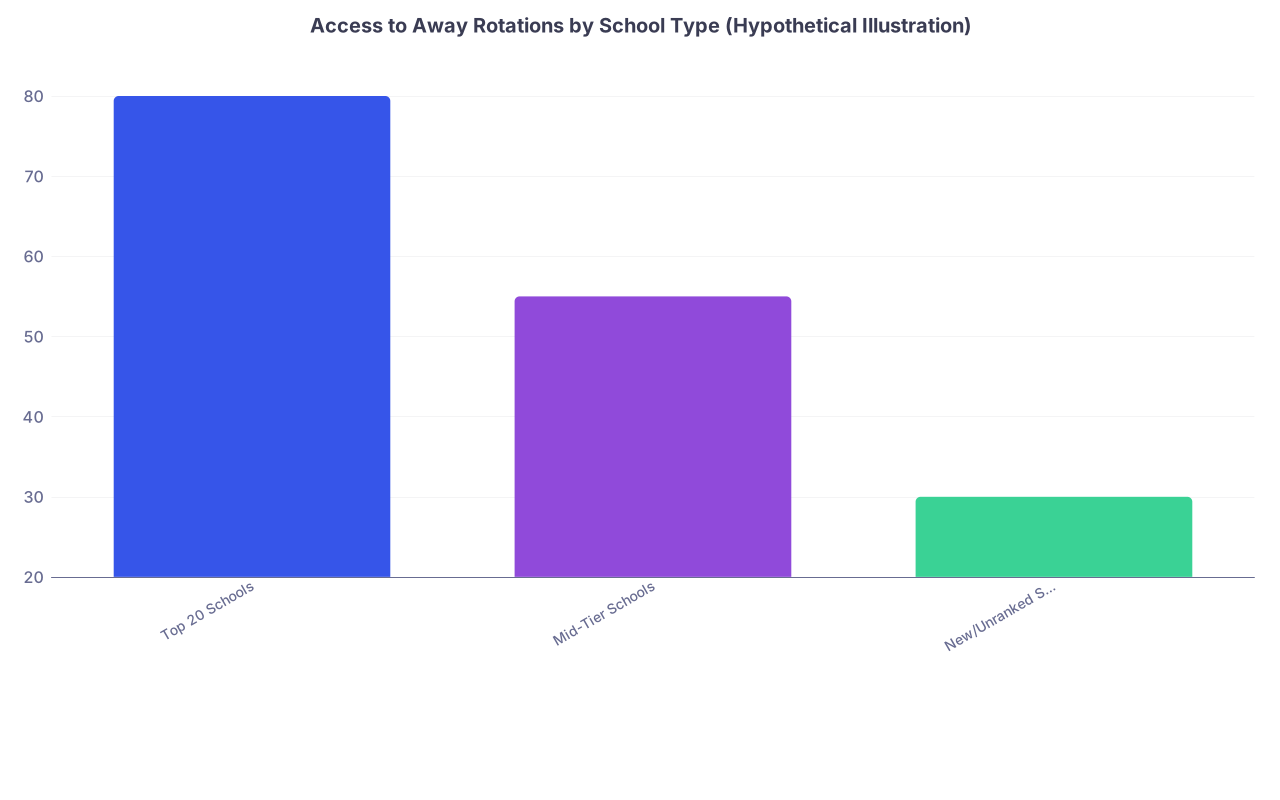
| Category | Value |
|---|---|
| Top 20 Schools | 80 |
| Mid-Tier Schools | 55 |
| New/Unranked Schools | 30 |
Even if the checkbox looks the same, a “top 10%” from a lesser-known program does not carry the same implicit weight as “top 10%” from a marquee institution. Programs will never say this out loud on their websites. But watch how rank lists shake out, and you’ll see it.
Writer experience and cultural calibration
Standardized forms assume the writer:
- Has seen enough students to meaningfully rank you
- Understands national norms
- Is calibrated against peers at other institutions
Often they’re not.
At a smaller site, the attending may have supervised only a dozen students total. Calling you “top 10%” there is not the same as “top 10%” in a massive teaching hospital where they see 80+ students a year. Yet on paper, the checkbox looks identical.
On top of that, there’s cultural mismatch. The same behaviors are interpreted differently depending on student background and faculty expectations. Assertive vs “abrasive.” Quiet vs “disengaged.” None of that disappears because the evaluator is now checking a box for “teamwork” or “communication.”
You’ve just made the bias easier to add to a spreadsheet.
How Programs Actually Use These Forms
Let me be blunt: standardized letters are filters, not salvation.
Program directors I’ve spoken with (and surveys back this up) often use structured LORs in crude, but efficient ways:
- Hard screens: Any student below “top 1/3” in global ranking gets binned, unless something else is extraordinary.
- Tie-breakers: Between two similar applicants, the one with higher SLOE/standardized rankings wins.
- Concern detectors: Anything less than “above average” in professionalism, communication, or work ethic is a red flag.
They are not sitting there philosophically analyzing whether a form has eliminated bias. They’re trying to survive application season.
So yes, standardized forms carry a lot of power. But that power is being used in a context that’s already skewed by:
- USMLE score culture (even with Step 1 pass/fail)
- School reputation
- Network and connections
- Specialty-specific norms
That means any tiny bias baked into a form can have an outsized effect. A single checkbox, on a single rotation, can cost you an interview at a place that never hears your side of the story.
Strategy: How You Actually Protect Yourself (And Sometimes Benefit)
You cannot fix the system during application season. But you can stop pretending the form guarantees fairness—and act accordingly.
A few practical, unromantic truths.
1. Who writes your form matters more than the form itself
Standardization doesn’t flatten writers. A strong evaluator with national credibility is still gold.
When possible:
- Choose attendings who’ve written standardized forms before (SLOE, IM structured LOR, etc.).
- Prioritize those who’ve seen many students and know the national bar.
- Avoid the perpetually grumpy, “no one is excellent” type unless you crushed the rotation and you know they respect you.
If your school has a clerkship director known for tough but respected letters, that’s often better than a random attending who adores you but has zero national credibility.
2. You must actively manage expectations with your writer
Do not just say, “Can you write me a letter?” and hope for the best.
Instead, say something like:
“I’m planning to apply in EM and will need a SLOE/standardized letter. I’m aiming to be seen as a strong candidate. Based on my performance, would you feel comfortable ranking me in the top third or above of students you’ve worked with? If not, I completely understand and would rather know now.”
Yes, that feels blunt. Do it anyway. You want an honest yes or no. A lukewarm standardized letter can hurt you more than no letter.
3. You can sometimes counterbalance a weaker standardized form
If you suspect you’ll have a borderline standardized letter (say from an away that didn’t go perfectly), you can:
- Weight your home rotation letter more, if it’s stronger.
- Add strong narrative letters from research mentors or other specialties (not as substitutes, but as context).
- Address serious issues (professionalism, leaves, grade anomalies) in your personal statement or advisor letter, rather than letting the form tell the only story.
No, this does not erase a weak form. But it stops programs from seeing only one data point.
Where The System Needs To Grow Up
The idea that “we have a standardized form, therefore equity” is lazy. Programs and specialties know this. Many just prefer the simplicity.
If people were serious about leveling the playing field, they’d be talking less about formatting and more about:
- Training letter writers in bias awareness and calibration.
- Monitoring rating patterns for gender, race, and school-type bias at the institution level.
- Providing guidance for smaller or newer programs on how to interpret national anchors.
- Tracking applicant outcomes across demographics and letter patterns over multiple cycles.
Some EM and IM groups have started nibbling at this—reviewing SLOE distributions, publishing analyses, adjusting forms. But the gap between “we have a standardized letter” and “we have an equitable system” remains large.
The presence of a standardized form is not evidence of fairness. It’s evidence of bureaucracy.


| Step | Description |
|---|---|
| Step 1 | Student Performance |
| Step 2 | Faculty Perception |
| Step 3 | Standardized LOR Ratings |
| Step 4 | Program Director Interpretation |
| Step 5 | Interview Offer Decision |
| Step 6 | School Prestige |
| Step 7 | Writer Reputation |
| Step 8 | Applicant Demographics |
The Bottom Line
Standardized LOR forms do not level the playing field. They tidy it.
If you want the short version:
- Standardized forms improve consistency and usability for programs, but they do not erase bias; they just package it into checkboxes and short narratives.
- The biggest inequities come from who gets access to powerful letter writers and high-visibility rotations—not from the letter template itself.
- Your best move is not to trust the form, but to be ruthlessly strategic about who writes it, how well they know you, and whether they’ll actually mark you in the top tier.


