

The belief that verbal praise on rotations guarantees a strong letter of recommendation is wrong. Flat-out wrong. And I’ve watched more students get burned by this assumption than almost any other part of the residency application process.
Let me be blunt:
The attending who told you, “You’re doing great,” “You’re one of the strongest students I’ve had,” or “I’d be happy to write you a letter,” might still write you a bland, useless, or even harmful LOR.
You’re confusing bedside compliments with documented advocacy. They are not the same thing.
The Myth vs. Reality: What Verbal Praise Actually Means
On the wards, praise is cheap. Letters are not.
Attending physicians use positive language constantly:
- “Nice job on that presentation.”
- “You handled that admission really well.”
- “I’d be happy to write you a letter.”
Students hear those lines and mentally convert them into:
“This will be a strong LOR.”
That conversion is where everything breaks.
Reality:
Bedside praise ≠ comparative ranking.
Programs don’t care that you “did well.” They want to know: Were you top 10%? Above average? Better than most students that attending has worked with?Praise is often situational and polite.
A lot of this is basic professional kindness. Some attendings are pathologically upbeat. Everyone on their team is “fantastic.” Their letters? All sound the same: generically positive, functionally useless.Agreeing to write a letter ≠ committed advocacy.
Most faculty will not say “No, I don’t want to write you a letter.” That’s socially awkward. So they say, “Sure, I can write you a letter” even when they plan to write a lukewarm one.
Here’s the rough hierarchy of what verbal feedback usually signals:
| Faculty Phrase | Likely Letter Strength |
|---|---|
| “I’d be happy to write you a letter.” | Neutral to mild positive |
| “You were one of our stronger students.” | Moderately positive |
| “I’d be delighted to write you a *strong* letter.” | Strong, specific support |
| “Why don’t you ask Dr. X for your letter?” | Weak / avoid if possible |
| “Email me to remind me and I’ll put something together.” | Generic, template-ish |
Is this table perfect? No. But it’s closer to reality than the fantasy that any nice comment = gold star LOR.
What PDs Actually Want From LORs (And Why Praise Alone Fails)
Program directors are not reading your letters to see if you are “nice” or “hard-working.” Those are table stakes. They’re trying to answer a specific set of questions.
This is where data helps.
Multiple NRMP Program Director Surveys (IM, Surgery, EM, etc.) converge on the same thing: LORs matter, but only when they say something concrete. Generic praise adds almost nothing to your file.
Program directors read letters to answer:
How do you rank compared to other students this faculty sees?
“Among the top 10–20% of students I’ve worked with in the last five years” carries more weight than three paragraphs of “team player, great attitude.”Can you function on Day 1 as an intern?
They’re scanning for evidence of:- Reliability (“always followed through without reminders”)
- Clinical reasoning (“built thoughtful, prioritized differentials”)
- Ownership (“took primary responsibility for their patients”)
- Communication (“communicated clearly with nurses and families”)
Any red flags or hedged language?
Program directors are fluent in “letter speak.” They know the difference between:- “I recommend them without reservation.”
vs. - “I recommend them for your program.”
- “I recommend them without reservation.”
That one word—“without reservation”—can override pages of fluffy compliments.
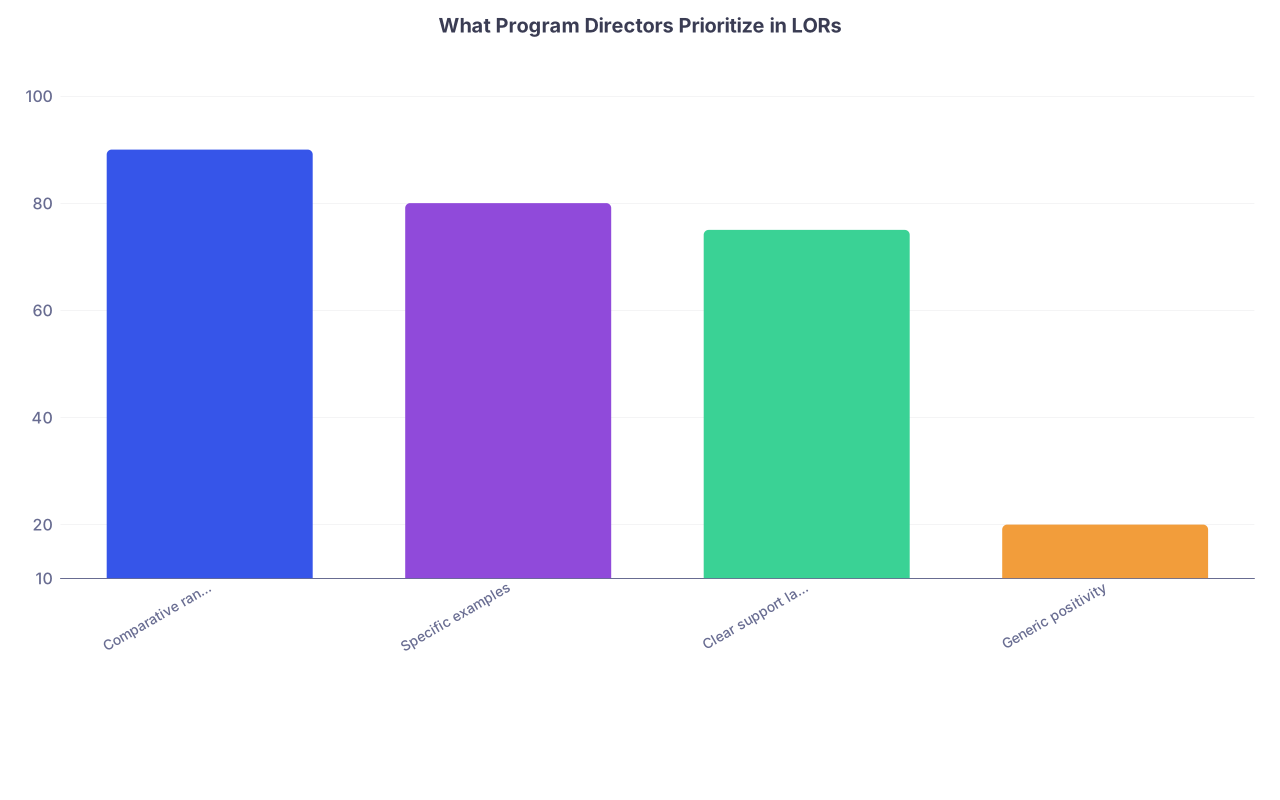
| Category | Value |
|---|---|
| Comparative ranking | 90 |
| Specific examples | 80 |
| Clear support language | 75 |
| Generic positivity | 20 |
That’s not literal numerical data from one single study, but it’s directionally accurate with what PD surveys and debriefs keep showing: generic positivity is almost background noise.
So if all you’ve got is “The attending said I was great,” you have nothing yet in the eyes of a PD.
Why Verbal Praise Rarely Matches the Letter You Imagine
Let’s talk about why this disconnect is so common. I’ve watched it from both sides: students overestimating letters, faculty underestimating the impact of vague language.
1. Attendings are conflict-avoidant and busy
Most attendings:
- Hate confrontation.
- Are exhausted.
- Are behind on notes, inbox, and a thesis-worth of admin work.
So when a student asks for a letter:
- They’re unlikely to say “No, I can’t write you a strong one.”
- They’re likely to say “Sure, send me your CV and personal statement.”
Then, three weeks before ERAS, they dig out a template, swap a few adjectives, add one example they vaguely remember, and hit send. The resulting letter is:
- Polite
- Positive-sounding
- Totally mediocre in content
I’ve read these letters. They’re painful. They sound like: “X was a pleasure to have on the team. They were punctual, professional, and well liked by patients and staff. I am confident they will make a fine resident.”
That is a C+ letter in PD-land.
2. Students confuse “enthusiastic in person” with “strong on paper”
Some faculty are charismatic. They teach with energy, praise generously, joke with you, tell you, “You should go into our specialty, you’d be great.”
Students walk away thinking: That’s my letter writer.
But the same faculty:
- Sit on a dozen committees
- Precept multiple students per month
- Write 30+ letters per year
Your enthusiastic memory of them does not guarantee they’ll remember you clearly or write you anything more than formulaic praise.
3. Faculty self-assessment of their letters is terrible
Most faculty genuinely think they’re writing helpful letters. PDs will tell you otherwise. A large chunk of letters are indistinguishable from each other.
If you’ve ever heard a PD say “We basically ignore most letters unless they’re clearly exceptional or clearly concerning,” this is why.
Verbal praise doesn’t change that pattern.
How to Tell If You’re Actually Going to Get a Strong Letter
You cannot read minds, but you can stop being naïve about signals.
Here’s what actually correlates with stronger letters, based on both data and years of PD anecdotes:
Specific, comparative language on rotation evals
If your formal evaluation says:- “Among the top students I’ve worked with in the last few years”
- “Above expectations in all domains”
- “Would be delighted to have as a resident”
That is a better predictor than casual comments on rounds.
They’ve seen you solve real problems, not just pre-round smoothly
Strong letters often mention:- The crashing patient you helped stabilize
- The complex social situation you navigated
- The weekend you took ownership of sign-outs and follow-up
If your time with them was shallow and brief, the letter will be shallow and generic.
They use the word “strong” unprompted when agreeing
There’s a world of difference between:- “Yes, I can write you a letter.”
vs. - “Yes, I can write you a strong letter for internal medicine.”
- “Yes, I can write you a letter.”
They know your story beyond the rotation
Faculty who ask for:- Your CV
- Your personal statement
- A quick meeting to talk about your goals
before writing—these people tend to write better letters because they have more to work with and care enough to get it right.

| Step | Description |
|---|---|
| Step 1 | Verbal Praise on Rounds |
| Step 2 | Good candidate for LOR |
| Step 3 | Need more info |
| Step 4 | Risk of generic/weak LOR |
| Step 5 | Did they clearly say strong letter? |
| Step 6 | Do they know you well & saw you handle challenges? |
You should be thinking at the F node way more often than students currently do.
How to Stop Relying on Flimsy Verbal Praise
If you want to avoid getting blindsided by weak letters, you have to change how you approach this entire process.
1. Ask the right question, not the comfortable one
Wrong question (what most students ask):
“Would you be willing to write me a letter for residency?”
Better question (slightly uncomfortable, but much more honest):
“Do you feel you know me and my work well enough to write a strong letter of recommendation for [specialty]?”
If they hesitate, redirect, or suggest someone else, that is a soft “no.” Believe them. That’s a win—you avoided a weak letter.
2. Corroborate verbal praise with written feedback
Do not anchor on that one compliment you got post-call. Look at:
- Your end-of-rotation eval
- Any written comments submitted through the clerkship system
- Emails they sent you highlighting your performance
Consistent, specific written praise is more predictive than one glowing hallway statement.
3. Give them ammunition (or don’t bother)
If someone agrees to write you a strong letter, make it easy for them to prove it on paper. Send:
- Your CV
- Your personal statement or at least a paragraph about “why this specialty”
- A short bullet list of:
- 2–3 patients you took ownership of
- Any specific moments they commented on (difficult family discussion, great presentation, weekend coverage, etc.)
No, you’re not “writing your own letter.” You’re jogging their memory so they can write a specific, credible one instead of defaulting to their template.
4. Prioritize depth over prestige in letter writers
Another myth that pairs nicely with the verbal-praise fantasy: “The most famous name is always the best writer.”
I’ve seen it play out:
- Student A: letter from nationally famous department chair who barely knows them → generic, name-heavy, content-light letter.
- Student B: letter from mid-level clinician-educator who worked closely with them for 4 weeks → detailed, vivid, strongly comparative.
Guess whose letter PDs quoted in meetings? Student B.
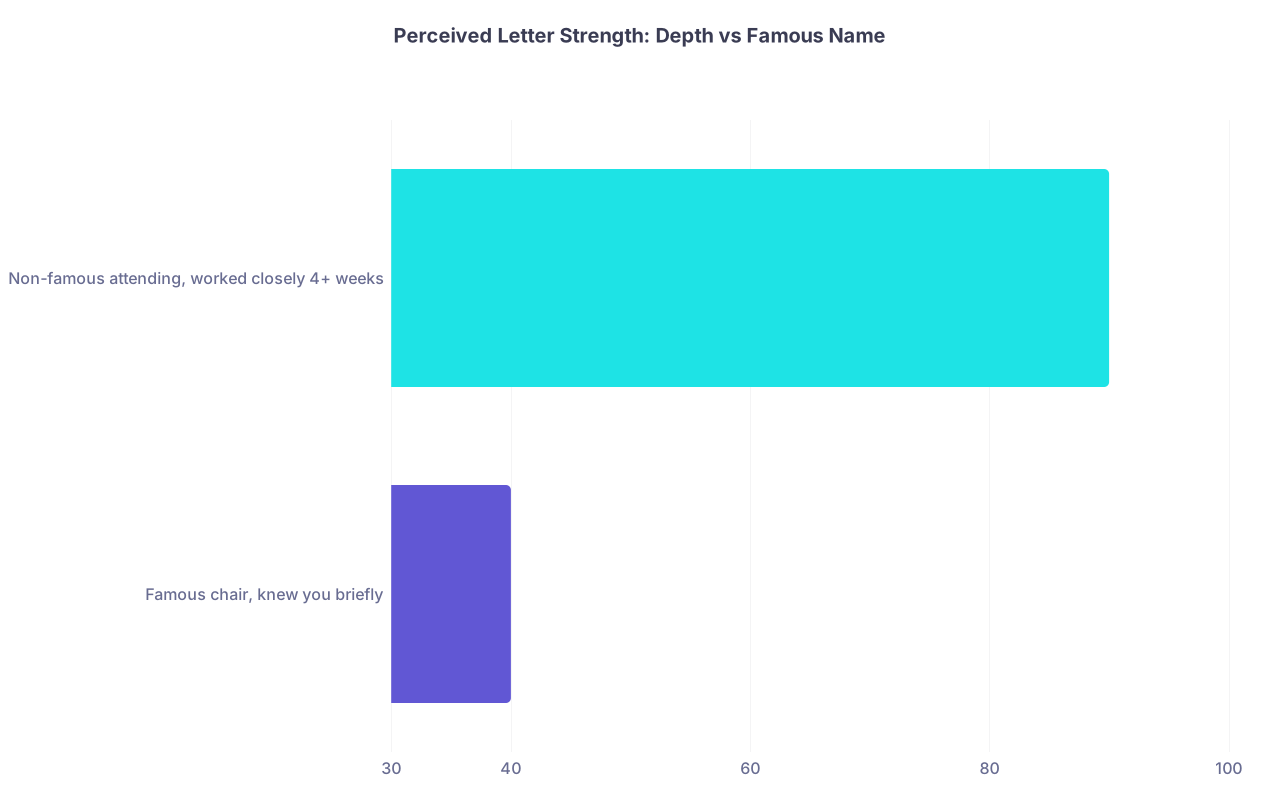
| Category | Value |
|---|---|
| Famous chair, knew you briefly | 40 |
| Non-famous attending, worked closely 4+ weeks | 90 |
Again, the numbers are conceptual, but PD sentiment tracks this direction. Prestige helps only if paired with substance.
Tactical Moves: What To Do During and After a Rotation
You want to maximize the chance that praise actually translates into a strong letter? Then you need to structure your behavior.
During the rotation
- Perform like you’re being compared to the best 5–10 students they’ve seen, not just to your team. Because you are.
- Seek intermediate feedback: “Are there things I could be doing to perform at the level of your strongest students?”
- Make your growth visible: if they give you feedback, implement it publicly and quickly.
Near the end
Direct conversation, short and respectful:
“Dr. X, I’ve really valued working with you and am planning to apply in [specialty]. I was wondering how you feel about my performance compared to other students you’ve worked with, and whether you’d feel comfortable writing me a strong letter of recommendation.”
Their response, tone, and speed will tell you far more than two weeks of casual “good job” comments.
After they agree
Follow up within 24–48 hours:
- Thank them.
- Attach CV, personal statement, and the bullet list of notable patient encounters / contributions.
- Gently remind them of any specific feedback they gave you that could be translated into concrete examples.

| Step | Description |
|---|---|
| Step 1 | Strong performance on rotation |
| Step 2 | Ask for comparative feedback |
| Step 3 | Ask explicitly for strong letter |
| Step 4 | Send CV, PS, bullet points |
| Step 5 | Thank them & choose someone else |
| Step 6 | Enthusiastic yes? |
This is the adult version of the process. Not the wishful, “they said I’m great so I’m set” version.
FAQ: Verbal Praise & Letters of Recommendation
1. The attending told me I was “one of the best students” they’ve had. Is that enough to assume a strong letter?
No. People say that far more often than they mean it in a comparative, PD-usable sense. It’s encouraging, but not dispositive. You still need to ask explicitly whether they can write you a strong letter and see how they respond. Back it up by checking your written evals and whether they remember concrete things you did.
2. Is it rude or risky to ask, “Can you write me a strong letter?”
It’s slightly uncomfortable, but it’s not rude. Serious applicants do this all the time. Faculty who understand the stakes will respect the question. If someone is offended by a professional, honest question about advocacy strength, they’re probably not your ideal letter writer anyway.
3. I already asked an attending for a letter before I knew all this. How can I tell if it’s actually strong?
You can’t see the letter directly (and you shouldn’t ask to), but you can infer. Red flags: they’re very delayed, you barely worked with them, they never asked for your CV/PS, and your eval from them was generic. If you still have time, you can add stronger letters from other attendings to dilute the impact of a weak one.
4. Is a generic but positive letter actually harmful, or just neutral?
Often it’s functionally neutral in a competitive pool, which becomes harmful by comparison. If other applicants have detailed, comparative, specific letters and yours reads like a template, you fall behind. In some specialties (like EM with SLOEs), a generic letter absolutely counts as a negative signal.
5. What if the only attendings who know me well aren’t in my chosen specialty?
That’s still better than a hollow “in-specialty” letter from someone who barely knows you. Programs care about quality and credibility first. You can balance: get at least one letter from your chosen specialty if possible, but don’t sacrifice strength and specificity just to have more on-specialty names. Depth of knowledge of your performance wins.
Key points, stripped of the fluff:
- Verbal praise does not equal a strong LOR; generic positivity is background noise to PDs.
- Strong letters come from depth of observation, comparative language, and explicit advocacy, not from polite compliments.
- If you are not asking directly for a strong letter and giving writers clear examples to work with, you’re gambling your application on wishful thinking.


