
The belief that “a strong chair’s letter can rescue a weak residency application” is fantasy. Comfortable, widespread, and wrong.
Program directors do not read one glowing paragraph from your department chair, toss your Step scores in the trash, and slide you into an interview spot. That story mostly lives in anxious MS4 group chats and hallway gossip, not in actual selection committee meetings.
You’re in the right category—letters of recommendation do matter in the residency match. But the hierarchy isn’t “weak app + powerful chair = safety.” It’s closer to “good app + solid letters = competitive; weak app + brilliant letter = still weak.”
Let me walk through what actually happens with chair’s letters, how PDs really use them, and why banking your entire application on “the chair loves me” is a losing strategy.
What Chair’s Letters Actually Do (and Do Not Do)
Chair’s letters have a role. A very specific, limited role.
In core specialties like internal medicine, surgery, pediatrics, EM, OB/GYN, the “chair’s letter” or “departmental letter” is often expected. It’s a signal that:
- You’re known to the department at least at an administrative level.
- You’re not a hidden professionalism disaster.
- Someone with an official title is willing to put your name on departmental letterhead.
Notice what’s missing: “This proves you’re a star who deserves an interview no matter what the rest of your file looks like.”
Most chair’s letters are formulaic. Many are written by a committee, chief resident, or an APD and then “signed” by the chair. They read like this:
“Ms. X is a graduating medical student at Our University School of Medicine. She completed two rotations in our department, during which she was enthusiastic and hard-working. Faculty and residents describe her as collegial and dependable…”
You know the rest. Generic praise. A few canned adjectives. Maybe one semi-specific sentence someone forced in at the last minute.
Program directors know this game. They’ve read thousands.
A chair’s letter typically confirms the baseline: safe to interview, or at least not obviously unsafe. It rarely redefines the competency picture if your numbers, clerkship performance, and narrative all say “borderline.”
What Program Directors Actually Weight More Than the Chair’s Letter
Look at the data, not the folklore.
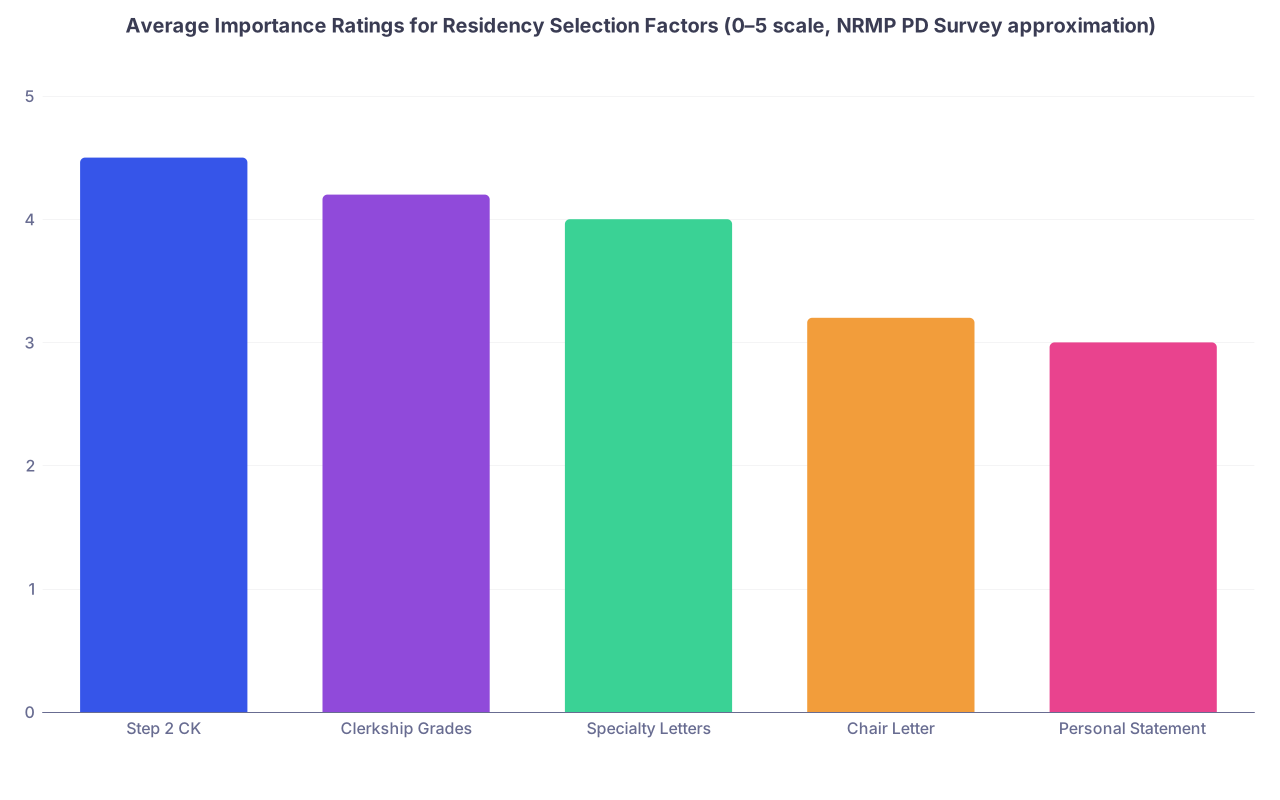
The NRMP Program Director Survey (2018, 2020, 2022) consistently shows that “Letters of recommendation in specialty” are important, but they’re one of several factors. And the big levers usually are:
- USMLE/COMLEX scores (or now Step 2 CK especially)
- Clerkship/third-year performance
- Class ranking/medical school performance evaluation (MSPE)
- Fit with specialty (as seen in your experiences and personal statement)
- Multiple letters in the specialty from faculty who actually worked with you closely
Not “one magical chair’s letter.”
| Category | Value |
|---|---|
| Step 2 CK | 4.5 |
| Clerkship Grades | 4.2 |
| Specialty Letters | 4 |
| Chair Letter | 3.2 |
| Personal Statement | 3 |
Is the chair’s letter considered? Yes. Is it usually the decisive lever? No.
In most real selection meetings, the discussion sounds like:
“Step 2 is 213, two medicine rotations with borderline comments, no AOA, no major red flags, chair’s letter is fine but generic. Probably a courtesy interview for our own student, but not a top rank candidate.”
Or:
“Step 2 252, strong narrative comments, two specialty-specific letters that rave about work ethic and clinical reasoning, chair’s letter solid. Definitely interview and probably rank middle/upper third.”
Notice in both, the chair’s letter is “fine” or “solid” – a supporting actor, not the star. The real weight sits on performance and detailed, experience-based letters.
The Myth of the “Powerful Chair” Who Can Pull You Through
You’ve probably heard this variation:
“Look, my friend had a 210 Step score and some passes on rotations, but the chair loves him and ‘made calls’ so he matched at a great program. So if the chair is on your side, you’re good.”
This story is told in every class. Here’s what’s usually actually happening:
The “weak” application was not as weak as the rumor mill makes it sound.
I’ve pulled the ERAS file on these mythical rescues many times. The “210” was actually a 225 Step 2 with a failed Step 1 that got redeemed, the “passes” included some solid high passes, and there were strong narratives about work ethic, leadership, or some niche strength like language skills or significant prior career.The chair didn’t “overpower” the file. They vouched for context.
Good chairs call programs where they have an actual relationship and say things like, “Listen, this student had some early struggles, but on our home service they functioned at an intern level. I’d put my name behind them.” That can get you looked at more generously—but only at the margins.This works in very specific situations, not as a universal rule.
This kind of call might help:- A home student get an interview at the home program despite some weaknesses
- A borderline candidate get a serious look at a mid-tier program where the chair knows the PD well
- Contextualize a red flag that otherwise might lead to an auto-screen out
It doesn’t regularly turn a chronically failing student with multiple professionalism issues and 10 failed exams into a categorical spot at a top-10 program. Chairs know their own credibility is finite. They don’t spend it trying to sell obviously unsafe interns.
The Real Hierarchy of Letters: Who Matters Most?
Let’s be blunt. PDs care far more about letters from:
- The attending who watched you see patients every day for four weeks
- The sub-I supervisor who saw you take call, write notes, handle cross-cover
- The faculty who can say, “I would trust this person on my team at 2 a.m.”
than a distant department head who met you twice at a lunch and signs 80 letters a year.
A good way to think about it:
- Chair’s letter = institutional stamp and risk screen
- Detailed specialty letters from line faculty = actual data on how you function
- MSPE/clerkship narratives = longitudinal pattern of performance, including any concerning trends

When PDs read applications, the letter that says:
“On our busy inpatient service, she consistently took on the sickest patients, anticipated next steps, and stayed late to make sure plans were executed. Residents requested to work with her again.”
carries more weight than the boilerplate:
“He is a pleasure to work with and will be an asset to any residency program.”
Chairs can write strong, specific letters too, particularly if they’ve truly worked with you (e.g., senior electives, funded research, small departments). But when the only reason you’re banking on the chair’s letter is their title, not their relationship with you, you’re misunderstanding how these letters are read.
When a Chair’s Letter Actually Moves the Needle
There are moments when a chair’s letter matters more than usual. Let’s talk about those, because they’re narrow and specific.
1. Explaining context or a blemish
If you had a rough patch—medical leave, family crisis, remediation—a chair or PD letter that clearly explains the story and explicitly vouches for your current readiness can calm nerves.
Something like:
“During MS2, Ms. Y took a leave for significant family obligations that affected her Step 1 timing and score. Since returning, she has performed at or above the level of her peers in all core rotations, with no professionalism concerns. Our department fully supports her readiness to begin residency.”
That framing matters. It doesn’t erase the numbers, but it changes how they’re interpreted.
2. Backchannel reassurance
Chairs who have been around for 20+ years sometimes have strong backchannel relationships. They’ll call a PD and say, “I know the board scores are low, but I’ve seen this student function; they’ll be a workhorse, not a problem.” Coming from someone whose judgment that PD has trusted for a decade, that can rescue a borderline file.
Borderline. Not catastrophically weak.
3. In small specialties or tight-knit fields
In niche fields (e.g., radiation oncology, some surgical subspecialties), everyone actually knows everyone. A chair’s letter there is more like a direct reference from a known quantity, not just a form. But even then, the letter typically confirms what the rest of the application already hints at—it doesn’t contradict it wholesale.

When You’re Weak: What Actually Helps More Than Praying for a Hero Letter
If your application has weaknesses—and many do—leaning back and saying “It’s okay, I’ll just get a fire chair’s letter” is delusional. Here’s what actually changes outcomes more reliably:
Strong Step 2 (or COMLEX Level 2) performance after a weak Step 1.
Programs explicitly look for “upward trend” or “evidence of improvement.” That’s real, not mythical.Crushing your sub-I and getting granular, behavior-based letters.
“Observed independently pre-rounding, formulating plans, and communicating clearly with the team” is gold to PDs. You earn that on the ward, not in the chair’s office.Targeted applying strategy.
Applying to programs that actually interview people with your stats and background. Not fantasy lists made for ego. That alignment does more for you than any superlative in a chair’s letter ever will.Owning your story in your personal statement and in interviews.
Not making excuses. Explaining what changed, how you improved, and what you can do consistently now.

| Step | Description |
|---|---|
| Step 1 | Application Arrives |
| Step 2 | Score & MSPE Screen |
| Step 3 | Auto Screen Out |
| Step 4 | Read Narrative & Letters |
| Step 5 | Lower Priority or Reject |
| Step 6 | Consider Interview |
| Step 7 | Maybe Chair Call for Reassurance |
| Step 8 | Interview Offer |
| Step 9 | Meets Basic Cutoffs? |
| Step 10 | Letters Consistent with Weakness? |
Notice: the call or the chair’s letter shows up after you’ve passed some baseline filters. It’s modulation, not resurrection.
The Courtesy Interview Trap at Your Home Program
Another quiet myth: “If the chair really likes you, you’ll always get at least a home interview.”
Sometimes true. But not guaranteed—and even when true, it’s not the safety net people think it is.
I’ve seen this scenario more times than I care to count:
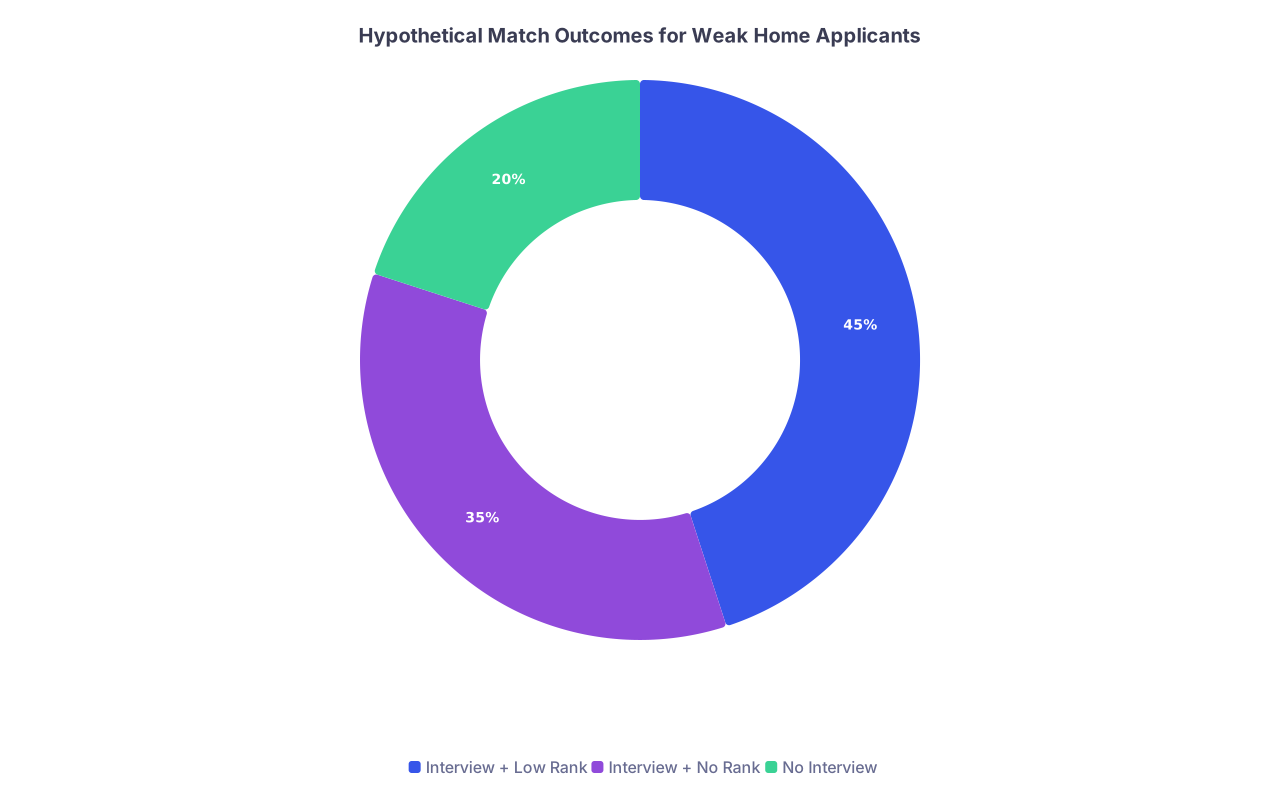
- Home student with weak metrics
- Department feels socially obligated to interview
- Chair writes enthusiastic letter, pushes them into the interview pool
- Committee debrief: “Nice student, but not competitive with the rest. Rank low or do-not-rank.”
| Category | Value |
|---|---|
| Interview + Low Rank | 45 |
| Interview + No Rank | 35 |
| No Interview | 20 |
Sure, the chair’s support got them an interview. It didn’t magically convert them into a rankable candidate above stronger external applicants. Programs are balancing departmental goodwill with the actual need for capable interns who won’t drown in July.
Courtesy can get you a conversation. It rarely gets you protection from reality.
The Red Flag Exception: What a Chair’s Letter Cannot Fix
There are some things no letter—not even from a nationally famous chair—can realistically fix:
- Repeated professionalism violations
- Chronic unreliability: no-shows, late notes, disappearing during call
- Lying, falsifying notes, exam cheating
- Consistently poor clinical reasoning across multiple rotations
Program directors will absolutely pick a quieter, average-scoring but reliable workhorse over a “brilliant” but unstable or dishonest trainee. Every. Single. Time.
And frankly, good chairs know this. They don’t go to war for applicants who will be dangerous interns. They will either refuse to write a strong letter or steer you toward a better-fit specialty or program tier.
If your plan is “I’ll be a disaster but really charming to the chair at the end,” you’re betting on a scenario that experienced faculty simply won’t endorse.
So What Should You Actually Do With the Chair’s Letter?
Treat it for what it is:
- Required box to check in many specialties
- A potential modest amplifier of an already coherent story
- A venue to explain context, not to pretend the numbers don’t exist
Your real levers are still your behavior on the wards, your exams, your sub-Is, and your overall pattern of performance. The chair’s letter is a lens; it doesn’t replace the image.