
The hype around residency letters of recommendation is only half right. They matter a lot—but not in the way most applicants think.
If you actually read the NRMP Program Director Surveys and not just Reddit threads, a clearer picture emerges. Letters are not magic golden tickets. They are one of several filters, and their impact depends heavily on specialty, context, and how they interact with the rest of your file.
Let’s walk through what the data actually show.
What the NRMP Data Say About LOR Importance
The NRMP Program Director Survey is the closest thing you have to “inside information” about what matters. It is not perfect, but it is consistent over years. And letters of recommendation are always near the top.
From several NRMP Program Director Surveys (2018–2023), you see the same pattern:
- Programs are asked:
- “Do you use this factor when deciding whom to interview?” (percentage of programs saying yes)
- “If yes, how important is it?” (mean rating on a 1–5 scale)
Letters of recommendation (regular specialty letters, not MSPE, not personal statement) typically land in:
- Top 3–5 factors used to decide interview offers
- Used by ~80–90% of programs
- Mean importance often around 4.0+ out of 5 among those that use them
To make this concrete, here is a stylized summary using representative ranges from recent surveys. Values are approximate, but they reflect the consistent pattern across years and specialties.
| Selection Factor | % Programs Using for Interview Offers | Mean Importance (1–5) |
|---|---|---|
| USMLE Step 1/COMLEX 1 (pre-pass/fail era) | 90–95% | 4.1–4.4 |
| USMLE Step 2 CK/COMLEX 2 | 85–95% | 4.0–4.3 |
| Grades in Required Clerkships | 80–90% | 4.0–4.3 |
| Letters of Recommendation (specialty-specific) | 80–90% | 4.0–4.4 |
| MSPE (Dean’s Letter) | 80–90% | 3.7–4.1 |
The key point: letters sit in the same weight class as clerkship grades and Step 2 CK, not as some soft, nice-to-have extra.
Put bluntly, for most programs:
- No letters → no interview.
- Weak, generic letters → interview risk, especially if you are not otherwise stellar.
- Strong, specific letters → meaningful positive signal, especially for borderline or mid-range applicants.
How LOR Importance Shifts by Specialty
The data get more interesting when you stop averaging all specialties together. The NRMP surveys consistently show different weighting by field.
Here is a simplified comparison across four archetypal specialty types, again based on ranges and patterns seen across multiple survey years.
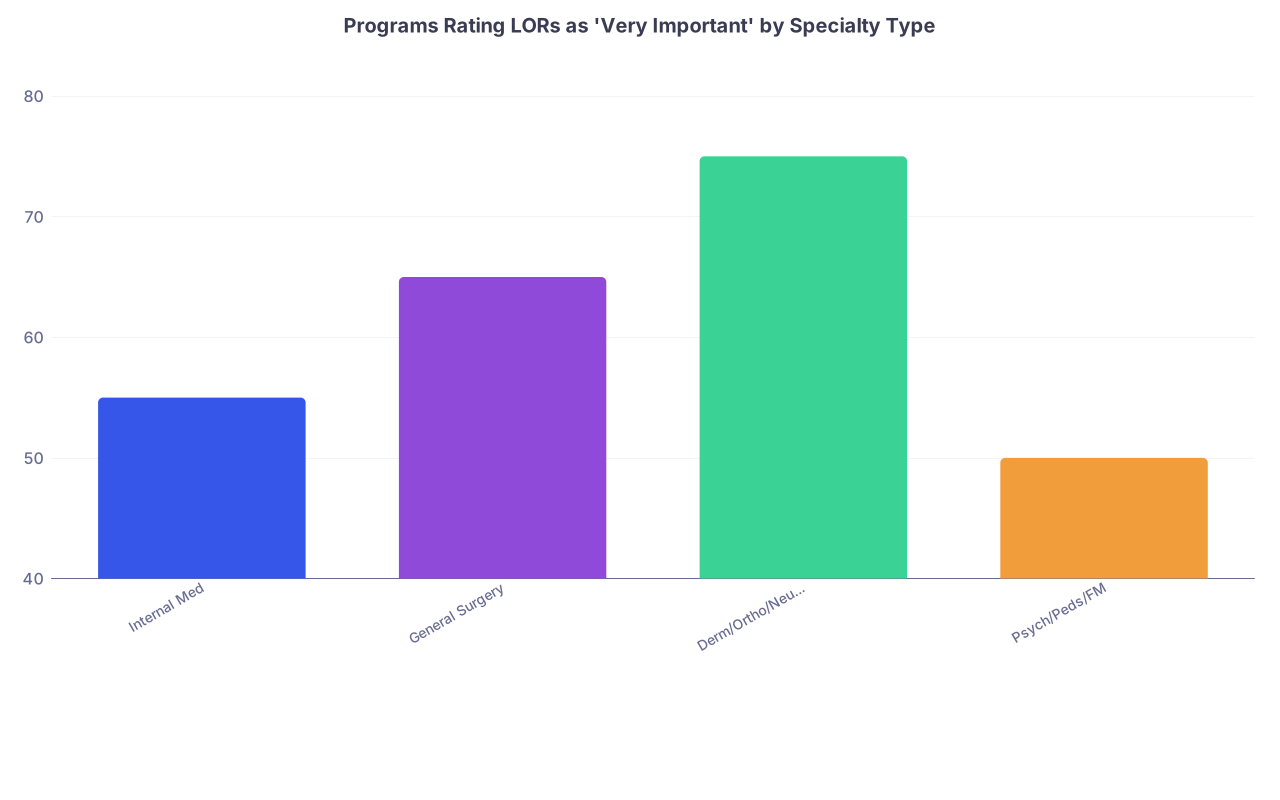
| Category | Value |
|---|---|
| Internal Med | 55 |
| General Surgery | 65 |
| Derm/Ortho/Neurosurg | 75 |
| Psych/Peds/FM | 50 |
What this means in practice:
Competitive procedure-heavy specialties (Derm, Ortho, Neurosurgery, ENT, Plastics):
- Letters are extremely weighted.
- You routinely see program directors rank “Letters of recommendation in specialty” in their top two or three factors.
- The presence of a strong letter from a known faculty name or from a home/away rotation can substantially change how an application is perceived.
General Surgery, Emergency Medicine, OB/GYN, Anesthesiology:
- Letters are heavily used; still in the “core metrics” category.
- For EM especially, standardized SLOEs (Standardized Letters of Evaluation) are structurally built into the decision process. They are not optional “supplements.”
Internal Medicine, Pediatrics, Psychiatry, Family Medicine:
- Letters still matter, but there is more cushion, particularly for community or mid-tier academic programs.
- The difference between good and excellent letters can shift your rank position but may not be make-or-break if you have strong board scores and clerkship performance.
Transitional Year and Preliminary Programs:
- More variable. Some use letters minimally and lean harder on test scores and transcript; others care about narrative fit because they want low-drama interns.
So no, you cannot use a single heuristic like “LORs are 10% of your application” and apply it everywhere. That is fantasy math. Reality: in some fields, letters are almost as critical as your board scores; in others, they are a strong but not dominant factor.
Where in the Process LORs Actually Matter
Another misconception: people treat letters like a final polish step. Something you tack on after the “real” parts of your application.
The sequence in most programs looks more like this:

| Step | Description |
|---|---|
| Step 1 | All Applicants |
| Step 2 | Score & Filter by Exams/GPA |
| Step 3 | Review Core Documents: LORs, MSPE, Clerkships |
| Step 4 | Decide Interviews |
| Step 5 | Interview Evaluations |
| Step 6 | Rank List: Integrate LORs + Interview + File |
LORs touch two major points:
Pre-interview screening.
Once an applicant passes crude screens (exam scores, citizenship/visa, major red flags), many programs move to a more holistic review. Letters are part of this core review, not an afterthought. A clearly negative or lukewarm letter can halt an interview. A strong letter from a known faculty can push an application out of the “maybe” pile into “interview.”Rank list decisions.
After interviews, programs often revisit letters when they are trying to separate very similar candidates. I have sat in rank meetings where the discussion literally went:- “These two Step 2 scores are the same, both honored surgery. What do the letters say?”
- Then someone reads excerpts. Tone, enthusiasm, and specific examples matter more here than generic praise.
So LORs are not just decoration. They participate both in gatekeeping and fine-grained ordering.
What Program Directors Say They Look For in LORs
The NRMP surveys are mostly quantitative, but when you read program director commentary and look at how they score structured letters (e.g., EM SLOEs), the same themes appear.
They are not counting adjectives. They care about signals. Reproducible, behavior-based signals.
Common elements that carry real weight:
- Clear statement of comparative ranking: “Top 5% of students I have worked with in the last 10 years.”
- Direct comparison to co-residents/peers: “Already functions at the level of a PGY-1 early in the year.”
- Evidence of work ethic and reliability: shows up early, stays late, follows through.
- Initiative and ownership: “Took ownership of a complex patient; anticipated problems without prompting.”
- Interpersonal behavior: gets along with nurses, residents, patients; no drama; no toxicity.
- Red-flag avoidance: no hints of professionalism issues, dishonesty, difficulty accepting feedback.
What kills applicants are not “average” letters. It is coded negativity or vague, hedged comments. The data here are qualitative but consistent: program directors are extremely good at reading between the lines. If a writer wants to warn them, they can do so politely and still be crystal clear to an experienced reader.
That is why “letter from a big name who barely knows you” is usually a losing strategy. The NRMP data say programs care far more about the content than the title. A tepid letter from a chair carries less weight than a detailed, specific letter from an associate professor who clearly supervised you closely.
Quantifying “How Much” LORs Matter: A Practical Model
Let’s get more concrete. You cannot assign precise global weights to every factor because specialties and programs vary, but you can outline a reasonable scoring model that matches how directors describe their thinking.
Imagine a program’s internal “pre-interview score” out of 100 points:
- Exams (Step 1/2 or COMLEX): 30–40 points
- Clerkship grades: 15–25 points
- Letters of recommendation: 20–30 points
- MSPE and class rank: 10–20 points
- Research/other extras: 5–15 points
For a moderately competitive specialty (say, anesthesiology or OB/GYN), letters easily sit in the 20–25% contribution range.
For an ultra-competitive procedural specialty, that range can creep up: letters may function as a primary tiebreaker once a large pool of applicants have equally high scores.
Here is a stylized comparison across specialty groups:
| Specialty Cluster | Approx Weight of LORs in Application Decision |
|---|---|
| Ultra-competitive procedural (Derm/Ortho/Neuro) | 25–30% |
| Surgical core (Gen Surg, ENT, Plastics) | 20–25% |
| EM with SLOEs | 25–30% (through structured SLOEs) |
| Medicine-adjacent (IM, Cards track, GI track) | 20–25% |
| Primary care (FM, Peds, Psych) | 15–20% |
These are not official NRMP percentages. But they align with how often LORs appear in the “top factors” lists and with how program directors talk about files in committee.
If your letters occupy 20–30% of your “evaluative space,” then:
- One truly excellent letter can substantially offset a slightly lower Step 2 CK score or a pass instead of honors on one clerkship.
- One weak or concerning letter can sink an otherwise competitive profile, especially in smaller programs where every resident has outsized impact on culture.
Step 1 Pass/Fail: LORs Got a Relative Upgrade
One consequence of Step 1 going pass/fail: programs removed a sharp quantitative filter. The NRMP survey data after this change show more emphasis on:
- Step 2 CK
- Clerkship grades
- “Objective” narrative components like MSPE and structured evaluations
- LORs, especially standardized ones
You can see this in how many programs now list:
- “Letters of recommendation in specialty”
- “Demonstrated interest in the specialty”
- “Fit with program culture”
as rising factors. All of these are now partly inferred from letters.
In other words, even if the absolute weight of letters did not explode, their relative information value increased once one high-signal exam score disappeared.
If you are applying in the post–Step 1–score era and you treat LORs as a minor task, you are ignoring one of the few components of your file that still provides high-resolution information about how you actually function on a clinical team.
Standardized Letters (SLOEs, etc.): Data in Disguise
Emergency Medicine is the best example of a specialty that decided to standardize LOR chaos.
SLOEs (Standardized Letters of Evaluation) are essentially a structured data instrument. They convert subjective impressions into ranked categories and comparative checkboxes.
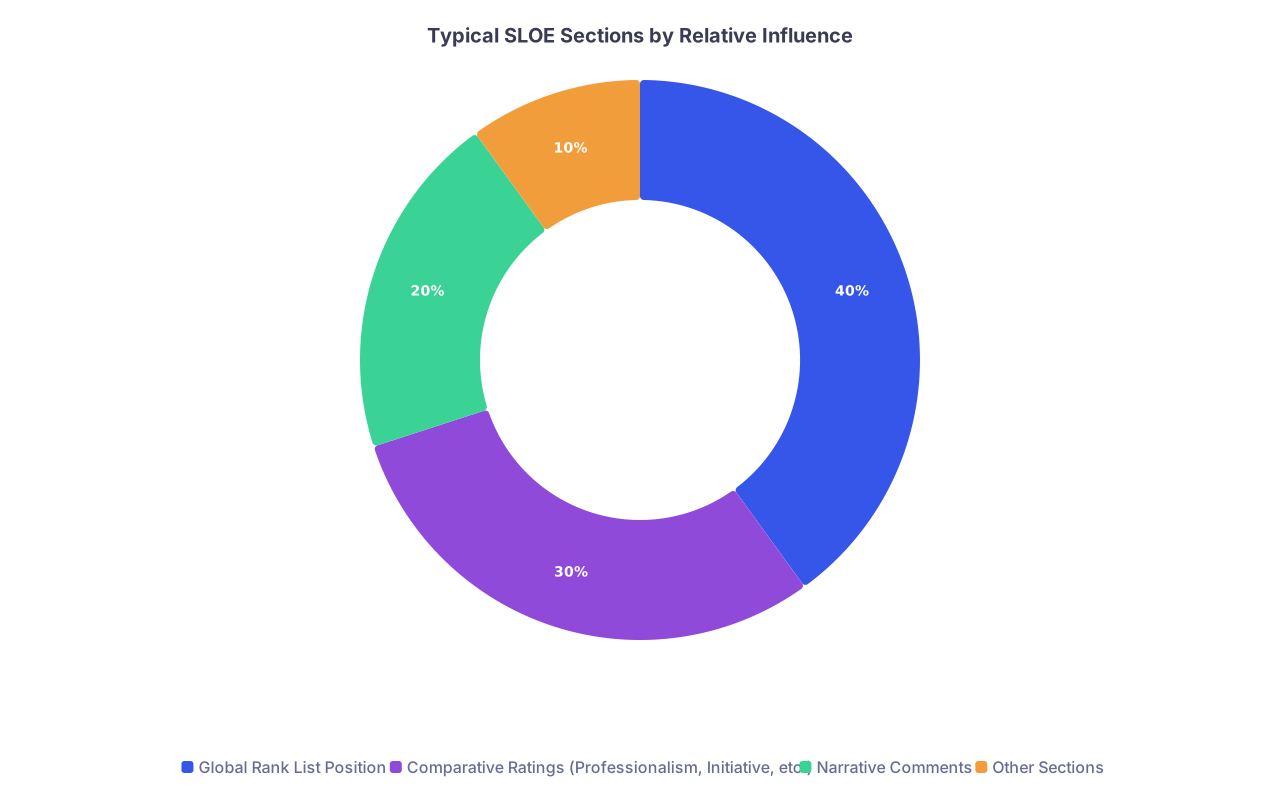
| Category | Value |
|---|---|
| Global Rank List Position | 40 |
| Comparative Ratings (Professionalism, Initiative, etc.) | 30 |
| Narrative Comments | 20 |
| Other Sections | 10 |
The point of SLOEs is simple: reduce inflation, increase comparability, and make it harder for letter writers to hide weak signals behind flowery language.
Other fields are not as standardized, but you will see the same behavioral criteria—professionalism, initiative, clinical reasoning, communication—becoming more explicit even in “free text” letters.
The takeaway: in specialties that use structured letters, the shape of the evaluation is data. You are not just trying to avoid bad comments; you are trying to land in the highest comparative buckets possible.
That requires:
- Working closely with letter writers who actually see you work.
- Performing consistently at a high level on away and home rotations.
- Avoiding the temptation to chase prestige letters at the cost of depth of interaction.
The Real Tradeoffs: Who Writes, How Many, and From Where
From an optimization perspective, you are making three key LOR decisions:
Who writes them.
Data and experience both say: content beats title. A modestly “big” name who knows you well beats a huge name who barely remembers you. The only common exception: if the big name both knows you well and is active in national circles, then their letter carries outsized weight in niche fellowships or subspecialty tracks.Distribution across settings.
Most programs (per NRMP data and individual program websites) want:- 1–2 letters from the target specialty
- 1 from a related core field or sub-internship
- Occasionally 1 from research or another meaningful longitudinal relationship
Oversupplying letters does not help. More data are not always better when readers are time-limited. Three well-chosen, high-quality letters beat five padded ones.
Home vs away vs “big name elsewhere.”
Many program directors give extra weight to:- Home department letters, because they know the grading culture.
- Away rotation letters at respected programs in the same region or reputation band.
Those letters are not only about you; they also encode information like, “This student thrived in an environment similar to ours.”
A simple rule of thumb that matches both survey patterns and what directors say in panels:
- 2 strong specialty letters (home + away or both home)
- 1 strong non-specialty or longitudinal letter (IM, surgery, research, etc.)
is usually sufficient for most fields.
So, How Much Do LORs Really Matter?
If you want a one-line answer anchored in data, here it is:
Letters of recommendation are roughly a quarter of your competitive profile in many specialties and one of the top three deciding factors for interview offers, alongside Step 2 CK and clerkship performance.
More precisely:
- They are nearly universal: ~80–90% of programs use them for interview decisions.
- They are high-importance: mean importance scores often sit in the 4.0–4.4 range (out of 5) for those that use them.
- They are context-sensitive: procedural and highly competitive specialties weight them more; primary care somewhat less.
- They are leverage points: good letters can elevate you; bad or generic ones quietly sabotage you.
The data show you cannot treat LORs as paperwork. They are a high-signal, high-stakes input into both whether you get interviewed and how you are ranked.
If you remember nothing else:
- Program directors almost universally use and value LORs; they sit in the same tier as exams and clerkship grades.
- The content and specificity of a letter matter far more than the prestige of the writer’s title.
- In the post–Step 1–score era, LORs are one of the few remaining pieces that describe how you actually work—and programs read them that way.