
Chasing a PD letter just because they’re “important” is how strong applications get weaker.
If you remember nothing else from this: a detailed, enthusiastic letter from someone who knows you well beats a generic name-brand letter every single time.
Let me walk you through who should write your strongest letters of recommendation (LORs) for residency—and when it should be faculty, fellows, or a program director.
The Core Rule: Choose the Person Who Can Write the Strongest Story
Programs are not counting titles. They’re scanning for evidence.
They want letters that:
- Clearly state how the writer knows you
- Give concrete examples of your performance
- Compare you to peers (“top 10% of students I’ve worked with”)
- Explicitly state support for your success in residency
Title helps. But only if the content matches.
So the hierarchy in practice looks like this:
- Attending/faculty who supervised you closely and liked working with you
- Subspecialty or fellowship-trained attendings in your chosen field
- Program director or chair who knows you reasonably well
- Fellow who worked with you every day and can add real detail
- Famous person who barely remembers you and writes fluff
That last one? Useless. Name recognition without substance gets ignored.
Faculty vs Fellows vs PDs: What Each Actually Brings
Here’s the honest breakdown.
| Writer Type | Best Use Case | Risk / Weakness |
|---|---|---|
| Faculty/Attending | Primary clinical & specialty letters | Can be generic if you were quiet |
| Program Director | Department-level endorsement | Weak if they barely know you |
| Fellow | Supplementary detail-rich clinical letter | Less “weight” if solo writer |
Faculty (Attendings): Your Default First Choice
If you did good work on a rotation and the attending saw you in action multiple times, they’re usually your best letter writer.
Strong attending letters sound like this:
- “I supervised her directly on inpatient GI for 4 weeks.”
- “He independently managed a census of 8–10 complex patients.”
- “Among ~80 students I’ve worked with in the last 5 years, she is in the top 5–10.”
This is the language that moves your application up the pile.
Who are your best faculty writers?
- The subspecialist or attending on your home rotation in your chosen field
- A medicine or surgery attending who saw you on busy, high-responsibility rotations
- An attending you worked with on a sub-I who saw you function almost like an intern
Do not overthink prestige here. A very strong letter from Dr. Solid-But-Unknown is better than a lukewarm letter from Dr. Famous-Writes-Three-Sentences.
Program Directors (PDs): Great When They Really Know You
Program director letters are powerful when:
- They actually watched you on service or in clinic
- They debriefed with attendings who raved about you
- They see your performance over time (home program, sub-I, research year)
A strong PD letter usually does three things:
- Confirms your performance across multiple settings or from multiple evaluators
- Speaks to your professionalism and reliability
- Signals you’ll succeed as a resident (often with explicit match support)
The problem: many students chase a PD letter “just because,” then get this kind of content:
“I have not worked with Ms. X clinically, but based on faculty feedback she was a solid student.”
That letter is basically a wet napkin. Programs can smell distance and generic language.
Ask your PD for a letter when:
- You’re applying to that specialty and they know you or your evaluations well
- You did a sub-I in their program and had more than one interaction
- You’re home-grown (their student) and they’re willing to vouch for you as a future resident
Skip or think twice when:
- You’ve barely met
- There were performance concerns they had to address
- They would just be re-packaging evaluations without direct insight
Fellows: Surprisingly Useful—But Usually Not Your Only “Big” Letter
Here’s the reality I’ve watched repeatedly:
The fellow is the one actually working with you day-to-day.
The attending pops in, co-signs, and rounds.
So who can actually talk about:
- How you responded when cross-cover blew up
- The time you stayed late to call a family and clarify goals of care
- Your attitude when everything was chaos at 5 p.m.?
Often: the fellow.
However, fellows don’t always have the same “institutional weight” as attendings. So use them strategically.
Best ways to use fellow letters:
- As an additional letter, not the only one from a rotation
- In procedure-heavy or ICU rotations where they genuinely supervised your work
- When a fellow knows you extremely well and is respected in the program
You can also ask:
“Would you be willing to co-sign or contribute to a letter with Dr. [Attending]?”
Sometimes the attending will formally sign the letter but heavily use the fellow’s feedback. That gives you both detail and title.
Don’t rely on:
- A single fellow letter in a key specialty with no attending letter at all (if it can be avoided)
- A fellow who just knows you from one call night or one consult day
By Specialty: What Programs Quietly Expect
Different fields have different norms. Here’s the pattern I see most often.
| Specialty | Common Expectation |
|---|---|
| Internal Med | 2 IM faculty (often 1 sub-I), 1 other |
| Surgery | 2–3 surgery attendings, maybe PD |
| Pediatrics | 2 peds attendings, 1 additional |
| Emergency Med | 2 SLOEs (mostly faculty-led) |
| Competitive (Derm, Ortho, etc.) | 2 in field, 1 PD/faculty |
If your specialty has standardized letters (like SLOEs in EM), your priority is whoever can write the most compelling version of that expected letter type. That’s usually faculty, sometimes PD, with fellow input behind the scenes.
How to Decide: A Simple Decision Framework
Strip away the noise and ask these three questions for each potential writer:
Who actually saw me at my best, multiple times?
- Long rotation > one afternoon
- Direct supervision > “I heard you did fine”
Who can compare me to others credibly?
- “Top 10% of students I’ve worked with” carries weight
- “Good” without comparison is nice… and forgettable
Who is likely to write a detailed, enthusiastic letter?
- They gave you strong verbal feedback
- They’ve written letters for students before
- They seem to genuinely like you and respect your work
If a PD ticks all three, use them.
If a fellow ticks all three and an attending only ticks one, use both and make the attending your main letter while the fellow supplements.
How Many of Each: Practical Mixes That Work
Most programs ask for 3 letters. Some allow 4. Use that capacity intelligently.
For a typical categorical medicine applicant:
- Letter 1: IM sub-I attending (saw you function like an intern)
- Letter 2: Another IM attending from a core or elective rotation
- Letter 3: PD or department-level faculty who can summarize your performance
- Optional 4th: Fellow or research mentor who knows you deeply
For a competitive specialty (ortho, derm, ENT, etc.):
- Letter 1–2: Specialty attendings who supervised you closely
- Letter 3: PD or high-ranking faculty who knows you more than superficially
- Optional 4th: Research PI in that specialty
For someone with a heavy research background:
- At least 2 strong clinical letters (faculty)
- 1 research mentor letter if:
- Long-term project, AND
- They can comment on work ethic, independence, reliability
Fellow-only letters: fine as a bonus, not ideal as your anchor.
When a PD Letter Is Mandatory vs Optional
Some specialties and some schools explicitly want a PD or chair letter. Check ERAS program sites and your dean’s office guidance.
Mandatory PD/chair scenarios:
- Some surgical subspecialties
- Some small community programs where the PD letter “validates” you’re safe to train
- Your school may require a departmental letter for certain fields
In those cases, you still triage:
- If your PD knows you: treat it as a strength letter
- If your PD doesn’t: make sure your other 2–3 letters are from people who do, and treat the PD letter as a required but not primary “stamp”
How to Ask (So You Actually Get a Strong Letter)
The question you ask matters. Do not say, “Can you write me a letter?” and leave it there.
Say this instead:
“Based on your experience working with me on [rotation], do you feel you could write a strong, detailed letter of recommendation for my [specialty] residency applications?”
This gives them an out. If they hesitate or downgrade “strong” to “supportive” or “nice,” that is a red flag. Pick someone else if you can.
For fellows:
- “You saw my day-to-day work most closely. Would you be willing to either write a letter or share your detailed evaluation with Dr. [Attending] for a letter?”
That often gets you the best mix—fellow detail, attending signature.
Concrete Examples: Who You Pick in Common Scenarios
Scenario 1: You worked more with the fellow than the attending
Medicine wards, 4 weeks. Fellow rounded with you daily. Attending changed week to week and mostly saw presentations.
Best move:
- Ask the attending for the official letter, but explicitly mention the fellow:
“Dr. [Fellow] supervised me directly most days; they’re happy to share detailed feedback with you.” - Then tell the fellow: “Dr. [Attending] is writing my letter and would really value your input.”
You get institutional weight + specific stories.
Scenario 2: PD barely knows you, but everyone says “get a PD letter”
You met the PD at an orientation and once in the hallway. They did not supervise you clinically.
If there’s no requirement:
- Skip the PD. Get three deep, specific attending letters.
If your school/specialty basically requires it:
- Accept that the PD letter will be a generic endorsement
- Load your application with strong, detailed clinical letters to carry the real weight
Scenario 3: Famous chair vs mid-level faculty who loved you
Do not get seduced by the name.
If the chair:
- Observed you twice in a big conference
- Knows your name from email only
And the mid-level faculty:
- Watched you handle sick patients for 4 weeks
- Gave you end-of-rotation feedback like “you’re one of the best students we’ve seen this year”
Pick the mid-level faculty. Every time.
If you really want the chair’s name, sometimes the solution is:
- Faculty writes the main letter
- Chair co-signs an addendum or short endorsement
But do not trade narrative strength for title.
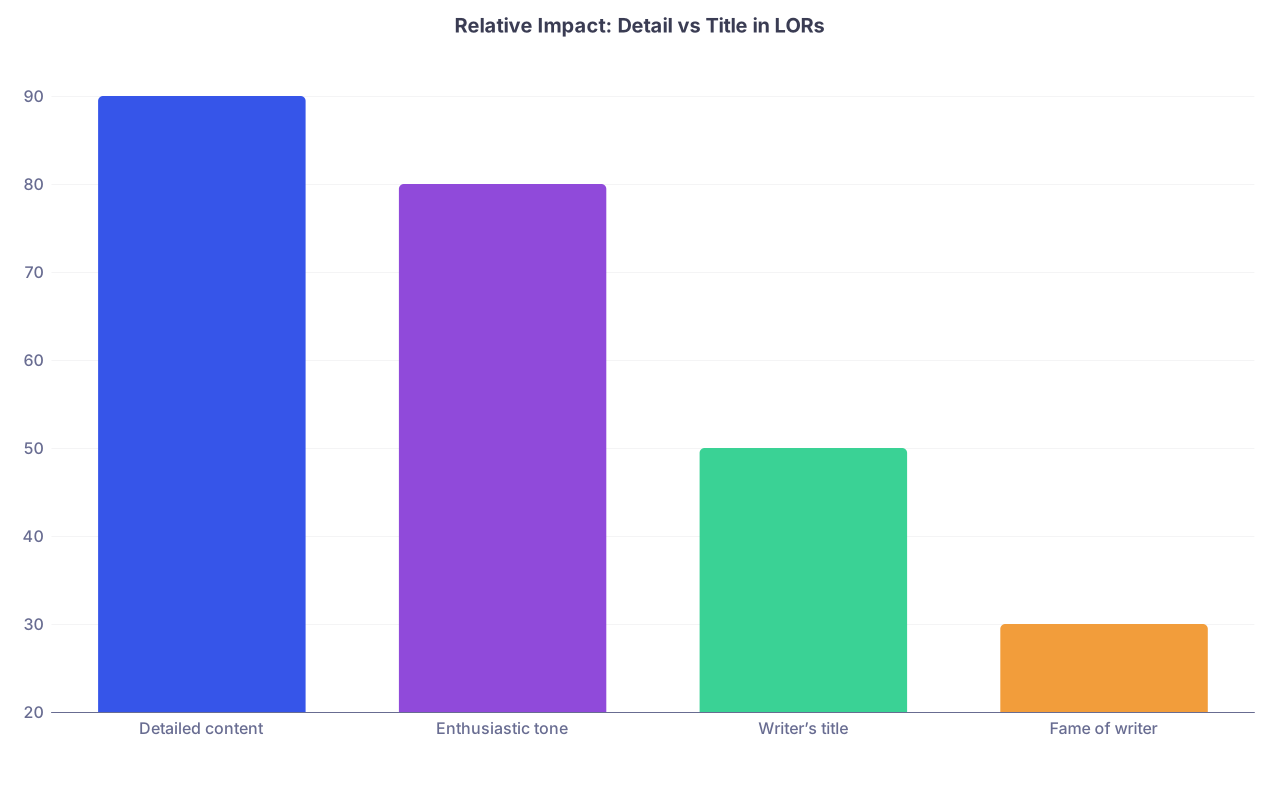
| Category | Value |
|---|---|
| Detailed content | 90 |
| Enthusiastic tone | 80 |
| Writer’s title | 50 |
| Fame of writer | 30 |
FAQ: Common LOR Questions (Answered Directly)
1. Is a generic PD letter better than a strong faculty letter?
No. A strong, specific faculty letter beats a generic PD letter. Use a PD letter when they truly know your work or when your specialty/school requires it. Otherwise, prioritize people who can describe you in detail.
2. Can a fellow be my primary letter writer for a rotation?
They can, but it is not ideal as your only “anchor” letter, especially in your chosen specialty. Best approach: ask the attending to sign the letter with heavy input from the fellow, or use the fellow as a supplementary letter.
3. How many letters should I get from my chosen specialty?
For most fields: 2 letters in your specialty plus 1 from a strong clinical faculty or PD is a safe target. Ultra-competitive specialties often expect at least 2 very strong specialty letters, sometimes 3 if allowed.
4. Do research mentors count as “strong” LOR writers?
Yes—if they know you well and can speak to specific behaviors: work ethic, persistence, independence, reliability. They should not replace clinical letters but can be excellent third or fourth letters, especially in research-heavy specialties.
5. What if the attending barely worked with me but the fellow loved me?
Ask the fellow first, then loop in the attending. Tell the attending that the fellow supervised you closely and is happy to share detailed feedback. Ask if the attending would be willing to write (or co-sign) a letter incorporating that input.
6. What actually makes a letter “strong” in residency applications?
Specifics and comparisons. Strong letters describe what you did, how you did it, how you compared to peers, and state clear support for your future as a resident. Vague praise (“hardworking,” “pleasant,” “good student”) without examples or ranking is weak, no matter who signs it.
Bottom line:
Pick the person who knows you best, not the person with the fanciest title.
Use PDs and chairs when they can genuinely endorse you or when required.
Let fellows feed the rich details, and let attendings (who truly supervised you) do the signing.