
How Many LORs Do I Really Need for Residency? Specialty-Specific Guide
What actually happens if you submit two letters when everyone else is submitting four?
Let me skip the fluff: the number and type of letters of recommendation (LORs) you send can quietly move you up or down a program’s rank list. Not because they read every word of every letter. But because your letters signal how prepared, connected, and serious you are in that specialty.
Here’s the straight breakdown, specialty by specialty, plus when extra letters help and when they’re just dead weight.
Core Rules: Before We Talk Specialties
You need to understand the ERAS and program-level basics first, or the rest of this gets confusing.
Most residency programs:
- Accept: 3–4 LORs total
- Actually read carefully: 2–3 of them
- Strongly prefer: at least 2 letters from physicians in that specialty
- Expect: 1 letter from your department or a “chair” letter in some specialties
Here’s the general rule of thumb:
- Minimum usable number for most specialties: 3
- Optimal number for a competitive application: 3–4 (with the right mix, not random extras)
- More than 4: Almost never helpful; ERAS only lets programs see 4 per program anyway.
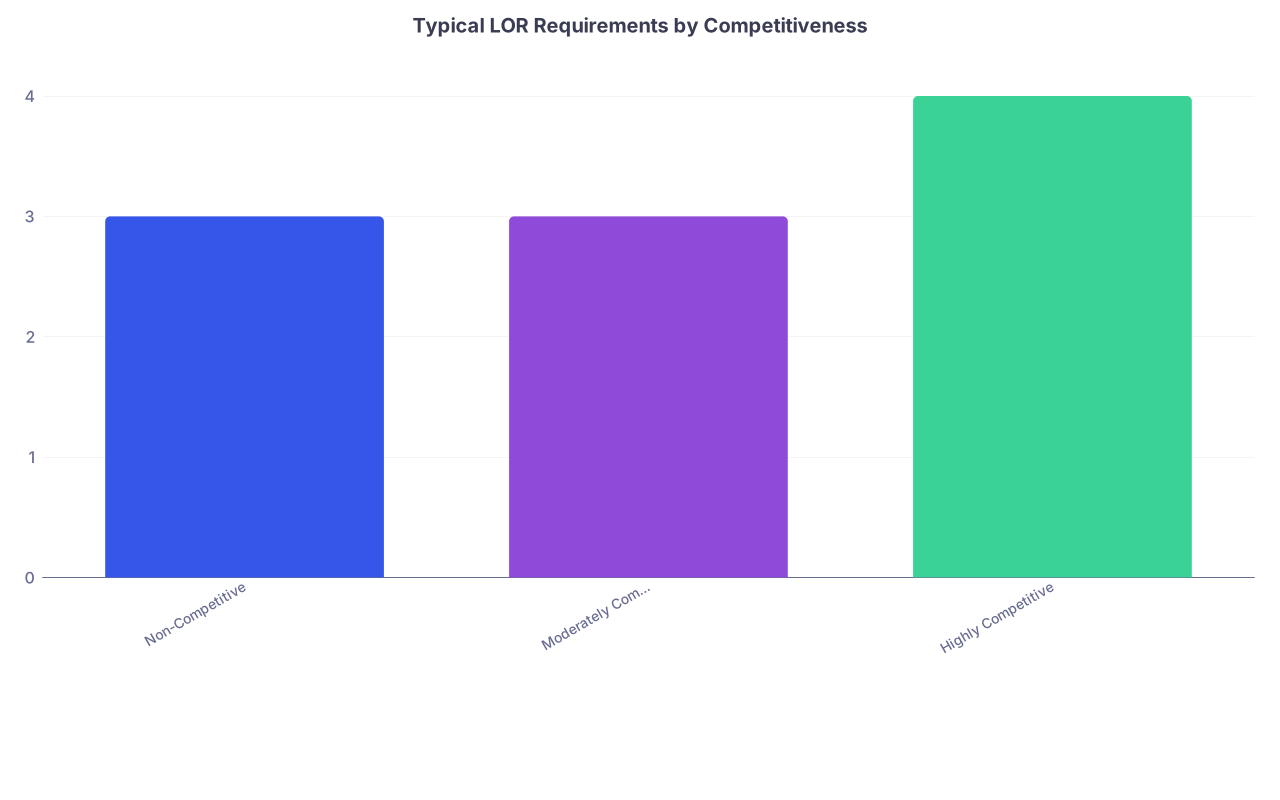
| Category | Value |
|---|---|
| Non-Competitive | 3 |
| Moderately Competitive | 3 |
| Highly Competitive | 4 |
If you remember nothing else: aim for 3 strong, specialty-relevant letters for every program you apply to. Then adjust up to 4 based on your field.
Internal Medicine (Categorical & Preliminary)
IM is flexible but not casual about letters.
Typical expectations:
- Total letters: 3–4
- Specialty letters: At least 2 from Internal Medicine attendings
- Department/Chair letter: Nice but not required everywhere; some academic IM programs still expect one
Safe setup:
- 2 letters from IM attendings (ideally from inpatient wards, acting internship, or sub-I)
- 1 additional letter:
- Another IM attending, or
- Research mentor (IM-focused), or
- Strong letter from a closely related field (e.g., cardiology, ICU)
If you apply to both categorical and prelim IM, you do not need a totally different set of IM letters. Most students use the same 3–4 core letters, maybe swapping in a surgery or anesthesia letter for prelim programs that don’t care about IM-heavy portfolios.
Bottom line for IM:
Submit 3–4 letters, with 2 from IM. Four can help at top academic places if they’re all strong and relevant.
General Surgery (Categorical & Preliminary)
Surgery programs care a lot about who is vouching for you.
Typical expectations:
- Total letters: 3–4
- Specialty letters: 2–3 from surgeons
- Department/Chair letter: Very commonly expected at academic programs
You want:
- 1 departmental / chair / program director letter in General Surgery
- 1–2 letters from surgeons you worked with closely on sub-Is or major surgery rotations
- Optional 1 from:
- Surgical subspecialty (vascular, trauma, colorectal, etc.)
- Strong research mentor in surgery
For prelim surgery, you can:
- Reuse the same surgery-heavy letters
- Add a non-surgical letter (IM, ICU) only if it strengthens your story (e.g., “excellent in critical care, team-oriented, strong work ethic”)
Bottom line for Surgery:
Target 3–4 letters, with 2–3 from surgery, including a departmental-style letter if at all possible.
Emergency Medicine (EM)
EM is weird compared to other specialties because of the SLOE (Standardized Letter of Evaluation). Programs trust SLOEs more than generic letters.
Typical expectations:
- Total letters: 3–4 (but focus is on SLOEs)
- SLOEs: Usually 1–2 from EM rotations (home and/or away)
- Other letters: Only after you’ve secured SLOEs
Standard competitive setup:
- 1 SLOE from home EM rotation
- 1 SLOE from an away EM rotation
- 1 non-EM letter (IM, surgery, ICU, or research) only if it is strong and relevant
If you only have 1 SLOE:
- You’re at a disadvantage for many EM programs.
- Still apply, but you should probably broaden your list and use a second strong clinical letter.
Bottom line for EM:
2 SLOEs + 1 additional letter is ideal. Do not swap out SLOEs for random generic LORs. If you have fewer than 2 SLOEs, you’re below the standard.
Family Medicine
FM is flexible and holistic, but that doesn’t mean they don’t care about letters.
Typical expectations:
- Total letters: 3 (3–4 accepted)
- Specialty letters: Prefer at least 1–2 from FM physicians
- Other clinical letters: IM, Pediatrics, OB/GYN all acceptable and common
Solid setup:
- 1 letter from a Family Medicine attending (ideally continuity clinic or sub-I)
- 1 letter from another FM attending or primary care doc
- 1 from IM, Peds, OB/GYN, or a strong research/leadership mentor
Rural or community FM programs may be more impressed by someone who has:
- Direct FM letters
- Letters that emphasize service, continuity, and community involvement
Bottom line for FM:
3 letters is fine. At least 1–2 from FM strongly preferred. Fourth letter only if it’s clearly strong and relevant.
Pediatrics
Peds behaves a bit like IM but with a focus on kids (obviously) and often more weight on personality and team fit.
Typical expectations:
- Total letters: 3 (3–4 ok)
- Specialty letters: 2 from Pediatricians
- Department/Chair letter: Sometimes used, but not required everywhere
Ideal combo:
- 2 letters from Pediatrics attendings (inpatient, NICU, PICU, or continuity clinic)
- 1 from:
- IM or FM if pediatrics-like setting is limited, or
- Research mentor in child health, or
- Strong sub-I letter in Peds or related field
Bottom line for Peds:
3 letters, with 2 from Peds. You will not look serious about pediatrics with only 1 pediatrics letter if your school had reasonable exposure.
OB/GYN
OB/GYN sits in the middle of IM and Surgery in how formal they are about letters.
Typical expectations:
- Total letters: 3–4
- Specialty letters: 2 from OB/GYN attendings
- Department/Chair letter: Helpful for academic programs
You want:
- 1 departmental or “leadership” OB/GYN letter
- 1 letter from an OB/GYN attending from your sub-I or major rotation
- 1 additional:
- OB/GYN letter (preferred), or
- IM/Surgery letter with a strong clinical endorsement
Bottom line for OB/GYN:
3 letters minimum, aim for 2 OB/GYN letters. Four letters are fine if all are truly strong.
Psychiatry
Psych is more flexible on letter types but cares a lot about how you interact with patients and teams.
Typical expectations:
- Total letters: 3
- Specialty letters: 1–2 from Psych attendings
- Other letters: IM, Neurology, FM also okay
Good combination:
- 1–2 letters from Psychiatry attendings
- 1 letter from:
- IM or Neurology rotation, or
- Research mentor in mental health/behavioral science
If you have zero psych letters, you’ll look like someone who doesn’t actually care about psychiatry.
Bottom line for Psych:
3 letters, with at least 1 Psych letter; 2 is better if you had enough exposure.
Highly Competitive Specialties: How Many LORs You Really Need
For these fields, you do not aim for “minimum." You aim for “clearly committed.”
| Specialty | Total Letters | In-Specialty Letters | Chair/Dept Letter Common? |
|---|---|---|---|
| Dermatology | 3–4 | 2–3 | Yes |
| Orthopedic Surg | 3–4 | 2–3 | Yes |
| Neurosurgery | 3–4 | 3 | Yes |
| Plastic Surgery | 3–4 | 2–3 | Often |
| ENT (Otolaryng) | 3–4 | 2–3 | Yes |
Dermatology
- Total: 3–4
- Specialty letters: 2–3 derm letters
- Often 1 department/chair letter, plus letters from derm research or sub-Is.
If you show up with 1 derm letter and 2 random IM letters, you look like a backup applicant.
Orthopedic Surgery
- Total: 3–4
- Specialty letters: 2–3 ortho letters
- Aim for: 1 chair/PD letter + 1–2 ortho attendings you worked with on away and home rotations.
Neurosurgery
- Total: 3–4
- Specialty letters: typically 3 neurosurgery letters
- Programs want to see their colleagues vouch you can handle this life.
Other letters are secondary.
Plastic Surgery (Integrated)
- Total: 3–4
- Specialty letters: 2–3 plastics letters
- Often from: home plastics faculty, away rotations, research mentors.
ENT (Otolaryngology)
- Total: 3–4
- Specialty letters: 2–3 ENT letters
- Department/Chair letter is expected at many programs.
Bottom line for competitive specialties:
You need 3–4 letters, with the majority in that specialty, and at least one from someone respected/known in the field (chair, PD, or active academic surgeon/derm/etc.).
Transitional Year (TY) & Preliminary Programs
These are “one-year” programs (prelim medicine/surgery, TY) feeding into advanced specialties (like Radiology, Anesthesia, Derm).
You’re usually submitting letters in the context of your advanced specialty plus their needs.
For TY and prelim:
- Total letters: 3 accepted almost everywhere
- Type: They’re fine with IM, Surgery, EM, or specialty letters, as long as they show you’re safe, hardworking, and not a problem.
If you’re applying to:
- Advanced Anesthesia + TY:
- 2 Anesthesia or IM/Surgery letters
- 1 general clinical or research letter
- Radiology + prelim IM:
- 1–2 Radiology or IM letters
- 1 strong general clinical letter
Bottom line:
Use your best clinical letters plus 1–2 in your final chosen specialty. TY and prelim programs care more about reliability and work ethic than perfect specialty match.
How Many LORs for Dual-Application Strategies?
Some of you are applying to two specialties: IM + EM, IM + Neuro, Surgery + Anesthesia, etc. Mess this up and you’ll look non-committal in both.
Straightforward approach:
- Build 4 total strong letters.
- Assign them differently by program on ERAS.
Example: IM + EM
- EM SLOE 1
- EM SLOE 2
- IM attending letter
- Research or IM/EM hybrid letter
For EM programs:
- Use SLOE 1 + SLOE 2 + IM or research letter (3 or 4 total).
For IM programs:
- Use IM letter + research/IM + maybe 1 SLOE (only if that SLOE strongly talks about internal medicine-like skills; otherwise it can look odd).
If you’re dual applying to two completely different cultures (like Ortho + FM), you really need:
- 2–3 in Specialty A
- 2–3 in Specialty B
You will be stretching. But it’s possible.
When Is a Fourth Letter Worth It?
A 4th letter helps if:
- It’s from a big name in your field who actually knows you.
- It’s from a major research mentor with real, specific praise.
- It adds new information (different setting, different strengths).
A 4th letter does not help if:
- It repeats the same bland “hard-working, a pleasure to work with” stuff.
- It’s from someone who barely knows you.
- It’s totally off-field and generic (e.g., your pre-med volunteer supervisor).
Programs can only see 4 letters per application. Don’t waste slots.
Quick Process: How to Decide Your Exact Number
Use this mini-decision framework:

| Step | Description |
|---|---|
| Step 1 | Start |
| Step 2 | Target 4 letters |
| Step 3 | Target 3 letters |
| Step 4 | Add 1 strong research/clinical |
| Step 5 | Get more in-specialty rotations |
| Step 6 | Use 2 specialty + 1 strong clinical |
| Step 7 | Prioritize specialty letters ASAP |
| Step 8 | Specialty highly competitive? |
| Step 9 | Have 3 in-specialty? |
| Step 10 | Have >=2 in-specialty? |
If you’re applying this cycle, your next move is simple: list your current attendings and categorize them by specialty, influence, and how well they know you. Then commit to a target: 3 or 4 based on your field and competitiveness.
FAQs (Exactly 5)
1. Is it bad if I only have 2 letters total?
Yes, for most specialties that’s not enough. Three is the functional minimum for a credible ERAS application. Two letters looks unfinished unless a program explicitly states they only accept two (very rare).
2. Can I reuse the same letters for every program?
Usually yes, and most people do. ERAS lets you assign different combinations to different programs, but you don’t need a unique letter for each. You just need a strong set of 3–4 and then choose combinations that make sense (e.g., more research-heavy for academic programs if you have that option).
3. How old is too old for a letter of recommendation?
Older than 1–2 years starts to look stale, unless you’ve maintained an ongoing, current relationship (research mentor, long-term clinic, etc.). For residency, programs want recent performance in clinical settings. If you’re a recent grad, aim for letters written in the current or just-prior academic year.
4. Do programs care more about who wrote the letter or what it says?
Both, but in different ways. Big-name attendings or chairs get initial attention; then content decides if the letter actually helps. A detailed, specific letter from a mid-level attending who clearly knows you is more valuable than a generic “template” letter from a famous person who barely remembers you.
5. Should I waive my right to see the letter?
Yes. Always waive. Not waiving creates suspicion that the letter might be influenced or that the writer held back. Programs are used to confidential letters; a non-waived letter can quietly hurt you.
Open your list of potential letter writers right now and label each one: specialty, strength (1–10), and how well they know you. Then decide: are you aiming for 3 letters or 4? Once that’s clear, you’ll know exactly who you still need to ask—today.