
A strong research LOR can help, but it almost never fully replaces a needed clinical letter. If you treat it as a substitute instead of a supplement, you’re taking a real risk.
Let me walk you through when a research letter can function “as good as” a clinical letter, when it clearly cannot, and how to build a strategy that doesn’t get your application quietly downgraded.
1. The Core Issue: What Programs Actually Want
Residency programs are not hunting for “three letters.” They’re hunting for specific evidence:
- Can you function as a day‑one resident on the wards/OR/clinic?
- Will you show up, do the work, and not be a problem?
- Do people who supervised you—clinically and academically—believe in you?
Clinical letters answer #1 and #2. Research letters mainly answer #2 and #3.
So the real question isn’t “Can my research LOR substitute?”
The real question is: “Given what this program requires and values, will I be penalized for having fewer true clinical letters?”
Common program patterns
Here’s the general breakdown I’ve seen across programs and specialties:
| Specialty | Minimum Clinical LORs | Research LOR Value | Comments |
|---|---|---|---|
| Internal Med | 2 | High | 1 research often welcomed |
| General Surgery | 2–3 | Moderate–High | Do not skimp on surgery clinical letters |
| Pediatrics | 2 | Moderate | Strong clinical focus |
| Neurology | 2 | High | Especially valued in academic programs |
| Radiology | 1–2 | Very High | Research heavy field |
| Psychiatry | 2 | Moderate | Fit and clinical narrative matter most |
If a program’s language says:
- “At least 2 clinical letters, 1 can be research” → your research letter can functionally substitute for a third clinical letter.
- “We require 3 clinical letters” → a research letter does not substitute, no matter how good it is.
Always read the program’s website and ERAS instructions. If they explicitly require a certain number of “clinical” letters, a research LOR is a bonus, not a replacement.
2. When a Research LOR Can Act Like a Clinical Letter
There are narrow cases where a research letter is essentially half‑clinical, half‑academic—and programs treat it as such.
Scenario A: Your PI supervised you clinically and in research
This is the strongest case. For example:
- You did an inpatient cardiology sub‑I with Dr. X.
- You also worked in Dr. X’s outcomes research lab for a year.
- Same attending, saw you in both environments.
If that PI writes about your:
- Patient care
- Clinical reasoning
- Teamwork and reliability on the wards
- AND your research productivity
That letter can effectively count as a clinical letter in the eyes of many programs, even if ERAS doesn’t tag it “clinical.”
If you’re in this situation, explicitly ask your PI:
“Could you comment in detail on my performance on the cardiology sub‑I and how I functioned clinically on the team? Many programs want clinical performance discussed.”
Scenario B: Research was embedded in a clinical service
Think of clinical research associates in an oncology clinic, or QI projects that required you to:
- Round daily
- Present on patients
- Coordinate with nurses and other residents
If the research attending observed you interacting with patients, fielding pages, and making basic clinical decisions, they can comment credibly on resident‑like behavior. That kind of letter can partially substitute for a weaker clinical letter.
But there’s still a catch: most programs want to see at least one “pure” ward‑based evaluation. They like to hear from someone who saw you pre‑round, write notes, take cross‑coverage calls, and be tired at 2 a.m.
Scenario C: You’re applying to a research‑heavy, academic program
Some programs—especially in:
- Radiology
- Neurology
- IM physician‑scientist tracks
- Certain university anesthesia or path programs
will absolutely light up when they see a big‑name PI calling you the best mentee in 10 years. In those environments, a top‑tier research letter can function as a major “plus factor,” and slight imperfections in clinical letter count may be overlooked.
But even there, they usually still want a minimum floor of clinical validation. No one wants an intern who’s never been battle‑tested on call.
3. When a Research LOR Clearly Does Not Substitute
Now the blunt part. Here’s where you absolutely cannot treat a research letter as a replacement.
1. When the program explicitly demands X clinical letters
If a program states:
- “Three letters, at least two must be from clinical rotations and one from a sub‑internship in our specialty.”
and you submit:
- One sub‑I letter
- One general IM or surgery letter
- One research letter from a lab‑only PI who’s never seen you on the wards
You technically meet the “three letters” requirement. But you may fail the “we want three clear clinical voices” expectation. They won’t always spell that second part out. They just quietly rank you lower.
2. When you lack any strong, detailed clinical letter
If all your clinical letters are:
- Generic (“pleasant to work with,” “arrived on time,” “worked well with the team”)
- Short and nonspecific
- Written by someone who barely remembers you
A superstar research letter does not fix that. It just telegraphs that you may be hiding weak clinical performance behind academic shine.
I’ve seen rank meetings where someone says, “Great research, but where is the letter that tells us they can actually run a list and handle cross‑cover?” and the file stalls right there.
3. Procedural / high‑acuity fields
For general surgery, EM, OB/GYN, anesthesia—your ability to:
- Handle pressure
- Be safe with procedures
- Work in high‑stakes, fast‑moving situations
has to come from people who watched you in exactly that environment. A research letter from a basic science lab, no matter how impressive, doesn’t substitute for a trauma surgery attending saying, “They’re calm, safe, and teachable at 3 a.m.”
4. How Many Clinical vs Research Letters Should You Aim For?
Let’s be concrete. Here’s a straightforward target mix that works for most people.
General rule of thumb
If programs allow 3–4 letters:
- Aim for 2 strong clinical letters in your chosen specialty or core rotations.
- Add 1 research letter if it’s truly strong and relevant.
- Use the 4th slot (if allowed) for:
- Another clinical letter, or
- A departmental chair / away rotation letter.
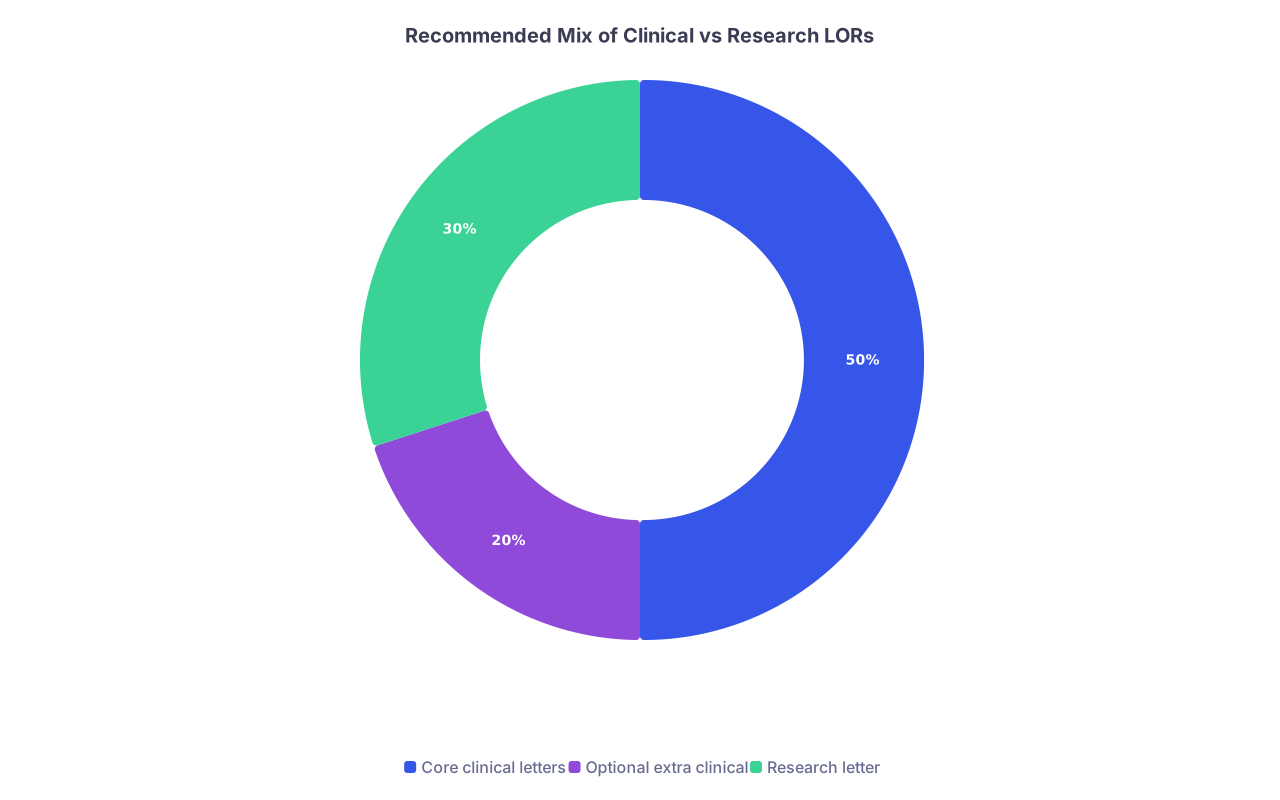
| Category | Value |
|---|---|
| Core clinical letters | 50 |
| Optional extra clinical | 20 |
| Research letter | 30 |
If they only allow 3 letters:
- Usually: 2 clinical + 1 research
- If no research: 3 clinical
- If research is your main strength: 2 clinical (non‑negotiable) + 1 powerhouse research
If a program clearly prefers more clinical content, skew to 3 clinical + 1 research where allowed.
5. Making Your Research LOR As “Clinically Useful” As Possible
If you are going to lean on a research LOR, you need to build it right. A vague “worked hard in lab, nice person” letter is barely worth the slot.
Choose the right writer
You want a PI or research mentor who:
- Actually knows you well
- Can compare you to other residents/medical students meaningfully
- Has seen you in stressful situations, on deadlines, in team conflicts
Big name + weak content is less useful than mid‑name + detailed praise.
Give them a focused ask
When you request the letter, don’t just say “Can you write me a strong letter?” Try this instead:
“I’d be very grateful if you could comment not just on my research productivity, but also on how I work in a team, respond to feedback, communicate under pressure, and follow through on clinical or project responsibilities. Programs use research letters to infer how we’ll function as residents.”
This nudges them to hit the “resident‑like behavior” themes programs care about: reliability, ownership, resilience.
Provide ammo
Hand them:
- A one‑page “brag sheet” with:
- Specific projects you led
- Times you troubleshot problems
- Moments you stayed late to finish something important
- Your personal statement or CV with your intended specialty clearly marked
- Summary of which programs you’re targeting (community vs academic, heavy research vs clinical)
You want them to write a letter that sounds like, “This person will thrive as a neurology resident at an academic medical center,” not just “good in research.”
6. Strategy by Specialty: How Risky Is Substituting?
A quick specialty‑by‑specialty reality check.
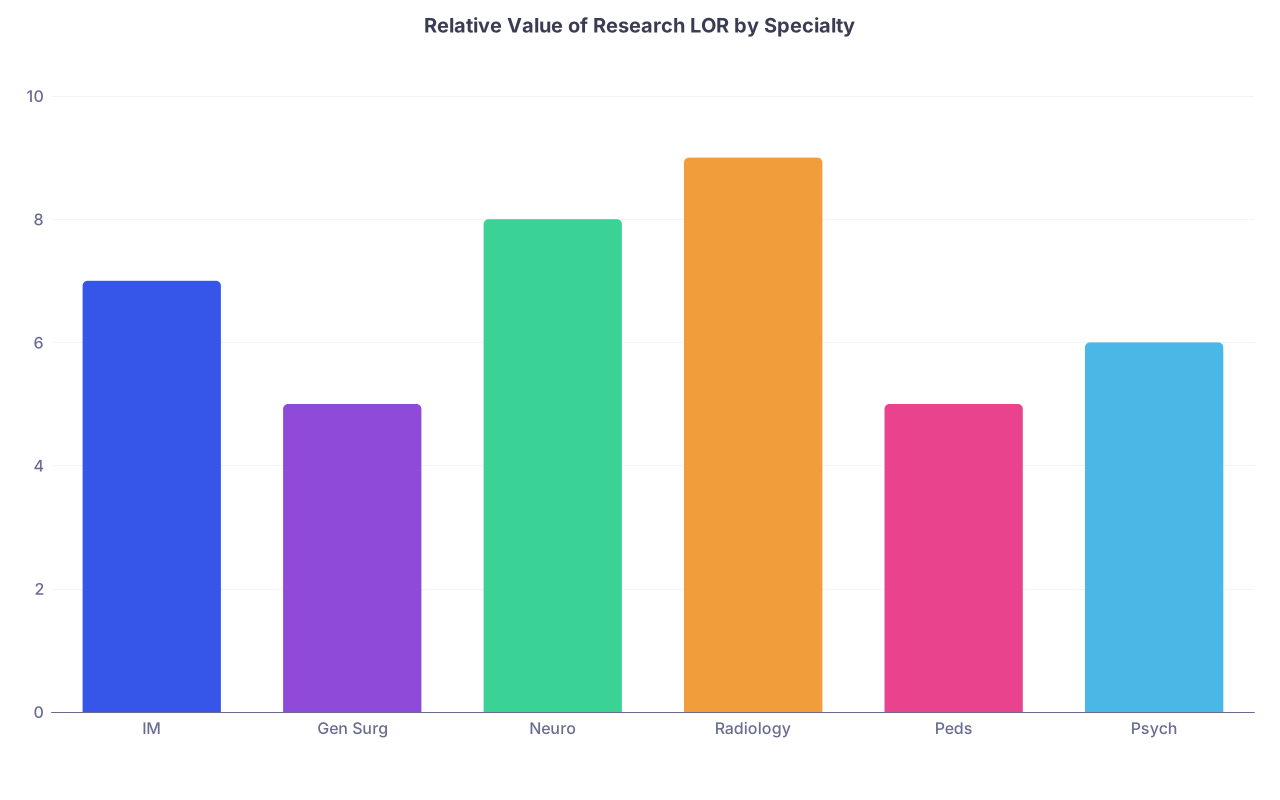
| Category | Value |
|---|---|
| IM | 7 |
| Gen Surg | 5 |
| Neuro | 8 |
| Radiology | 9 |
| Peds | 5 |
| Psych | 6 |
(Scale 1–10: higher = research letters are more valuable and more likely to offset minor clinical gaps.)
Internal Medicine
- Can a strong research LOR substitute for an extra clinical letter?
Sometimes, especially for academic IM programs and PSTP/physician‑scientist tracks. - Still aim for: at least 2 rock‑solid clinical IM letters.
General Surgery
- Research is valued, but if you shortchange operative/ward letters, you look risky.
- Use research LOR as a 4th letter, not as a replacement for a surgery attending who saw you scrubbed in and taking call.
Neurology
- Academic neurology loves research, especially in stroke, epilepsy, neuroimmunology.
- A powerful research LOR can offset not having a 3rd neuro letter, but not having any strong neuro clinical letter is a problem.
Radiology
- Research LORs can be huge here, particularly if from radiology, AI, imaging, or relevant fields.
- Still need at least one core clinical letter showing you functioned well as a medical student on wards.
Pediatrics / Psychiatry
- Fit, communication, and bedside manner letters carry a lot of weight.
- Research letters help, especially for academic child psych, developmental peds, etc., but they won’t replace a good inpatient or outpatient attending speaking to how you handle families and team dynamics.
7. If You’re Short on Clinical Letters Right Now
If you’re reading this late and realizing you’re light on clinical letters, here’s the triage plan.

| Step | Description |
|---|---|
| Step 1 | Assess current letters |
| Step 2 | Add best research LOR as supplement |
| Step 3 | Identify upcoming or recent rotations |
| Step 4 | Email attending with specific request |
| Step 5 | Prioritize current rotation for LOR |
| Step 6 | Ask mid-rotation for feedback & LOR |
| Step 7 | At least 2 strong clinical? |
| Step 8 | Can you request retroactive letter? |
Steps:
- Count how many truly strong clinical letters you have (specific, detailed, enthusiastic).
- If it’s fewer than 2:
- Go back to recent rotations and ask attendings directly.
- If needed, request a letter late and give them a reminder of who you are and what you did.
- Use your best research letter as:
- Letter #3 or #4, not #1 or #2.
- If timing is tight:
- Submit applications with what you have.
- Add stronger clinical letters as they come in; programs do see late-added letters.
8. How Program Directors Actually Read This Mix
Program directors are skimming, not doing literary analysis. Their mental checklist looks a lot like this:
- Do I have at least 2 voices saying this person works hard, is teachable, and is safe clinically?
- Does anyone say they’re in the top X% they’ve worked with?
- Is there evidence they can handle the kind of program we run (academic vs community, research vs pure clinical)?
A strong research LOR checks boxes for:
- Work ethic
- Intellectual curiosity
- Follow‑through
- Initiative
A strong clinical LOR checks:
- Reliability on the floor
- Communication with patients and staff
- Speed of learning and independence
- How you behave when tired, busy, and frustrated
You want both boxes checked. Over and over, if possible.

9. Bottom Line: So, Can It Substitute?
Here’s the distilled answer you probably wanted at the top:
- If the program requires a specific number of clinical letters, a research LOR does not officially substitute.
- If the program allows flexibility and you already have 2 strong clinical letters, a powerful research LOR can functionally serve as your “extra” letter without hurting you.
- In research‑heavy specialties or academic tracks, a top‑tier research LOR may be almost as valuable as an additional clinical letter—sometimes more.
- But if you’re light on solid clinical endorsements, a research LOR will not rescue that weakness. It just shifts your profile toward “good student, unproven clinician.”
Use research letters as a force multiplier, not a shield.

FAQ (Exactly 6 Questions)
1. If I only have one strong clinical letter, should I still use my research LOR?
Use your research LOR, but do not stop there. One clinical letter is below what most programs are comfortable with. Actively chase a second strong clinical LOR from a recent or current rotation, even if it means a late-arriving letter. Your research LOR should be a supplement, not the crutch.
2. Does a research letter from a famous PI help more than a clinical letter from a relatively unknown attending?
If the clinical letter is generic and the famous PI writes a detailed, enthusiastic letter—yes, the PI letter often helps more. But the ideal is not either/or. You want at least two detailed clinical letters plus that big‑name research letter. Fame amplifies; it doesn’t replace the fundamental need for someone to vouch that you can actually function on the wards.
3. Can a department chair letter substitute for a clinical letter?
Depends what’s in it. Many chair letters are template‑like and impersonal, which makes them weak as true clinical evaluations. If the chair personally supervised you clinically and writes specifically about that, it can function as a clinical letter. If it’s just “department overview + 2 generic sentences about you,” it’s not a real substitute.
4. Should I send more than the minimum number of letters if I have both strong clinical and research LORs?
If ERAS and the program allow 4 letters, sending 3–4 strong letters is usually better than 2–3. But don’t send weak extras just to hit a number. Four strong letters (2–3 clinical, 1–2 research/departmental) is a sweet spot. Beyond that, more adds noise, not value.
5. What if my only really strong letter is from research and my clinical letters are mediocre?
Then you’ve got a lopsided application. Use the research letter, of course, but your priority should be getting at least one more recent clinical letter that’s genuinely strong. Consider an away rotation, a sub‑I, or asking a clinical faculty member who knows you better to write a new letter, even mid‑application season.
6. How do I know if my research letter is actually “strong”?
Ask directly: “Do you feel you can write me a strong, detailed letter for residency?” Strong letter writers usually say yes with no hesitation and may mention specific things they’ll highlight. Also, clues: they know your work well, have praised you compared to peers, and have seen you overcome challenges. If they seem lukewarm or vague, do not rely on that letter to substitute for anything critical.
Key points:
- A strong research LOR is a powerful supplement, but it rarely fully replaces a needed clinical letter.
- Aim for at least two robust clinical letters, then layer research on top—especially for academic or research‑leaning programs.
- When in doubt, prioritize letters from people who saw you function as a budding resident, not just as a productive researcher.