
The short but specific letter of recommendation usually beats the long generic one. And sometimes it is not even close.
If you remember nothing else, remember this: vague praise is invisible. Concrete detail is what moves program directors.
Let me walk you through how people on the other side of ERAS actually think about this.
The Real Answer: Specific > Length, Almost Every Time
Residency readers are busy and cynical. They’re scanning 60–100 applications in a sitting. Nobody is impressed by a full-page wall of clichés.
A short letter that says:
“I directly supervised Dr. Patel on our inpatient medicine service for 4 weeks. She independently managed 8–10 complex patients daily, anticipated cross-cover issues, and wrote notes I felt comfortable co-signing without edits. I ranked her in the top 10% of students I’ve worked with in the last 5 years for clinical reasoning and professionalism.”
…is worth more than a page and a half of:
“It is my great pleasure to recommend this outstanding student. She is hard-working, compassionate, and will be an excellent resident in any program she chooses.”
Same student. One letter actually tells the committee something. The other just fills space.
Here’s the rule:
If a letter has clear context + direct observation + comparison to peers + specific examples, it can be 2–3 paragraphs and still be strong. Length only helps when it’s full of those four things.
How Program Directors Actually Read LORs
They do not read every word like it’s a novel. They skim with a purpose:
- Who is the writer and how well do they know you?
- What did you actually do? In what setting? How long?
- How did you compare to other students/residents they’ve seen?
- Any red flags or soft language?
- Does the letter support the narrative of your application?
Most PDs, APDs, and selection committee members read LORs fast. They zero in on a few key phrases and structural clues.
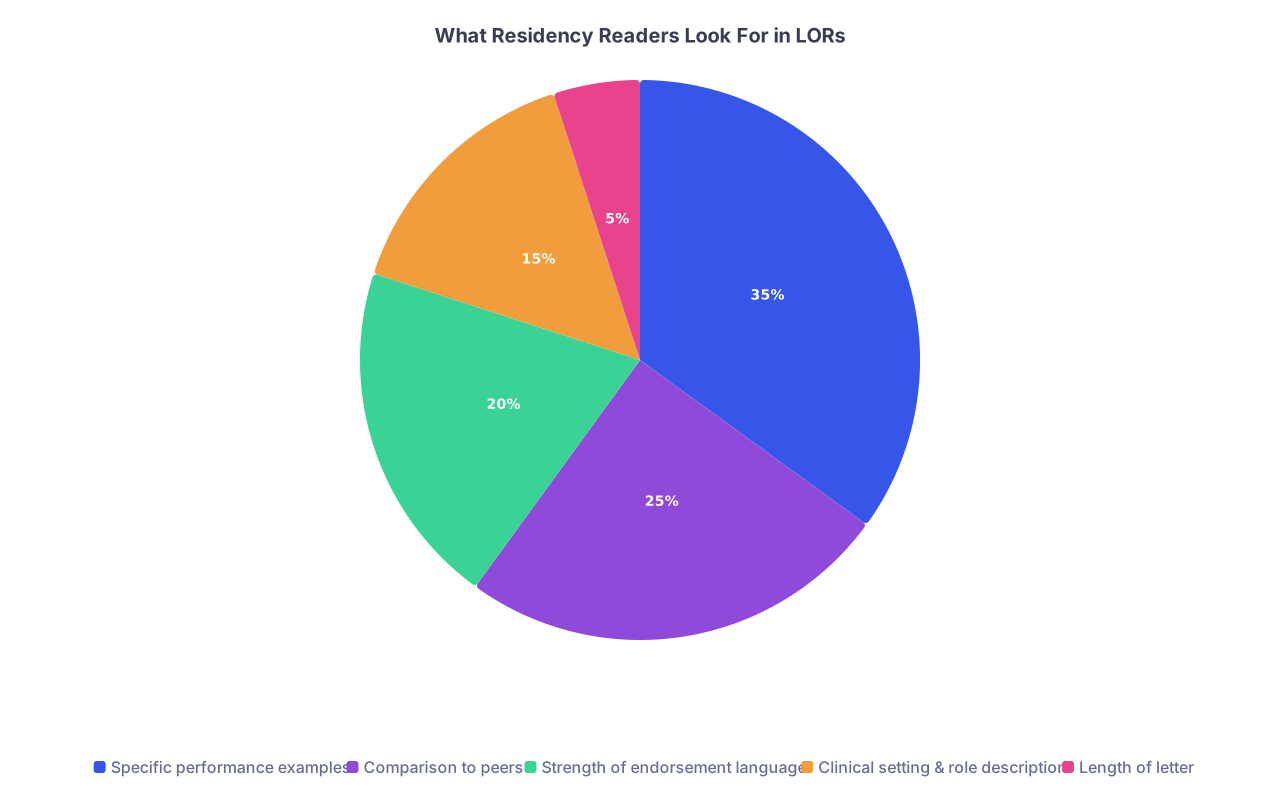
| Category | Value |
|---|---|
| Specific performance examples | 35 |
| Comparison to peers | 25 |
| Strength of endorsement language | 20 |
| Clinical setting & role description | 15 |
| Length of letter | 5 |
Notice that “Length of letter” is almost irrelevant. In practice, long generic letters get mentally downgraded because they look like templates.
I’ve sat in meeting rooms where someone literally said, “This is just a template letter. Next.” The letter was long—full page—and basically useless.
When a Short Letter Is Better (And When It’s Not)
Let’s get concrete.
A short but strong letter is better when:
It clearly states the relationship and time frame
(“I supervised her directly for 8 weeks on the surgical oncology service.”)It includes at least 1–2 specific behaviors or examples
(“He routinely stayed late to communicate plans to families with complex psychosocial needs.”)It compares you to peers
(“Top 5% of students I have worked with over the last decade.”)It has clear, enthusiastic language
(“I give her my strongest recommendation for your residency program without reservation.”)
In this case, 2/3 of a page can be plenty. A tight, specific, half- to three-quarter-page letter from a busy, credible attending screams: “I actually know this person and I’m willing to go to bat for them.”
A short letter is a problem when:
The writer barely knows you and admits it implicitly
(“I came to know John during several weeks of his clerkship…” with no real detail.)There’s no comparison language
(“He was a solid student and did everything asked of him.”)It’s “damning with faint praise”
(“She will be a dependable resident.” No “outstanding,” “excellent,” “top,” “strongest.”)
Here’s the catch: sometimes a short letter is short because the writer has nothing impressive to say. That short letter is not better than a long generic one; it’s just a different kind of weak.
So it’s not “short vs long.” It’s:
- Specific short vs generic long → specific short usually wins
- Specific long vs specific short → both can be strong; length is secondary
- Generic short vs generic long → both are bad; length doesn’t fix emptiness
Anatomy of a Strong Letter (Regardless of Length)
You should know what good looks like so you can choose letter writers wisely and coach them (subtly, professionally).
A high-quality LOR for residency usually has:
Context + credibility
- Who is the writer? (Title, role, specialty)
- How do they know you? (Rotation, duration, level of supervision)
- Example: “I am an Associate Program Director in Internal Medicine and supervised Dr. Lee for 4 weeks as his inpatient attending.”
Concrete behaviors
- What did you actually do?
- Examples:
- “Managed 12+ patients with minimal oversight by the third week.”
- “Led family meetings on complex goals-of-care discussions.”
- “Consistently generated accurate and prioritized problem lists.”
Comparison language
- Where do you stand compared to peers?
- Strong phrases:
- “Top 10% of students I’ve worked with.”
- “Among the very best clinical students I have supervised.”
- “Clearly above the level of an incoming intern in clinical reasoning.”
Global endorsement
- Clear strength of recommendation.
- Strong:
- “I give my highest recommendation.”
- “I would be delighted to have her as a resident in our program.”
- Weak or concerning:
- “I recommend him.” (Nothing else. That’s not great.)
If a letter has these four components in 3–5 tight paragraphs, it’s better than a long, rambling version that hits them weakly over two full pages.
The Real Question: What Should You Aim For?
You are not choosing between LOR shapes in a vacuum. You’re choosing letter writers and how you set them up to write about you.
Here’s the framework I recommend.
1. Prioritize who knows you well over who is “famous”
A specific letter from the hospitalist who actually rounded with you daily beats a generic paragraph from the Chair who met you twice.
If a big-name person truly knows you and will write something detailed—fantastic. But do not chase titles at the cost of content.
2. Ask the right question when requesting
Do not ask, “Can you write me a letter?”
Ask:
“Do you feel you could write me a strong, detailed letter of recommendation for [specialty] residency?”
The word “detailed” matters. It signals what you want. It also gives them a graceful out if they can’t be specific.
3. Give them raw material for specificity
Most attendings are busy. Many write fast from memory. If you hand them nothing, you get generic.
Give them:
- A one-page CV or ERAS experiences list
- A short paragraph with 3–5 concrete things you did on their service
- Your personal statement or a brief “Why [specialty]” summary
You’re not writing the letter for them. You’re jogging their memory so they can add real examples.
Short vs Long: How It Plays by Specialty
Different specialties care about letters a bit differently, but the specificity rule still holds.
| Specialty | Weight of LORs | Specific Short Letter | Long Generic Letter |
|---|---|---|---|
| Internal Med | High | Strongly favorable | Mildly negative |
| General Surgery | Very High | Strongly favorable | Often ignored |
| EM | Critical (SLOEs) | Essential, preferred | Actively harmful |
| Psych | Moderate-High | Helpful | Neutral to negative |
| Radiology | Moderate | Helpful if detailed | Mostly ignored |
| Derm/Ortho | Very High | Crucial if from insiders | Looks like filler |
For EM, for example, a short SLOE with specific ranks and comparisons is the standard. A long, flowery letter without the SLOE structure is actually a red flag. Wrong format, wrong content.
Warning Signs Your Letter Might Be Generic and Weak
You cannot read waived letters. But you can see the danger signs before they’re written.
- The attending barely worked with you.
- They say things like “I write these for all students” or “Just put my name down.”
- They delegate all their letters to a chief resident you never worked with.
- They don’t ask for your CV or any info.
- They agree too fast and seem indifferent.
Compare that to a strong-writer behavior:
- “Sure, happy to. Send me your CV and a list of the rotations you did with me or cases you found meaningful.”
That’s someone who might actually get specific.
How Committees Interpret Different Letter Types
Let’s decode how your letters actually land in the room.

| Step | Description |
|---|---|
| Step 1 | Letter arrives |
| Step 2 | Generic letter - Low impact |
| Step 3 | Strong letter - Positive impact |
| Step 4 | Moderate letter - Slight positive |
| Step 5 | Supports interview/Rank |
| Step 6 | Mostly ignored unless negative |
| Step 7 | Neutral - No boost |
| Step 8 | Specific examples present? |
| Step 9 | Comparison to peers? |
| Step 10 | Strong endorsement language? |
Length does not even show up in this decision tree. Because it’s not driving the decision.
What can hurt you is:
- Generic long letters that look like templates
- Short, lukewarm letters that suggest “I didn’t have much positive to say”
- Letters that contradict your stated strengths (e.g., personal statement says you love teaching, but no mention of it in any letter)
Practical Playbook: What You Should Do This Week
Here’s how to use all of this without overthinking.
List your potential letter writers.
For each, ask:- Did they see me work enough to know my strengths?
- Did I have meaningful responsibility with them?
- Have I seen them write strong letters for others?
Prioritize:
- Direct supervisors who know you well > big titles who barely know you.
- Specific specialty-aligned attendings > random unrelated rotations (with rare exceptions).
When you ask:
- Use the “strong, detailed letter” phrase.
- Offer to send CV, experiences, and 3–5 bullets of things you did on their service.
Do not chase length.
Chase substance. If an attending says, “My letters are short, but I’m happy to be very direct and specific,” that’s fine. That’s often exactly what you want.If someone seems lukewarm or unsure:
- Thank them.
- Do not use them as a letter writer.
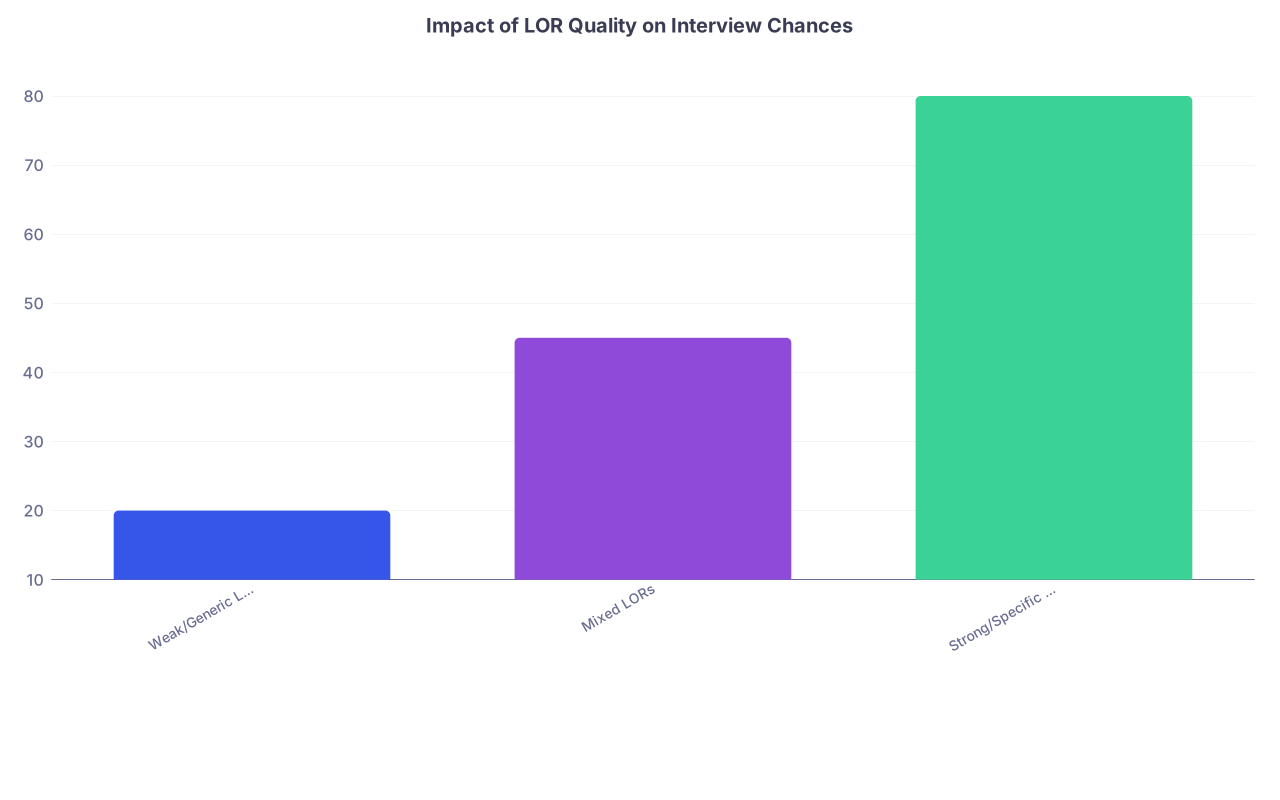
| Category | Value |
|---|---|
| Weak/Generic LORs | 20 |
| Mixed LORs | 45 |
| Strong/Specific LORs | 80 |
Programs will not tell you this directly, but internally, a pattern of strong, specific letters absolutely shifts you into the “interview” pile more often. Especially in competitive fields.
FAQs
1. Is there an ideal word count or page length for residency LORs?
No magic number. Most strong letters land between half a page and a full page. Above 1.25–1.5 pages, readers start skimming hard unless the content is exceptional. A tightly written 2/3-page letter packed with specifics is often better than a 2-page letter padded with clichés.
2. Will program directors think a short letter means the writer didn’t care?
They might think that if it’s short and vague. Short + specific + strong endorsement is usually interpreted as: “Busy person who knows the applicant well and got to the point.” The concern isn’t the length; it’s the absence of concrete detail or clear enthusiasm.
3. What phrases signal a strong letter vs a weak one?
Strong signals (if your dean or advisor reads unwaived letters and tells you): “Top [x]% of students,” “one of the best I have worked with,” “my strongest recommendation,” “performing at or above the level of an intern.” Weak or concerning: “solid,” “dependable,” “met expectations,” “I expect he will be a good resident,” with no comparative or superlative language.
4. Should I avoid a writer who says they write ‘standard’ letters for everyone?
Generally, yes. A “standard” letter almost always means generic, template, or checkbox-style letters without personal detail. You get one shot at each letter slot on ERAS. Do not waste it on someone who has already told you they’re not going to be specific.
5. What if my strongest clinical experience was with a junior faculty or hospitalist, not a big-name chair?
Use the junior faculty or hospitalist. A specific, enthusiastic letter from the person who watched you grind through long calls, manage sick patients, and grow over weeks is much more valuable than a bland one-liner from a big name who barely knows you. Committees care about evidence, not just titles.
6. Can I coach my letter writers without being pushy?
Yes, and you should. When they agree, say something like: “Thank you, I really appreciate it. I’ll send you my CV, ERAS experiences, and a brief list of things I worked on during the rotation in case it’s helpful for specifics.” That’s professional, not pushy. You’re making their job easier and nudging toward a specific letter.
7. What if I already have a long generic-looking letter in ERAS—am I doomed?
Not doomed, but you should compensate. Make sure your other letters are as strong and specific as possible. If applications are not submitted yet and you genuinely suspect a letter is weak, you can choose not to assign it and request a better one from someone else. Programs see only the letters you assign. You cannot fix a bad letter, but you can prevent it from being used.
Open your list of potential letter writers right now. For each name, ask yourself: “Will this person write about specific things I did, or just say I’m ‘hard-working and compassionate’?” Cross off anyone in the second group and replace them with someone who actually watched you work. That single decision will do more for your application than adding 300 extra words to any letter ever will.