
The short answer: you do not need a department chair letter for every residency field. And for many specialties, you don’t need one at all.
Let me be very clear: people overcomplicate chair letters. They stress about the wrong things, chase the wrong signatures, and then end up with generic letters from chairs who barely know them. That hurts more than it helps.
Here’s the real framework you should use instead.
1. The Core Question: Do I Need a Chair Letter?
Here’s the rule I tell students:
You care about a department chair letter only if:
- Your target specialty explicitly requires one, or
- Your home department strongly expects one for that field.
If neither is true, you prioritize strong clinical letters from attendings who know you, not big titles.
Let’s break it down by category.
Specialties that commonly require or strongly expect a chair letter
This can vary by program, but generally:
- Internal Medicine – Many academic IM programs want a “departmental” letter or a chair/vice chair letter. Sometimes it’s a standardized “department summary letter” from the medicine education office rather than the actual chair.
- General Surgery – Very common expectation for a surgery chair or program director-level letter, especially at academic places.
- OB/GYN – Many academic OB programs strongly encourage or expect one departmental letter.
- Some competitive fields in academic centers may want a departmental endorsement (not always the literal chair).
For these, you’re usually looking at one departmental letter in your main specialty, not one for every field you flirted with.
Specialties where a chair letter is less relevant or often not needed
- Emergency Medicine – They care far more about SLOEs (Standardized Letters of Evaluation) from EM rotations than a chair letter.
- Family Medicine, Pediatrics, Psychiatry – Chair letters are usually not required; strong clinical letters are more important.
- Neurology, Pathology, Radiology, Anesthesiology, PM&R – A few programs might ask for a chair letter, but it’s not universally expected.
- Highly competitive subspecialties (Derm, Ortho, ENT, Plastics, Urology) – Some programs or specialties may want a departmental letter; more often, they care about letters from well-known faculty in the field who supervised you directly.
What matters most is what programs put on their websites and in ERAS:
If they say:
“1 letter from Department Chair or departmental summary letter” → then you need it.
If they say:
“3 letters from faculty who supervised you clinically” → don’t go chasing a chair just for the title.
2. One Field vs Multiple Fields: How Many Chair Letters?
You do not need a chair letter for every field you’ve ever considered. You only care about chair letters in two situations:
You’re applying to one specialty
Then:- If that specialty requires a department letter → get one appropriate chair/department letter in that specialty.
- Use that one letter for all programs in that specialty.
You’re applying to two specialties (example: IM and Neurology, or Surgery and Anesthesiology)
Then you ask:- Does each specialty actually require a chair letter?
- If yes for both → yes, you may need two separate chair/departmental letters (one in each field).
- If only one specialty requires it → get one for that specialty, and don’t bother for the other unless your school makes it easy.
Don’t invent work for yourself.
If you’re dual applying and:
- One field is more competitive (e.g., Derm, Ortho, ENT, Urology)
- The backup field is something like IM, FM, or Psych
Your priority:
- Strong letters from that main specialty
- One departmental letter where required
- Backup specialty: strong clinical letters from people who know you; chair letter only if programs explicitly ask for it.
3. What Actually Counts as a “Chair Letter”?
This is where people get confused. “Chair letter” doesn’t always mean a warm, personal letter written by the actual department chair who knows your dog’s name.
Most of the time, it means one of three things:
True Department Chair Letter
Signed by the chair. Sometimes they met you. Sometimes not. Often based on:- Clerkship evaluations
- Input from core faculty
- Maybe a short meeting with you
Departmental Summary Letter
Internal Medicine is notorious for this. You get:- A “Department of Medicine Summary Letter” or “Chair’s Letter”
- Written by a committee or clerkship director, signed by chair, vice chair, or designated official
- Standardized format across all students
Program Director-level or Vice Chair Letter
Some programs are flexible: a letter from the program director or clerkship director of that specialty meets the “department” requirement.
The punchline:
If a program says “Department Chair or Departmental Letter,” it usually includes these standardized letters your school sets up. You’re not expected to personally woo the chair into writing you a novel.
| Specialty | Chair/Dept Letter Common? | What They Usually Want |
|---|---|---|
| Internal Medicine | Yes (academic-heavy) | Departmental summary or chair |
| General Surgery | Yes (many programs) | Chair or PD-level surgery letter |
| OB/GYN | Often | Departmental OB/GYN letter |
| Emergency Med | Rare | SLOEs from EM rotations |
| Family Med | Uncommon | Strong clinical FM letters |
4. How Programs Actually Read These Letters
Here’s the part nobody tells you: a generic chair letter is background noise. Program directors know exactly what these letters are:
- Often formulaic
- Based heavily on clerkship grades
- Written by someone who didn’t work with you day-to-day
They scan them for:
- Any red flags (professionalism, major concerns)
- Where you roughly rank compared to your peers
- Whether your story aligns with the rest of your file
Then they move on.
What actually shapes their impression:
- Detailed, specific letters from faculty who directly supervised you on wards, in the OR, or on specialty rotations
- SLOEs in EM
- Subspecialty letters from recognized names in that field (orthopedic attending, derm faculty, etc.)
So if you have to choose between:
- A glowing, specific letter from a subspecialist who loved working with you
- Or a bland departmental letter from someone who’s barely met you (when not required)
You choose the strong letter every single time.
5. How to Figure Out What Your Programs Want
Stop guessing and start reading.
Here’s your step-by-step:
Check ERAS program listings
Under each program, look at “Letters of Recommendation”:- Some will say: “At least one letter from Department Chair of Internal Medicine”
- Others: “Three letters from faculty who supervised you clinically”
- Some: “We accept a Department of Medicine summary letter as one of the letters”
Go to the program’s website
They sometimes add:- “We strongly prefer one letter from the Department Chair”
- Or “Chair letter not required”
Ask your school’s advising office or specialty advisor
They know the norms:- “At our school, we generate a Department of Medicine letter for anyone applying to IM”
- “Surgery here expects everyone applying to have a chair letter, we coordinate it in late summer”
Ask upperclassmen who matched in your field
You’ll get real talk like:- “I applied to 60 IM programs; only 10 truly required the chair letter, but everyone here uses the departmental letter so I sent it everywhere.”
6. How to Request a Chair or Departmental Letter (Without Messing It Up)
Once you know you need one, don’t overcomplicate the ask.
Here’s the usual pattern:
Internal Medicine / OB / some IM-adjacent fields
The department or clerkship office has a process:- You submit: CV, personal statement, list of programs, maybe a brief form
- They gather clerkship comments, evaluations, test scores
- They produce and sign one standardized letter
- You assign that in ERAS like any other letter
Surgery and some smaller departments
More old-school:- You email the chair’s admin or the chair themselves with:
- Who you are
- Your interest in the field
- CV, personal statement
- Which faculty know you best
- Sometimes they meet you briefly
- They write a letter, often after asking for input from surgeons who worked with you
- You email the chair’s admin or the chair themselves with:
When you request, be explicit:
- State your specialty and that programs may require a departmental letter
- Share any relevant info: honors, research, away rotations
- Be early: late July–August is typical, not October.

| Step | Description |
|---|---|
| Step 1 | Choose Specialty |
| Step 2 | Check school process |
| Step 3 | Prioritize strong clinical letters |
| Step 4 | Confirm if each needs dept letter |
| Step 5 | Request 1 dept letter |
| Step 6 | Get separate dept letters as needed |
| Step 7 | Does specialty require dept letter? |
| Step 8 | Multiple specialties? |
7. Strategy: How Many Letters and Which Ones Go Where?
ERAS basics:
- Most programs allow 3–4 letters per application.
- You can store more letters in ERAS and choose a different combo for different programs.
So if you’re applying to, say, Internal Medicine:
You might have:
- Department of Medicine summary/chair letter
- 1–2 letters from inpatient IM attendings
- 1 letter from a subspecialist or research mentor in IM
For each program, you send:
- If they require a departmental letter → one slot goes to that, the rest to strong clinical letters
- If they don’t mention it → you can still include the departmental letter if it’s solid, but don’t sacrifice better, more personal letters.
For dual applicants (e.g., IM + Neurology):
- You can have:
- Dept of Medicine letter
- Neurology subspecialty letters
- General IM clinical letters
- For IM programs: send Dept of Medicine letter + IM clinical letters
- For Neurology: send strong neuro faculty letters + maybe one IM letter to show solid medicine foundation
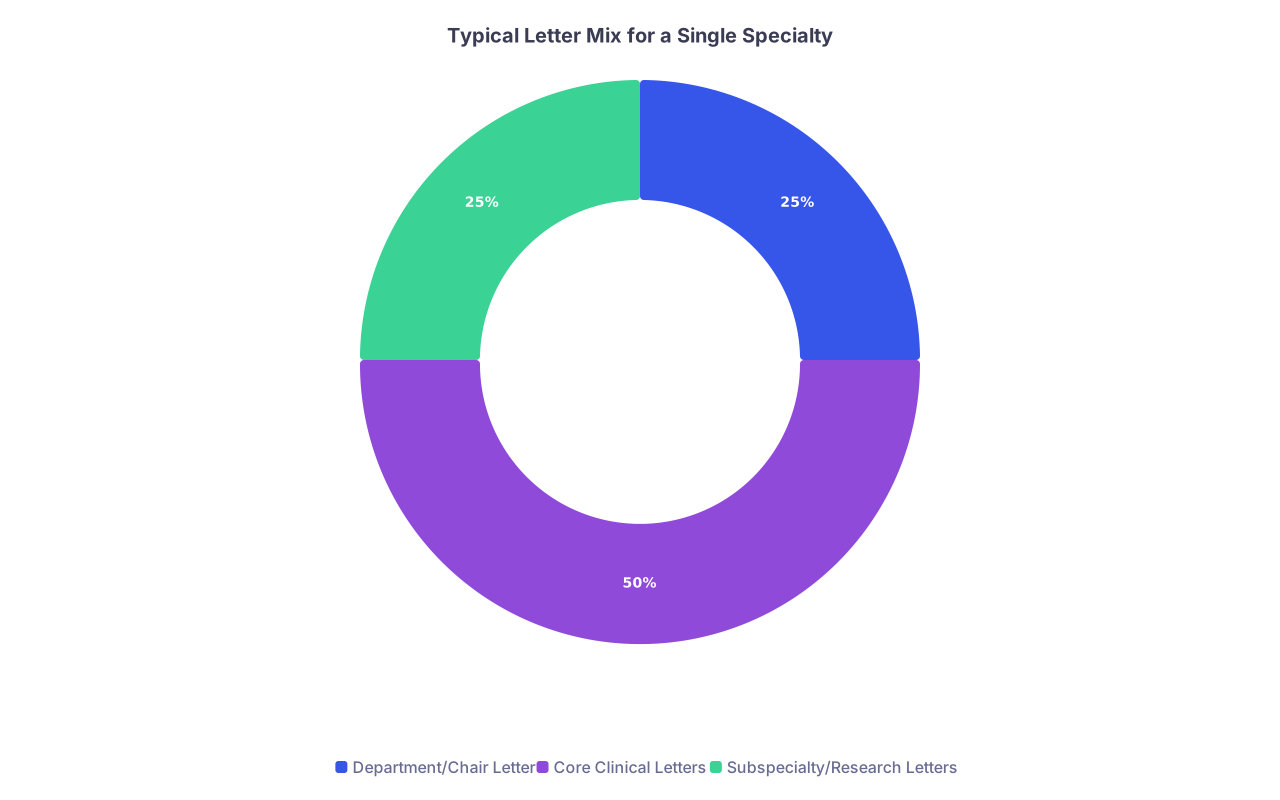
| Category | Value |
|---|---|
| Department/Chair Letter | 25 |
| Core Clinical Letters | 50 |
| Subspecialty/Research Letters | 25 |
8. Common Mistakes with Chair Letters
I’ve watched students tank otherwise strong applications with dumb letter decisions. Don’t do these:
- Chasing a chair letter that’s not required while ignoring attendings who loved working with you.
- Assuming a big title beats real content. Programs care much more about detail and sincerity.
- Requesting too late. Chairs and departments are flooded by mid-August.
- Not checking how your school handles it. You might be inventing a problem that your department already solved years ago with a standard process.
- Using one vague departmental letter as your main specialty letter instead of also getting specific subspecialty letters.
Your rule:
If the department letter is required → get it.
If it’s optional → include it only if it’s at least decent and doesn’t push out a stronger letter.
FAQ (Exactly 7 Questions)
1. Do I need a department chair letter for every residency program I apply to?
No. You usually need at most one departmental/chair letter per specialty that requires it. Many specialties and programs don’t require one at all.
2. If I’m dual applying, do I need two separate chair letters?
Only if both specialties explicitly require or strongly expect departmental letters. If one field doesn’t care, don’t waste time chasing an unnecessary chair letter there. Focus on strong clinical letters instead.
3. Does a chair letter have to be from the actual department chair, or can it be from a program director?
Depends on the program wording. “Departmental letter” or “Chair or designee” often includes letters from program directors, vice chairs, or standardized department summary letters. Many schools handle this through the department, not through a one-on-one relationship with the literal chair.
4. How strong does a chair letter need to be?
It needs to be at least neutral to positive and free of red flags. Most are somewhat bland but acceptable. Your big impact letters should come from faculty who worked directly with you and can give detailed, enthusiastic descriptions of your performance.
5. What if my chair barely knows me? Will that hurt my application?
Not really. Programs expect that many chair or departmental letters are based on evaluations and brief interactions. As long as it’s not negative, you’re fine. That’s why you must also have other strong, specific letters from attendings who actually know your work.
6. When should I request a chair or departmental letter?
Aim for late June to early August, depending on your school’s timeline. Earlier is safer, especially in competitive fields. Don’t wait until September to start the process; departments get overwhelmed.
7. If a program doesn’t mention a chair letter at all, should I still send one?
Only if you already have it and it’s at least solid. But never at the cost of a better letter. If you have to choose, send the more detailed, enthusiastic clinical letters over a generic chair letter that adds little value.
Bottom line:
You don’t need a department chair letter for every field. You need one appropriate departmental letter only in specialties or programs that clearly want it, and you should never sacrifice strong, detailed clinical letters just to chase a big name on letterhead.