
You’re three letters into your ERAS packet, staring at one paragraph from the famous department chair and a full-page narrative from a no-name community doc. And you’re thinking: “Does LOR length matter more than writer reputation? Which one actually helps me match?”
Here’s the blunt version: both length and reputation matter. But not in the way most applicants assume.
Let’s break this down like someone who’s actually read thousands of LORs and sat in rank meetings.
Short Answer: What Matters More?
If you force me to choose between a long, detailed letter from an average-name attending vs. a short, vague letter from a famous chair?
I’ll take the detailed letter. Every time.
But if it’s:
- A strong, specific, half-page letter from a well-known PD or chair
vs. - A rambling, unfocused two-page letter from a random attending
I’ll take the strong chair letter.
So the real hierarchy is:
- Content quality (specific, comparative, enthusiastic)
- Writer reputation/role (PD, chair, known faculty, field relevance)
- Length (enough space to say something real, not a word count contest)
Length is only useful if it allows more useful content. Past a certain point, longer just means “I didn’t edit.”
How Program Directors Actually Read LORs
Let me be honest: nobody is joy-reading your letters over a glass of wine.
Most PDs and selection committee members skim with a purpose. They’re scanning for:
- Who wrote it (PD, chair, fellowship director, core faculty, community doc, fellow)
- How strongly they recommend you
- Concrete examples backing up the praise
- Any red flags, hedging, or obvious form-letter language
Here’s how that looks in practice:
- They look at the letterhead and signature line first.
- They scan the last paragraph for the classic line:
- “I give my strongest recommendation”
- “Top 5% / one of the best students I’ve worked with”
- Or the weak sauce: “I recommend them without reservation” (often code for “fine, not amazing”)
- Then they check the middle for:
- Specific anecdotes
- Where you rank among peers
- Any signals about work ethic, team fit, reliability
The length? It only matters in that a three-sentence letter can’t support strong claims, and a three-page letter is annoying and gets skimmed harder.
Length: How Long Is “Enough”?
For residency LORs, here’s the practical sweet spot:
- About ¾ to 1.5 pages is ideal in most fields
- Anything under ~½ page looks weak or rushed
- Anything over 2 pages almost never adds real value and just dilutes
Typical structure of a solid letter:
- 1 short intro paragraph: who they are, how they know you
- 2–3 body paragraphs: clinical performance, work habits, examples, comparisons
- 1 tight closing paragraph: overall assessment + strength of recommendation
If a well-known writer sends a 5–6 sentence letter, that’s a problem. Not because it’s short, but because it usually means:
- They don’t know you well
- They’re using a generic template
- They’re not willing to go on record saying more
Short but dense and enthusiastic is different from short and generic. A single, very tight paragraph that clearly places you in the top tier and gives one strong example can still be powerful—especially if it’s from a PD or chair in your specialty.
Reputation: How Much Does the Writer’s Name Move the Needle?
The writer’s title and reputation do influence how their words are interpreted. That’s just reality.
Rough ranking of letter writers in terms of impact (assuming similar quality content):
| Writer Type | Typical Impact Level |
|---|---|
| Program Director (your specialty) | Very High |
| Department Chair (your specialty) | Very High |
| Clerkship / Site Director | High |
| Core Faculty in your specialty | High |
| Subspecialist in same field | Moderate–High |
| Community physician in field | Moderate |
| Faculty from other specialty | Low–Moderate |
A few key realities:
- A PD or chair saying “top 10% of students” carries more weight than an unknown community attending using the exact same words. Why? Because PDs/chairs write hundreds of letters and know what “top 10%” means in practice.
- A letter from someone known personally to the PD or on the same “circuit” (national organizations, subspecialty societies) can quietly help more than you realize.
- A “big name” with a weak, sparse letter is worse than a “no-name” with a strong, specific one. Committees can smell the difference.
So no, reputation doesn’t override garbage content. But strong content from a high-reputation writer is absolutely your best-case scenario.
Length vs Reputation: How They Interact
Here’s how the tradeoffs actually play out:
Famous person + very short, generic letter
- How it reads: “They asked me to do this, I barely know them.”
- Risk: Raises questions, especially if this is supposed to be a key letter (e.g., home specialty letter).
Famous person + short but sharp letter
- How it reads: “Busy PD/chair took real time to write something specific and strong.”
- This can be excellent, particularly if they’re efficient writers.
Average attending + long, rambling letter
- How it reads: “They like you, but they don’t know how to write a letter and can’t prioritize.”
- Committees skim, pull out a line or two, and move on.
Average attending + 1 page, specific, comparative letter
- How it reads: “This person actually worked with you and is clearly invested. Trusted direct observer.”
- Very solid. Often more impactful than the name-only chair signature.
So does length matter more than writer reputation? No.
But a long, content-rich letter from an average writer beats a short, content-free letter from a star. And a concise, potent letter from a high-rep writer beats a bloated, vague one from anybody.
What Makes a Letter “Strong” (Beyond Length and Name)
If you want to judge your potential letter options, use this checklist. Strong letters usually have:
Relationship clarity
“I supervised her directly on inpatient medicine for 4 weeks…”Concrete examples
Specific cases, patient interactions, or moments where you stood out.Comparisons
“Among the 100+ students I’ve worked with in the last 5 years, he ranks in the top 5–10.”Clear, enthusiastic language
Not “will do well,” but “I give my strongest recommendation” or “I’d be thrilled to have her as a resident in our program.”Domain relevance
For residency: letters from your chosen specialty (or closely related fields) usually hit harder than random specialties praising you generically.
A two-page letter that doesn’t hit those points is worse than a one-page letter that does.
Choosing Between Potential Letter Writers
Let’s make this brutally practical. Here’s a decision framework.
If you’re picking between:
- A famous chair who barely worked with you
- A mid-level attending who supervised you closely and loves you
Most of the time, choose the attending who really knows your work. If you can get both, even better—but don’t sacrifice content just to chase the big signature.
Use this simple priority order:
- People who directly supervised you + can speak to your day-to-day performance
- Writers in your target specialty (or closely aligned)
- Writers with known roles (PD, APD, chair, clerkship director)
- Then, if it’s still a tie, you can consider who is more “famous”
And yes, sometimes the smart move is different for ultra-competitive fields (like derm, ortho, ENT) where chair or PD letters are more standard. Even then, you want those big names to actually know you.
How Many Pages Is “Too Long”?
For residency readers, anything beyond 2 full pages is overkill and may backfire.
Why?
Because super-long letters often:
- Repeat the same adjectives over and over
- Drift into storytelling that doesn’t change the evaluator’s mind
- Make the writer look like they don’t understand how busy PDs are (which weirdly hurts credibility)
Your goal isn’t a maximalist manifesto. It’s a high-yield summary of why you’re a strong, safe, and appealing choice.
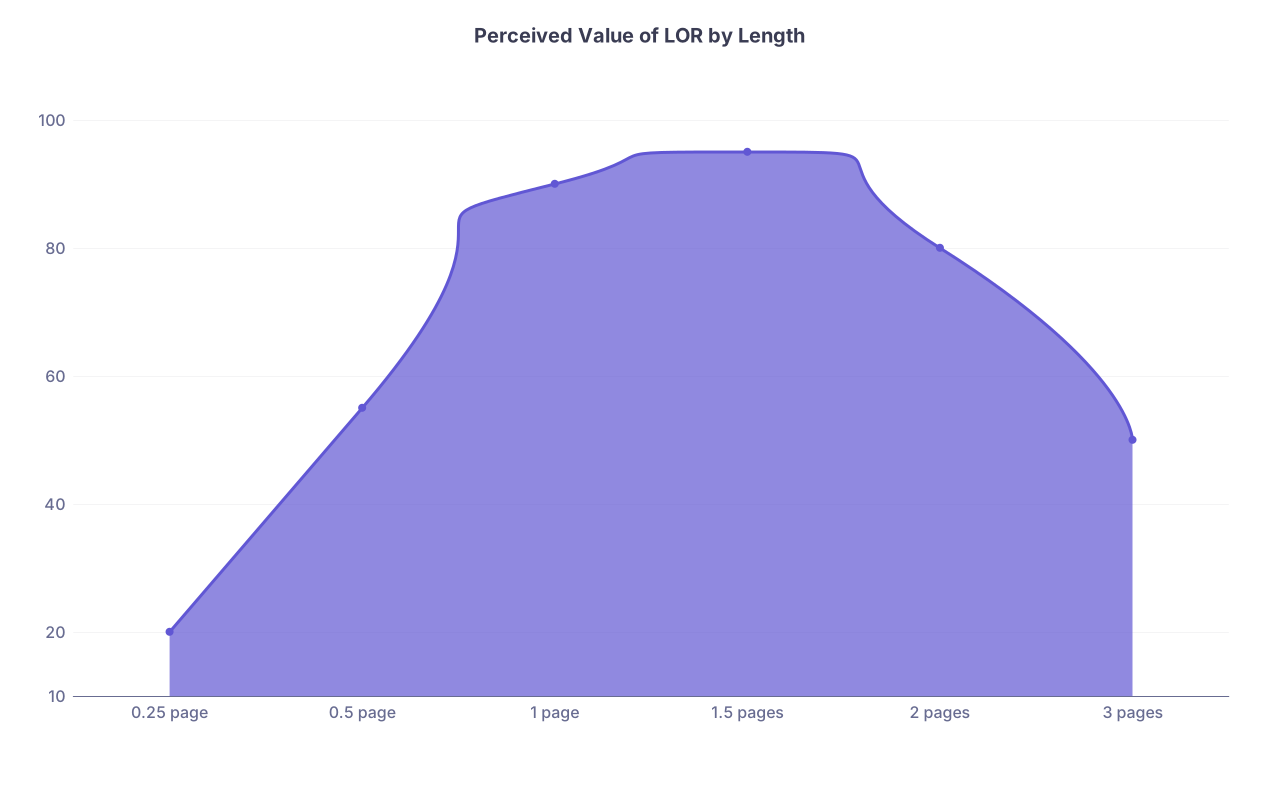
| Category | Value |
|---|---|
| 0.25 page | 20 |
| 0.5 page | 55 |
| 1 page | 90 |
| 1.5 pages | 95 |
| 2 pages | 80 |
| 3 pages | 50 |
That dip after ~1.5–2 pages is real. Past that, readers assume there’s filler.
What You Can Actually Do About This
You can’t control your writer’s reputation. And you shouldn’t be word-count policing them either. But you can influence a few key things:
Choose the right writers.
People who:- Saw you work closely
- Liked your performance
- Are in or near your specialty
- Have at least some academic/educational role
Ask the right question.
Don’t say: “Can you write me a letter?”
Say: “Do you feel you can write me a strong letter of recommendation for [specialty] residency?”Provide a high-yield packet.
Include:- Your CV
- A short “brag sheet” with 3–5 concrete examples/stories they saw
- Your personal statement draft or a one-paragraph summary of your goals
Give them time.
Rushed letters are shorter and sloppier. Ask at least 4–6 weeks before you need it.Don’t script them, but give direction.
You can say:
“Programs in [specialty] really value reliability, team skills, and clinical reasoning. If there are specific cases where you saw those, it’d help a lot if you mentioned them.”

| Step | Description |
|---|---|
| Step 1 | Need LOR |
| Step 2 | Probably not ideal |
| Step 3 | Strong candidate |
| Step 4 | Lower priority |
| Step 5 | Still useful |
| Step 6 | Did they supervise you directly? |
| Step 7 | In your target specialty? |
| Step 8 | Another specialty letter already? |
Special Situations
A few edge cases people worry about:
“My chair only writes short letters”
Some chairs/PDs have a strict template: half-page, tight, to the point. That’s fine as long as:
- It’s clearly specific to you
- They include comparative language (top X%, strong recommendation)
In this case, yes, get the short chair letter. But make sure your other letters include more detailed narrative.
“Community vs academic writer”
A detailed, thoughtful letter from a community attending who really knows you can be more powerful than a dry academic letter. But for highly academic or ultra-competitive programs, you still want at least one letter from someone in academics.
Best mix for most fields:
- 1 letter from specialty PD/chair or clerkship director
- 1–2 letters from faculty who worked closely with you in that specialty or related rotations
Quick FAQ: Does LOR Length Matter More Than Writer Reputation?

FAQ
1. Is a one-page LOR enough for residency?
Yes. A well-written, one-page letter is ideal for most residency programs. It gives enough space for specifics and comparisons without wasting the reader’s time. Under half a page starts to look weak unless it’s extremely dense and from a highly credible writer.
2. Would you choose a famous PD’s short letter over a long letter from a regular attending?
If the PD’s short letter is clearly personalized and strong, I’d take that plus a solid attending letter. But if the PD’s letter is generic and almost templated, and the attending’s letter is detailed and specific, the attending’s letter may be more influential. Best case: you have both, and the attending provides the narrative depth.
3. Are two-page letters bad?
Not automatically. A two-page letter that’s tightly written, full of concrete examples, and clearly structured can still be excellent. But once you pass ~1.5 pages, the odds of repetition and filler go up, and readers skim more aggressively. So they don’t help as much as people think.
4. Does it hurt me if one of my letters is from a different specialty?
Usually not, especially in fields like IM, peds, FM, EM, psych. Programs know you rotate on multiple services. It can even help if the writer speaks strongly about your work ethic and team behavior. Just make sure you still have the expected number of letters from your target specialty.
5. How do I know if a letter writer will actually write a strong letter?
Ask them directly: “Do you feel comfortable writing me a strong letter for [specialty]?” If they hesitate, are vague, or suggest someone else might be better, believe them. That’s them gently saying “I’m not your best option.”
6. Bottom line: what should I prioritize when choosing letter writers?
Prioritize:
- People who supervised you closely and think highly of you
- Writers in your target specialty or closely related fields
- People with some leadership or academic role (PD, chair, clerkship director, core faculty)
Then let length be what it naturally is, as long as it’s not so short it looks like an afterthought.
Key takeaways:
- Strong, specific content beats both length and reputation.
- Reputation amplifies good content; it doesn’t rescue bad or generic letters.
- Aim for 1–1.5 page, content-dense letters from people who actually know your work—then let committees see the version of you you actually want them to see.