
The blunt truth: you can use the same LORs for multiple specialties in ERAS—but if you do it blindly, you’ll tank your application.
Let’s walk through exactly when it’s smart, when it’s lazy (and obvious), and how to set this up in ERAS without shooting yourself in the foot.
Short answer: Yes, but only if you’re strategic
Here’s the core rule you’re dealing with:
ERAS lets you:
- Upload a letter once
- Assign that same letter to any program in any specialty
ERAS does not:
- Tell programs which other specialties you’re applying to
- Stop you from reusing letters across specialties
So technically: yes, you can reuse letters.
The real question is: should you?
Here’s my stance:
- Using generic or misaligned letters across specialties is a red flag
- Using carefully chosen, broadly applicable letters is smart and normal
- For two related specialties, you can often share 1–2 letters safely
- For very different specialties, you should limit overlap and tailor hard
How ERAS handles LORs (mechanics you need to know)
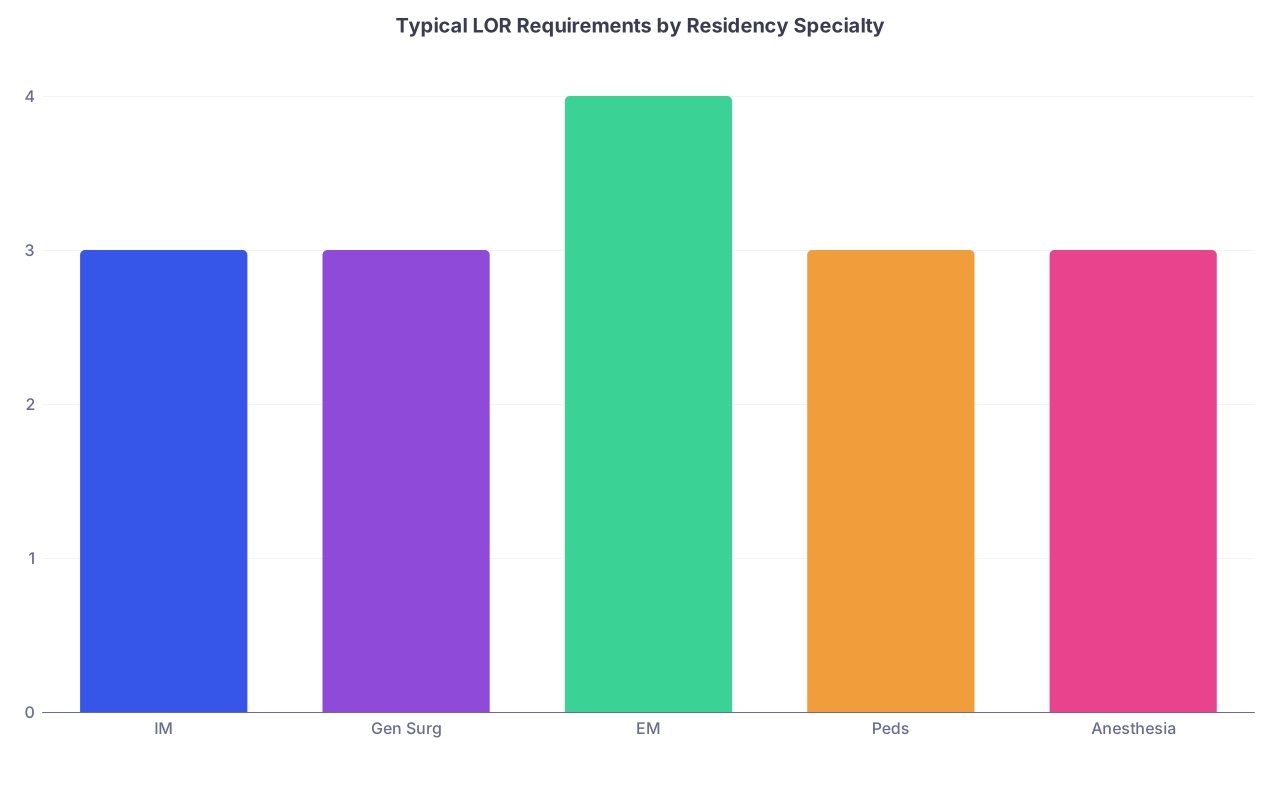
| Category | Value |
|---|---|
| IM | 3 |
| Gen Surg | 3 |
| EM | 4 |
| Peds | 3 |
| Anesthesia | 3 |
Quick system reality check:
- You upload a letter once (via letter writer portal)
- You label it however you like on your end (e.g., “IM – Dr. Smith – Cardiology”)
- You can assign that letter to:
- Internal Medicine programs
- Family Medicine programs
- Neurology programs
Same letter. Different programs. No one sees where else it goes.
Programs only see:
- The letter content
- The letter writer
- Whether it’s SLOE (for EM) vs standard letter
- Whether it’s waived or not
They don’t see your whole letter portfolio or what you used elsewhere.
So mechanically, you’re safe. The danger isn’t ERAS. It’s content.
When it’s OK to use the same LORs for multiple specialties
Let’s split this into scenarios, because that’s how real life works.
Scenario 1: Closely related specialties
Think:
- Internal Medicine ↔ Neurology
- Internal Medicine ↔ Dermatology
- Pediatrics ↔ Child Neurology
- General Surgery ↔ Vascular / Plastics / CT (as alternatives, not fellowships)
Here, 1–2 shared letters is usually fine.
Example:
- You’re applying IM and Neuro
- You have:
- Strong IM inpatient attending letter
- Strong Neuro attending letter
- A research letter (stroke outcomes research)
How to use them:
- For IM: IM letter + Neuro letter (if it emphasizes medicine skills) + research letter
- For Neuro: Neuro letter + IM letter (if it talks about neuro patients or cognitive skills) + research letter
Key filter: If a line in the letter would make a PD think, “Does this person actually want my specialty?” then don’t use it.
Scenario 2: Generalist vs specific
Think:
- Applying FM + IM
- Applying IM + Psych
- Applying Peds + FM (common for people who like outpatient + kids)
Letters that often cross over well:
- Sub-I or AI where you showed ownership of patients
- Longitudinal continuity clinic preceptor
- Strong research mentor in something clinically relevant
If a letter focuses on:
- Communication
- Work ethic
- Maturity
- Clinical reasoning
…without being obsessed with one specialty, it’s usually safe to share.
Scenario 3: One “anchor” letter for everything
Every applicant should have at least one “anchor” LOR:
- A respected attending
- Who knows you well
- Who can comment on clinical skill and professionalism
- Without being narrowly tied to one field
That letter can usually go to any specialty you’re considering.
I’ve seen students use:
- A medicine ward attending letter across IM, Neuro, Psych
- A pediatric ward attending letter across Peds, FM
- A research PI letter across multiple related specialties
The trick: the letter should read as, “This is a strong doctor,” not “This is the next great nephrologist.”
When using the same LORs is a bad idea
Here’s where people get burned.
1. Conflicting specialty language
If your letter says things like:
- “She is deeply committed to a career in surgery.”
- “He will be an outstanding obstetrician-gynecologist.”
- “I recommend her without reservation for a position in Internal Medicine.”
…and you use that letter for:
- Psychiatry
- Radiology
- Anesthesiology
You’re sending a mixed message.
Programs won’t think you’re “flexible.” They’ll think you’re unfocused or hedging.
If a letter writer hard-commits you to one specialty, do not use that letter for another specialty.
2. Totally unrelated specialties
Common high-risk combos:
- EM + Radiology
- Ortho + Psych
- Dermatology + General Surgery
- EM + Anesthesia (kind of related clinically, but viewed differently)
You can still apply to multiple, but you shouldn’t expect one set of letters to cover both well.
At minimum:
- 2 letters specific to each specialty
- 1 letter that can safely overlap (research, general clinical, etc.)
If you’re trying to use 3 pure EM letters for Anesthesia or 3 Ortho letters for FM? That’s simply a weak application.
3. SLOEs used outside of EM
SLOEs (Standardized Letters of Evaluation) are for EM. Period.
You can technically assign them to other specialties in ERAS, but it screams “EM applicant” to anyone who reads it.
If you’re pivoting away from EM:
- Use SLOEs only if they read more like general clinical evals
- And even then, I’d limit to one and only if it’s truly exceptional
Most of the time: keep SLOEs inside EM applications.
Smart LOR strategy if you’re dual-applying
Let’s map out what a sane letter portfolio looks like if you’re applying to 2 specialties.
| Path | Specialty A Letters | Specialty B Letters | Shared Letters |
|---|---|---|---|
| IM + Neuro | 1 IM, 1 shared | 1 Neuro, 1 shared | 1 IM/Neuro-friendly, 1 research |
| Peds + FM | 1 Peds, 1 shared | 1 FM, 1 shared | 1 general ward, 1 continuity clinic |
| EM + IM | 1–2 SLOE, 1 IM | 2 IM, 1 research | 1 strong medicine letter |
| Psych + Neuro | 1 Psych, 1 shared | 1 Neuro, 1 shared | 1 IM or Neuro-Psych crossover, 1 research |
General framework:
- Aim for at least 1 specialty-specific letter per specialty (2 is ideal)
- Use 1–2 shared letters that work for both
- Don’t let the majority of letters for Specialty B be obviously written for Specialty A
If you must prioritize (limited time, limited letter writers):
- Get the required/specialty-specific letters first (e.g., EM SLOEs, surgery for surgical fields)
- Then chase flexible, “anchor” type letters that can support multiple paths
How to talk to letter writers if you’re applying to multiple specialties
This is where people get weirdly shy. Don’t.
Be honest and specific. Here’s what actually works:
You:
“I’m applying to both Internal Medicine and Neurology. For your letter, would you be willing to keep it focused on my clinical skills and reasoning rather than committing me strongly to one specific specialty? I may need to use it for both.”
Most attendings are totally fine with this. They know people change course.
If you do want two versions of a letter (one for each specialty), then say so:
You:
“I’m leaning Neurology but also applying IM for geographic reasons. Would you be comfortable doing a Neuro-focused version of the letter, and I’ll only use it for Neuro programs? I have an IM attending writing an IM-focused letter as well.”
Don’t overcomplicate it. Clear ask, clear use.
Practical ERAS setup: how to keep things straight
Here’s how to avoid chaos in September.
Label letters clearly in ERAS
Examples:- “IM – Dr. Smith – General, OK for Neuro”
- “Neuro – Dr. Lee – Neuro-specific”
- “Peds – Dr. Patel – Generic Clinical”
- “Research – Dr. Kim – Hem/Onc project”
Make a simple assignment plan
For each specialty, list:- Must-use letters
- Optional/shared letters
- Never-use letters (if too specialty-specific elsewhere)
Double-check combination logic
Ask yourself:- “If a PD only saw this set of LORs, what specialty would they think I’m going for?” If the answer isn’t the specialty you’re submitting to—that’s a problem.
Special notes by specialty (where people mess this up most)
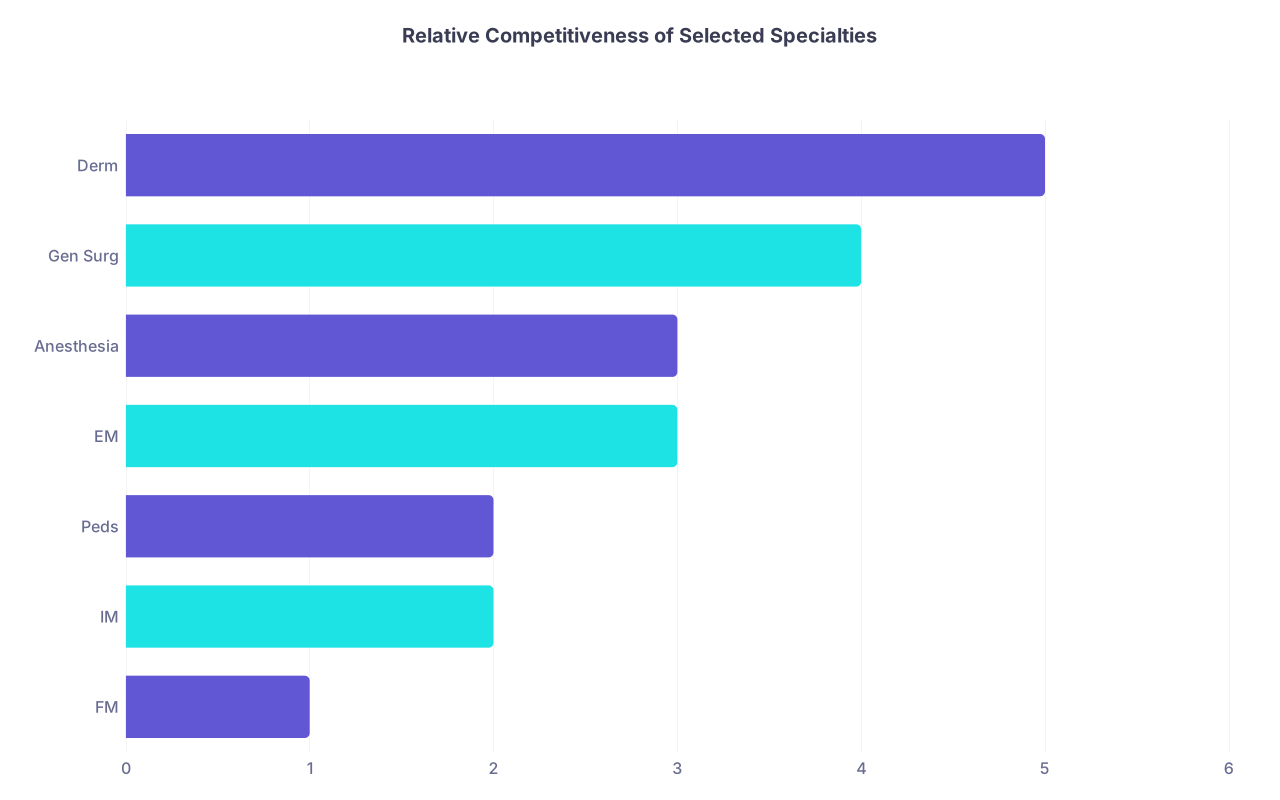
| Category | Value |
|---|---|
| FM | 1 |
| IM | 2 |
| Peds | 2 |
| EM | 3 |
| Anesthesia | 3 |
| Gen Surg | 4 |
| Derm | 5 |
This is rough, but you get the idea: some fields are more letter-sensitive than others.
Emergency Medicine
- SLOEs are king
- Using SLOEs outside EM is usually a no
- Using non-EM letters for EM is OK as a 3rd/4th letter, but SLOEs still matter most
Surgical specialties
- They expect at least 1–2 real surgery letters
- Using all medicine/IM letters for a surgical specialty is weak, no matter how “great” the content
Psych / Neuro / IM triad
This combo is very common and more forgiving:
- An IM letter focused on cognitive skills often works for all three
- A Neuro letter often plays fine for Psych and IM, if not too niche
- A Psych letter that emphasizes interpersonal skills plays well in IM/Neuro too
Here, you can often get away with more overlap if letter content is framed right.
Timeline: when to decide on letter reuse vs new letters
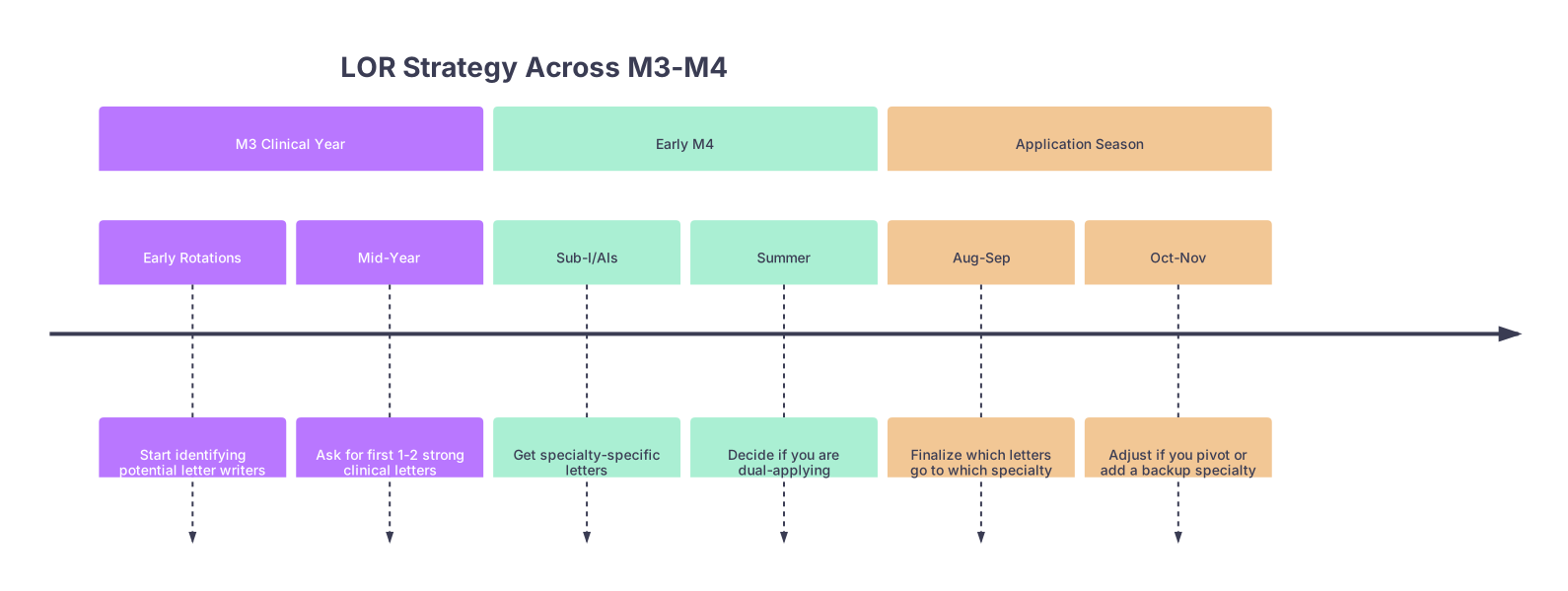
| Period | Event |
|---|---|
| M3 Clinical Year - Early Rotations | Start identifying potential letter writers |
| M3 Clinical Year - Mid-Year | Ask for first 1-2 strong clinical letters |
| Early M4 - Sub-I/AIs | Get specialty-specific letters |
| Early M4 - Summer | Decide if you are dual-applying |
| Application Season - Aug-Sep | Finalize which letters go to which specialty |
| Application Season - Oct-Nov | Adjust if you pivot or add a backup specialty |
Don’t wait until September to “figure it out.” You want:
- Specialty-specific letters requested during your sub-I/AI or core rotations
- Anchor/general letters requested by late M3 or early M4
- Your dual-apply decision set before ERAS opens, if possible
Quick reality check: what PDs actually care about
Most PDs aren’t playing detective about whether you also applied to something else. They’re asking:
- Do these letters support this specialty choice?
- Do they show this applicant will be safe and effective on Day 1?
- Are there any red flags or confusing mixed messages?
If your letter set:
- Makes sense for the specialty
- Matches your personal statement tone
- Doesn’t contradict your “story”
…you’re fine, even if some letters are reused behind the scenes.
FAQs
1. Can program directors tell if I used the same LORs for other specialties?
No. ERAS doesn’t show them where else the letter was used. What they can tell is if the content clearly points to a different specialty or conflicts with your stated interests.
2. How many letters can safely be shared between two specialties?
For related specialties, 1–2 shared letters is usually fine. For very different specialties, I’d cap it at 1 shared “anchor” letter and make the rest specialty-specific.
3. Is it OK if a letter mentions I’m “considering multiple specialties”?
It’s not ideal, but it’s not fatal if the rest of the letter is strong and clearly supportive. I’d rather see that than a letter aggressively pitching you for a completely different field.
4. Should I ask for two versions of the same letter for different specialties?
Only if the writer is very supportive, organized, and understands what you’re doing. In most cases, it’s cleaner to have that writer do a strong, more general clinical letter, then get specialty-specific letters from others.
5. Can I use an EM SLOE for Internal Medicine or another specialty?
Technically yes, but I almost never recommend it. SLOEs are written in a template format for EM. They scream “EM applicant” and can confuse your narrative elsewhere unless you truly have no better option.
6. What if I pivot specialties late and don’t have ideal letters?
You use what you have, prioritize at least one new specialty-appropriate letter as soon as possible, and explain the pivot briefly in your personal statement and interviews. It’s not perfect, but students match every year with imperfect letter mixes.
Key points to keep in your head:
- ERAS lets you reuse letters; content decides whether that’s smart or stupid.
- Have at least 1–2 specialty-specific letters for each field, then layer in 1–2 shared “anchor” letters.
- Avoid obvious mixed messages—no “future surgeon” letters in a Psych application and expect people not to notice.