
Should I Send Programs New LORs After Interviews Have Started?
What actually happens if you upload a shiny new letter of recommendation after programs have already started—or even finished—sending interview invitations? Does anyone read it, or are you just yelling into the void?
Here’s the blunt answer:
Sometimes a new LOR helps. Often it does nothing. Occasionally it annoys people. The trick is knowing which situation you're in.
Let’s walk through it like someone who’s sat behind the ERAS portal watching hundreds of updates roll in every season.
The Core Answer: When a New LOR Helps vs. When It’s Pointless
If you remember nothing else, remember this:
A new LOR can help you if:
- It’s from a high-impact writer (program director, department chair, nationally known faculty).
- It’s from a recent rotation in that specialty, especially at that same institution or a strong academic site.
- It adds meaningfully new information (performance, growth, context after Step failure, career switch, etc.).
- The program has not finalized its rank list yet.
A new LOR is usually pointless or low-yield if:
- It’s from a random community preceptor who barely knows you.
- It’s just “one more letter” saying the same generic stuff.
- The program has already finalized rank lists (late January/February).
- You’re just uploading because “more is better” and you feel anxious.
You are not trying to pad your file. You are trying to give programs a reason to move you up in their mental (and actual) list.
How Timing Really Works With New LORs
Residency programs do not sit there constantly refreshing your ERAS page to see what you added. They batch everything. Here’s how adding new letters interacts with their typical timeline.
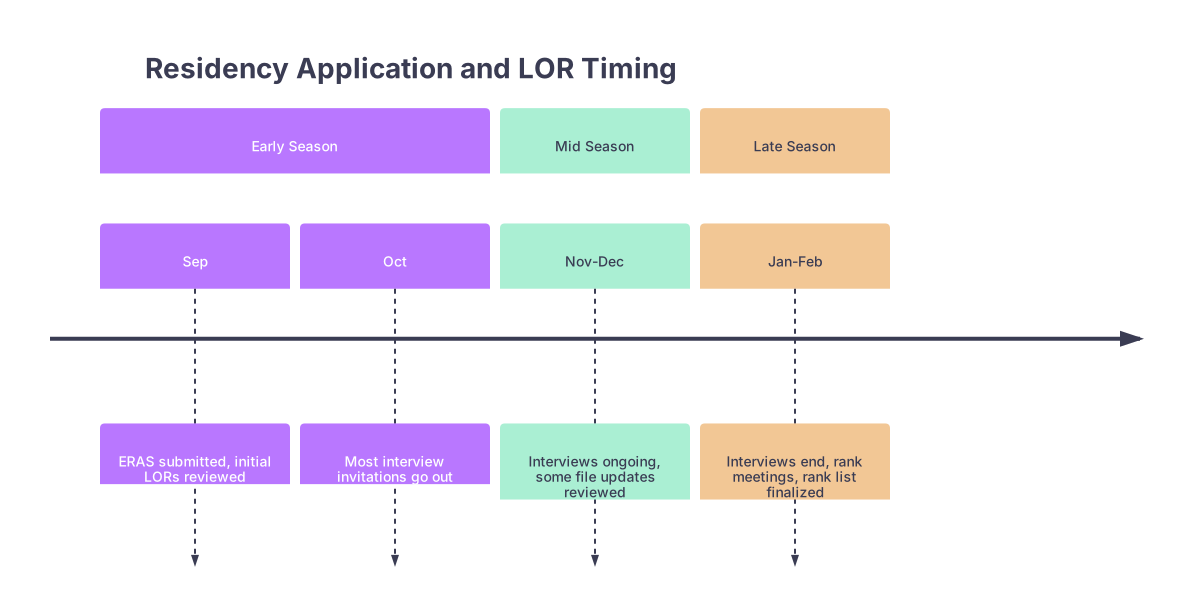
| Period | Event |
|---|---|
| Early Season - Sep | ERAS submitted, initial LORs reviewed |
| Early Season - Oct | Most interview invitations go out |
| Mid Season - Nov-Dec | Interviews ongoing, some file updates reviewed |
| Late Season - Jan-Feb | Interviews end, rank meetings, rank list finalized |
Early season (September–early October)
Uploading new LORs early:
- Can absolutely be seen.
- Can influence whether you get interviewed at all.
- Especially helpful if you were missing a key letter (e.g., no IM letter for IM, no SLOE for EM, no sub-I letter yet).
If interviews have just started but most invites haven’t gone out, a strong new specialty-specific letter can still tilt you from “maybe” to “yes.”
Mid-season (late October–December)
This is the messy gray area.
Programs vary wildly:
- Some review files again before each interview day and might see new LORs.
- Some essentially “set and forget” after offering you an interview unless you send a big update (significant publication, new Step 2 score, major award).
- Some only take a quick look right before ranking and will skim your updates once.
Uploading a strong, new, targeted LOR here:
- Sometimes helps push you up a few spots on the rank list.
- Rarely gets you a brand-new interview unless the letter is from someone with serious influence or fills a big gap.
Late season (January–February)
By the time rank meetings are happening:
- Many programs don’t care about additional letters unless they’re tied to a direct communication (e.g., your home PD calls them).
- Some programs explicitly say: “We will not consider application updates after X date.”
If you upload a new LOR mid-February:
- For most places, it’s dead on arrival.
- For a few, someone might quietly glance at it if they’re still tweaking at the margins.
Bottom line:
Early = potentially high impact.
Mid = situational.
Late = mostly symbolic.
Situations Where You Should Send New LORs
Let me be concrete. Here are the scenarios where I generally tell applicants: yes, send it.
1. You finally got a strong specialty-specific letter
Example: You applied in internal medicine with:
- 1 IM letter
- 1 surgery letter
- 1 research letter
Now in November you receive:
- A glowing IM sub-I letter from a well-respected academic attending.
You should:
- Upload it to ERAS.
- Assign it to all IM programs.
- Optionally send a very short email to your top few programs saying your file has been updated with a new IM sub-I letter.
This can:
- Strengthen your candidacy at places still reviewing.
- Matter during rank list discussions: “Hey, this new sub-I letter says she was in the top 5% of students.”
2. You did an away rotation at a program or in that region
If you get:
- A LOR from an away rotation in that specialty
and especially if: - It’s at a program you’re applying to or a big name in that geographic area,
then yes, upload it and assign it. If the letter writer is from that same program, that’s not just a LOR; it’s basically insider advocacy.
3. Your early letters were weak or not aligned
If your initial letters:
- Are generic (“worked hard, good team player” with no specifics),
- Or not from your chosen specialty (3 peds letters for a psych application, for example),
then a late, strong, on-specialty letter can reduce the damage. It won’t erase everything, but it might move you from “low” to “solid middle” on rank lists.
4. You had a major positive change
Not just “I finished another elective.” I mean:
- A major national presentation with direct supervision from someone who then writes a letter.
- A new LOR from a PD/Chair who knows you well and can speak to growth, maturity, or addressing a red flag (Step failure, leave of absence, discipline issue, significant career change).
In that situation, the LOR isn’t just another opinion. It’s context and narrative.
When You Should Not Bother Sending New LORs
Some of you are about to cause yourself a lot of stress for zero gain. Here’s when I’d skip it.
1. The letter is generic or “filler”
If the letter is from:
- A preceptor from a 2-week community elective who barely remembers you,
- Someone who doesn’t work in your specialty,
- Or it basically repeats your existing letters (“hardworking, pleasant, good with patients”),
it adds noise, not signal.
2. You already have enough strong, on-specialty letters
If you’re applying to:
- IM with 3 strong IM letters + 1 research IM letter,
- EM with 2+ strong SLOEs,
- Or surgery with 2–3 solid surgical letters,
you do not need to send a random additional ambulatory FP letter in December. It does not help and can make your file look cluttered.
3. The program has clearly closed updates
Some programs explicitly say on their websites or in emails:
- “We do not accept application updates after [date].”
- Or they instruct: “Please do not send additional letters directly to our office.”
If they say no, they mean no. Don’t try to be the exception.
How Programs Actually Weigh Late LORs
Let me demystify this. Programs are not ranking your LORs like a scoring rubric from 0–10. They’re thinking in broad buckets.
| LOR Type | Typical Impact |
|---|---|
| New letter from PD/Chair | High – can shift rank meaningfully |
| Sub-I/away letter in specialty | Moderate–high, esp. if strong |
| Generic faculty letter | Low – rarely changes decisions |
| Out-of-specialty but strong | Low–moderate, adds character/context |
| Very late (after ranks set) | Essentially none |
The key is who wrote it, what they actually say, and when it arrives.
One thing that does matter: internal credibility.
If a faculty member on their own staff writes your letter, that can disproportionately influence the committee. Same for a well-known name in the field.
Should You Email Programs About the New LOR?
Short version:
Only sometimes. And keep it brief.
Reasonable to email:
- If this is a key new specialty-specific letter that changes your file.
- If it’s from their own institution or a big name.
- If the program is in your true top tier.
Example of a concise, non-annoying email:
Subject: Application Update – New IM LOR Added (ERAS #XXXXXX)
Dear Dr. Smith,
I wanted to let you know that I’ve added a new letter of recommendation to my ERAS application from Dr. Johnson, my internal medicine sub-internship attending at [Institution], completed in November.Thank you again for considering my application to [Program Name].
Sincerely,
[Your Name], ERAS #XXXXXX
Then stop. Do not follow up. Do not ask “did you see it?” Program coordinators are already buried.
Do not email every single program about a mediocre new letter. That’s how you get quietly eye-rolled.
Step-by-Step: How to Decide If You Should Send That New LOR
You can use this as a quick filter.
| Period | Event |
|---|---|
| Early Season - Sep | ERAS submitted, initial LORs reviewed |
| Early Season - Oct | Most interview invitations go out |
| Mid Season - Nov-Dec | Interviews ongoing, some file updates reviewed |
| Late Season - Jan-Feb | Interviews end, rank meetings, rank list finalized |
Ask yourself:
- Is it in my specialty or from a PD/Chair/big name?
- Is it clearly stronger or providing new, important context?
- Is it before programs finalize rank lists?
If you cannot say yes to at least 2 of those 3, I’d skip it.
Special Situations
Couples Match
If you’re Couples Matching and your application was initially weaker than your partner’s:
- A strong late LOR can help pull you up a bit on some lists.
- But don’t expect miracles. It won’t move you from bottom to top tier.
Switching specialties late
If you pivoted from, say, surgery to psychiatry in November:
- You absolutely need psych letters.
- Even if they’re late, add them.
- Email programs very concisely explaining the switch and that you’ve now added aligned letters.
SOAP / Unmatched
For SOAP:
- Programs move very fast.
- If you get a new LOR immediately before SOAP and it’s strong and on-specialty, upload it.
- But focus more on getting advocates (PDs, advisors) to contact programs rather than just stacking letters.
FAQ: New LORs After Interviews Have Started
1. Will programs get notified automatically when I add a new LOR to ERAS?
No. ERAS does not push alerts like “New letter added!” to every program. Programs only see it when they open your application again. That’s why a targeted, brief email to a few top programs sometimes makes sense for a major letter.
2. Can adding a new LOR hurt me?
Indirectly, yes. Not because the letter exists, but because:
- It can make you look unfocused if you keep spamming updates.
- If the letter is weaker than your others, a reviewer might anchor on the mediocre one.
- If you ignore explicit program instructions not to send updates, you look like someone who cannot follow directions.
So don’t add junk. And don’t ignore rules.
3. How many LORs is “too many” for residency?
Most programs read 3–4 letters seriously. If you have 6–7, they’re not going to carefully study all of them. Excess letters don’t “hurt” numerically, but they can hide the strongest ones in noise. Aim for 3 very solid letters in your specialty + 1 additional strong, relevant letter.
4. I got a new letter mid-December. Is that too late?
Not automatically. Many programs are still interviewing and haven’t finalized ranks. If it’s:
- Strong,
- Specialty-specific,
- And clearly adds value,
upload it. Maybe flag it with a short email to your top programs. Just know the impact is smaller than if you’d had it in October.
5. Do I need to assign the new LOR individually to each program?
Yes. Uploading a letter into ERAS does nothing until you actually assign it to specific programs. Double-check your assignments for each specialty. And do not unassign a required or highly valued letter (e.g., SLOE for EM) to make room for a weaker one.
6. Should I ever replace an older LOR with a new one?
Sometimes. If:
- The older letter is weak, generic, or from outside your specialty,
- And the new letter is clearly stronger and directly relevant,
then yes, you can unassign the weaker one (if you’re at the max allowed) and assign the stronger one instead. Just don’t unassign a letter you know programs already care about (like a chair’s letter in some fields).
7. I’ve already interviewed at a program. Is it still worth sending them a new LOR?
If the letter is high-impact (specialty-specific, strong, important writer) and it’s before rank lists are finalized, then yes, it can still be worth it. The committee might review files again or at least skim updates before ranking. Upload it, and for your very top programs, send a short, respectful note that you’ve added a new letter.
Open your LOR list right now. For each letter, write a single word: “core,” “upgrade,” or “filler.” If your new letter is clearly an “upgrade” over something you’re already using, assign it and, for your top programs, let them know it’s there. If it’s “filler,” stop thinking about it and move on to something that actually helps your Match chances.